


OnLive Revived With New CloudLift Cloud Gaming Service
Cloud gaming company OnLive was revived today with the announcement of two new gaming services, including CloudLift and OnLive Go. CloudLift is a subscription service that allows users to play digital games, such as those from Steam, on any device, while OnLive Go for developers is designed to bring MMOs to mobile devices.
With CloudLift, OnLive is able to link games purchased from Steam or other services to OnLive, uploading the games and their metadata to the cloud to be played anywhere on any PC, TV, or mobile device, continuing where a save left off.
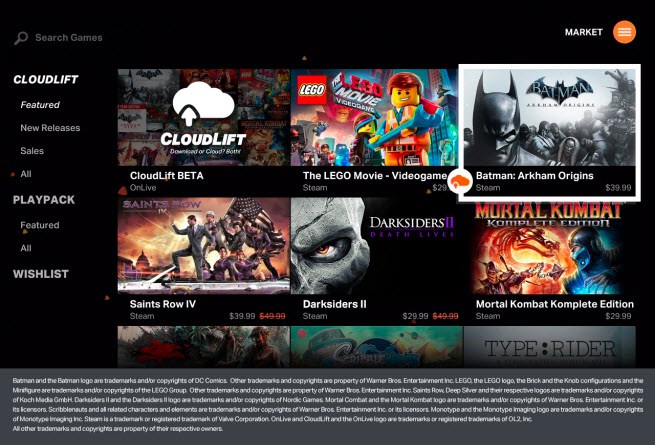
Users only need to purchase a game from a distributor once in order to play it with the OnLive service, which streams the games as a video of game imagery from the cloud to the device. Games are delivered in 720p at 60 frames per second.
At the current time, CloudLift is limited to 20 launch titles such as The LEGO Movie Videogame, Batman: Arkham Origins, Scribblenauts Unlimited, LEGO Lord of the Rings, and Saints Row IV.
OnLive Go is similar to CloudLift, but it is designed to allow massively multiplayer games such as War Thunder or Second Life to be accessible on any device without having to wait for long installs. Players can access MMOs on mobile devices and can launch cloud versions of games while waiting for downloads on Macs or PCs.
OnLive’s first Game Service was introduced in 2010, but issues with Internet connections, latency, and video compression caused it to receive unfavorable reviews. In 2012, the company was forced to lay off most of its employees, later being sold to Lauder Partners for just $4.8 million.
The company has now hired former IGN Chief Mark Jung as executive chairman and hopes to make a comeback with its new services and an expanded set of data servers. In an interview with VentureBeat, Jung said the company is aiming to deliver a higher value service to users.
“In this last year, we have been repositioning the company and redesigning our services for a positive business going forward,” Jung said. “We have rearchitected it to deliver a much higher value proposition for the users.”
The CloudLift service is currently available on Macs, PCs, and Android devices. OnLive has plans to bring connectivity to iOS devices, but the company told Pocket-Lint that getting the technology right around Apple’s limitations is a difficult task.
“iOS is a big platform. We’re not sitting here ignoring it,” he said. “It’s the same thing with Surface. We want to be platform agnostic. We continue to grow and we’ll focus on growing across all of those.”
OnLive’s new CloudLift service is available for $14.99 per month, while OnLive Go is variably priced with Second Life gaming available for $3 per hour. Both CloudLift and OnLive Go require a solid Internet connection of at least 2 megabits a second.
OnLive is also offering its PlayPack subscription service, which provides users with 250 games, for $9.99 per month.
     |
Apple to Introduce Full-Screen Video iAds to Apps This Year
 Apple plans to introduce full-screen video iAds for apps on the iPhone and the iPad later this year, reports AdAge. The new ads, described as “interstitials,” will allow developers to opt into ads that play in between levels within a game or in between articles in a news-style app.
Full screen ads will mark a departure from Apple’s typical advertising style, which has limited iAds within the App Store and iTunes Radio to less obtrusive banners that must be clicked for a video ad to be played. iTunes Radio also features audio ads, but full video ads within apps are arguably more interruptive.
Some free-to-play apps already feature full-screen third-party video ads. Zynga’s Draw Something on iPad, for example, requires users to watch a video ad before allowing them to move on to the next level, a task that takes several seconds away from gameplay.
Since its 2010 introduction as a way for developers to make money on the iOS platform, iAd has been largely unsuccessful attracting developer interest and revenue. Apple has, however, been attempting to revive iAd with a new focus on iTunes Radio.
The in-app video ads may be a way for Apple to rekindle advertisers’ interests in its fancy-but-flawed iAds. The ad product line was unveiled in 2010 with all the pomp and circumstance of a new iPhone, but they’ve struggled to gain traction in the market. Advertisers were initially asked to drop $1 million for the rich-media units, which more closely resemble a mobile microsite than a banner. That price tag has dropped to $100,000 over the years, even as Apple has added features like maps.
Few details are available on the video ads, including how Apple plans to sell and price the spots, but they may be positioned as a way to further entice new advertising partners to advertise via the service. The introduction of iTunes Radio, which has the potential to bring in quite a bit of revenue, already garnered Apple several major advertising partners, including McDonald’s, Nissan, Pepsi, and Procter & Gamble.
Apple’s ad sales, which were at just $125 million in 2012 according to IDC, have lagged significantly behind those of other companies, including Google, but the new video ads along with revenue from iTunes Radio may shift those figures considerably in the years to come.
| |

Gmail for iOS Updated With Background Refresh [iOS Blog]
 Google today updated its Gmail for iOS app to version 3.0, adding both simplified sign-ins and background app refresh. With the new update, Gmail will use iOS 7′s background refresh capabilities to fetch mail even when the app is not open.
Before the update, users could receive notifications when new mail was received, but opening the app was required to download the messages.
The app also supports a simplified sign-in that allows users to sign into all Google apps when signing into a single app such as Maps, Drive, Chrome, or Gmail.
Background app refresh: Gmail now fetches your mail even when it is not open so it will be waiting for you when you open the app. Requires iOS 7 and at least one type of notification (badge, alert, or banner) to be turned on.
Simplified sign-in: Signing into Google Apps such as Gmail, Maps, Drive and Chrome just got easier. Sign in to one, and you’ll be signed in to all automatically.
Note: In some cases, you may need to sign-in to Gmail again after this update.
Gmail can be downloaded from the App Store for free. [Direct Link]
| |
Evernote adds handwriting recognition to Android app
The Evernote experience gets even better today as the Android app adds in handwriting functionality. As part of the latest update, users can jot down their notes using a finger or stylus. Notes can employ combinations of audio, handwriting, annotations, images, and more. Perfect for schools, lectures, work meetings, church, and other situations where you can write faster than typing.
Also included in the software update:
- Fluid handwriting experience – move easily from writing to typing to photos and back within a single note
- Tap to write – whenever you’re in a note, tap the pen icon to start writing
- More editing options – added text highlighting and more powerful editing features
- Faster Camera – 2x faster than before
The post Evernote adds handwriting recognition to Android app appeared first on AndroidGuys.
SEIDIO Surface case for Galaxy Note 3 review
Today we’ll be taking a look at the SEIDO Surface series of cases for the Samsung Galaxy Note 3. We’ve been fortunate enough to spend a few weeks testing this guy out and have come to really appreciate the device.
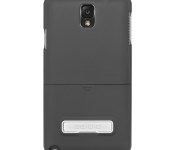
Offered in a variety of color options, we received the gold edition for our testing purposes. At first glance we found the case to have a premium look and design language; the color and finish had “class” written all over it. Suffice to say, we imagine the other colors provide the same effect.
The case itself comes in two parts, splitting in the middle around the 60/40 mark. Installation is a breeze as you merely slide the opposite ends down over the phone and snap them into place. We’ve run into problems with other cases where getting them off proved to be difficult. This was not the case for the SEIDIO Surface – thanks to the handy indentation right at the seam.
Given that the Galaxy Note 3 is a large device which lends to viewing movies and media, we love that the case comes with a built-in kickstand. Indeed, it’s one of those features you don’t use often, but certainly love having around. The kickstand itself is more of a polished aluminum feel that has a bit of a contrast to the case. It, like the gold color, gives off a certain air of quality. The magnetic pull ensures it doesn’t come flopping out in a pocket or purse.
 There’s not much thickness or weight to the SEIDIO Surface case and it hardly adds anything to feel of your phone. It might be just enough to squeeze it out of your card dock, however, but the all-in-one’s still tend to work okay.
As is to be expected, there are cutouts for volume, power, microphone, headphones, stylus, etc. If there’s one quibble in the design it’s that we had to keep checking for the volume buttons. Something didn’t feel totally natural in the experience and we weren’t always able to turn up volume levels or down without looking. On the other side, though, power was just fine.
The SEIDIO Surface cases come in six colors and retail for $34.95. We guessed the price range would been somewhere in this area, maybe shading higher. With that in mind, this is one we can definitely recommend. Check Amazon and you’ll likely find it even cheaper, some are coming in below $30 each.
Bonus points are awarded here for the ability to snap into a Surface holster (sold separately) for even more protection.
// <![CDATA[
amzn_assoc_ad_type = "product_link";
amzn_assoc_tracking_id = "agref_apps-20";
amzn_assoc_marketplace = "amazon";
amzn_assoc_region = "US";
amzn_assoc_placement = "B00FEQ15OU";
amzn_assoc_asins = "B00FEQ15OU";
amzn_assoc_show_border = true;
amzn_assoc_link_opens_in_new_window = true;
// ]]>
// <![CDATA[
// ]]>
The post SEIDIO Surface case for Galaxy Note 3 review appeared first on AndroidGuys.

Dish’s TV streaming app is now available for newer Kindle Fire tablets

Dish subscribers are no longer stuck if they want to catch up on TV shows from one of Amazon’s tablets — the satellite provider has released a version of Dish Anywhere for Kindle Fire HDX devices. As with the regular Android app, HDX owners using Sling-equipped Dish DVRs (such as the Hopper with Sling) can watch live, on-demand and recorded TV from any reasonably fast internet connection. There’s no word yet on support for the lower-cost Kindle Fire HD, but those who own Amazon’s latest and greatest hardware can grab Dish Anywhere today.
Filed under: Home Entertainment, Tablets, HD, Amazon
Source: Amazon Appstore, Dish

10 Years in Social Media

It’s our birthday! And there’s a good chance you found out via one of two social networks. However, back in 2004, when Engadget launched, Facebook was in its infancy and Twitter still hadn’t hatched. While the former catered to Harvard’s elite, Friendster and Myspace were still schooling us in the ways of social networking. Fast-forward 10 years, and Friendster is a social gaming platform, Myspace is a sounding board for musicians, Facebook and Twitter are both publicly traded companies and hashtags aren’t just a thing, they’re an epidemic.
Every week in March, we’ll bring you a new story that explores how the social landscape has changed since our inception. So grab a glass of bubbly, raise a toast and dig in. Here’s to 10 Years in Social Media!
 |
 |
|
|
Where are they
|
Our first time |
By the numbers |
In Pictures |
| . | . | . | . |

Where are they now? The travels and trash talk of Myspace Tom

It was 2009 and things weren’t looking good for Myspace. According to comScore, Facebook logged 307.1 million visitors globally that April, while Myspace failed to reach even half of that with 123.3 million users. One month later, Facebook inched out ahead of its predecessor for the first time in the US. There was no turning back.
Today, Myspace is showing growth with 36 million users last October, up from 32.6 million the previous June, but it’s largely lost its cultural cachet and barely resembles the site that captured the world’s attention years ago. Under new ownership, Myspace has refocused its vision as a platform for musicians, re-upped its design and landed itself a hot new celebrity spokesman/investor. Justin Timberlake is bringing the sexy back to the social network, but whatever happened to Myspace Tom?
Tom Anderson was everyone’s first friend on Myspace, but when traffic started to decline, there were no warm feelings for Anderson and his co-founder Chris DeWolfe. In April 2009, News Corp. let DeWolfe go, while Anderson, then the company’s president, stayed on in a diminished capacity. But in February of the following year, the face of Myspace was replaced by another “Tom” (Today on Myspace) as users’ first friend.
Life is good for Myspace Tom, and he’s not afraid to flaunt it.
Although retired, he hasn’t left Myspace altogether, at least not as a user. His last post to the site appeared in June of last year, and broadcasted to a relatively small group of about 13,000 followers that he’d just finished listening to six songs from Mumford & Sons. That’s not to say he’s given up his passion for social media, however. In fact, he’s keeping his one-time competitors in the money. At last count, Anderson had 216,000 followers on Twitter and 51,471 on Instagram, where he’s pledged an unambitious goal to “create one good photo a day.”
His not-quite-daily updates to Instagram show a man leading a life of leisure. He spent Christmas Eve in Hanoi, Vietnam and New Year’s Day in Singapore. Late last year, he posted an image of the world surrounded by various religious symbols, saying that he’d visited nine countries in two months.
Life is good for Myspace Tom, and he’s not afraid to flaunt it. In a heated Twitter exchange over Instagram’s new terms of service in 2012, Anderson mocked the working class while touting the payout he and his fellow co-founders received when News Corp. acquired the social network in 2005.
@polotapia says the guy who sold myspace in 2005 for $580 million while you slave away hoping for a half-day off
– Tom Anderson (@myspacetom) December 20, 2012
But it hasn’t been all Sutro sunsets and internet class clashes for Anderson. Despite his self-proclaimed retirement, he’s been attached to real estate ventures in Vegas and a Facebook gambling app called RocketFrog, also backed by Brody Jenner.
Advising on an online casino is a far cry from taking social networking mainstream, but then the internet of today looks a whole hell of a lot different from the one Myspace dominated. When News Corp. bought Myspace for $580 million in 2005, no one could have predicted its biggest competitor would eventually buy a mobile messaging app for $19 billion.
To celebrate our 10th anniversary, we’ll bring you a new story every week in March that explores how the social media landscape has changed. Check out our hub every Wednesday for more from of our 10 Years in Social Media series, and keep your eyes out for more ’10 Years In’ content in the months to come.
Lead image: Tom from Myspace and Ted Skillet from Myspace during Ted Skillet’s 30th Birthday Celebration at Aura Nightclub in Pleasanton, California, United States. (Photo by Kevin Sam/FilmMagic)
Gmail for iOS now fetches for mail in the background, simplifies log-in

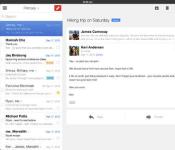
Today, Google updated its Gmail app on Apple’s mobile platform, bringing with it some features bound to be very useful for users. The iOS application is finally capable of fetching mail in the background, so new stuff can hit your inbox at any given time — not just when you open the app. For the background app refresh to work as intended, however, the company points out that notifications will need to be turned on. Google’s also made its sign-in process more streamlined, meaning that once you log into the Gmail app, you’ll automatically be signed in to other iOS apps from the search giant. Because, c’mon, Google wants you to be doing Google things all the time.
Filed under: Internet, Software, Mobile, Apple, Google
Source: App Store

Apple’s A8 Chip Production for iPhone 6 Underway at TSMC
 Apple’s new chip partner Taiwan Semiconductor Manufacturing Company (TSMC) has begun production on the next-generation A8 chip destined for the iPhone 6 later this year, according to a report [Google Translate] from Taiwan’s Commercial Times picked up by AFP.
The world’s leading contract microchip maker last month started producing the A8 chip, which is tipped to power the expected iPhone 6, the Commercial Times reported.
The report, which cited supply chain sources, said TSMC had won most of the manufacturing orders for logic and power management integrated chips for the new handset.
The report claims that the new 20-nanometer A8 will include a quad-core 64-bit processor and quad-core graphics, and that an earlier start to chip production compared to the previous years could give Apple the flexibility to comfortably launch the new iPhone in the third quarter of this year.
Samsung has been Apple’s exclusive manufacturing partner for A-series chips, but Apple has long been reported to be trying to shift orders to TSMC. After years of rumors, Apple and TSMC reportedly struck a deal in mid-2013 to begin chip production in early 2014. TSMC and Samsung were initially reported to be splitting the production load for the A8, but Samsung is now said to have dropped out due to low yields.
| |
 AIVAnet