


Sony MDR-1000X review – CNET
The Good The Sony MDR-1000X is an excellent-sounding, comfortable wireless headphone with effective noise-canceling that measures up to Bose’s for muffling ambient noise. It has good battery life and some nifty extra features geared toward frequent travelers.
The Bad Not great as a headset; its adaptive noise-canceling is too noticeable at times.
The Bottom Line If you can overlook a few small drawbacks, the MDR-1000X is a top-notch wireless noise-canceling headphone that’s stacked with features and sounds excellent.
When it comes to noise-canceling headphones — those models that actively block outside noise like airline engines — Bose is generally considered the gold standard, but Sony’s engineers have been on a mission to beat Bose at what it does best.
The result of their efforts is the MDR-1000X, which Sony is calling its most technologically advanced headphone. It features both wireless Bluetooth connectivity and adaptive noise-cancellation in a swanky looking chassis that retails for $400, £330 or AU$700.
Sony says it developed new ear pads for this headphone, and the embedded touch controls for volume adjustment and skipping tracks either direction are more responsive than those found in its predecessor, the MDR-1ABT.

What you get in the box.
Sarah Tew/CNET
I’m not going to get into all the technical details but this headphone is equipped with similar drivers to the highly rated MDR-1A (a wired headphone) and has microphones not only on the outside of the ear cups to measure ambient noise, but inside to take account for the shape of your head and ears, and whether you wear glasses.
Sony has trademarked this feature, calling it the Sense Engine, and the company says it tailors the noise-canceling individually to you. You can also choose alternate settings that allow more ambient noise to seep in or even filter out everything but voices so you can hear announcements in airports while listening to music.
Another cool feature is the ability to muffle your music and let the outside world in by simply holding your hand over the right ear cup, where the touch controls are located. Once you finish talking to someone, you remove your hand and the music resumes playing at its previous volume and the noise cancellation kicks back in.

The headphone in black.
David Carnoy/CNET
Battery life is rated at 20 hours and a cord is included if you want to listen in wired mode. You don’t need power to use it as a corded headphone (that means if the battery dies, you can still get sound out of it), but it sounds better as a powered headphone in wired mode.
Like a lot of Sony’s latest headphones, the company is promoting it as a high-res headphone, with support for Sony’s proprietary LDAC format that’s supposed to provide higher quality sound than conventional Bluetooth streaming. Unfortunately, you need a Sony music player with LDAC to take advantage of it. (Sony makes a variety of hi-res music players, but I suspect that the majority of people will use this headphone with their phones).
Also, Sony says this is the first headphone to have its Digital Sound Enhancement Engine (DSEE HXTM) built-in to “upscale compressed music from any source to near hi-res audio sound quality, even in wireless mode.”
Starbucks Verismo V coffee maker review – CNET
The Good The Starbucks Verismo V coffee maker brews both espresso shots and full cups of coffee. The machine is compact, operates quickly and doesn’t create a mess. An included milk frother accessory whips up dairy foam for lattes and other café favorites.
The Bad Buying into the pod-based Starbucks Verismo V system is exorbitantly expensive. Pulled espresso shots and brewed coffee from the Verismo V are weaker than they should be. The brewer is limited to Starbucks-branded Verismo pods.
The Bottom Line Even with some enhancements, only well-heeled Starbucks fans should buy into the mediocre Verismo V coffee maker and pricey supporting pod system.
For the true Starbucks coffee fanatic, nothing will satisfy the day’s first caffeine craving like a trek to the nearest Starbucks storefront. The mega java chain, however, wants to supply its fans with an alternate fix you can have at home with the $179 Starbucks Versimo V. The machine is the company’s latest domestic small appliance billed to recreate its drinks, including those dollops of real foamed milk that can make or break a latte.
Using and cleaning the Verismo V is a cinch, plus the machine slings coffee that successfully mimics much of that sought-after Starbucks taste. But this convenience comes at a steep price — the coffee maker itself is expensive, and purchasing pods over time is even more extravagant when compared with brewing java from bags of supermarket beans (you can only use the specific Starbucks pods in the machine). And the espresso shots aren’t as robust as I’ve had when I tested other machines. Unless you’re a diehard Starbucks fan, skip the Verismo V and invest in a better espresso machine that will save you more money and waste in the long run.
A fresh design to fit in more places
This isn’t Starbuck’s first stab at a self-branded coffee maker. The original Verismo machine debuted back in 2013, and it did a decent job of brewing Starbucks staple drinks like mugs of coffee and espresso shots from pre-packed plastic pods. The Verismo V also brews its coffee from pods, though Starbucks has trimmed down the size of this machine by a good 1 to 2 inches all around (11.7 inches tall, 5.9 inches wide, 14.9 inches deep). At 7.7 pounds, the V is also more than a pound lighter than the original.

The new Verismo V is smaller and lighter than the original.
Chris Monroe/CNET
Another physical difference is a side-mounted water tank (77.7 ounces, 2.3 liters), which is much easier to reach and manipulate than the old model’s reservoir that was on the back. The Verismo V also ditches the chrome highlights that graced its predecessor’s chassis in favor of a subdued dark-gray-and-black color scheme.
Brewing and tasting
Operating the appliance remains mostly the same. To brew espresso, simply lift its handle, drop a pod into a special slot, lower the handle back down, then hit the designated button. After 13 seconds, you’ll have a 1-ounce shot of pulled espresso. While these shots had a well-developed crema and a balanced flavor, they lacked the richness and intensity that I’ve enjoyed in coffee made with true espresso machines.

Drop in a Verismo pod then brew.
Chris Monroe/CNET
For instance, shots of espresso from both the $600 Breville Barista Express and $2,000 Miele CM6310 Countertop Coffee System had much more body and depth of flavor. Espresso from those two appliances also had higher TDS (total dissolved solids) percentages. Essentially, the higher a coffee or espresso’s TDS percentage, the more coffee essence and flavor the liquid contains. That means you’ll get a drink with a richer taste and fuller body. The Breville and Miele hit 10.5 percent and 7.4 percent, respectively (average, measured with refractometer). The Verismo V’s espresso averaged 5.3 percent.

Espresso had nice crema but could have been stronger.
Chris Monroe/CNET
I’m not surprised that espresso from the Verismo V was rather mediocre. No matter how tightly sealed the container, ground coffee loses much of what makes it delicious in short order. And the other machines used more coffee grounds per shot than the Verismo, which made for stronger espresso. I used more than double the amount of coffee grounds (0.6 ounce) per each 1.4-ounce shot I manually pulled from the Barista Express. Likewise, the fancy superautomatic Miele CM6310 robotically consumed 0.5 ounce of grounds for each of my 1.1 ounce shots of test espresso.

The Verismo V pulled espresso shots from pods in 13 seconds.
Chris Monroe/CNET
Nomu S10 and Nomu S30 unboxing initial impressions

We recently received review units to two of Chinese handset maker Nomu’s new unlocked smartphones, the S10 and S30. Launching this week, the devices are powered by Android 6.0 and feature IP68 waterproof protection. Moreover, they each boast a downright insane battery at 5,000mAh capacity. In terms of specs to price ratio, the handsets come in rather aggressively at $100 and $230, respectively.

A Qualifying Statement
We’ve only had these phones in our possession for a few days, so do not look for this to be a comprehensive review. Rather, this will be more of a piece that details what comes in the box, how the devices stack up against each other, and what we think of them so far. A full review will follow in the coming weeks.
Quick Comparison
While the two phones do share a number of features and traits between them, there are are obviously going to be differences. Here’s a quick breakdown of each model.
Nomu S10
- Android 6.0 Marshmallow
- 5.0-inch display at 1280 x 720 pixel resolution; Gorilla Glass 3
- Quad-core Mediatek 1.5GHz processor
- 2GB RAM
- 16GB internal storage; microSD expansion card slot for 32GB
- 8-megapixel (interpolated to 13-megapixel) rear camera
- 5-megapixel front-facing camera
- Dual-SIM
- 5000mAh battery
- 2G GSM:850/900/1800/1900(B5/B8/B3/B2)
- 3G WCDMA:900/2100(B8/B1)
- 4G FDD-LTE:800/900/1800/2100/2600(B20/B8/B3/B1/B7)
- TDD-LTE:2300(B40)
Nomu S30
- Android 6.0 Marshmallow
- 5.5-inch display at 1920 x 1080 pixel resolution; Gorilla Glass 4
- Octa-core Mediatek 2.0GHz processor
- 4GB RAM
- 64GB internal storage; microSD expansion card slot for 32GB
- 13-megapixel (interpolated to 16-megapixel) rear camera
- 5-megapixel (interpolated to 8-megapixel)front-facing camera
- Dual-SIM
- 5000mAh battery
- 2G GSM:850/900/1800/1900(B5/B8/B3/B2)
- 3G WCDMA:900/2100(B8/B1)
- 4G FDD-LTE:850/900/1900/2100(B5/B8/B2/B1)
- FDD-LTE:800/900/1800/2100/2600(B1/B3/B7/B8/B20)
What’s In The Box?
We’re not sure if the review units we received are actual retail model boxes but we suspect they might be. But, with that said, it’s a no-frills experience that doesn’t give you any more than it needs to. The cardboard box is brown and features only the Nomu brand embossed on the top; the bottom has a sticker with the model number and serial number.

Inside you find the phone, a pair of headphones, and a wall charger and USB cable. The outlet plug, for what it’s worth, is not going to work here in the United States. You’ll want to either get an adapter or just use one of your existing units to plug the cable in.
The quick-start guide details the basics of the phone, indicating where all of the ports and buttons are. It does have multiple languages, one of which is English.
Initial Impressions
Taking the phone out of the box and powering it on, you get the sense that these phones are rugged and ready for various conditions. Indeed, the IP68 ratings, utilitarian design, and general aesthetics signal the S10 and S30 are the sort of phones that a construction worker, contractor, or field worker might enjoy having. They’re not unlike what Kyocera is doing with its DuraForce line.

Both models have very distinct and angular corners with rubber edges. The S10 has a little bit more of a rough and tumble build that looks like something out of Battlestar Galactica. Moreover, the orange and black colors look sharp and unlike anything else we’ve spent time with.
The S30, for its part, doesn’t look to be as waterproof or built to spill. In fact, we had to double-check and triple-check that it was IP68 rated before putting it into water. The back of this one has more of a plastic shell with carbon fiber design and silver aluminum/titanium side. It would easily pass for an early generation of Droid from Verizon and Motorola.
Android
Hey look, it’s a nearly stock Android experience! Props to Nomu for not doing much to mess with the look and feel of the phone. It’s easy for a Chinese hardware maker to put a “foreign” spin on things that doesn’t resonate with US buyers. Fortunately, it appears that there’s not much done here to customize the interface.
With that said, the icons look like something you’d find in an old version of Android, perhaps something around the Ice Cream Sandwich and Jellybean era. It confused us at first, because we though, “wasn’t this supposed to be Android 6.0?” Alas, it does run Marshmallow, but with an interesting approach.
Looking through the settings we see a number of options that don’t come standard with Android. Be it gestures, flip to mute, or other subtle tweaks, it’s a nice mix additional options. And, while they may not be something we specifically use, there’s nothing here that feels out of place. If someone were just getting into Android or smartphones, we see things that would actually appeal to them or make the experience better.

While there are a handful of the major Google apps present on the S10, you’ll have to head to the Play Store to pick up a few of them. Present are Calendar, Chrome, Gmail, Google, and Play Store. You’ll need to manually install others such as YouTube, Hangouts, Drive, Mesenger, or Google+.

The S30, by contrast, had nearly all of the above (no YouTube) as well as Photos, the full suite of Google Play clients, and Android Pay.
Sound and Camera
We tested the speakers out on both models and found the S10 to get really distorted at the higher volumes. Moreover, it was a flat and unappealing experience. Perhaps related to a couple of water droplets that were still on the speaker, we heard some minor rattling or extra noise that should not have been present. The S30, by comparison, was louder and more full.

Same thing goes for the camera. The S10 is so-so, if not a little less than desired, while the S30 comes in with more of what you’d hope for in a smartphone. Keeping price in mind, we can see where corners have to be cut. It’s not always the RAM and storage that makes the difference; sometimes it’s the internal components, too.
In short, the S10 is probably around a 2/5 stars with the S30 closer to a 3/5 stars. We’ll get a better sense for both the audio and camera features over the coming days and weeks.
Waterproof Protection
We’re always reluctant to put phones into water, even when they carry a certified rating. our philosophy is that unless you absolutely have to, there’s no reason to tempt fate. And, while these two phones do protect the ports and speakers, there’s always that slight risk that you could “do it wrong”.
With that in mind, we did submerge both phones into water, albeit briefly. It just so happened that it had rained for two days straight here at the office. Going outside, we found a couple of puddles in which to dunk the phones. Both continued to work immediately after and in the hours to follow.
We are compelled to tell you, however, that the S30 seems to be just ever so wonky at times. It’s hard to say if it’s related to the water or something else in the hardware and software, but the home screen likes to bug out. By that we mean it acts as if you were long pressing on it to change the wallpaper. It flits and flickers and a quick press of the home key brings things back in line. We also saw traces of this when navigating around the device in various apps, too.
A Note About Network Support
One of the best features of most unlocked phones is the almost universal support for GSM carriers. Here in the US we have two major players competing on the GSM 4G LTE front, AT&T and T-Mobile. Verizon and Sprint, for their parts, offer their own 4G technology with CDMA.
Every so often a phone comes along that sounds so appealing on paper that you simply can’t pass it up. That is, until you look closely at the supported networks. Alas, the Nomu S10 and Nomu S30 don’t have the same support for 4G LTE that you might expect or hope for in the US.
While there are a few frequencies allowed for, you’re going to have a tough time getting nationwide coverage, especially at higher speeds. Take a look at the respective carrier bands and frequencies and you may end up with 3G speeds at best.
The last thing we want to do is endorse something that you end up buying only to find out it doesn’t work in your area. After all, a smartphone is rather dumb if it has not data to support it.
Understanding that our readers are not entirely US-based, we are certainly not going to write this one off. There are obviously going to be users who may benefit from such a device. We’ll do our best to put together as thorough of a review as possible in the next few weeks and circle back.
Where to Buy
Already set and looking to pick one of these up? There are a number of places to do so, including Gearbest, Everbuying, Geekbuying, and AliExpress. As part of a launch event, you can head to Nomu’s promotional page to check out more details. As a refresher, the Nomu S10 runs $100-$120 while the Nomu S30 fetches approximately $230.
In the meanwhile, feel free to learn more at the links below:
- Nomu S10: http://nomu.hk/product/s10
- Nomu S30: http://nomu.hk/product/s30
- Nomu Official FB Page: https://www.facebook.com/nomumobile/
Nintendo Switch Release Date, Price and Specs – CNET
Nintendo’s got a completely new game system coming next year, and it’s totally modular. The Nintendo Switch is a lot of things: a tablet, a console and even a portable multiplayer tabletop game system.
The Switch is a bold move, not a surprise from a company that’s made bold hardware moves its modus operandi since the ’80s. The Nintendo DS introduced crazy dual-screen touch gaming in a handheld; the Virtual Boy was a tabletop 3D game system. The Wii introduced motion gaming and a wild reinvention of the classic game controller. The 3DS has glasses-free 3D. The Wii U has its bizarre quasi-tablet GamePad controller.
Nintendo Switch: The first pictures
See full gallery


1 – 4 of 22
Next
Prev
Compared to all those wild ideas, the Switch leans on a concept that’s relatively sane. It’s a combination portable system and home console. It might bridge the gap between Nintendo’s long-lasting handheld game business and its TV-connected gaming. And, maybe, it’s pointing towards the future of Nintendo and where it’s headed as a company.
Here’s what we know so far, now that the Switch has been announced.
It’s a system that will play connected to a TV, or by itself on the go.
Nintendo demonstrated that the Switch will play its games connected to a TV like a regular games console, or as a tablet-style handheld with its own controls. It can also be played while standing up on its own kickstand, with detachable controllers.
It pops into a dock.
The “Nintendo Switch Dock” is where the Switch lives when it’s in your living room. The tablet slides into the dock, and then seems to instantly switch into a TV-connected mode. This is a bit like the Nvidia Shield tablet, which had a similar play-on-TV, play-on-the-go idea.
You can hot-switch between TV mode or handheld mode on the fly.
Nintendo’s preview video shows people playing games on the TV, then popping the tablet out and playing on the sofa. Games should instantly switch, and play in either mode.

The Switch in both of its forms.
Nintendo
Its Joy-Con controllers detach and become stand-alone wireless controllers.
The Switch has a flexible idea of controllers: two “Joy-Con” side pieces slide onto the edges of the Switch tablet, adding four buttons and an analog stick on each side, plus shoulder buttons, just like the Wii U GamePad. But when these are slid off, they can become standalone Wii remote-like controllers, held sideways to play games. The Joy-Con controllers also slide into another accessory, the Joy-Con Grip, turning them into a full controller separate from the tablet.
There’s a kickstand, too.
The Switch can stand up on a table, and games can be played with the controllers like a mini console. Local multiplayer games can be played on one or several Switch tablets. It looks like several people could play games on one together, or network several for LAN-style gaming.
There’s a cartridge slot.
Besides downloading games, the Switch will have its own little card-based cartridges. It doesn’t support any DVD or Blu-ray-style discs.
Is it backwards-compatible with old Nintendo games? We don’t know.
Nintendo did show the Switch using 3DS-like cartridges, but the safe bet is that this will use its own category of software.
What games will it play?
We don’t know about much that yet, but Nintendo’s upcoming Legend of Zelda: Breath of the Wild will be a launch title. Nintendo’s new Switch video also shows a Splatoon game, Skyrim, a Mario Kart title, a Super Mario game, and an official NBA basketball game.
Nintendo’s already announced a lot of development partners.
The list of partners unveiled by Nintendo is pretty extensive: Activision, EA, Capcom and more are onboard. Of course, they haven’t said what games they’ll release. Ubisoft’s CEO Yves Guillemot said in a statement, “With the Nintendo Switch’s unique capacities and design, Nintendo could again redefine the way we play games. The Nintendo Switch is accessible at its core and also seizes on the growing trends of sharing more experiences and playing anywhere at any time.” Of course, similar statements were made by developers during the launch of the Nintendo Wii U.

Some of the partners developing for the Switch already.
Nintendo
It’s powered by an Nvidia Tegra processor.
Nvidia says the Switch uses a custom Tegra processor. Nvidia Tegra processors have previously powered Nvidia’s Shield gaming tablets and other mobile devices, but Nvidia promises this processor is “based on the same architecture as the world’s top-performing GeForce gaming graphics cards,” adding a revamped physics engine and other tools. Nvidia’s Tegra processor might sound like it’ll be less powerful than a full “normal” console, but it’s hard to tell how advanced the Switch will truly be.
It’s arriving March 2017.
We don’t yet know the price.
Samsung HW-K950 review – CNET
The Good The Samsung HW-K950 is one of the best sound bars we’ve ever heard for both movies and music. The dedicated rear speakers deliver increased immersion compared to single-speaker designs. It’s cheaper than buying a Dolby Atmos receiver and speakers.
The Bad It’s expensive for a sound bar, and DTS support is limited. Dolby Atmos is only available on a limited number of titles compared with other surround formats.
The Bottom Line The Samsung HW-K950 combines the discreet looks and simple setup of a sound bar with truly impressive sound for both movies and music.
Visit manufacturer site for details.
For the longest time my recommendation for people shopping for sound bars was “spend no more than $500.” Sound quality doesn’t typically take a massive leap beyond this amount, because the necessity of keeping cabinets small and bar-like restricts how good they sound.
In the past year I’ve been rethinking my approach after hearing excellent-sounding models such as the $899 Sony HT-NT5, the $1,100 Definitive Technology Studio W, and now the $1,500 Samsung HW-K950. The Sony and Samsung speakers make the most of the available sound bar real estate, specifically by by angling their drivers back into the cabinet, which enables them to have larger diameters. The larger the driver, the better it can sound.
The Studio W was CNET’s favorite high-end sound bar, with great looks, wireless streaming and superb sound for movies, but the Samsung has eclipsed it in almost every way. It sounds clearer, it’s a more capable streamer thanks to the Samsung Multiroom app, and it has superior features. The Samsung HW-K950 is the best reason I could think of to spend over a grand on a sound bar. Especially if you listen to music a lot.
The HW-K950 is now available in the US for $1,499 , in the UK for £1,299 and in Australia for $1,999.
Design
 View full gallery Sarah Tew/CNET
You’ll notice how I said the Samsung is better than the DefTech in almost every way. Well, the Studio W has it over the Samsung in the design department, with its solid aluminum billets and its massive subwoofer.
The Samsung still has some design touches that elevate it above the usual “black oblong you flop in front of your telly,” however. The endpieces are thin slices of brushed aluminum that curve subtly at the edges. The front has a black steel mesh that conceals a blue LED text readout — no confusing flashing lights here. The speaker is suitable for most bigger televisions at just 3 inches tall, 48 inches wide and 5 inches deep.

View full gallery Sarah Tew/CNET
Most sound bars don’t come with rear speakers, but the ones that do, including the K950, provide a sense of immersion during movies that faux surround ‘bars can’t match. The two satellites are roughly desktop audio monitor size at 8 inches tall, and our own resident Audiophiliac Steve Guttenberg remarked that they seemed like “real speakers.” High praise, indeed, coming from Steve!

View full gallery Sarah Tew/CNET
The included subwoofer is 16 inches tall and deep, and half that across. It’s not the discreet, hide-under-the-couch size of the sub that comes with the Vizio SB4551-D5, but it’s not toweringly ugly, either.

View full gallery Sarah Tew/CNET
The remote control looks just like the ones CNET’s David Katzmaier liked so much on Samsung’s 2016 TVs, and it’s a big improvement over the dire clickers included with most sound bars. The small wand comes with a handy dedicated volume control for the subwoofer, and it feels premium when you hold it in your hand.
Features
The HW-K950 is one of the first products to be designed at Samsung’s audio facility in California, after the Radiant360 range. It is one of two Samsung sound bars that can handle Dolby Atmos. The other is the HW-K850 ($999), which is virtually identical to the K950 but doesn’t include rear speakers.

View full gallery Sarah Tew/CNET
The HW-K950 incorporates a 5.1.4 setup for Dolby Atmos: five surrounds, one subwoofer and four overheads. The Samsung HW-K950’s main speaker has dual sets of ceiling-facing drivers as well as three forward-firing driver sets that come with a dedicated tweeter in each. On my visit to the Samsung audio lab, the technicians explained that the drivers are paper-based, which they claim has better acoustic properties than other popular materials such as Kevlar.

View full gallery Sarah Tew/CNET
Connections include two HDMI ports and one output, optical digital audio, 3.5mm analog stereo audio in addition to Bluetooth and Wi-Fi. The system is compatible with the proprietary multiroom system Samsung brought into the world with the Shape system back in 2014. As such it is also compatible with the Radiant360 speakers.
The Samsung will decode Dolby Atmos from Blu-rays as well as from Vudu/Netflix streams if the source device supports it. I tested it with an Nvidia Shield (3.2 firmware) and found it was able to output Dolby Atmos test scenes from Vudu correctly. While the Samsung will decode Dolby in all its forms, unfortunately for movie fans the sound bar is unable to decode DTS:X, and further will only decode DTS streams in stereo.
The Yamaha YSP-5600 costs about the same but comes without a sub (in the US) or rear speakers. The Yamaha will decode DTS:X, however.
Multiroom app

View full gallery Screenshot by Ty Pendlebury/CNET
The competition for multiroom music is fiercer than ever, but I expect things to consolidate in the next year or two, thanks largely to the influence of Google Cast/Home.
In the meantime, Samsung’s Multiroom app is one of the best following an update earlier this year. The app now features a very straightforward layout which lists the music on your phone first and then lets you scroll horizontally through other streaming services available. The list is quite comprehensive and includes most of the big apps like Spotify (Connect), Pandora, Amazon Music and Tidal. I wasn’t surprised to learn that Samsung doesn’t support Apple Music.
Razer Blade Pro Release Date, Price and Specs – CNET

Razer
Razer doesn’t mess around when it comes to premium gaming laptops, and the totally refreshed 17-inch Razer Blade Pro is the case in point. Razer says that the new Blade Pro was designed for “enthusiasts and power users who want desktop performance but don’t want to sacrifice portability.”
So Razer put an Nvidia GTX 1080 — the new hotness when it comes to graphical overkill — in a laptop under an inch thick. Of course, you’re going to pay for all those fancy new internals. Clench up, because here it comes: The Blade Pro starts at $3,699, or £3,499 (that converts to around AU$4,815).
“It’s definitely not for everybody,” says product manager Kevin Sather. “It’s for people who need to get the most out of a PC.”
Okay. Breathing again? Here’s what you get for that princely sum:
Key Specs
- Nvidia GeForce GTX 1080 (with 8GB GDDR5X VRAM)
- 6th-gen Intel quad-core i7 processor
- 17.3-inch touchscreen, 3840×2160-pixel resolution with G-Sync
- Mechanical keyboard
- VR-ready
- 512GB, 1TB or 2TB of PCIe solid state storage in RAID-0
- 32GB of memory
- 16.7 by 0.9 by 11 inches (427 by 23 by 281mm)
- Aluminium chassis
- 7.8 pounds (3.5kg)
- 99Wh battery (the largest you can legally take on a plane)
- Ports: USB Type-C / Thunderbolt 3, 1x 3.5mm headset jack, 3xUSB

The 17.3-inch Razer Blade Pro is much bigger than its siblings.
Sean Hollister/CNET
If you compare it to the previous model of the 17-inch Razer Blade Pro, you’ll see it’s packing — no exaggeration — double the numbers in some key specs like RAM, storage and screen resolution.
Most “desktop replacements”, or at least laptops with that kind of processing power, clock in much larger than the incredibly slim Blade Pro.

Yup. It’s pretty thin.
Razer
Oh, and the touchscreen (did we mention it’s a touchscreen?) displays 100 percent of the Adobe RGB color gamut, potentially making it suitable for photo and video editing. (There’s also full-size, full-depth SD card slot, so you can quickly offload your DSLR photos). It’s a G-Sync screen, too, for smoother gameplay.
The Blade Pro is also the first laptop to use Razer’s new low-profile mechanical switches that can mimic the feel of full-sized mechanical keyboards. The keys definitely feel like they’ll take some getting used to: while they’ve got a satisfying click and a cushion-y bounce, they take a bit more pressure than we expected to push down. For a little added flair, the keyboard also runs Chroma, Razer’s dynamic multicolour backlighting that can be programmed to respond to in-game cues.
We can already tell one of our favorite features is the new programmable dial which lives right above the touchpad, It’s a slick, easy way to quickly adjust the volume, and we’re curious what else we might be able to do with it.
And while we already miss the discrete mouse buttons for the touchpad (you have to press down on the pad itself), we won’t shed many tears for the underutilized Switchblade touchscreen that used to live underneath the Blade Pro’s mouse surface. Razer says it had to get rid of the Switchblade to make room for more battery and components. (Razer says it can’t yet commit to how long the Blade Pro will last on a charge.)
One last note: everything packed into that aluminium frame means that the Blade Pro’s specs exceed the recommended requirements for the HTC Vive and Oculus Rift VR headsets. Just in case you were worried it wouldn’t be ready for virtual reality.
If you can afford it, the Razer Blade Pro will start shipping next month.
Sony MDR-1000X Review: Wireless Hi-Res Headphones Offer Next-Level Noise Canceling
The wireless headphone market has been shaken up so much recently that it’s hard to know where to begin when a new entry appears on the stage and announces itself as the next big thing.
Fortunately this latest Bluetooth offering from Sony is targeting a very specific market segment best referred to as “premium noise cancelation”, and the company seems pretty confident that with the MDR-1000X headphones ($400), it has got a hit on its hands.
Sony is claiming “industry-leading noise cancelation” with these luxury cans, which use ostensibly the same drivers as last year’s highly regarded MDR-1A headset made for listening to Hi-Res Audio, as supported by the company’s audiophilic Walkman range, not to mention its line of wireless home speakers and in-car audio systems.
Can it improve upon the finely honed features of Parrot’s Zik 3.0, Bose’s QuietComfort 35, and Sennheiser’s PXC 550 Wireless noise-canceling headphones? Let’s take a look.
Design
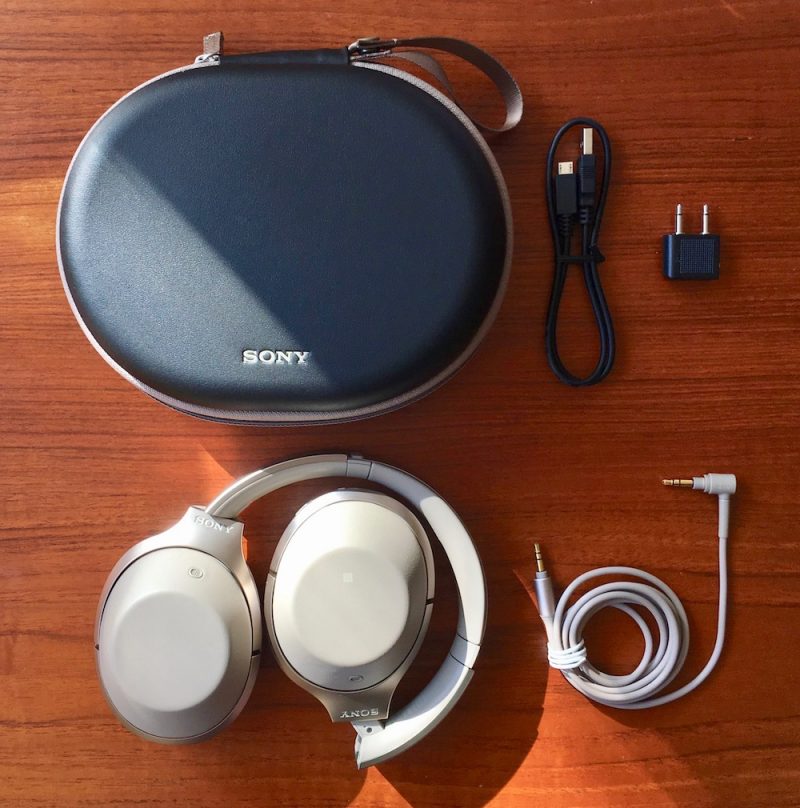
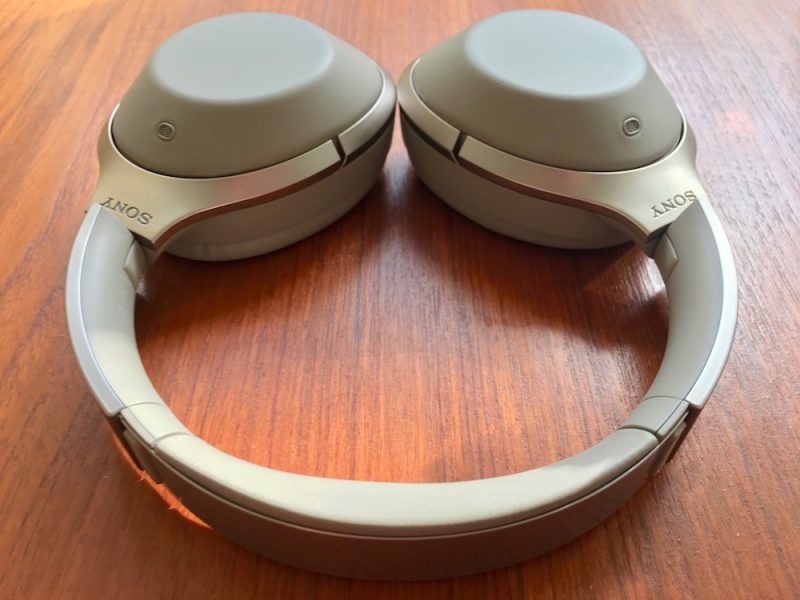
The Sony MDR-1000X’s come in a box design and hard carry case that will seem suspiciously familiar to Bose QC35 owners, but that’s where the similarities pretty much end. I received a beige pair (also available in black) that came with a nice thick matching 1.5 meter cable sporting a gold-plated mini jack, along with a black micro-USB charging lead and an airline adapter.
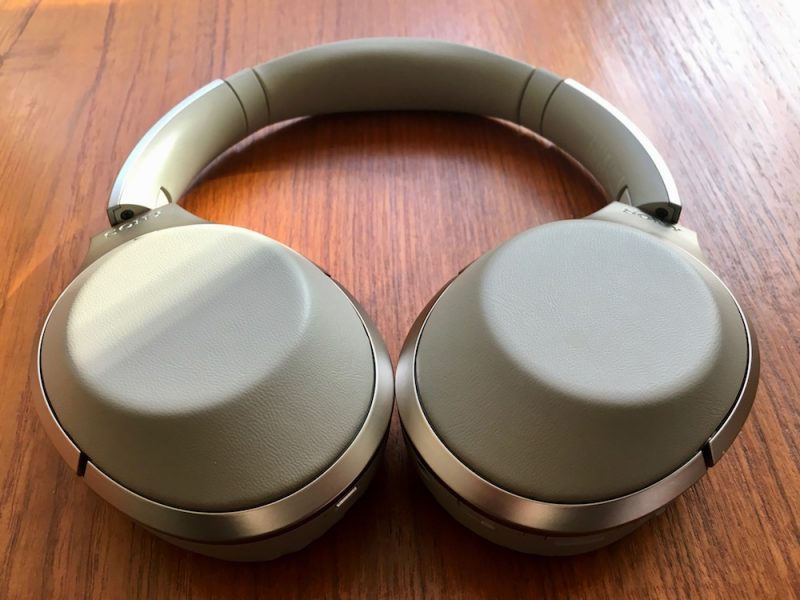
The swivel-folding earcups and pivots are made of a robust, creak-free plastic, with champagne-colored rims and squishy earpads covered in smooth synthetic leather that’s pretty convincing to the touch.
The polished steel headband packs some decent padding between the adjustable slats, and Sony has decided to let the design speak for itself by keeping the branding relatively understated. The only other distinctive mark on the outside of the cups are two small grilles where the noise-canceling microphones live. Altogether the headset weighs 275 grams, so slightly lighter than the QC35’s (309g).
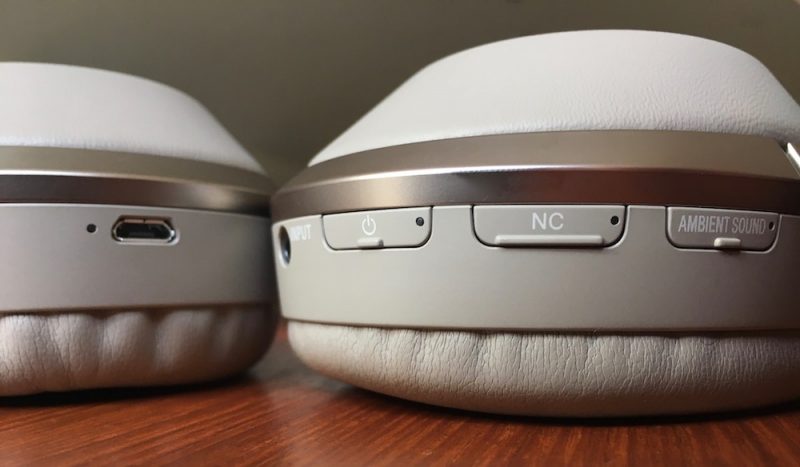
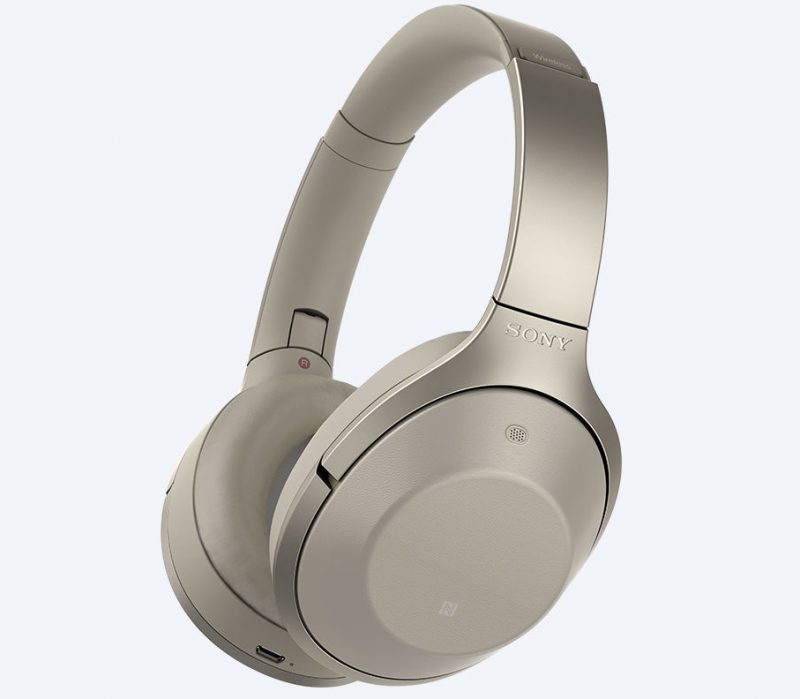
The left earcup contains an NFC chip for pairing with compatible devices and a micro-USB port for charging, while the right earcup has a touch-sensitive back that responds to taps and swipes to control music playback, skip tracks, change volume, and invoke Siri. Like most modern headphone gesture pads, it can also be used to take and end calls.
Around the rim of the right earcup are three physical buttons and an input jack. Unfortunately these controls aren’t particularly textured or distinctive, so expect some fiddling when you’re wearing the headphones before you get used to where they sit in relation to each other (although voice prompts helpfully accompany each press). The Ambient button lets you choose between different external sound filtering modes which we’ll cover below, the NC button lets you turn noise canceling on and off independently, while the power button can be pressed quickly for a battery level update and also activates the pairing sequence with a long press. All of the buttons have inset LEDs to indicate status.
Performance and Features
It’s worth stating right off the bat that Sony has taken noise cancelation to a new level with these headphones. This seems to have been achieved through a sustained period of self-reflection and extensive acoustics research in light of earlier shortcomings, combined with an exhaustive exercise in technological oneupmanship. In other words, Sony has pulled out all the stops in an attempt to beat Bose at its own game.

To begin with, Sony has chosen a headset design with a firmer grip than its NC rivals so that the earcups alone do a better job of isolating you from the outside world. There’s a slight trade-off here – Sony has used thicker urethane foam earpads than those found on Bose and Sennheiser’s NC cans to improve passive reduction, and they don’t feel quite as plush against your head as a result. It’s not a deal breaker by any means – they still feel lovely and squishy, and never bothered me after several hours of listening, but a few minutes back with the QC35’s was all it took to confirm they do lack the latter’s sumptuous cushiness.
Second of all, Sony’s patented Sense Engine boasts a “personal NC Optimizer”, a fancy-sounding piece of tech that’s supposed to determine your individual characteristics and wearing style to optimize the audio output just for you. Basically, Sony had the bright idea to build a microphone within each ear cup, which means the headset can sample ambient noise from both inside and out, effectively canceling out a wider range of sounds with corresponding inverted frequencies.

Hold down the NC button, and the headphone speakers emit a series of tones that bounce back and forth between the mics to analyze the shape of your head, work out whether you have big hair, wear glasses, and so on. It’s a unique innovation from Sony in the NC space – and it works, too. The only minor drawback for some wearers will be the ever-so-slightly more noticeable hiss when no music is playing. I found it pretty relaxing, kind of like distant lapping ocean waves. Your mileage may vary.
Otherwise, the NC easily stood up to scrutiny in a range of environments, including a busy bus and a crowded shopping mall. It didn’t detract from calls either, and effectively piped in my own voice as part of the conversation. The filtering is adaptive too, and corrected for changes in ambient levels as I moved around. These are also the first pair of noise cancelers I’ve worn that completely blot out my heavy-handed keyboard tapping and reduce my house phone in the same room to a barely audible, faraway whisper.
You don’t even need to take off the cans to realize just how effective the technology is, thanks to another feature unique to the Sense Engine called “Quick Attention”. Cupping your fingers over the touchpad instantly turns the volume down and lets in the outside world, allowing you to engage someone in conversation. Bring your hand back down and the music is re-instated to its prior volume. It’s genuinely useful for situations in which you’d usually be apt to take off the headphones – when a fight attendant offers you refreshments, for example.
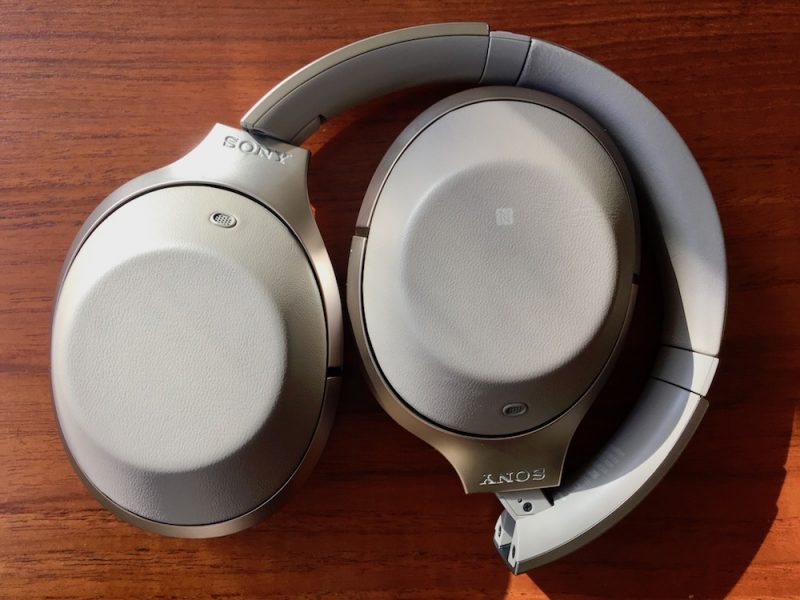
The MDR-1000X’s Ambient button performs two further NC sound tricks. One is called “Voice mode” and lets in the range of sound frequencies the human voice normally occupies. This is also meant to let you hear in on important announcements – when you’re waiting to be called to a boarding gate, say – while still allowing you to enjoy your music in relative quiet.
I found the feature a bit overly enthusiastic, sometimes failing to filter out other ambient sounds like the rustle of bags and suchlike which then became exaggerated and annoying. The “Normal” ambient mode on the other hand worked very well, and let me stay mindful of traffic sounds as I walked the street without entirely extinguishing that insulated cocoon feeling that good NC cans do so well.
Sony’s headphones certainly have a stronger Bluetooth connection than the competition – the MDR’s didn’t drop out once in areas where rival Bluetooth headsets I’ve tested regularly faltered. The link was retained around harder corners and over bigger distances – the MDR-1000X’s even passed the ‘microwave test’ and didn’t get all glitchy as I hovered around the kitchen while my dinner was being nuked.
Wireless audio connections have their limits of course, but Sony has also included a neat sound prioritization feature in the MDR-1000X that I haven’t seen in other cans. By default the headphones automatically select the highest quality Bluetooth protocol available, but hold down both power and NC buttons for a couple of seconds and you can switch them to “Priority on stable connection” mode, which falls back to the less-demanding SBC codec. Bear in mind I’ve no idea how well it works because I never had to use it.
On the subject of wireless codecs, this headset supports them all: AAC (iPhone), aptX (Mac/Android), SBC (everything), and LDAC. That last one is a Sony special which apparently transmits up to three times more data than conventional Bluetooth for superior sound, but it only works with Sony devices, such as the company’s Xperia smartphones and Walkman digital audio players. There’s some proper science behind it and I have it on good authority (an audiophile friend) that it delivers on its promise, but I didn’t have any other Sony hardware to test it with.

To be honest though, it didn’t bother me. The MDR-1000X’s sound brilliant over bog-standard Bluetooth anyway, and certainly outperform the QC35’s thanks to a wider, more expansive soundstage. The mid-range is wonderfully balanced and the highs sparkle, while a good, chunky bass serves as a warm foundation. They sound even better when the cable is used – so long as the headphones are on. Whether this is all down to Sony’s DSEE HX processing (which allegedly recreates higher frequency signals lost in low-quality compressed music files) or simply better tuned drivers, I can’t say. Whatever the reason, the MDR-1000X’s sound fantastic, especially for NC cans.
A few other points bear noting. Unlike the QC35’s and PXC 550’s, Sony’s headphones don’t seem to be able to pair with more than one device at the same time. I had to manually disconnect my iPhone to reconnect with my Mac, and vice versa, despite the fact that the cans had no trouble auto-pairing with the last known device when turned on. Also, the 1000X’s live up to their 20 hour battery life, but they take 4 hours to fully charge – twice as long as Bose – and the battery is similarly integrated, so it has to go back to Sony if/when it comes to replacing.
Bottom Line
Sony has pulled a fast one on its rivals here. For a company whose last serious attempt at noise canceling was the h.ear on Wireless NC headphones, the MDR-X1000’s are a huge step up in performance. Not only do they look smart and block out distraction, they also pack a ton of technology (not to mention compatibility), keep a strong connection, and deliver a beautiful sound.
It’s a sure sign that the premium NC market is maturing, and that translates to better consumer choice. For those who favor comfort, always-on NC and listening simplicity, Bose still wins. If a bigger sound and the ability to switch between multiple audio sources are your top considerations, Sennheiser’s PXC 550 cans are a great alternative. But if superior noise canceling and audio quality are more important to you than cushiness and dynamic pairing, then these new MDR-1000X headphones from Sony have your back.
Pros
- Unrivaled noise canceling
- Exceptional sound for wireless
- Multiple audio codec support
- Solid design and touch controls
Cons
- Comfy, but not Bose-comfy
- Lacks dynamic multiple device switching
- Longer charge time than other cans
- $50 more expensive than Bose QC35
How to Buy
The Sony MDR-1000X headphones come in beige or black, cost $400, and can be ordered via the Sony website.
Note: Sony supplied the MDR-1000X’s to MacRumors for the purposes of this review. No other compensation was received.
Tags: Sony, review
Discuss this article in our forums
UA Sport Wireless Heartrate Headphones Release Date, Price and Specs – CNET
Under Armour has partnered with JBL to create a pair of in-ear Bluetooth sports headphones with a built-in heart-rate sensor. Bose and Jabra also make in-ear sports headphones with an integrated heart-rate monitor, so this isn’t a unique product, but few sports headphones offer this feature.
Under Armour has one advantage, though: The UA Sport Wireless Heart Rate Headphones can connect to the company’s immensely popular Record platform. The app lets you track workouts and receive audio updates for things like pace, distance, heart rate and heart-rate zones.
While the Record app is free, Under Armour’s headphones are priced at $200 (which converts to about £160 or AU$260), which is higher than some better-sounding alternatives. To sweeten the deal, the company is throwing in a complimentary 12-month subscription to MapMyFitness Premium, an offer valued at $30, which converts to about £25 or AU$40.
Hands-on with Under Armour’s new heart-rate…
See full gallery


1 – 4 of 10
Next
Prev
Design and battery life
The headphones are designed primarily for working out and are rated IPX5, so although they aren’t fully waterproof they will do just fine in the rain and with sweat. The open design and loop hooks help keep the headphones in place when exercising. This also allows you to hear cars and people around you when running, but it means they aren’t very good for blocking out noise.
 Sarah Tew/CNET
I want to hear my surroundings when running, but not at the gym. Unfortunately you can’t have it both ways. These weren’t able to cancel out gym noise unless I raised the volume to an uncomfortable level.
The headphones come with a small carrying case and four different size earbuds, but they aren’t normal earbuds. They are super-sized ones with a small ear tip at the end, and they are incredibly difficult to remove and replace. While I had an OK fit, my colleague David Carnoy struggled with his and preferred the comfort of the Bose SoundSport Pulse Wireless headphones.
 Sarah Tew/CNET
Other features include an inline remote and microphone on the right wire for taking calls, changing songs, and changing the volume. Charging the headphones is done through a Micro-USB port located right on the remote. The battery will last up to 5 hours, which is the same as Bose’s heart-rate headphones, but still a bit short for my liking.
Working out
I’ve been working out with the headphones for the past few weeks. I had no connection issues with Android and iOS phones, and the audio sounded crisp and clear for the most part, although the bass was a bit lacking. These were also one of the only headphones that didn’t fall out when I was running.
 Sarah Tew/CNET
Under Armour’s Record app has been one of my favorites for quite some time. It’s easy to use and is compatible with a lot of devices, even those that aren’t made by Under Armour. The app uses the sensors in your phone (such as GPS) to track a variety of exercises, such as running, biking and weightlifting.
You can set up audio prompts to activate after a specific distance or time. These will give you real-time feedback on your pace, distance, calories burned, heart rate and heart rate zones. You can also get an on-demand audio update on your heart rate by tapping the Under Armour logo on the right earbud.
 Sarah Tew/CNET
As for the heart rate sensor, it’s located on the left earbud and is similar to what we’ve seen in the Fitbit Charge 2 and Apple Watch — a flickering green LED light used to illuminate the capillaries and measure the blood as it flows past. I was a bit skeptical at first. This was my first time using heart-rate earbuds, but they turned out to be pretty accurate for measuring both runs and gym sessions.
The heart rate feature is cool. But let’s be honest, most people probably don’t care about it, and those who do are better off getting a heart-rate running watch or using a chest strap at the gym.
There are better alternatives
The sport earphone market is extremely competitive. If I’m paying top dollar for a pair of headphones, I expect them to be as close to flawless as possible. The sound quality of Under Armour’s headphones doesn’t justify the high price. They also aren’t worth wearing when you aren’t working out, and $200 (about £160 or AU$260) is a lot of money to pay for a pair of part-time headphones.
If you’re sold on having heart-rate tracking headphones, you’re better off getting the Bose SoundSport Pulse Wireless and Jabra Sport Pulse Special Edition. Both cost the same as Under Armour’s headphones, include heart rate, offer superior sound quality and are a more comfortable fit.
Amazon Fire TV Stick With Alexa Voice Remote review – CNET
The Good The $40 Amazon Fire TV Stick with Alexa Voice Remote is one of the least expensive devices to stream video from Netflix, Amazon, Hulu, HBO, Sling TV and other online services. It’s just as responsive as other devices, meaning it’s lightning-fast, and charges less for an included voice remote.
The Bad The current user interface pushes Amazon content too aggressively. Alexa is less useful than with always-on devices. There’s no dedicated app for any other a la carte video service beyond Amazon’s.
The Bottom Line The fast, affordable new Fire TV stick is great for fans of Amazon who’ll use its voice capabilities, and an excellent value, but it’s still not as good as Roku.
Amazon’s Alexa rules the home voice-tech world while rivals Google, Apple and Microsoft race to keep up. The giant retailer doesn’t make phones (anymore), but it’s building the talking digital assistant into devices beyond its blockbuster Echo and Dot line of always-on, always-listening home speakers.
The cheapest, the Fire TV Stick with Alexa Voice Remote, costs just $40. It’s always on but not always listening. Instead, it requires your TV to be powered up and you to talk into the remote while you hold down, er, Tap, the mic button.
Once you do that, the Stick behaves just like any other Alexa device. Her sorta-robotic female voice replies to questions like “What’s the weather?” or “How much does the sun weigh?” via your TV’s speakers (unlike Siri on Apple TV, who remains silent for now) and an on-screen message. She can turn on the lights, set the thermostat or otherwise interact with any other Alexa-compatible device in your home.
Amazon Fire TV Stick with Alexa Voice Remote
See full gallery


1 – 5 of 18
Next
Prev
That’s not why you’re buying one, however. For most people, Alexa on the Fire TV Stick will be an afterthought. The Stick’s main schtick is streaming video, just like its predecessor, which cost the same and also worked with Alexa, but didn’t include that voice remote.
The new Stick is faster and remains an excellent value with plenty of content. It’s a no-brainer buy for heavy Amazon video watchers and people who prefer talking rather than pressing buttons. But compared to rival Roku, whose $50 streaming stick is our favorite such device, the new Amazon stick currently falls a bit short.
The main reason is the on-screen user interface, which still relentlessly pushes you toward Amazon’s TV shows and videos rather than provide the equal playing field for all apps (like Netflix, YouTube, Hulu, WatchESPN, Sling TV and countless others) that Roku does. The new Amazon Stick is just as quick as Roku’s stick, and its voice capabilities run circles around Roku’s, but for now it’s not as good unless you already get most of your video from Amazon anyway.
Why do I say “currently” and “for now”? Amazon will soon give all of its Fire TV devices a completely overhauled menu system and user interface (above). It will roll out first to this product by the end of the year, then make its way to older Fire TV models like the 4K-capable Fire TV box (which remains on sale at $100). For that reason I’m not going to say much about the current menu system (detailed here) in this review.
I will update this review when the new system becomes available and I can test it. In the meantime, here’s my take today.
 View full gallery
The original $40 Fire TV Stick (left) is a bit smaller than the new one, and doesn’t include the voice remote.
Sarah Tew/CNET
Same winning stick design
In my book smaller is better for pretty much any tech device (that doesn’t have a screen). The stick form factor slims streaming down to the bare minimum, allowing the device to hide discreetly behind the TV. The only real downside compared to boxes like the $100 Fire TV, Apple TV or Roku’s boxes is lack of ports like Ethernet (although Google’s Chromecast has a clever solution), MicroSD, USB and optical audio.
Unlike many of streaming boxes the new Fire TV Stick has 1080p resolution, not 4K. The only mainstream 4K stick-like streamer is the $70 Chromecast Ultra. Like the 4K-capable Fire TV box the new Stick does have HEVC decoding, so it can take advantage of that superior compression format to enable better image quality and use less bandwidth, even with 1080p streams. Amazon has re-encoded its entire video library to HEVC.
The newer version of the Fire TV stick is a bit chunkier than the original but still plenty small. If the back of your TV is too cramped to accommodate it, you can use the included “port saver,” a short female-to-male HDMI adapter included in the box (Roku’s stick doesn’t include one).

View full gallery Sarah Tew/CNET
Compared to the original, the new Fire TV Stick improves the Wi-Fi capability from 802.11n to 802.11ac, and adds the ability to connect a set of Bluetooth wireless headphones for private listening. I had no issues connecting to either 2.4GHz or 5GHz networks, and both of the headsets I tried (a Polk Hinge and a Motorola SF520) connected easily and showed good-enough lip sync. Lip sync issues can vary on different Bluetooth headphones, however.
Like other sticks Amazon’s power can come from a standard AC wall socket via the included adapter and cable, or from a USB port (typically on the TV). I recommend using the wall socket since it allows the stick to remain in standby, ready to go immediately. Using USB power from a TV means you’ll have to wait around 40 seconds for it to boot up each time. At least that beats the original stick, which took 110 seconds to boot up.

View full gallery Sarah Tew/CNET
Amazon’s speed stick
Amazon claims a 30 percent boost in speed compared to the original Fire TV Stick thanks to a new quad-core processor, and comparing the two directly the new version is certainly faster in many ways. That said, the improvement isn’t so stark that current Stick owners should feel compelled to upgrade.
The most popular apps provide the biggest differences. Netflix launched twice to three times faster, while YouTube launched about twice as fast. Browsing Netflix was about the same on both devices, although while YouTube’s browse was a bit pokier on the old one.
Kodak Ektra Release Date, Price and Specs – CNET
It would either be very brave or very foolish of Kodak to try and compete with the likes of Apple and Samsung. But with the launch of its camera-focused new Ektra phone, that’s exactly what it’s doing.
Kodak used to be one of the biggest names in traditional film photography. But the digital era hasn’t been kind to it, so the company is looking to the world of phones to help get some cash back in the bank.
True to Kodak’s heritage, the Ektra is aimed squarely at photography enthusiasts. At the camera’s core is a 21-megapixel sensor, with a bright f/2.0 aperture lens in front. Kodak claims the camera will be able to capture crisp images in low light, helped by optical image stabilisation and software tweaks.
A physical wheel on the front of the phone lets you change settings quickly — something that will no doubt appeal to photography purists who like the tactile feel of physical dials. There’s also a wide range of scene modes and a manual mode to help you get a bit more creative.
On paper, the phone’s camera has plenty to boast about, although whether it delivers on image quality remains to be seen until we take it for a proper test.
The Ektra will need to produce some stunning shots if Kodak truly hopes to make photographers take interest. Photography prowess is one of the mostly hotly contested aspects of top-end phones, with devices such as the iPhone 7, Galaxy S7 and new Google Pixel all capable of taking beautiful photos.
It’s interesting to note that Kodak hasn’t built the phone itself — the actual hardware is produced by a company called Bullitt. It’s not clear how much work Kodak has had to do on the Ektra beyond slapping its branding on it, but it’s hopefully wise enough to not lend its name to a product before checking that it’s any good first.
The Ektra will be on sale across Europe later this year and will set you back £449. At the time of launch, Kodak has no plans to launch the phone in the wider world, but that UK price converts to $552 and AU$719. We’ll update this article with more information when it’s available.
Specs and features
- Android 6.0 Marshmallow software
- MediaTek Helio X20 2.3GHz decacore processor with 3GB RAM
- 32GB storage, expandable with microSD cards
- 13-megapixel front-facing camera
- 3,000mAh battery
- USB type-C
 AIVAnet