


Apple to Announce Third Quarter 2018 Earnings Results on July 31
Apple today updated its investor relations page to announce that it will share its earnings results for the third fiscal quarter (second calendar quarter) of 2018 on Tuesday, July 31.
The earnings release will provide a look at continued sales of the iPhone X, iPhone 8, and iPhone 8 Plus, along with data on how well the new low-cost 9.7-inch iPad is doing.
Apple’s guidance for the third fiscal quarter includes expected revenue of $51.5 to $52.5 billion and gross margin between 38 and 38.5 percent. Based on those guidance numbers, Apple will beat its Q3 2017 earnings results.
Apple’s quarterly earnings statement will be released at 1:30 p.m. Pacific/4:30 p.m. Eastern, with a conference call to discuss the report taking place at 2:00 p.m. Pacific/5:00 p.m. Eastern. MacRumors will provide coverage of both the earnings release and conference call on July 31.
Tags: earnings, AAPL
Discuss this article in our forums
Matrix PowerWatch X review: The would-be future of wearables
It’s about time the smartwatch fitness tracker industry did something interesting. We only need so many devices to count calories and measure heart rate.
The Matrix PowerWatch X might be just the shakeup that we’re looking for. This watch has pretty light fitness and “smart” functionality, but nevertheless grabs attention with one show-stopping feature: it never needs charging!
That’s right, this is a watch with a digital display and accompanying app that you can wear indefinitely without ever needing to look for a power outlet thanks to its proprietary thermoelectric technology. The PowerWatch X (like previous models) is powered by your own body heat, charging as you wear it.
We’ve all seen analogue timepieces pull a similar trick by using kinetic energy. However, that a digital watch with notifications, a stopwatch, and more never needs a charge is really interesting.
Is the Matrix PowerWatch X a device you’ll want to wear on your wrist? Let’s take a look in our full Matrix PowerWatch X review.
Features and capabilities
As I alluded to earlier, this watch isn’t all that smart. It’s light on fitness tracking features too.
It’s got a clock (of course), as well as a stopwatch mode and a running mode. It can receive notifications (SMS and phone calls), count calories, steps, and track sleep. Matrix also says customizable watch faces are coming.
All this runs on a custom, very light OS, which you navigate with two buttons and a dial on one side of the device. To change settings and access your data, you need to use the accompanying app for iOS and Android.
Instead of a heart rate monitor, the watch calculates calories at least partly by your body heat. Seeing as the body converts heat into energy, it’s theoretically another route for getting a good estimate. Apparently, the body generates 100 watts of heat at rest, and that number then jumps to a kilowatt when exercising!

That body heat is what gives the watch its longevity. Never having to take your watch off to charge is very cool, and it also makes a lot of sense for a fitness tracker. After all, if you’re meant to count your steps and track your sleep, when exactly are you meant to charge these things?
Moreover, this could be very useful for someone doing a long expedition who doesn’t want their device to die halfway through the trip. It’s also going to win favor with the environmentally friendly crowd, seeing as bioenergy is pretty clean!
For the average Joe, it might sound like a small thing, but it’s strangely liberating knowing you’ll never have to charge your device. (Even if most fitness trackers only require charging once every few days or even weeks the rest of the time anyway!)
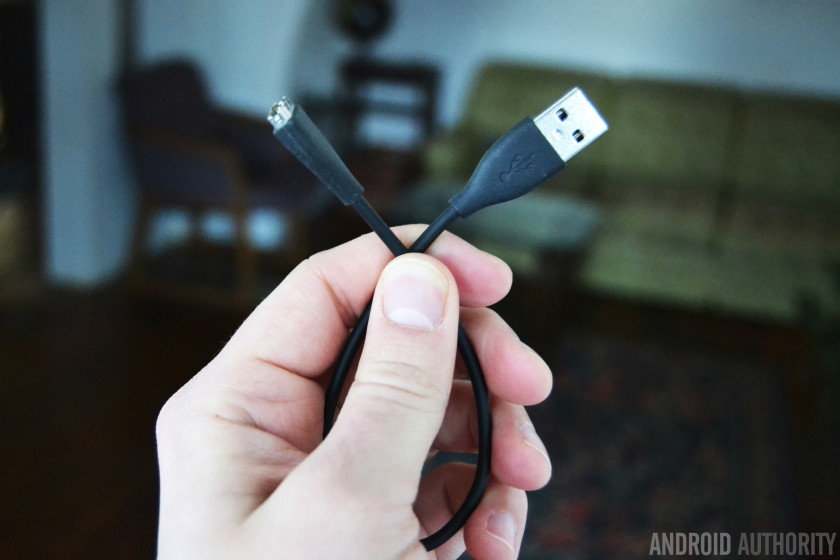
Interestingly, it’s not so much your body heat alone that charges the device, but rather the differential between your body heat and the ambient temperature. If you’re running and getting hot somewhere that is very cold, that actually charges it faster.
When you take the device off, it enters an idle mode, saving your data until you next put it on. Apparently, it can last in this idle mode for up to two years.
Performance
So, there aren’t a ton of features here aside from the battery, which might lead you to expect the watch would perform those few jobs really well.
Not so much.
The notifications are very basic, to the point where you’re literally just being notified that you have a call incoming, or an SMS received, and who it is from, rather than what it says. You’ll need to open your phone to learn anything about it. Worse, sometimes they don’t come through at all.

The predecessor to this device — the Matrix PowerWatch (the X is new) — actually comes without the notifications. You could always save yourself a few bucks and some frustration by getting that instead.
Then there’s the sleep tracking, which flat out doesn’t work as far as I can tell. It’s supposed to auto-detect when you doze off and there is no way to start the tracking manually. According to the Matrix PowerWatch X, I haven’t slept a wink in the past three days. Disappointing!
The sleep tracking just flat out doesn’t work as far as I can tell.
Step counting fairs a little better and largely correlates with what my other devices tell me. Calorie counting is definitely a little strange though. I’m 77kg with around 11 percent body fat at the moment. Yesterday I walked 6,923 steps and did a 40-minute workout, but apparently only burned 1,500 calories. That is way off, and I would expect to see at least 2,400 calories.
This could be at least partly because the device wasn’t tracking my sleep — you burn a surprising number of calories at night. It could also be due to the simple fact that heat alone isn’t enough to calculate calories accurately. If it was combined with a heart rate monitor (which would require significantly more juice to power) that would be a different story.

Working out with the MATRIX PowerWatch. It can only track runs unfortunately but also seemed to fail to notice I burned extra calories for this hour…
Moreover, I’m not convinced the device is actually doing any BMR calculations to work out how many calories I burn at rest. You can input your details into the app, but it never explicitly asks you to. Since finding that option, I haven’t noticed much difference.
I love being able to see the power meter on the watch face — telling me how much electric power my body is generating — but that information doesn’t really correlate with anything particularly useful (it seems to go up and down randomly with no relation to what I’m actually doing). I’m not convinced it’s more than a gimmick, though it’s admittedly a cool one.
The app
The app is also disappointing.
When I first received my review unit, I eagerly installed the app and got ready to set up the device, only to find it wouldn’t pair via Bluetooth. I tried again and again — even on a different phone, in case it just wasn’t playing nice with my Honor 10.
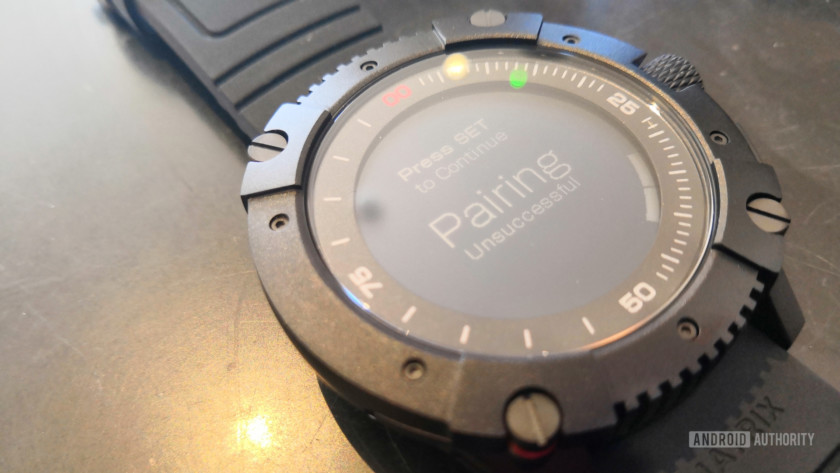
Well that’s disappointing…
Checking reviews on the Play Store, it turned out I wasn’t the only person experiencing this issue. Seeing as you need to sync the device to set it up, I actually worried I wasn’t going to be able to write this post!
Luckily, when looking at the IndieGoGo page for the original Matrix PowerWatch (which uses the same app), I spotted a comment that mentioned their watch would sync only one in every 10 attempts. I decided to persevere and eventually it paired.
Since then, syncing has been a little more reliable (though not perfect). The biggest issue otherwise is that the app is incredibly bare bones, providing barely any more information than the watch face itself. Interaction is also awkward, to the point where scrolling doesn’t quite work for inputting numbers meaning I was forced to press “+” 30 times to enter my age (it starts at 0) and 77 times to enter my weight!

This is pretty much it…
The app is also incredibly power hungry. I’ve had to charge my phone significantly more frequently while using it.
Hopefully this will receive some attention going forward.
The design
Although the concept is cool, the design of the device isn’t quite so space age. I like to think a watch powered by bioenergy is the kind of thing Tony Stark would wear. Sadly, I just can’t see him — or anyone who loves premium tech — being particularly eager to flaunt this design.
Although the concept is cool, the design of the device is also not quite so space age.
It’s not hideous or anything. It’s just not as svelte or curved as a lot of the competition. Nor is it as refined and elegant as an old-school analogue watch. The detailing falls flat, and it’s just kind of chunky.
It’s also really large, at 13.5mm thick with a 50mm diameter and 60-70g weight (I don’t know why this number varies so much either!).
The size doesn’t just make the watch a little ostentatious, it also makes it somewhat awkward and occasionally uncomfortable. It gets sweaty, catches on things, and it’s difficult to sleep with. Its included strap is rubber too, which tends to get hot and adds to the uninspiring look. You could of course change that should you so wish however.
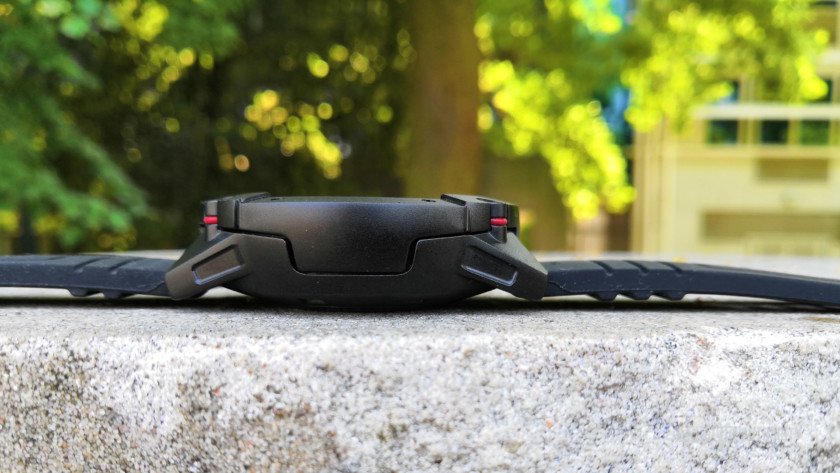
The Matrix PowerWatch: thick!
On the plus side, this watch is also waterproof up to (down to?) an awesome 200 meters — making it the most water-resistant smartwatch on the market, according to its manufacturer. It uses aircraft-grade aluminum, making it very light and durable. It certainly looks rugged.
The display itself is black and white and the UI is predominantly text based. It’s fairly visible in direct sunlight, but there’s no backlighting. You can turn on a small light in one corner for reading the time in the dark though.
In future, Matrix Industries says it will bring a range of customizable watch faces to the gadgets. Taking a quick look at reviews and comments for the first Matrix PowerWatch though, the company already appears a few months behind schedule in this regard.

As mentioned, interaction is handled by two buttons and a dial. These are rather fiddly to use. It’s not always intuitive navigating through menus or starting and stopping the timer, among other things. I’m not really sure what the point of the dial is. It can scroll through some settings, but so can the mode button. Hopefully, this is an indication of upcoming features?
Closing comments
I can’t help but feel I’ve been a bit harsh on the Matrix PowerWatch X. The device is no doubt a laudable attempt at doing something different in the smartwatch space. I always have a soft spot for crowdfunded projects.
The watch is also pretty expensive. The Matrix PowerWatch X goes for $279, which is about the same as the Garmin Vivoactive 3 or the Fitbit Ionic, both of which offer considerably more options and features. Even the notification-less, 50m resistant original Matrix PowerWatch is $199.
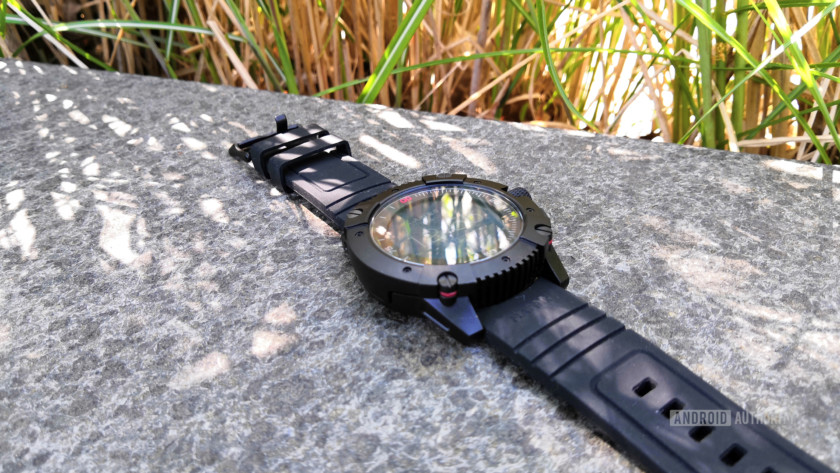
Right now, it doesn’t really deliver on its potential. It has a lot of bugs and growing pains, and it’s not particularly good looking or comfortable. It feels more like a tech demo than a finished product.
Even if you’re a wealthy early adopter who just wants to show off with something unique, this hardly looks like the kind of thing you’d actually want to wear out and use as the conversation piece.
You probably shouldn’t buy this watch, but I hope Matrix Industries keeps making more. If the company can make the watch slimmer, improve its design, fix its software, and iron out the bugs, it could have something really special.
There’s a lot of potential here, but the Matrix PowerWatch X just doesn’t nail the execution.
How to use your camera’s histogram
Have you ever taken a photo and thought it looked great on your digital camera’s LCD, only to get home and discover an overexposed mess on your computer screen? Yuck.
It can be difficult to discern if an image looks good on a small, bright screen, but fortunately, there’s a tool you can use to determine whether your image is too bright or too dark: your camera’s histogram. This is a feature that used to be reserved only for more advanced cameras, but in recent years has been added to more and more base level units – even many phones.
Photography 101
Exposure, aperture, and ISO
Shoot better photos at the golden hour
The rule of thirds and how to use it
How to take great actions shots
Here’s how to get the most out of the histogram, which will let you get the correct exposure on your images — and ultimately let you ace your digital photography.
What is a histogram?
The dictionary definition of a histogram is a graphical representation of data distribution, usually displayed as a bar graph. In digital photography, this related to the pixels that make up your image, and a histogram on your camera displays where each pixel is distributed from pure black to pure white in terms of brightness. In practice, this looks like a chart with a series of peaks and valleys. The higher the peak, the more bright pixels. This is the tonal distribution of your image, and by reading it you can judge the exposure of your image on you camera’s LCD or EVF.
The histogram can usually be found on an image by image basis when you scroll through your photos (depending on your camera’s playback mode, it may or may not be on by default). Many cameras now also allow for a live histogram view, either on the rear LCD or — in the case of mirrorless cameras — on their electronic viewfinders. This is incredibly helpful, because you can watch your histogram change as you frame your image and adjust your exposure.
An example of a DSLR’s histogram. (Image via Nikon)
How do you use a histogram?
Despite being one of the best ways to quickly and accurately judge your exposure, the histogram is often overlooked by amateur and novice photographers. After all, if you don’t know what it is, a histogram just seems like a weird graph, and many people have no idea how to use it to their advantage. Also, the “ideal” histogram is different for every shot and changes depending on the look you desire. So when you’re not comfortable with the histogram, there can be a lot of hesitancy to rely on it.
Luckily, on the most basic level, a histogram isn’t difficult to understand: The horizontal axis shows the tonal distribution (dark to light), while the vertical axis shows the number of pixels in a particular tone – and remember, the higher the peaks, the more pixels there are. The far left of the horizontal axis shows the darkest areas of the image, then moving to medium-gray in the middle and lightest on the far right. An image with a lot of light, for example, will see the graph’s data toward the middle and right of the histogram.
The histogram in this image shows that the majority of pixels are in the far left, indicating that there are a lot of dark tones.
You’ll lose details where your image is too bright or too dark, and you’ll notice if a photo is overexposed or underexposed in the histogram as missing pixel information on the far left or far right. This is when you should adjust your settings to compensate – try a different shutter speed, choose a larger or smaller aperture, increase or decrease the ISO, or adjust the exposure compensation.
Depending on the situation, sometimes an uneven distribution is OK. If you’re shooting snow, a white object, or something against a white background, the histogram will display more data points on the right. The opposite holds true when you’re shooting a dark scene or a black object. The key here is knowing what you want your image to look like and exposing it properly to get that result. On its own the histogram is just data, not right or wrong in any situation; you need the context of your desired image to gauge whether the data on the histogram will give that to you.
There’s obviously a lot of overexposure in this photo, and the histogram shows that.
The histogram is a not a foolproof tool for shooting perfectly exposed photos, because that’s not always possible. You can’t push a button and make a picture better – not even the camera’s auto setting is smart enough to do that. But think of it as a useful tool that tells you quickly what your photo’s exposure levels are, instead of just guessing by looking at the image on the LCD. As your photography improves and you learn to adjust the settings to compensate, you will learn to read the histogram better too.
You can also utilize the histogram in apps like Adobe Photoshop or Lightroom to improve image quality during post-processing. It can help you more accurately match the look and exposures of a series of images you may be editing, or even just analyze your images after a shoot to see how you may improve your photography.
Still unsure? Check out this video from Creative Live that demonstrates how the histogram works.
Editors’ Recommendations
- 17 tips and tricks for better digital photography
- Panasonic Lumix GH5S review
- Photography 101: exposure, aperture, shutter speed, and ISO
- How to photograph the stars: 9 steps to stunning night images
- What is HDR photography and how can I shoot it with my camera?
Your Galaxy phone probably won’t send your images to a random contact
Andy Boxall/Digital Trends
Samsung might be pumping out some of the best Android phones in the world right now, but that doesn’t mean that they’re without their flaws. Your Galaxy smartphone may be sending images to random contacts — and even worse, there is no evidence that it even happened.
The issue seemingly stems from a problematic update to the Samsung Messages app, and multiple users on Reddit have complained that their entire gallery has been sent to certain contacts. Part of the issue is the fact that there’s no indication on the device that anything of the sort has happened — in fact, the only trace of the activity (outside of the messages on the recipient’s phone) can be found in text logs on your carrier account. The issue has been reported on the Galaxy S9, S9 Plus, and the Note 8. At this time, it’s not sure if the issue affects multiple carriers, but it seems that most complaints are with T-Mobile.
But before you scramble to delete any compromising images, you might not need to. While the widespread of devices indicates that any Galaxy device could be affected, it seems that it’s mostly T-Mobile users that are affected by the bug. What’s more, it seems clear from some sleuths on Reddit and Samsung’s official forums that the messages are only sent to people who are on the same plan. Most messages from affected users (including the original poster) note that the messages have only been sent to girlfriends and wives, indicating that it’s shared plans on T-Mobile that may be causing the issue. So unless you’re in that very specific camp, you’re unlikely to be unaffected. It’s most likely the issue is a part of the larger issues reported on Samsung Messages for T-Mobile users.
But if you want to be on the safe side, then there is a quick way that you can make sure it won’t happen to you. Simply open your Settings app, then hit Apps -> Samsung Messages > Permissions, and then revoke the Storage permission. This method will probably make your Samsung Messages app stop working entirely, but there are a bunch of great messaging apps out there, as well as Google’s Android Messages app that will work until the situation is resolved.
Editors’ Recommendations
- Selling your phone or tablet? Here’s how to wipe your Android phone
- You can now set Amazon Alexa as the default home assistant on your Android
- Debating between Apple and Samsung phones? Open your eyes a little wider
- Master your Huawei P20 and P20 Pro with these helpful tips and tricks
- How to share your screen on Skype
Get a business phone number the easy way with the OpenPhone app
Vadymvdrobot/123RF
If you’ve ever run your own business, or kept a personal line open for business inquiries, you’ll know how tough it can be to switch off from business matters when your personal phone is so tied into your business. That’s what OpenPhone, Y Combinator participant and startup, wants to eliminate with an app that simulates a business line.
OpenPhone is aimed at small business owners rather than larger companies, and aims to offer users a simple way to differentiate their business calls from personal. Once downloaded, users will be given a business phone number, or can use an existing one, if available. They will then receive texts and calls through the VoIP, running them through your device’s internet connection. This allows for an unlimited amount of texts and calls, without setting up a costly new plan.
Since business calls and texts come through the OpenPhone app, it makes it easy to see when a call is business related. OpenPhone’s aim is to give smaller business owners the ability to shut off from their business life, and OpenPhone’s app comes with various features that can help make that happen. Do Not Disturb, voicemail, and business hours are among the features currently available. OpenPhone plans to add more features, such as the ability to share business numbers with your team.
“Both my co-founder and I grew up in families where all of our income was dependent on the businesses our parents were running. Later, I joined a software company building back-office tools for home improvement contractors,” said co-founder and CEO Mahyar Raissi to TechCrunch.
“There I noticed two important things. First, most of our users were using their personal phone numbers for business and they absolutely hated that. They’d have to put their numbers online or give it out to strangers. This meant getting constant calls when they were spending time with their families or when they were busy doing work. Second, contractors who communicated more professionally and were more responsive had more successful businesses and earned more money.”
The app costs $10 a month for a single business line, and is available for iPhone, iPad, and Android. Even though it’s based on an internet service, at the moment OpenPhone’s functionality is only usable within the U.S. and Canada, though you’ll still be able to use it to call numbers in the U.S. and Canada if you venture abroad. If you’re looking for more great apps that might benefit your business, check out our list of the best iPhone apps, and the best Android apps currently available.
Editors’ Recommendations
- How to use Apple’s Business Chat on your iPhone or iPad in iOS 11.3
- You have to get an invite for Walmart’s personal shopping service, Jetblack
- Google Tasks stand-alone app aims to help you to organize your life
- Amazon ramps up gig economy with Delivery Service Partners fleet program
- BlackBerry Key2 review
Microsoft’s foldable ‘Andromeda’ pocket device may never surface
Unnamed sources claim Microsoft’s unannounced two-screen “Andromeda” project may be put on hold indefinitely. Executives made the decision over the last several weeks to not include the software components and services used by Andromeda in the next Windows 10 feature release, aka Redstone 5, slated to arrive in October. The Andromeda components may not arrive in Redstone 6 (or whatever it’s called) either.
Sources claim Microsoft put Andromeda on ice over scheduling and quality. Given the company split up its Windows engineering team to better focus on artificial intelligence and cloud computing, the new Windows team will be building “experiences” based on those platforms. That also means retooling current software and services to take advantage of those platforms.
The problem with Andromeda is that it had no real target audience, and even if it were to hit the market, it would be sold at a price that wouldn’t be attractive to whatever market it does find. It was on a path to become a device “in search of an audience,” thus Microsoft currently sees no compelling reason to launch a dual-screen device.
A recent prototype revealed that Andromeda included telephony components. The two-screen book-style form factor seemingly aimed to transform the smartphone market much like the original Apple phone did in 2007, but apparently, that is not the case at all. Sources said Microsoft never had any intention to enter Andromeda into the smartphone market to compete with Apple and Google.
A recent wave of “leaks” indicated that Andromeda would arrive by the end of the year sporting the Surface brand. In fact, one leaked document said the disruptive “new pocketable Surface device form factor” would provide a personal and versatile computing experience based on “innovative new hardware and software experiences.”
Even more, a leak provided last week revealed Andromeda would have five modes depending on how the screens are oriented via the 360-degree hinge: Closed, flat, convex, concave, and full. In a flat position, the two screens would come together as a tablet while convex would be similar to “tent mode” on 2-in-1s. Concave would serve as your typical laptop mode while full mode would see the two screens’ backs touching each other. To put the device to sleep, simply close it by touching the faces together.
What’s interesting about all this Andromeda talk is the sheer amount in 2018 alone. Based on all the leaked information, an official reveal looked promising at the end of 2018 along with new Surface devices and Redstone 5’s launch (likely called November 2018 Update). But given that Microsoft is putting Andromeda on hold indefinitely, someone or some group is apparently trying to save the project, generating hype. Maybe Microsoft itself is “leaking” the information just to evaluate consumer response.
Talk of Andromeda isn’t exactly new. Rumors of the device appeared in 2015 as Microsoft reportedly dumped an earlier phone project to create a “disruptive” device. It would be an entirely new design built by the Surface team and led by Microsoft hardware lead Panos Panay.
Editors’ Recommendations
- Microsoft’s foldable Andromeda PC could transform into five distinct modes
- Microsoft’s ‘Andromeda’ device may be a phone after all
- Microsoft calls its foldable Andromeda device “disruptive”
- Everything we know about Microsoft’s ‘Andromeda’ Surface phone device
- Folding ‘Andromeda’ device could be Microsoft’s iPhone moment
Microsoft’s foldable ‘Andromeda’ pocket device may never surface
Unnamed sources claim Microsoft’s unannounced two-screen “Andromeda” project may be put on hold indefinitely. Executives made the decision over the last several weeks to not include the software components and services used by Andromeda in the next Windows 10 feature release, aka Redstone 5, slated to arrive in October. The Andromeda components may not arrive in Redstone 6 (or whatever it’s called) either.
Sources claim Microsoft put Andromeda on ice over scheduling and quality. Given the company split up its Windows engineering team to better focus on artificial intelligence and cloud computing, the new Windows team will be building “experiences” based on those platforms. That also means retooling current software and services to take advantage of those platforms.
The problem with Andromeda is that it had no real target audience, and even if it were to hit the market, it would be sold at a price that wouldn’t be attractive to whatever market it does find. It was on a path to become a device “in search of an audience,” thus Microsoft currently sees no compelling reason to launch a dual-screen device.
A recent prototype revealed that Andromeda included telephony components. The two-screen book-style form factor seemingly aimed to transform the smartphone market much like the original Apple phone did in 2007, but apparently, that is not the case at all. Sources said Microsoft never had any intention to enter Andromeda into the smartphone market to compete with Apple and Google.
A recent wave of “leaks” indicated that Andromeda would arrive by the end of the year sporting the Surface brand. In fact, one leaked document said the disruptive “new pocketable Surface device form factor” would provide a personal and versatile computing experience based on “innovative new hardware and software experiences.”
Even more, a leak provided last week revealed Andromeda would have five modes depending on how the screens are oriented via the 360-degree hinge: Closed, flat, convex, concave, and full. In a flat position, the two screens would come together as a tablet while convex would be similar to “tent mode” on 2-in-1s. Concave would serve as your typical laptop mode while full mode would see the two screens’ backs touching each other. To put the device to sleep, simply close it by touching the faces together.
What’s interesting about all this Andromeda talk is the sheer amount in 2018 alone. Based on all the leaked information, an official reveal looked promising at the end of 2018 along with new Surface devices and Redstone 5’s launch (likely called November 2018 Update). But given that Microsoft is putting Andromeda on hold indefinitely, someone or some group is apparently trying to save the project, generating hype. Maybe Microsoft itself is “leaking” the information just to evaluate consumer response.
Talk of Andromeda isn’t exactly new. Rumors of the device appeared in 2015 as Microsoft reportedly dumped an earlier phone project to create a “disruptive” device. It would be an entirely new design built by the Surface team and led by Microsoft hardware lead Panos Panay.
Editors’ Recommendations
- Microsoft’s foldable Andromeda PC could transform into five distinct modes
- Microsoft’s ‘Andromeda’ device may be a phone after all
- Microsoft calls its foldable Andromeda device “disruptive”
- Everything we know about Microsoft’s ‘Andromeda’ Surface phone device
- Folding ‘Andromeda’ device could be Microsoft’s iPhone moment
Intel’s next mainstream compact PCs won’t have discrete Radeon graphics
If you’re looking for a new super-compact Next Unit of Computing (NUC) from Intel, the company is gearing up to launch five new “Bean Canyon” models with eighth-generation processors. Dates and prices are unknown for now, but they will be more “mainstream” than the skull-bearing “Hades Canyon” NUC released at the beginning of the year.
According to a leaked slide, there will be two short models measuring 1.41 inches tall and three larger versions measuring two inches tall that can host a 2.5-inch hard drive or solid-state drive. But unlike the “Hades Canyon” NUC, these five mini PCs don’t rely on Intel’s module packing discrete AMD Radeon graphics, but instead solely rely on an integrated Iris Plus Graphics 655 component.
Here are the processors used in Intel’s “Bean Canyon” NUC:
These three processors were part of Intel’s third wave of eighth-generation chips released in April, following desktop processors in late 2017 and the first batch for ultra-thin laptops in August 2017. All three chips listed above draw 28 watts of power, which is higher than the 15-watt chips used in previous NUC designs. The integrated Iris Plus Graphics 655 component has a base speed of 300MHz across the board while the Core i7 chip has the highest boost speed of the trio.
Now here are the actual “Bean Canyon” NUCs Intel has in the works:
Note that two of the five NUCs don’t support Intel’s Optane memory, which is used to boost the performance of hard drives. The larger models pack an empty drive bay for a 2.5-inch hard drive or SSD while the smaller models only provide a SATA port. All NUCs are barebones anyway, thus you’re required to purchase memory and storage separately in addition to the cost of Intel’s NUC.
The “Hades Canyon” NUC released by Intel earlier this year doesn’t target the mainstream market but sets its eyes on gamers. Packed inside is the Core i7-8809G module: An all-in-one package/chip containing four seventh-generation processor cores and integrated HD Graphics 630, dedicated HBM2 memory for graphics, and 1,536 Radeon RX Vega M GH discrete graphics cores. All three portions are connected by “fast lanes” and housed in one single package.
That said, the “Hades Canyon” NUC starts at $898, but that’s without memory and storage. It provides two slots supporting up to 32GB, two M.2 slots for card-style storage, two SATA ports for your typical hard drive or SSD and a handful of outputs including Thunderbolt 3, Type-C and Type-A ports, and more. If you’re wanting a super-compact gaming PC that hides in the shadows, “Hades Canyon” would be a good option.
But if you want a similar form factor but without the gaming frills, the “Bean Canyon” may be your best pick for good performance without the huge bulk of a desktop PC. Perhaps we’ll hear more about these NUCs later this year as the summer comes to a close and students head back to school.
Editors’ Recommendations
- Lenovo’s new IdeaPad laptops tickle your gaming fancy without breaking the bank
- HP’s mainstream Pavilion PCs refreshed with latest AMD Ryzen, Intel Core CPUs
- HP’s Envy curved AIOs sport a six-core CPU, Nvidia graphics, and maybe Alexa
- Intel’s 10nm CPU finally makes it to retail in a refreshed Lenovo IdeaPad laptop
- Asus just rolled out the world’s slimmest gaming laptop with GTX 1070 graphics
PlayStation 4 Slim vs. PlayStation 4 Pro: Which should you buy?

Which PlayStation 4 should I buy?
Anyone looking to buy a PlayStation for family now have a couple of options that look very similar. You’ve got the new slim PlayStation 4, and the new PlayStation 4 Pro. The original PlayStation 4 is all but impossible to find these days, and even if you do come across one refurbished it’s usually more expensive and generally not worth buying. But do they all offer similar experiences? Is there a downside to buying the slim over the pro? There are a lot of unanswered questions here.
It’s confusing by anyone’s standards, so your best bet is to know what you need before you head into the store.
What’s the difference?

Sony has a history of releasing a “slim” version of the PlayStation a couple of years after its initial release. In the past, those consoles have been labeled a little differently at launch to make it easier to tell the new version apart from the old one. These slimmer versions typically offer more a physical difference than a functionality difference, and this year is no different. The significant feature and performance difference comes with the PlayStation 4 Pro, and even then the difference isn’t huge unless you own a 4K television with HDR support.
| Price | $259 | $269 | $399 |
| Dimensions | 10.83in x 12.01in x 2.08in | 10.43in x 11.34in x 1.54in | 11.61in x 12.87in x 2.17in |
| CPU | AMD Jaguar 8-core (x86-64) | AMD Jaguar 8-core (x86-64) | AMD Jaguar 8-core (x86-64) |
| GPU | AMD Radeon (1.84 TFLOP) | AMD Radeon (1.84 TFLOP) | AMD Radeon (4.2 TFLOP) |
| Storage | 500GB / 1TB | 500GB / 1TB | 1TB |
| Optical out | Yes | No | Yes |
| WiFi | 802.11b/g/n (2.4GHz) | 802.11b/g/n (2.4GHz + 5GHz) | 802.11b/g/n (2.4GHz + 5GHz) |
| AV out | AV/HDMI 1.4 | HDMI 1.4 | HDMI 2.0 |
| Power consumption | 250w max | 165w max | 310w max |
| 4K Streaming | No | No | Yes |
| USB | USB 3.0 (x2) | USB 3.0 (x2 ) | USB 3.0 (x3) |
| PSVR support | Yes | Yes | Yes (Enhanced) |
The biggest functional difference between the original PS4 and the new slimmer PS4 is power consumption. Sony claims the new PS4 has a max power draw of 165 watts, which sounds impressive next to the original 250w max of the first PS4 until you see most benchmarks. The original PlayStation 4 had an average power draw of 150w during its heaviest gameplay sessions, and never pushed anywhere near that 250w max. It is slightly smaller though, so there’s that.
PlayStation VR performance is something altogether different.
As you can see, Sony is using the same CPU and a GPU that’s a little more than twice the performance in the new PlayStation 4 Pro. There’s also an updated version of the HDMI standard in the PS4 Pro, but there’s no immediate difference in performance out of the box for video output. Games that struggled in the past to maintain 30fps or 60fps on a standard PlayStation 4 will be able to offer a more consistent experience with the PlayStation 4 Pro through its “boost mode” feature. This basically means games that appear a to stutter a little on a normal PS4 will look and play smoother on a PS4 Pro.
PlayStation 4 Pro also offers 4K video streaming and enhanced graphics on supported titles. Game developers will have the option to offer higher quality graphics to PlayStation 4 Pro gamers, which will be clearly labeled with PS4 Pro Enhanced on the box. Not only are most new PlayStation games being made to support this Enhanced ability, many of the more popular games from the past year are releasing updates to look better through the more capable console.
Take a look at every PS4 Pro Enhanced game you can buy today!
As for HDR support, while all of these consoles are technically capable of outputting HDR visuals thanks to a software update from Sony, the HDR content offered by almost every app and game doesn’t apply to anything but the Pro. HDR is typically tied to either 4K content or PS4 Enhanced content, neither of which will play on these older consoles.
| HDR Output | 🤔 | 🤔 | ✔️ |
| 4K Streaming | ❌ | ❌ | ✔️ |
| Remote Play | 720p | 720p | 1080p |
| Share Play | 720p | 720p | 1080p |
PlayStation VR performance is something altogether different. PlayStation 4 Pro was built to better support PlayStation VR (You know, Project Morpheus and PlayStation Neo kinda go together and all that) but even here the differences are subtle on many titles.
Most titles that were available before the Pro was released look slightly better on the Pro, and those titles updated to support the enhanced graphics in the Pro are noticeably better looking than on the standard PS4. Because of the high focus on framerate in PlayStation VR, what you’ll see in Pro Enhanced titles is more detail, not smoother transitions like you’d see on the television.
Which should I buy?

Now that you know everything you need to know about the differences between these consoles, lets break it down!
- Slim PlayStation 4 — This is the PS4 you will see the most of on shelves this year, and it’s the nicer looking of the two in my opinion. This is also the most likely to be found in a bundle with free games and extra controllers if you’re looking to get more than just the console.
See on Amazon
- PlayStation 4 Pro — If you own a 4K HDR television, or you’re interested in the best possible gaming experience from your PlayStation, this is the console for you. Also, if you’re looking to go all in on PlayStation VR, you’ll want this version of the console.
See on Amazon
Limited Edition consoles
Totally separate from the standalone PlayStation 4, Sony occasionally releases Limited Edition bundles. These bundles focus on delivering a unique look at feel to the console and its one included controller, and is typically themed after the game included in the box. You’ll usually pay a little more for these versions of the console, but if you or the person you are shopping for has a deep love for a specific game these options might be more what you are looking for.
Every limited edition PlayStation 4 you can buy today!
Update July 2018: This article has been updated with new information on PlayStation 4 updates and new bundles available for the current models.
PlayStation 4

- PS4 vs. PS4 Slim vs. PS4 Pro: Which should you buy?
- PlayStation VR Review
- Playing PS4 games through your phone is awesome
Amazon
Gaming headsets, portable SSDs, smart bulbs, and more are all discounted today
Whether you’re looking for new tech gear or household items, we’ve got you covered.
We found plenty of great deals today that include big discounts on the Cloud II gaming headset, a SanDisk portable SSD, Philips Hue smart bulbs, and more! Time’s running out to take advantage of these prices, so hurry!
View the rest of the deals
If you want to know about the deals as soon as they are happening, you’ll want to follow Thrifter on Twitter, and sign up for the newsletter, because missing out on a great deal stinks!
 AIVAnet