


Timehop security breach leaked names, email addresses of 21 million users
Some users’ phone numbers were also exposed.
Timehop, the app that lets you link your social media accounts to it and see what you posted/shared years ago, recently confirmed that it had a security breach on July 4, 2018, that exposed the names, email addresses, and phone numbers for its 21 million users.

In an official statement, Timehop says it was able to stop the attack but not before the above data was stolen. On the upside, users’ financial information, social media posts/photos, direct messages, and Timehop streaks remain secure and unaffected.
Per Timehop:
The damage was limited because of our long-standing commitment to only use the data we absolutely need to provide our service. Timehop has never stored your credit card or any financial data, location data, or IP addresses; we don’t store copies of your social media profiles, we separate user information from social media content – and we delete our copies of your “Memories” after you’ve seen them.
After Timehop detected and stopped the attack, it deauthorized the tokens it uses to communicate with your social media profiles. As such, you’ll need to re-link all of your accounts the next time you open the Timehop app.
Most of the affected users had their social media names (not full legal ones) and email addresses compromised, but phone numbers were only stolen if you logged into the Timehop app using your phone number. If you did that, Timehop recommends contacting your wireless carrier to make sure your number can’t be ported somewhere else.
According to Timehop, “there has been no evidence of, and no confirmed reports of, any unauthorized access of user data through the use of these access tokens.”
Timehop’s already completed an initial audit of the situation and is currently in the process of a more thorough one to analyze all of its security measures. Furthermore, the company says it’s communicating with local and federal law enforcement officials while working through everything.
Mapping the most important phone announcements remaining in 2018
FuboTV may be your best option for watching the World Cup finals
 FuboTV is streaming the World Cup Finals in 4K resolution on pretty much every platform. And it has a free seven-day trial.
It’s available on Chromecast, Apple TV, Amazon Fire TV and Roku — with a free trial.
Admittedly, streaming video can still be a bit of a crapshoot. Do you have the right hardware? Do you have the right service? Do you have a good enough internet connection? Will your home network hiccup? And just how good is the source video in the first place? Is it compressed to within an inch of its life? Is 4K resolution eschewed for something lesser?
 Streaming the World Cup in 4K resolution has been excellent, even when your team loses.
It is — or at least it can be — a mess.
But we’ve had a beacon of hope during the latter stages of the 2018 FIFA World Cup. (The men’s edition, anyway; the women play in two more years.) FuboTV — one of the lesser-known but extremely sports-friendly streaming services — is showing all of the remaining games in 4K resolution, and you really have no excuse to not give it a shot. Here’s why:
First: FuboTV is available on just about everything. It’s got a channel on Roku. It’s got an Apple TV app. It’s got an Amazon Fire TV app. And while there’s no Android TV app, you can stream over Chromecast (on iOS as well as Android). I’ve done it both with a Chromecast Ultra and NVIDIA Shield TV.
Second: FuboTV has a free seven-day trial. The World Cup Final is on July 15. Do that math.
I’m usually an over-the-air kinda person. But in this case, I’m streaming. Because 4K trumps 1080i any day of the week.
Get a free 7-day FuboTV trialMore: How to watch the World Cup if you cut the cord
Introducing CordCutters.com
- The hardware you need
- All about streaming services
- What channels are on which service
- FREE over-the-air TV
- How to watch sports
- Join the discussion
Get the latest deals
Just Cause 4 for PlayStation 4: Everything you need to know
You’ve never played a game like this before.

Just Cause 4 is the first game in the series made solely for current generation consoles. That gave Avalanche the perfect excuse to juice their formula up with an exciting new gameplay engine that has the potential to change the expectations of what a physics engine should be.
To understand what we mean, let your eyes scan the contents below. This is everything you need to know about Just Cause 4.
What is Just Cause 4?
Ever wanted a game where you could just blow stuff up in the wildest ways possible? Have you ever wanted to send a baddie sky high on the tip of a missile? Have you ever wanted to use a freaking tornado to destroy a militant mercenary base?
That’s what Just Cause 4 is. It’s over-the-top, raunchy, violent, and fun. And Avalanche’s winning formula is getting even better with some highly innovative additions.
What’s the story so far?

If you happen to be in it for the story, Just Cause 4 has a little bit to offer you. You play as long-time series protagonist Rico Rodriguez, a fearless man who seems to have developed a knack for tearing things up.
His latest musings take him to the fictional South American country of Solis, where a leader named Gabriella is mobilizing her Black Hand mercenary organization to take control of the country. Rodriguez wants to liberate the country from that damning fate.
This wouldn’t be the first time Rico has gone against Black Hand, but it is the first time he’s gone to their home turf. They have a bit of a home-field advantage because of it, but you can bet he’ll find a way to mitigate that.
Expect the mercenary group to field a vicious army, including foes with deployable machine guns and even invisible stealth suits. We’re sure you’ll find some highly appropriate way to take care of them.
An amazing weather engine

With Just Cause 4, Avalanche saw fit to throw out their old engine to use an upgraded version of APEX. This engine boasts highly powerful physics rendering, and it’s not just to simulate the effects of those wacky ragdoll animations we’ve come to love. It’s to power the craziest weather system we’ve ever seen in a video game.
Just Cause 4 has weather, and we’re not talking about a slight drizzle of rain. There are tornadoes, blizzards, sandstorms, lightning storms, and more. And they are all backed by a more realistic wind engine that’ll significantly change how you approach the game.
Early gameplay demos show that a tornado is nothing to sneeze at. The massive twister can rip and roar through the environment and, in real time, rip pieces from structures, suck up and toss out debris, and other things tornadoes are infamous for. It can even pull an airplane in from the sky if it’s close enough.
The beauty of this being a real-time physics-based phenomenon is that there may be some cases where you can actually control said weather. In at least one mission, you do so by destroying wind machines that are designed to keep a tornado from being able to rip through specific areas. Black Hand uses these machines to keep their base safe, and Rico can destroy them to wreak a whole new type of havoc on his enemies. It’s not quite the God hand you might have hoped for, but it’s close enough.
We’re not sure how other types of storms will look or be handled, but if as much time were put into them as they were into tornadoes, we’re in for a treat. Avalanche’s developers supposedly spent tons of time studying wind and weather patterns, so much so that they might even be able to pass a crash course in meteorology.
On the less crazy side of things, the weather system also shines in the form of diverse biomes. There are four biomes within the massive world of Solis, including jungle, planes, snow, and desert. Each of the biomes has two sub-biomes. We’re not exactly sure how that’ll be presented in the game just yet, but it sounds like there will be a great variety of conditions to behold as you make your way from one corner of the map to another.
Classic Just Cause gameplay

Despite the substantial changes to the game engine, this is still a Just Cause game at its core. That means this game is still all about finding creative, insane ways to kill your enemies, move across the map, and get into general nonsensical activities.
So, yes, that means your parachute and wingsuit are still vital pieces of your kit. Things become a lot more dynamic, however, when you have to factor heavy winds into your base jumping equations. If you’re not careful, you might even find yourself sucked in by one of those tornadoes.
The grappling hook also returns, and it’s getting a whole new suite of abilities to play around with. Mods allow you to change how certain things on your grappling hook works. The retractor ability, for instance, can be augmented by an electricity mod to make for an electrical blast when you make two objects collide.
You can also use it to attach booster rockets and balloons to, well, whatever it is you want. And that naturally includes humans. Early gameplay demos have shown the ability to send a shipping container into the sky using balloons, and then blast it across the map by activating the thrusters on the booster rockets.
Creative gamers will find no shortage of ways to bring destruction to Black Hand, though even the casuals will have the chance to make some noise thanks to an upgraded weapons system. You’ll have a ton of different weapons to use in the game, and some of them now have alternate firing modes, attached grenade launchers, and more.

Vehicles also remain a vital piece to the puzzle, and they’re more important than ever before. Your best friend will be the Stormchaser, a yellow truck that can somehow withstand the pull of that twister we talked about earlier.
But if you really wanted, you could choose to drive right into the tornado and launch your car into the air to pull off a stunt that’s truly special. Other vehicles won’t be so forgiving, so if you find yourself hopping into a jet, a hovercraft, or whatever else you want to use, make sure you aren’t taking them straight into the belly of the storm (unless, of course, you really want to).
Pre-order details
Pre-order the standard Just Cause 4 to get the Day One Edition, which includes the Neon Racer Pack. You’ll get neon versions of your Stormchaser, wingsuit, and parachute.
See at Amazon
The $89.99 Gold Edition is also available. With it, you’ll get the Neon Racer Pack, plus the expansion pass that gives you access to all three expansion packs when they become available. There’s also the Golden Gear Pack, which contains a golden shotgun that has a ricochet tracer ability, a golden parachute, and a golden wingsuit.
You can even get your hands on some of Black Hand’s weaponry, including the Stealth Micro JET that features retractable wings and stealth optic camouflage, as well as a wingsuit that improves your missile capabilities. Finally, you’ll get to play the game one day early.
See at Amazon
When can you play it?
Just Cause 4 launches December 4th, 2018 for PlayStation 4, Xbox One, and PC. Those who get the Gold Edition play it one day early, on December 3rd, 2018.
PlayStation 4

- PS4 vs. PS4 Slim vs. PS4 Pro: Which should you buy?
- PlayStation VR Review
- Playing PS4 games through your phone is awesome
Amazon
Xiaomi raises $3.05 billion USD following its IPO
The stock opened at HK $16.60.
On Monday, July 9, Xiaomi’s initial public offering went live in Hong Kong. While this is a huge move for the company as it continues to grow, Xiaomi’s first day of trading wasn’t the most successful.

The IPO opened at a price of HK $16.60 (about $2.12 USD) per share which is a fair amount below the original IPO value of HK $17. The stock finally closed at HK $16.80 but dropped as low as HK $16 earlier in the day (a decrease of 5.88%).
Xiaomi first announced it was going public on May 3 and hoped to raise $10 billion USD to get to a total valuation of $100 million. After its first day on the market, Xiaomi ended up raising $3.05 billion USD.
Speaking to CNBC, Xiaomi’s Co-Founder and President Lin Bin said:
I think short-term stock price is mostly dictated by market conditions. What we will be doing is to focus on the long-term growth of our business.
As a public company, Xiaomi previously noted that it doesn’t plan on making any more than 5% when it comes to hardware sales. Instead, the majority of the revenue comes from Xiaomi’s various software services and features that are installed on its phones.
These are all the phones Xiaomi is releasing in 2018
This is the first and best reason you should use a phone grip
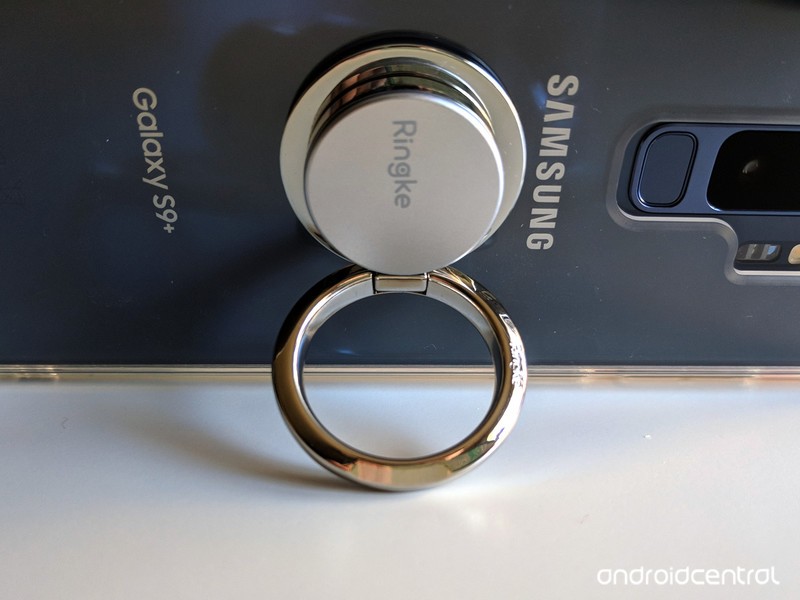
A $10 phone grip versus a lifetime of nerve pain is the easiest tech decision I ever made.
I am a 27-year-old writer and newscast director, and since the tender age of 14, I’ve spent most of my waking non-school, non-sleep hours on a computer. I use a lot of Photoshop, custom hotkeys on my station computers with ENPS and Edius, and there’s an almost constant stream of Ctrl + T/R/N/W/E/S/C/V/A/etc that I use while writing, formatting, creating, or just browsing the web in free time I don’t really have. I’m also not a huge CAPS LOCK fan, so I use Shift for capitalizing names, acronyms, and adding important #HashtagOverload to my posts online.
In short, my pinkies hate me, and they’re the first and only reason I need for using a phone grip like a PopSocket or Spigen Style Ring.
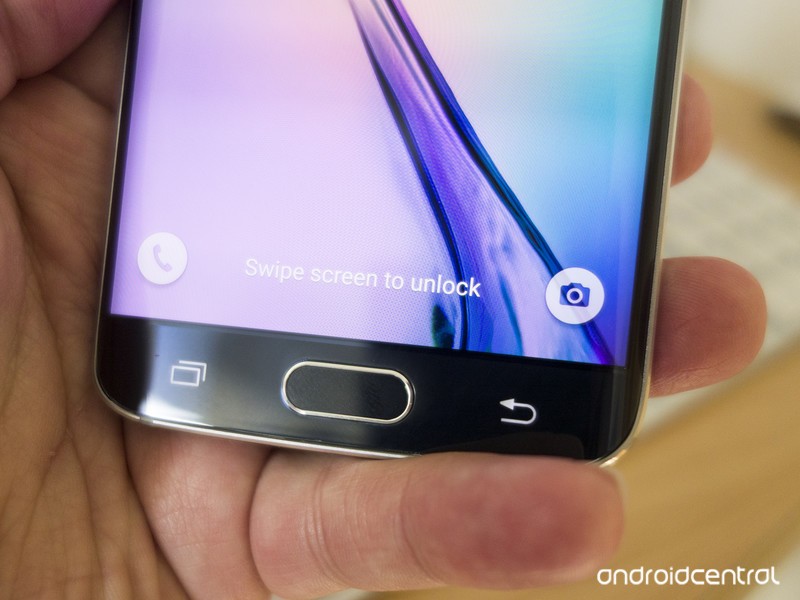 Pinky propping is a problem, and a bad habit many of us have had for years.
Since my Samsung Blackjack days, I’ve propped up my phone up in my hand with my pinky under it for stability, and I’m not alone. Even though the Samsung Galaxy S9+ I’m using these days is far larger and heavier than that Windows Mobile throwback, my pinky still gravitates to the bottom of the phone. And then painfully informs me of its displeasure.
As someone who uses computers a lot, I’d heard of carpal tunnel. BlackBerry Thumb and Nintendinitus are just two of the many, many joking names devloped for De Quervain syndrome over the years, and so long as there has been a workforce with repetitive tasks, there have been repetitive stress injuries.
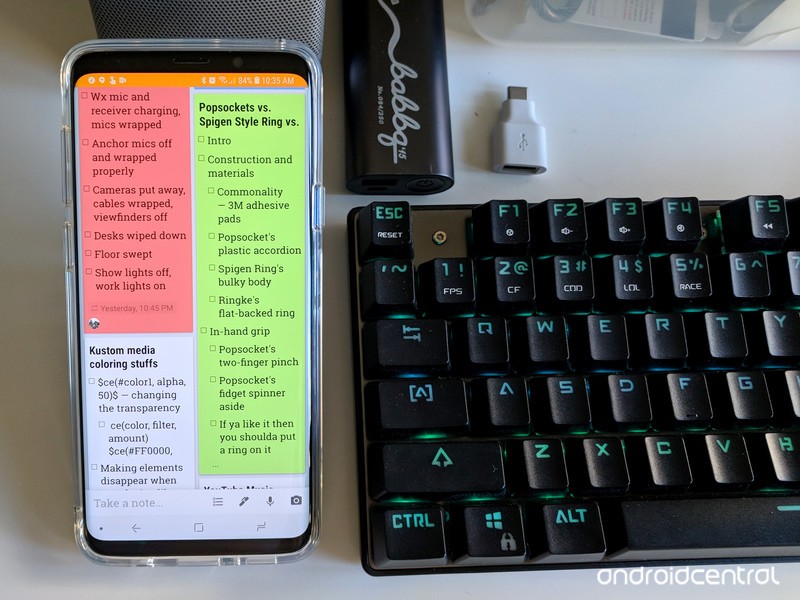
And if you develop a repetitive stress injury, there’s no real “fixing” it. You can ice the affected area and use medication to help you ignore the pain when it flares up, but there’s only one way to completely eliminate it. If you have a repetitive stress injury, the biggest and sometimes only real advice most doctors will give you is to rest and give your muscles a break from the repetitive task.
Whenever there’s a computer around, I generally use the computer over the phone, especially for typing-intensive tasks like writing, email, and social media. When I get to work, my phone largely reverts to a music player, sitting in my shoulder holster and streaming music to my Bluetooth headphones while I prepare for shows and work on special projects. It that helps a little, sometimes, but I still often end a day with my pinky stiff and the joint popping when I try to stretch it out.
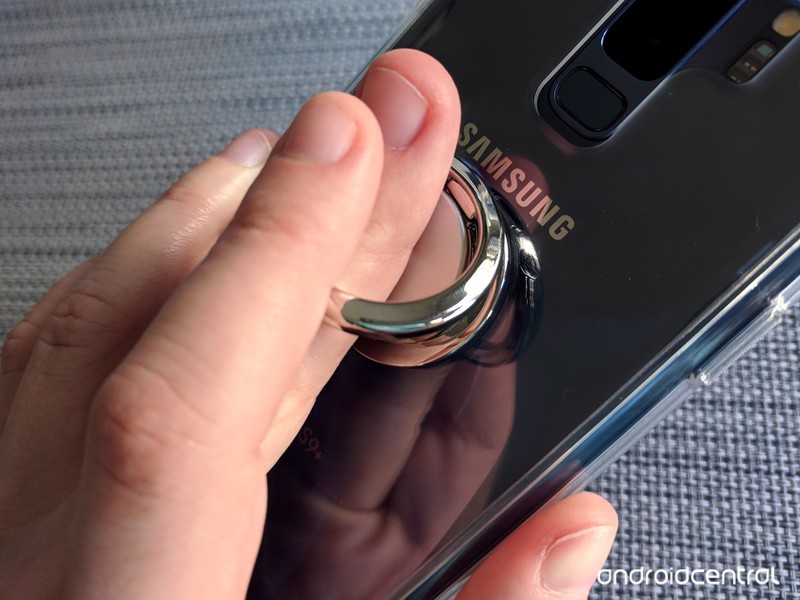
Rest helps a little. Using a phone grip helps a lot.
When I started using a smartphone grip last year, I immedatiately felt a difference. Instead of my pinky straining, and my nerves screaming, at the bottom of my phone, it sits straight and unused flat against the back of my device while my middle finger sits inside the grip’s ring and uses the pointer and ring finger to help keep the grip steady. My thumbs are also happier with the grips, as more of the phone’s screen can be reached without straining — though I’ve also tried to cut down on one-handed phone use when I can, too.
I can go days without my pinky getting intensely angry with me, and on days heavy with data entry and lots of Ctrl commands, my hands will last longer before cramping up. I’ve worn out a number of phone grips in the 15 months since then, but I’m perfectly fine with that.
 Phone grips are replaceable; my fingers are not.
Am I weak for needing a phone grip? Well, I certainly don’t think so. A phone grip that alleviates the strain on my hands is just like an ergonomic office chair or vertical mouse that helps office workers avoid carpal tunnel. A good phone grip is less expensive than an ergonomic keyboard, and certainly less expensive than physical therapy and pain management. Even Google has seen the value in phone grips during major events like Google I/O.
 Even Google uses PopSockets phone grips.
Phone grips can double as kickstands, and they offer a little more drop protection, but really, the only reason anyone needs to use one is that they can help save your hands from often permanent and painful damage.
See at Amazon
Which phone grip is right for you?
Google Assistant can now control DISH Hopper TV receivers

Voice control everything from simple commands to volume.
Google Assistant’s prowess in home control is making another solid step with a new DISH partnership. You can now simply talk to Google Assistant to control your DISH Hopper TV receiver, cutting down on the number of times you have to use (or find) the remote or deal with moving through on-screen menus.
Cutting down on the number of times you reach for the remote is always a good thing.
With a Google Assistant device on the same network as your Hopper box, you’ll be able to do the basics like “Turn on my Hopper,” “Rewind 30 seconds” or “Tune to channel 105,” but that’s kind of a given at this point. What’s really neat is being able to perform more specific actions, like “Record Game of Thrones on Hopper” or “Show me home improvement shows” — things that would normally take several steps with a remote, including typing or browsing through genres. You can also adjust the volume, or launch directly into apps on the Hopper like Netflix and YouTube.
Voice control isn’t going to make sense in all situations, but having it as an option when you want to perform a general search or set a recording is going to save you a lot of time when you’re getting settled in to watch some TV. It obviously also encourages people to keep a Google Home near their TV as well, which has its own benefits — both for you and Google alike.
Introducing CordCutters.com
- The hardware you need
- All about streaming services
- What channels are on which service
- FREE over-the-air TV
- How to watch sports
- Join the discussion
Get the latest deals
Virgin Galactic wants to launch space tourism flights from Italian spaceport
A suborbital space flight service for tourists could be launching from a spaceport in Italy within a couple of years after Virgin Galactic inked an agreement with two of the country’s largest aerospace companies.
The agreement with Italy’s leading private space company SITAEL, and ALTEC, a public-private company owned by both the Italian Space Agency and Thales Alenia Space, outlines plans for a spaceport to be constructed in the province of Grottaglie in the south of the country.
Besides providing launch facilities to take wealthy folks on a once-in-a-lifetime trip to the edge of space, the spaceport will also be used by customers such as the Italian Space Agency as a science platform for high-frequency space research, Virgin Galactic said in a release.
Virgin Group founder Richard Branson said he believes the collaboration will provide “a real impetus as we strive to open space for the benefit of life on Earth … together, we will help to expand opportunities for science, industry, and the millions of people who dream of experiencing space for themselves.”
Virgin Galactic recently completed the second successful rocket-powered test flight of its latest SpaceShipTwo plane called VSS Unity, the two-crew, six-passenger aircraft that will take space tourists on their thrilling trips to a point 62 miles above Earth.
Depending on how the trials progress, Virgin Galactic could launch its first commercial service for tourists from its existing Spaceport America in New Mexico. The company’s CEO, George Whitesides, even teased the idea of “high speed, intercontinental travel” between the American and Italian spaceports at some point in the future.
Virgin Galactic recently said it believes it can begin offering suborbital space trips in the next 12 months. Around 700 people have already booked a seat with the company, with each ticket costing $250,000. Virgin Galactic said the growing list of customers means anyone buying a ticket today will probably have to wait until at least 2021 before they can climb aboard the aircraft.
Blue Origin
Blue Origin, owned by Amazon CEO Jeff Bezos, is also developing technology for a service similar to that of Virgin Galactic, and there’s something of a race going on to see who can launch first.
Blue Origin’s reusable New Shepard rocket has so far completed eight successful test launches since its first one three years ago.
Branson said his team is neck and neck with Bezos’s, but mindful of the disaster that hit Virgin Galactic in 2014 when one of its pilots perished in a failed test flight, the Virgin boss said recently, “Ultimately, we have to do it safely. It’s more a race with ourselves to make sure we have the craft that are safe to put people up there.”
Editors’ Recommendations
- Watch Richard Branson’s Virgin Galactic test its tourist spaceplane
- Virgin Galactic ‘neck and neck’ with Blue Origin in space tourism race
- Blue Origin sends New Shepard space capsule to its highest altitude yet
- NASA reveals its plans to have astronauts orbiting the moon by 2025
- Norway tests its first all-electric plane, hopes for passenger flights by 2025
Next Mavic Pro could offer swappable cameras and safer flight
DroneDJ
When DJI launched the compact Mavic Air drone in January for $800, it seemed like there was no longer a compelling enough reason to splash money on the older, larger, and more expensive Mavic Pro quadcopter.
Well, if DroneDJ‘s sources are to be believed, DJI hasn’t given up on the Pro and has plans to launch the “Mavic 2” with at least a couple of new features that could turn heads.
For starters, an image that sources claim shows the second version of the Mavic Pro appears to reveal a removable gimbal that would allow the owner to use a different camera — perhaps a more advanced one, or one with a different field of view, or both. This could appeal especially to budding filmmakers looking to cut down on the size of their kit for outdoor shoots that require aerial imagery. But take note, the image appears to show another gimbal assembly alongside the drone, suggesting the cameras would be designed by DJI, thereby limiting the choice of camera you could attach to the machine.
The Mavic Pro’s video quality has received mixed reviews, and while we’d expect DJI to launch any follow-up device with an improved camera, giving owners additional options would be a big plus and also set it apart from the Mavic Air, which has a fixed camera.
Another new feature rumored to be coming to the next Mavic Pro are additional sensors that could provide it with 360-degree obstacle avoidance. That’d give the machine greater situational awareness than the Mavic Air, which has sensors on the front, underneath, and rear, and therefore help beginners or risk-takers from flying the drone into a building or some other such obstacle.
We’re currently waiting for details about DJI’s next press event, which may or may not take the wraps off the follow-up to the Mavic Pro. DJI had announced an event for July 18 with the tagline “see the bigger picture,” but it’s since postponed it without offering a new date.
DJI said it’d decided to shift the date so that it could “deliver according to our standard of innovation.” Yes, it sounds rather like it’s hit a snag with its technology and needs to sort it out first.
If and when the next Mavic Pro does see the light of day, we’ll of course be sure to cover it here at Digital Trends.
Editors’ Recommendations
- DJI Mavic Air review
- DJI Mavic Air vs Mavic Pro: Which drone is better?
- Apple’s Touch Bar might be the influence for a future laptop from Asus
- The best drones under $500
- Porsche Design Huawei Mate RS review
School shooters leave clues. Could AI spot the next one before it’s too late?
In the light of recent deadly school shootings in the United States, educators, parents, and security experts are looking to technology to help solve the problem. At the forefront is the use of artificial intelligence.
“Our goal is to make sure a kid never wants to bring a gun to school,” Suzy Loughlin, co-founder and chief council of Firestorm, a crisis management firm, said. Toward that end, in partnership with the University of Alabama School of Continuing Education, the company has developed a prevention program that looks for early warning signs in kids who may be at risk of committing future violent acts.
Dubbed BERTHA, for Behavioral Risk Threat Assessment Program, the idea grew out of the 2007 mass shooting at Virginia Tech when 32 people were murdered — one of the deadliest in U.S. history. The February shooting at the Marjory Stoneman Douglas High School in Parkland, Florida that killed 17 people brought more attention to the issue, underscored again in May, by the Santa Fe High School shooting in Texas where 10 students and teachers were killed.
School shooting victims since 1989, Source: Mother Jones
Incident
Fatalities
Injured
Total Victims
Year
Santa Fe High School shooting (Santa Fe, TX)
10
13
23
2018
Marjory Stoneman Douglas High School shooting (Parkland, Florida)
17
14
31
2018
Umpqua Community College shooting (Roseburg, Oregon)
9
9
18
2015
Marysville-Pilchuck High School shooting (Marysville, Washington)
5
1
6
2014
Isla Vista mass murder (Santa Barbara, California)
6
13
19
2014
Sandy Hook Elementary massacre (Newtown, Connecticut)
27
2
29
2012
Oikos University killings (Oakland, California)
7
3
10
2012
Northern Illinois University shooting (DeKalb, Illinois)
5
21
26
2008
Virginia Tech massacre (Blacksburg, Virginia)
32
23
55
2007
Amish school shooting (Lancaster County, Pennsylvania)
6
5
11
2006
Red Lake massacre (Red Lake, Minnesota)
10
5
15
2005
Columbine High School massacre (Littleton, Colorado)
13
24
37
1999
Thurston High School shooting (Springfield, Oregon)
4
25
29
1998
Westside Middle School killings (Jonesboro, Arkansas)
5
10
15
1998
Lindhurst High School shooting (Olivehurst, California)
4
10
14
1992
University of Iowa shooting (Iowa City, Iowa)
6
1
7
1991
Stockton schoolyard shooting (Stockton, California)
6
29
35
1989
The risk assessment program is conceived of as a safety net to catch children who may need help and intervention before they become suicidal or violent. As demonstrated after each previous incident, administrators, parents, and students wonder why early warning signs — like cyberbullying, allusions to guns, and references to the Columbine High School shooting in Colorado, in 1999 — weren’t noticed earlier.
Using AI to search for clues
The challenge has been the difficulty of sifting through the mountains of data generated in forums and social media accounts to find the few needles that might alert a school counselor or psychologist that a child is in trouble. So, to filter out such clues online, administrators are enlisting artificial intelligence tools.
“Our goal is to make sure a kid never wants to bring a gun to school.”
“We’re the AI component,” explained Mina Lux, the founder and CEO of New York-based Meelo Logic. Her company is working on the BERTHA program with Firestorm to perform the initial heavy lifting of sorting through what has become known as big data. “Our focus is knowledge automation to understand the context.”
Meelo’s software can trace comments and postings back to their original source. The company refers to the process as causal reasoning, but it’s more analogous to finding patient zero, the original individual about whom someone else may have expressed concern.
“Usually, there’s an initial outburst online, and they are purposely making that public — it may be a call for help,” Hart Brown, the COO of Firestorm, explained. “And in 80 percent of the cases, at least one other person knows, so even if the first post is private, someone else is likely to make it public.”
The AI program provides the initial screening, based on slang terms used, context, location, and related links. Then, Firestorm’s BERTHA dashboard flags activity for possible intervention. That’s where people — counselors, teachers, psychologists — step in to assess whether there’s a real threat, whether a child needs extra attention because they’re exhibiting anger or suicidal tendencies, or if the activity is benign.
The challenge has been the difficulty of sifting through the mountains of data generated in forums and social media.
“But no one person is responsible for making the decision,” said Brenda Truelove, a program administrator at the University of Alabama who has been working with Firestorm on the program and an associated e-learning program for educators nationwide. “One person might miss something, so it’s a team of people who decide what to do.”
Truelove noted that the program is based on experience from teachers, forensic psychologists, and other experts to create a formula for dealing with potential crises.
Does increased safety mean less privacy?
While the potential of AI in preventing future school shootings may be promising, such tracking and data analysis raise inevitable concerns about privacy and accuracy, and whether safety overrides any concerns.
Bryce Albert, a ninth-grade student at Marjory Stoneman Douglas High School, was in the third-floor hallway when the shooter started firing at students. As Albert saw the killer coming down the hall, a teacher let Albert into a classroom and he survived. Since that experience, he has had a change of thought about privacy.
Firestorm
“Before, I was like, don’t go into my stuff,” Albert told Digital Trends, about authorities tracking his social media usage. “But now, I’ve totally changed my mind.”
Meelo’s Lux emphasized that the AI programs do not access any private accounts; all the information is public. Firestorm’s Loughlin underscored the fact that they do not collect or store the data themselves. It’s maintained by the individual schools, which already have experience keeping student records. (Firestorm charges a license fee of $2,500 per school, while the University of Alabama offers a free online training course for Alabama K-12 educators. Schools can also work on their own early warning projects for free by using Firestorm’s basic nine-step formula for establishing such programs.)
Lux acknowledges that subtleties of language, such as sarcasm, can prove challenging for any AI research. Meelo focuses on textual analysis, rather than the sort of image analysis other AI companies, like Cortica, study. Still, there’s room for misinterpretation even for human participants.
“It’s hard to get emotion through texting,” Albert acknowledged.
On the other hand, a dispassionate program doesn’t play favorites or ignore the kinds of emotional or behavioral changes that might indicate that trouble is ahead.
AI is still only an initial filter or tool to stop future school shootings.
“Ultimately, it can be more accurate by eliminating as much bias as possible,” Firestorm’s Brown said. An HR person or counselor might minimize a person’s emotional outbursts, for example, saying it happens all the time. The unblinking computer makes no such excuses.
“But it still requires a human touch to follow through, to interview that person,” Brown said. “The computer won’t determine if that person needs to be expelled or needs counseling.”
AI is a tool, not a solution
All of the experts Digital Trends spoke with for this story emphasized the fact that AI is still only an initial filter or tool to stop future school shootings. It can generate alerts about children at risk, but it cannot tell educators how, when, or even if they should intervene. Schools still need their own team of experts — from teachers who know the students to psychologists — and are likely to continue to need them.
“Statistics show that with every school shooting that happens, there’s a higher probability of another school shooting happening,” Lux said.
Ultimately, the human element is the most important factor. “Talk to people and ask for help,” Albert said. “Don’t be afraid to ask for help.”
Editors’ Recommendations
- Crime-predicting A.I. isn’t science fiction. It’s about to roll out in India
- Get smart: The best educational apps for iPhone and Android
- Why a 19-year-old Bitcoin millionaire built a working Dr. Octopus suit
- The best robot kits for kids
- The best Netflix originals
Anker’s discounted charging gear will help keep all your electronics powered up
You can never have too much charging gear.

It’s been a while since we’ve seen one, but Amazon is back today with a one-day sale on Anker’s charging gear. Whether you’re looking for a new cable, car charger, USB hub, or even battery pack, you won’t want to miss out on this. You can grab a 3-pack of USB-C cables for $10.98 or a 10-foot PowerLine+ Lightning cable for just $12.59. Anker’s PowerLine series of cables are designed to be insanely durable and last for a long time, so if you’re harsh on your cables, these are the ones you will want.
To help keep your stuff charged, Anker has its 5-port USB hub with USB-C connector on sale for $24.74, its wireless charging pad with 12W wall charger for $12.59, and a 30W car charger with Quick Charge 3.0 for $15.99.
If you need portable power, this pocket-sized 5000mAh external battery is available for $13.99, which is just about the lowest it’s ever sold for. Need more power? This 20100mAh PowerCore II option is down to $39.89 and the 26800mAh PowerCore+ with Power Delivery is $89.99.
Many of these prices are at or near all-time lows for each item, so you won’t want to miss out. These deals are all exclusive to Amazon Prime members, so if you aren’t already a member, you’ll want to sign up for a free 30-day trial right now.
See at Amazon
 AIVAnet