


Apple Music Reportedly Surpasses Spotify Subscriber Count in the U.S.
Apple Music has now surpassed Spotify’s subscriber count in the United States, according to an industry source who spoke to Digital Music News.
The anonymous source, said to be a major U.S.-based distributor, is said to have shared a report with the website detailing the subscriber tallies of several streaming music services, including Apple Music, Spotify, Tidal, and Sirius XM.
Among primarily on-demand music streaming services, the report says both Apple Music and Spotify have more than 20 million subscribers in the U.S., with Apple now “a hair ahead” with “20 million plus” members. The exact figure was reportedly withheld on request of the source to protect confidentiality.
In February, The Wall Street Journal reported that Apple was gaining U.S. subscribers at a higher rate than Spotify. Apple’s US-based subscriber growth rate was believed to be 5 percent in the U.S., compared to Spotify’s 2 percent. Based on those figures, the report predicted Apple Music would surpass its biggest rival in the summer.
Apple’s growth was said to be due in part by the increasing numbers of devices in consumers’ hands. Since the WSJ report, Apple has also released its HomePod speaker, which includes features specific to Apple Music.
Apple’s service recently surpassed its single-day streaming record, with Drake’s fifth album, Scorpion, notching up over 170 million streams in its first 24 hours of availability. Spotify was unable to keep up with its rival’s streaming figures for the album, despite Apple Music having around 120 million fewer subscribers than Spotify, suggesting Apple won via stronger user engagement.
In May, Apple CEO Tim Cook said Apple Music had over 50 million users worldwide on either paid subscriptions or free trials. However, that figure still put Apple Music some ways off Spotify, which said it had 75 million paying subscribers as of March 31. Spotify has a much larger total of at least 170 million active users due to the free, ad-supported tier that it offers.
Apple Music has been a major contributor to the continued growth of Apple’s services category, which brought in $9.1 billion revenue in the second fiscal quarter of 2018, an increase of 31 percent on a year-over-year basis. Other service-related revenue includes App Store and iTunes Store sales, paid iCloud storage, licensing, and more.
Tag: Apple Music
Discuss this article in our forums
How to Use the New Continuity Camera Feature in macOS Mojave
In macOS Mojave, Apple has extended its Continuity features so that now you can use your iPhone or iPad’s camera to take a photo or scan a document, and it will be immediately available on your Mac.
Continuity Camera works in several native Mac apps, including Pages, Keynote, and TextEdit. The following steps explain how to use it. Bear in mind that both your iOS device and your Mac need to be logged into the same Apple ID for this feature to work.
How to Add a Photo Using Continuity Camera
Launch the app that you want to import a photo into.
Open an existing project or document, or create a new one.
Right-click (or Ctrl-click) the location where you want to insert the photo.
In the contextual menu, click Take Photo under the name of the iOS device that you want to use.
Take the photo on your iPhone or iPad.
Tap Use Photo on your iOS device, and the image will appear in the open project or document on your Mac.
How to Scan a Document Using Continuity Camera
Launch the app you want to use and open a project or document, or create a new one.
Right-click (or Ctrl-click) the space where you want to insert the captured document.
In the contextual menu, click Scan Document under the name of the iOS device that you want to use.
Using your iPhone or iPad’s camera, frame the document in the onscreen viewfinder. The document should turn yellow and scan automatically. You can repeat this step to scan several documents if desired.
Tap Save on your iOS device, and your scanned documents will be inserted into the open project or document on your Mac.
Related Roundup: macOS Mojave
Discuss this article in our forums
Samsung forecasts dip in Q2 2018 profits following weak smartphone sales
Samsung is still making boatloads of money, but profits don’t quite match up to previous quarters.

Samsung announced record earnings for four straight quarters, but that streak is about to come to an end. In its Q2 2018 earnings guidance, Samsung is forecasting an operating profit of $13.2 billion (14.8 trillion won), up 5% from the same period a year ago.
Overall revenue at $51.7 billion (58 trillion won) is less than the $54.8 billion the company raked in last year. To put things into context, Samsung made a profit of $14.6 billion on revenues of $56.5 billion last quarter.
As noted by The Wall Street Journal, Samsung’s profits over the course of the last year were bouyed by strong perfromance by the manufacturer’s semiconductor division, which overtook Intel last year. Samsung may not be able to maintain its edge in this category, however, as NAND and DRAM module prices are expected to fall by up to 15%.
Slow sales of the Galaxy S9 series is attributed as a reason for the decline in revenue, with the company estimated to ship 31 million units this year. To compound matters, it looks like Apple is siding with LG as the display vendor for the upcoming iPhone to reduce its reliance on Samsung, and that has a potential to hurt Samsung’s display business.
Samsung Galaxy S9 and S9+
- Galaxy S9 and S9+: Everything you need to know!
- Galaxy S9 review: A great phone for the masses
- Complete Galaxy S9 and S9+ specs
- Galaxy S9 vs. Galaxy S8: Should you upgrade?
- Join our Galaxy S9 forums
Verizon
AT&T
T-Mobile
Sprint
Microsoft ‘Movies & TV’ App Reportedly Coming to iOS
Microsoft may be working to bring its Windows-based Movies & TV app to iOS devices, according to Windows Central.
The app lets users browse and play movies and TV shows purchased from Microsoft’s Store, but it’s only available on Windows 10, Xbox, and Windows 10 Mobile, and Microsoft is apparently eager to bring it over to rival platforms to give consumers more of a reason to buy from its catalog of video content.
While most people have moved over to streaming content via services like Netflix, there is still a whole lot of content that isn’t immediately, or ever, available to stream. Lots of people buy digital movies and TV content, and Microsoft has a huge store that a lot of people seemingly ignore or don’t know about because there is no mobile companion app for their phone.
But it appears Microsoft is now finally working on bringing its Movies & TV service to iOS or Android, according to sources familiar with the matter.
Microsoft killed off its Groove Music streaming service last year, which led many to assume the same fate would befall its Movies & TV service.
However, since the death of Windows 10 mobile in October, Microsoft has seen fit to bring over some popular apps like Edge and Windows Launcher to iOS and Android, and it looks as if the company counts Movies & TV in that select list.
That said, sources told Windows Central not to expect the iOS and Android version of Movies & TV anytime soon, since the app is still a work in progress.
Tag: Microsoft
Discuss this article in our forums
Apple is reportedly ditching Intel for 5G chips in the iPhone
The likes of Intel and Qualcomm may well be locked in a battle over next-gen communications chips, which will help phones connect to futuristic 5G networks in the future. And the biggest of those contracts, at least when it comes to consumer devices, has to be the iPhone. We can now rule out one major player in the race to supply the world with 5G chips — Apple has reportedly notified Intel that it will not be using its modems for 2020 iPhone models. The news was first reported by Calcalist.
The fact that Apple has notified Intel that it won’t be using its chips may have wide implications for Intel. As a result of the decision, Intel has reportedly halted development on a modem internally known as “Sunny Peak,” and the team working on the modem redirected to other Intel efforts. Reports note that Intel expected Apple to be the main customer for these new modems.
All hope may not be lost for Intel. The company is reportedly now focusing on improving its product in an attempt to win Apple back for the 2022 iPhone lineup.
The news isn’t completely surprising. In June, Bloomberg reported that Apple was looking to move away from Intel chips, instead turning to MediaTek for its communications components. On top of that, there have been plenty of reports indicating that Apple was looking to move away from using Intel processors altogether by 2020 — which lines up with this new report.
Of course, until 2020, Intel’s modem business may be better than ever. Apple has also been trying to reduce its dependence on Qualcomm chips, and because of that has moved to using Intel components in modern iPhones. That is likely because of the ongoing legal troubles between the two companies, which are expected to last for some time.
It will be interesting to see what Apple does do come 2020. While it may completely turn to MediaTek for internal components, it may also improve its relationship with Qualcomm, or perhaps it’s hoping to instead use its own tech, which would help give it more control over the iPhone and how much an iPhone costs to make.
Editors’ Recommendations
- AT&T brings ‘5G Evolution’ to more than 100 new markets
- Apple vs. Qualcomm: Everything you need to know
- Is Apple poaching Intel talent from a new hush-hush facility in Oregon?
- Apple iPhone X Plus: News, rumors, specs, and more
Cryptocurrency may be why you still don’t have Nvidia GTX 11 Series graphics
Unnamed sources in the supply chain point to the current overabundance of add-in desktop graphics cards as to why you’re not already seeing Nvidia’s new GeForce GTX 11 Series on store shelves. Nvidia reportedly has around 1 million chips ready for release but is holding back because there is simply no room for the next-generation cards. This is why Nvidia CEO Jensen Huang said in June that the launch would be “a long time from now.”
The problem stems from cryptocurrency. Throughout 2017, as values climbed through the roof, miners scooped up every graphics card they could find, leaving store shelves barren. The few cards you could find on the internet suffered crazy overinflated prices due to sellers taking advantage of the product void. To meet the rising demand in the cryptocurrency and gaming markets, Nvidia and its partners created more cards.
But then in 2018 cryptocurrency prices tanked. Individuals and small organizations closed shop while the larger miners cut back on their purchases including the ASIC systems designed specifically for cryptocurrency mining. With all that digital coin digging slowing to a crawl, the market currently has“around several million units” collecting dust on store shelves.
To make room for new GTX 11 Series products, graphics card prices may be reduced 20 percent starting in July. Prices presented by retailers may get even lower once cryptocurrency miners begin selling their used equipment at dirt-cheap prices. The current overflow likely affects the revenue of every party involved including Nvidia, its partners, the company that actually manufactures the chips (TSMC) and more.
China’s Sichuan province could help with the overstocking issue. This region accounts for nearly 70 percent of China’s mining operations, which recently faced severe flooding that damaged many of its cryptocurrency mining operations. These operators will be looking to replace their damaged hardware including whatever Nvidia-based graphics cards they had installed.
Despite the inventory issue, Nvidia’s GTX 11 Series may still get an introduction during Gamescom in August. Nvidia is sending individuals in the press out to the convention in Germany, meaning the company likely isn’t spending that kind of money just to showcase PC games running on current hardware. There is no reason why Nvidia couldn’t reveal the series at that time if the company has the hardware ready. But a retail release could reside in the fourth quarter, depending on the current-generation stockpile.
Most of the “Turning” GPUs Nvidia reportedly has locked and loaded will ship out to third-party manufacturers while the company will reserve a batch for its own first-party “Founders Edition” cards. Previous reports said Nvidia’s partners would receive the chips by the end of August or early September, putting product availability between weeks or several months thereafter. Mass production of Micron’s GDDR6 graphics memory didn’t even begin until June.
The GTX 11 Series will include both desktop and mobile products later this year, including the GTX 1180 add-in card and the GTX 1160 6GB chip for notebooks.
Editors’ Recommendations
- Nvidia may release the GTX 1180 Founders Edition in July
- Nvidia saw a revenue spike from sales of graphics cards to crypto miners
- Nvidia could debut GTX 11 Series graphics cards during Gamescom
- Nvidia graphics cards may be back in stock, but they’re disappearing quick
- Nvidia’s GTX 11 Series may get people ready for the next generation of VR
Cheap Android phones are selling user data in developing countries
Data is collected and sold through the guise of a firmware update app.
User data and the privacy surrounding it has been a particularly hot topic this year, and while there’s been plenty of talk regarding it in the U.S., a new light is being shown onto this matter in developing countries.

According to a report from The Wall Street Journal, an Android phone called the Singtech P10 that’s sold in Myanmar and Cambodia actively collects various bits of information from users of the phone and sells it to an advertising company called General Mobile Corp. (aka GMobi) in Taiwan.
Per The Wall Street Journal:
Taipei-based GMobi, with a subsidiary in Shanghai, says it uses the data to show targeted ads on the devices. It also sometimes shares the data with device makers to help them learn more about their customers.
As for what kind of data is being shared, it’s reported that the GMobi app gathers IMEI numbers, MAC addresses, and even location data that’s then sent off to GMobi servers over in Singapore.
Per Mark Groman, former Senior Privacy Adviser at the White House Office of Management and Budget:
They are exploiting developing economies and individuals who can’t afford better devices and clearly tracking them.
As WSJ continues:
Many popular smartphone apps collect user data such as contacts and even locations, but users typically install such apps, actively consent to the data collection and can delete the apps at any time. GMobi’s software comes pre-installed on new smartphones out of the box, and it can only be removed by taking elaborate technical steps.
GMobi’s website lists that it works with Huawei, Xiaomi, and BLU, but all three companies told The Wall Street Journal that they have never worked with the company (BLU did have a relationship with GMobi competitor Adups but has since terminated it).
There are certainly improvements we can make in the U.S. and other developed parts of the world when it comes to the way data is handled, but at the very least, we don’t have to deal with this sort of madness on a daily basis.
Best Cheap Android Phones in 2018
How to Access Controls for USB Restricted Mode in iOS 12
iOS 12 includes a new feature called USB Restricted Mode, which is designed to make your iPhone and iPad immune to certain hacking techniques used by law enforcement and other potentially malicious entities to gain access to an iOS device.
There are some iPhone access methods that use a USB connection, downloading data from your iPhone (or iPad) through the Lightning connector to crack the passcode.
iOS 12 prevents this by disabling data access to the Lightning port if it’s been more than an hour since your iOS device was last unlocked.
This feature is enabled by default, but there are some situations where you might want to turn it off, such as when using CarPlay to drive long distances when you might not be able to unlock your iPhone for a few hours. Here’s how to access the setting:
Open the Settings app.
Choose Touch ID & Passcode or Face ID & Passcode, depending on the device.
Enter your passcode to access the settings. 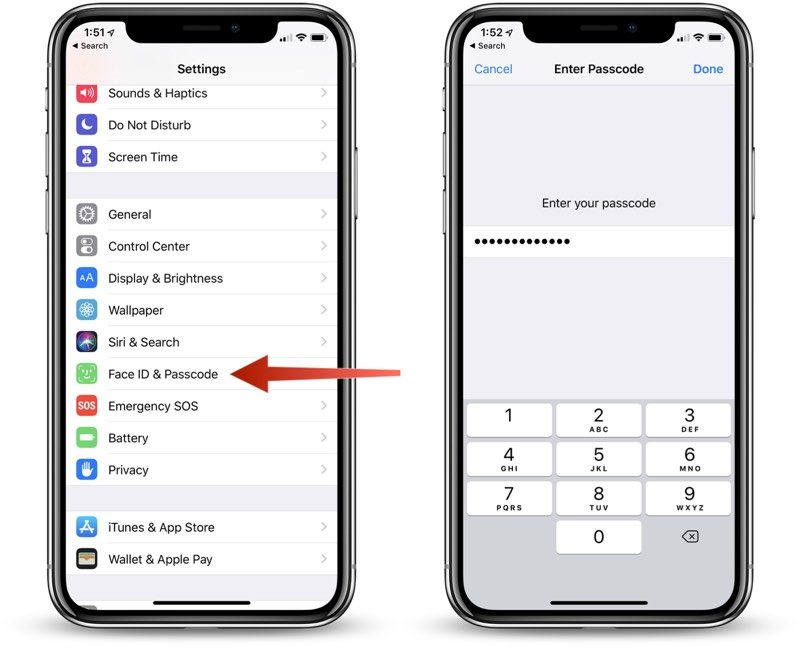
Scroll down to the bottom of the app where it says “USB Accessories.”
Leave it toggled off to disable access to your iOS device if you want it to refuse USB connections if it’s been more than an hour since the iPhone or iPad was unlocked.
Toggle it on if you want USB accessories to be able to connect even if it’s been more than an hour since the iPhone or iPad was unlocked. 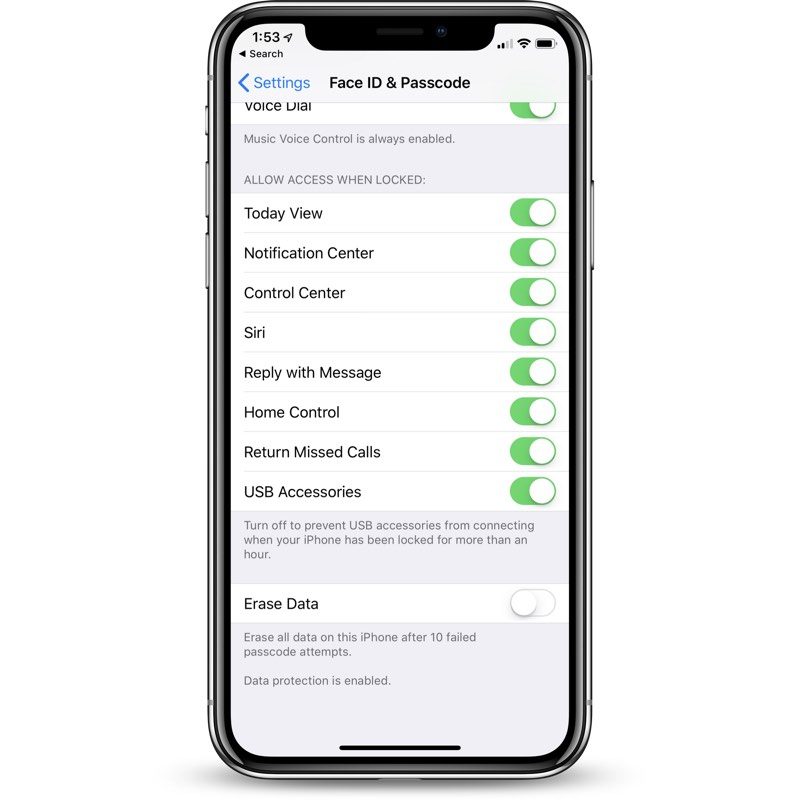 Most people are going to want to leave this toggle in its default off position for extra protection.
In normal usage, most of us unlock our iPhones every hour or two, and if you do need to plug your iPhone or iPad into a computer to access it, you can just enter your passcode to allow data access if it’s been over an hour since the iPhone was last unlocked.
Right now, in the iOS 12 beta, these USB restrictions do appear to shut down access to a wired CarPlay interface after an hour, so that’s one exception where people might want to turn this setting on to disable the restrictions on the USB port. From the iOS 12 beta notes:
“If you use iPod Accessory Protocol (iAP) USB accessories over the Lightning connector (such as CarPlay, assistive devices, charging accessories, or storage carts) or you connect to a Mac or PC you might need to unlock your device to recognize the accessory.”
Note: Even if data access to USB port has been disabled because it’s been over an hour since an iPhone was last unlocked, it continues to be able to charge through a standard Lightning cable because the power connection is not disabled.
Related Roundup: iOS 12
Discuss this article in our forums
Tesla Powerwalls keep Vermonters comfortable and safe during heat wave
As the summer heat wave drags on, nearly 500 Vermont homes with Tesla Powerwall batteries are staying cool, reports VermontBiz. The state’s Green Mountain Power (GMP) electric company stored-solar-power project is paying off for the utility company and its customers.
GMP launched the Powerwall program in 2015. The goal is to install the energy storage devices in 2,000 homes, according to Electrek. Residential Powerwall installations started slowly, with approximately 220 installed by April, GMP told Electrek at the time. GMP also noted in April that the demand for Powerwalls was building, with 1,200 homeowners interested in the heavily subsidized units.
Additional home energy storage examples
Tesla home battery packs in Canada
Tesla home Powerwalls sell out quickly
Tesla announced Home Powerwall energy storage
Normally it costs about $7,000 for a residential Powerwall installation. GMP subsidizes the program with two options. Customers can pay $15 a month or a $1,500 one-time charge. The huge discounts work for GMP, however. Part of the deal is that customers allow GMP to treat the Powerwall units as “virtual power plants” to access stored energy for the grid.
The current installed base also means GMP has potential 5,000 kWh of stored energy to access during periods of peak demand.
The residential Powerwalls are charged by homeowners’ on solar panel arrays or by conventional power loaded when demand is low. According to Green Mountain Power, the utilities conventional power sources are 90 percent carbon-free — so any argument that the company burns dirty fuel to charge the batteries is not valid.
GMP’s “green power” sources include solar farms, wind power, hydroelectric plants, and cow manure. The Cow Power program currently consists of 14 farms with approximately 13,500 cows. By burning the methane waste from cows, GMP cuts carbon emissions and produces power. The program powers 3,200 Vermont homes with the equivalent of 8.2 million gallons of gasoline by burning 73,000 tons of methane each year.
With almost 500 Powerwalls in Vermont homes, the comfort and safety factors of backup power during the prolonged summer heat, it’s a good bet GMP customers will sign up for the remaining units.
“We know our customers are environmentally conscious and make smart choices about their energy use every day. In this heat wave, our customers’ safety and comfort is key. We are so glad to be able to leverage innovation like battery storage to bring down costs for customers and keep them comfortable and safe,” Josh Castonguay, vice president and chief innovation officer at GMP, said in a statement. “Our growing network of stored energy is allowing us to use technology, in partnership with our customers, to deliver innovative solutions today.”
Editors’ Recommendations
- Samsung has made a very big promise for 2020, and it’s not for the Galaxy S12
- California prepares to lead the nation in solar-equipped housing
- World’s largest battery on a desert solar farm would triple Tesla’s record
- Google Assistant grows hookup list to over 5K smart home devices, appliances
- PG&E applies to build Tesla’s largest battery farm yet in Silicon Valley
A.I. players master ‘Quake III Arena,’ manage to outperform humans
Those among us who fear that we’ve already passed the point of no return when it comes to artificial intelligence becoming self-aware and plotting to murder the human race will likely cite A.I. research company DeepMind’s latest experiment as further proof of that notion. Using Id Software’s Quake III Arena, DeepMind has managed to train artificial players to be even more effective than their human counterparts.
The challenge for DeepMind was not to see if its A.I. agents could defeat human players in battle, but rather if they could work together on procedurally generated levels to complete an objective — in this case, capture the flag.
Because the levels’ structure changes each time they play, the agents are unable to simply memorize locations in order to make it to the flag. This forced them to actually learn the strategies needed to win in a similar manner to how human players might improve at the game. The agents even used an emulated game controller to control their characters in Quake III Arena.
“The agents are never told anything about the rules of the game, yet learn about fundamental game concepts and effectively develop an intuition for capture the flag,” DeepMind said in a blog post. “In fact, we can find particular neurons that code directly for some of the most important game states, such as a neuron that activates when the agent’s flag is taken, or a neuron that activates when an agent’s team is holding the flag.”
As the A.I. agents won matches, the behavior they used to do so was reinforced and these agents were paired up with human players to impressive results. Eventually, DeepMind held a Quake III Arena tournament, and not only did these A.I. agents have a higher success rate than humans, they were also rated as “more collaborative” in a post-tournament survey. Unfortunately, just like with so many children on Xbox Live, the A.I. agents also learned to “camp.” Maybe it is a legitimate strategy.
You can watch a full deep-dive video on the Quake III Arena project above. Visual settings have been greatly reduced, as the A.I. don’t actually care how their game looks.
Editors’ Recommendations
- Can’t get enough of ‘Doom’? A.I. can generate an infinite number of new levels
- Machine learning? Neural networks? Here’s your guide to the many flavors of A.I.
- Microsoft wants artificial intelligence to catch cheaters on Xbox Live
- What is an artificial neural network? Here’s everything you need to know
- This chessboard isn’t haunted, it just moves the pieces on its own
 AIVAnet