


macOS 10.14 Mojave Removes Software Update Mechanism From the Mac App Store and Returns it to System Preferences
As the dust settles on Apple’s macOS 10.14 Mojave announcement at WWDC on Monday, developers are already busy digging into the beta version that Apple made available to download shortly after the keynote for testing purposes.
Among other headlining features, Apple is introducing a new redesigned Mac App Store with MacOS Mojave, and as part of the change, it looks as if Apple has decided to stop delivering system software updates via the Mac App Store’s Updates tab.
Instead, Apple has moved the system update mechanism to System Preferences, and in doing so has re-introduced the Software Update preference pane of old. The re-instated pane, which was discovered by a Reddit user, includes Advanced options previously found in the old Mac App Store preference pane, which it replaces.
The change will likely be warmly received by Mac owners, as it means they will no longer have to open the Mac App Store to check for and download system updates, which has been criticized for being a slow and clunky affair in current versions of macOS. As expected, the Mac App Store will continue to be the delivery mechanism for individual app updates, the section for which can be accessed via a new sidebar.

macOS Mojave is limited to registered developers at this time, but later in the summer, Apple plans to make a public macOS High Sierra beta available, giving public beta testers a chance to try the software before it sees a public launch in the fall.
Apple likes to focus on tentpole features when it unveils a new operating system, but there are always lots of small tweaks and improvements that gradually come to light in the days and weeks after the WWDC keynote. Stay tuned to MacRumors for upcoming coverage of all the little things new to macOS Mojave and iOS 12.
Related Roundup: macOS Mojave
Discuss this article in our forums
9 Ways Drone Technology Revolutionizes Realty Imagery
9 Ways in Which Drone Technology Revolutionizes Real Estate Imagery
A good picture speaks louder and clearer than a thousand words. In real estate, the eye plays a cardinal role in buying decisions. The reason is that people buy things that please their eyes. This means that excellent images, whether still or motion, are significant in influencing buyers’ final decisions. But how do you get such images that will have a compelling impact that will swing a prospect’s mind in favor of a piece of property? The answers to this question bring drone filming and photographing technology into view.
In the remaining sections of this post, we will examine how drone technology is revolutionizing the real estate industry. Just like all other industries, real estate is also embracing drone technology to capture crispy and spicy photos and videos to show prospects. With drones, real estate agents can give potential buyers and renters a 3D view of properties and their environments. For instance, a drone film can give prospects a better view of the location and culture of its inhabitants. That is why research shows that more than 70% of homebuyers watch video tours. The remaining sections of this post will explore more details regarding this technology and its impact on real estate imagery. Remain with our uk essay experts to discover how this disruptive technology is changing the landscape of this critical industry.
H2: What Studies Are Telling Us
According to a study NAR conducted, it is clear that real estate prospects are most likely to prefer drone-shot photos. The reason is that most of these buyers depend on visual marketing to make buying or leasing decisions. Here are some of the figures the studies give us.
- 86% of home buyers utilize video footages to get a clue of the environment they will live in.
- 54% of potential buyers prefer watching videos to get all the details they want about a home on sale.
- 44% of homebuyers utilize videos when comparing and contrasting different homes on offer.
- Another 38% of them utilize films to learn more about the specific features of the houses they intend to buy or rent.
With these trends among buyers and renters, the need for quality videos and photos cannot be overemphasized.
Enhanced Buyer Experience
Our generation is different from that of our parents. In our day, time has become one of the scarcest commodities. Therefore, most people no longer have the time to go and view houses they intend to rent or buy. This means they need something that will give them a full view of their prospective new homes without going there. With tech, realtors can send drone videos and photos to prospects’ smartphones to watch at their own free time and convenience.
Enhanced Convenience for Realtors
To real estate agents, the ability to shoot clear airborne videos and photos offers them unrivalled convenience. For instance, they can spend the time they were supposed to drive prospects to sites doing other things. The reason is that the smartphone does all the work because they only need to email or WhatsApp the video clips or photos.
Better Land Survey
Another way drone technology is revolutionizing real estate is enhanced land surveying. For estate developers, they need to survey their locations thoroughly before investing their money. This way, they can get the real potential and value of the land they want to construct on. But with drone tech in place and use, they can get all the details and know if the property has serious defects that could require a change of mind.
A Better View of Reality
Since real estate decisions are visual, it is necessary to give potential buyers and leasers a clear view of the property they intend to inhabit. For instance, a drone will give the prospect a distinct footage of how the property looks like on the ground level, the sides, and the roof. Moreover, the footages can give prospective buyers an aerial view of the environment they will live in. For example, they can see how the neighborhood looks like, the kind of facilities that surround it, and its road network.
Ease of Sharing Across Different Platforms
Since visuals sit at the center of all marketing activities, drone-shot pictures and videos are critical in enhancing such marketing processes. In the age of online marketing, agents can use these videos and photos across different online and offline platforms. For instance, they can utilize and integrate them into their social media marketing platforms such as Twitter, Facebook, Instagram, LinkedIn, YouTube, and Pinterest. They can also integrate them into their landing pages, and blogs to engage visitors.
Greater Precision
Excellent marketing means getting things right, even if it may not be on the first attempt. Using drone, you can be sure of getting more excellent videos and photos with higher resolution. For instance, modern drones allow you to use programs to calculate the best angles from which you can shoot your clips and snaps. This means you give your prospective customers a better view than when using traditional methods.
Greater Safety
Another way through which drone video and photo tech is redefining real estate is enhanced safety. With these tools, you can get accurate information regarding high-altitude installations without exposing anyone to danger.
Greater Quality for Less Money
Moreover, it is cheaper to buy or rent a drone for better aerial views than it is to rent a helicopter. For instance, you could pay hundreds or even thousands of dollars to rent a helicopter per day. However, with as little as $2,000, you can buy your own professional drone and get better quality shots.
Creating the Buzz
Lastly, you can use these tools to create the much-needed “tech-savvy buzz and aura” around your business. The reason is that they are still trendy, and they can elevate your company’s tech-savvy profile in the minds of your customers.
So far, we have spilled all the beans we needed to in this discourse. We hope you are now up to date with how this technology is revolutionizing real estate imagery.
Parkinson’s is hard to detect early, but this ingenious mobile app can help
Progressive neurodegenerative brain disorder Parkinson’s disease (PD) can be tough to spot early on. A failure to do so can mean that patients miss out on valuable time during which they could get treatment or have the opportunity to make lifestyle changes. That’s something an EU-funded project called i-Prognosis wants to change. A four-year project led by Greece’s Aristotle University of Thessaloniki, it has launched a smartphone and smartwatch app which could help diagnose onset Parkinson’s much earlier than is currently the case.
“PD is a progressive and chronic neurological disease that often begins with mild symptoms that advance gradually over time,” Professor Leontios Hadjileontiadis, coordinator of the project, told Digital Trends. “Symptoms can be so subtle in the early stages that they go unnoticed, as there are no PD-related biomarkers, such as blood tests, and findings on routine magnetic resonance imaging and computed tomography scans are unremarkable — leaving the disease undiagnosed for years.”
It is here that i-Prognosis aims to help, thanks to the various sensors found in modern mobile devices and some amazing insights from machine learning.
“i-Prognosis proposes a radically novel approach to capture the risk of transition from healthy status towards PD by unobtrusive behavioral sensing and large scale collection of elderlies’ data, acquired from their natural use of smart devices,” Hadjileontiadis continued.
Once a user’s consent has been gathered, the app proceeds to analyze an extraordinary amount of data on their phone. This includes (but isn’t limited to) their voice characteristics while having conversations, the steadiness of their hands while holding their device, the way they enter keystrokes, and even their facial expressions on stored photos or the emotional content of text messages. In other words, it combs through every inch of data in a way that no doctor would be able to, and uses this to predict whether you might want to see a physician. This level of detail probably doesn’t make it an app for the more privacy conscious of people, but if it is able to successfully make you aware of onset Parkinson’s the trade-off may be worth it.
For now, the app is firmly in the testing phase. Hadjileontiadis said that the models will continued to be refined through February 2020. At present, it is available in the Google Play app store for Android users, although only in Germany, Greece, Portugal, and the United Kingdom. Hopefully, a U.S. version — and possible iOS support — could follow at a later date.
ASUS unveils blood pressure-reading VivoWatch BP
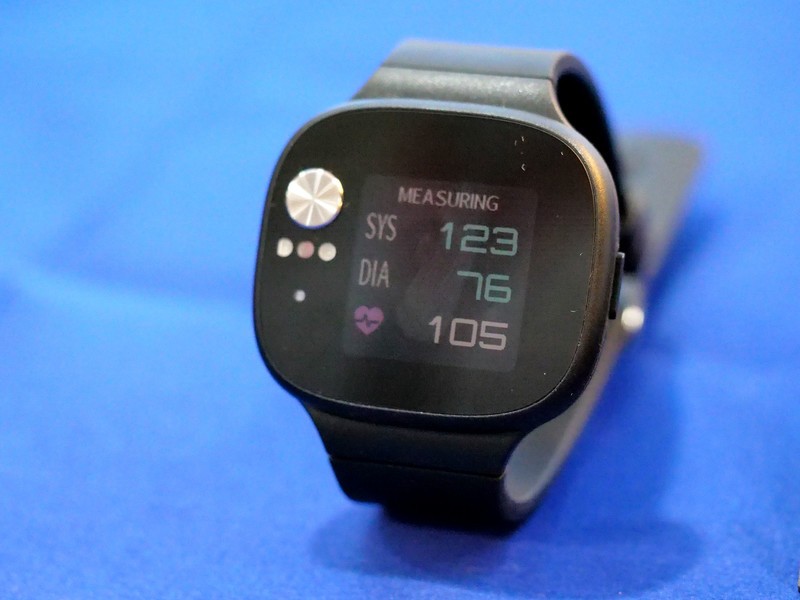
ASUS sticks it to hypertension at Computex 2018.
Today at Computex 2018 in Taipei, ASUS has unveiled a new health-focused wearable designed to accurately measuring and tracking blood pressure. In a break from the general-purpose smartwatch focus of the ZenWatch series, the new VivoWatch BP can last for 28 days between charges, and is instead intended to help the 20 percent of all adults who suffer from hypertension.
The device includes grade ECG (electrocardiography) and PPG (optical) sensors in a metal nub on its front face, with the former collecting raw electrical data from the user’s heart, and the latter measuring their pulse. By combining ECG with PPG sensors on the front and back, ASUS says an accurate blood pressure reading can be taken in just 15 seconds, as the user holds a finger on the front-facing metal disk.
ASUS’s wearables strategy shifts away from traditional smartwatches.
The whole package is significantly smaller and lighter than even the most portable of traditional blood pressure monitors, including the relatively small Vital Moto Mod we saw back at CES in January. The VivoWatch is also a general health tracker, measuring activity, sleep quality, heart rate and stress levels.
All this data can then be fed into ASUS’s Health AI software on the user’s phone, which the company says can help people meet their health goals, and provide doctors with more complete data than would be possible with periodic check-ups in a clinic.
ASUS didn’t comment on any traditional smartwatch features, such as notification mirroring, in the VivoWatch, but it’s clear that’s not the real focus of this product. This is a health accessory first and foremost, as evidenced by the relatively plain design that’s clearly not intended to compete with more fashion-forward wearables like the Apple Watch.
The manufacturer hasn’t given us pricing or availability details for its new wearable, but we’d expect it to be priced in line with other mid-tier fitness watches.
Drone-delivered meals come to Shanghai, but they’re dropped off by … a human?
Ele.me
Drone-delivered meals is now a thing in Shanghai with a new service launching in recent days on the outskirts of the Chinese city.
Hungry folks living and working in Shanghai’s Jinshan Industrial Park can now fire up an app, choose their lunch or dinner, and have it delivered by … a human being.
OK, let us explain.
The drone service isn’t door to door. Instead, ele.me — the Alibaba-owned company operating the service — is using the technology to increase delivery speeds by flying meals along 17 pre-defined routes, bypassing busy roads that would ordinarily ensure your meal arrives late as well as cold. The industrial park covers an area of about 22 square miles ( 58 square km) and ele.me claims it can deliver meals within just 20 minutes of being ordered, the South China Morning Post reports.
It works like this: You use the app to select a meal from one of 100 food outlets in the area. When the meal is ready, a delivery rider collects it and takes it a short distance to the nearest drone station. The drone carries the meal to the drone station nearest to your location. Another delivery rider takes the food to your door.
Ele.me said at a launch event that the drone service will reduce its operating costs by a significant amount compared to regular road-based delivery, adding that it has the potential to boost the income of its delivery personnel by as much as a factor of five.
With a growing number of delivery companies grappling to find a workable drone platform that’s both safe and efficient, ele.me’s solution seems to fit the bill. With regulatory bodies worried about chaos in the skies, flying drones along fixed routes to drone stations seems like a logical approach until an effective drone air traffic control system can be devised, especially for urban areas. Other companies, Airbus among them, are looking at similar setups for package delivery by drone. Another bonus is that the system should prevent the rapid offloading of delivery personnel.
Ele.me, meanwhile, clearly sees technology as vital to its future success. Last year, it unveiled a food-delivery robot for so-called last mile deliveries inside office buildings. Chief operating officer Kang Jia said this week that his company is looking to introduce its second-generation food delivery robots, which will cover more than 500 office buildings in major Chinese cities, later this year.
Editors’ Recommendations
- World’s fastest ever delivery drone could deliver medical supplies in U.S.
- DoorDash is helping Walmart to take on Amazon and Whole Foods
- Volkswagen tests autonomous parking, aims for 2020 commercial launch
- SideChef and AmazonFresh partner to deliver your grocery list
- Walmart makes good on its grocery delivery promise in North Carolina city
Drone to the rescue: Hawaii resident saved from Kilauea’s lava flows
Drones are fast becoming an invaluable tool for emergency response teams engaged in search and rescue operations. On the island of Hawaii, for example, the technology is being used right now to move people out of harm’s way as lava continues to pour from Kilauea volcano.
The U.S. Geological Survey (USGS) this week described how live-streamed video from one of its unmanned aerial vehicles helped guide emergency responders to a resident whose home looked to be on the verge of getting swallowed up by the lava flow. Live footage from the flying machine was then assessed by a remote team so that it could direct the rescue group along the safest escape route.
“[The drone] helps prompt and guide evacuations and led to the successful rescue of a resident after a lava pond outbreak sent a very fast pahoehoe flow” down one of the Big Island’s streets, the USGS said in a Twitter post on Wednesday, May 30.
Footage posted with the tweet (below) shows the actual video captured by the drone, which the rescue team was able to use in real time as they tackled the hazardous conditions.
“Follow the drone to safety.” USGS UAS mission in Kīlauea volcano’s lower East Rift Zone on 5/27/18 helps guide evacuations and leads to the successful rescue of a resident after a lava pond outbreak sends a fast pāhoehoe flow down Luana Street. https://t.co/S3nUtwYMdM pic.twitter.com/kpfjQI9pOX
— USGS Volcanoes (@USGSVolcanoes) May 30, 2018
The situation on the ground looks precarious to say the least, and it’s safe to say the resident must have been feeling pretty terrified as the lava flow closed in. The live data from the drone allowed the rescue team to follow a safe path, and if you look carefully you can see their flashlights scanning the scene when they make it to the property. Once they reached the resident, the team was then guided to an available evacuation route, safely removing them from the danger area.
As Discover magazine points out, the recent rescue effort was prompted when a USGS drone flight spotted new, rapid lava flows from one of the volcano’s fissures. The situation became all the more urgent when it was apparent that vital escape routes looked as if they were about to be blocked.
Drone technology is clearly proving a real boon for volcanologists, as well as the emergency management teams that work with them. The remotely controlled flying machines offer a safe way to get up close to active volcanoes, providing geologists with up-to-the-minute data on the direction and extent of lava flows, and valuable information regarding developments on and around the volcano over a longer period of time.
When every second counts, real-time data is everything, and drones are proving to be an indispensable tool in the battle to protect lives on the Big Island as the lava continues to flow.
Editors’ Recommendations
- Drones are helping efforts to free whales from dangerous marine debris
- Our ‘Fortnite: Battle Royale’ building tips and tricks will help you survive
- Drone to the Rescue: Hawaii Resident Saved From Kilauea’s Lava Flows
- Drones are no longer crash-test dummies thanks to MIT’s new VR training platform
- Yuneec Breeze review
Scotland has a rehab clinic for people who are addicted to trading bitcoin
If you find yourself taking the “hold on for dear life,” or HODL, stance toward cryptocurrency to the extreme, and can’t help yourself when it comes to buying cryptocurrency, you may be addicted. That’s the view of experts at the Scotland-based Castle Craig Hospital, which expanded its rehab services to cover cryptocurrency addiction earlier this month.
Experts have long compared the thrill of cryptocurrency to day trading, both of which entail high degrees of risk. You’re essentially gambling with your money with crypto and with day trading, and the thrill of massive returns — and the potential addictive effects — create an emotional dependence that is not much different from gambling addiction.
“The high risk, fluctuating cryptocurrency market appeals to the problem gambler,” Castle Craig gambling therapist Chris Burn says. “It provides excitement and an escape from reality. Bitcoin, for example, has been heavily traded and huge gains & losses were made. It’s a classic bubble situation.”
Similar to those that might be addicted to casino table games or slots, the addicted trader spends most if not all of their money on cryptocurrency, and will “chase” their losses in attempts to win back lost money. They may borrow excessively or even steal, or experience mood swings and obsessive thoughts and actions, the hospital says.
Castle Craig plans to treat addicts using the same methods used for excessive gambling. Cognitive behavioral therapy is the primary tool, and teaches the person how to accept responsibility for their addiction and coping strategies, finding positive activities to replace the need for cryptocurrency trading, and most importantly how to manage their debts and finances appropriately.
The help is not cheap: according to WikiTribune, Treatments start at 2,975 British pounds (about $4,000) per week for a multi-occupancy room all the way up to 4,970 pounds (about $6,600) weekly for a private room. Considering most addiction programs are multi-step processes — Castle Craig’s is 12 — treatment could easily run into the tens if not hundreds of thousands of dollars.
While most won’t be able to afford the treatment out-of-pocket, the company says it offers payment plans, and in some cases a portion of the cost might be covered under public or private insurance. The company also operates clinics in at least six other European countries, however it’s not immediately clear if the program will be offered at those locations.
Editors’ Recommendations
- The tech behind cryptocurrency could save lives by fixing medical records
- Become a cryptocurrency master with these online Bitcoin courses
- Addicted to your smartphone? Ironically, there is an app for that
- Bitcoin put him on the street. Then it made him a fortune
- Shocking the brain with electricity can prompt people to remember old dreams
50,000 Las Vegas workers set to strike, demand protection from robots
They say what happens in Vegas stays in Vegas, but a strike planned by hospitality workers across Sin City could plunge its bright lights and late nights into functional darkness, and inspire similar demonstrations across the nation.
Among the demands of the 50,000 members of the Culinary Workers Union are higher wages, better job security, and protections against automation. The workers, whose contracts are up on June 1, are employed by more than 30 of the city’s renowned resorts.
“We know that many hospitality jobs are slated to be automated in the next coming years, so we want to make sure that we’re innovative and thinking about how we can protect workers and their jobs,” Bethany Khan, director of communications at the Culinary Workers Union, told Digital Trends. “Our automation and technology proposals deal with protecting workers. We know technology is coming and we want to make sure that workers are protected and have a say in how technology is implemented in their workplace.”
The real-world impact of automation is tough to understate. In the decade after 2000, robots and A.I. were responsible for about 87 percent of jobs lost in the United States, according to one study. American jobs as a whole face cutbacks of 38 percent by 2030, according to another. The issue is significant enough for the Executive Office of the President put together a 55-page report outlining how technologies like A.I. And robotics could displace millions of workers.
Automation is also likely to affect workers across the board. Both blue-collar jobs, such as truckers and hospitality workers, and white-collar ones, such as attorneys and financial advisors, are at risk.
Workers in hospitality have already felt the impact of these changes, as fast food restaurants and hotels have increasingly implemented automated systems, from ordering screens to self-check-ins. There are also behind the scenes cases, the ones customers don’t directly interact with, that may increase efficiency but decrease employment opportunities.
“There’s all kinds of ways robots and automation are impacting the workplace,” Khan said. “It’s already doing that for prep-cooks, for example. They used to prepare the food to go into the main dish, but now much of that is prepared off sight in factories.”
For members of the Culinary Workers Union, this strike isn’t so much a show of outright opposition to technology as it is an effort to integrate disruptive tech into a compatible role with humans.
“We think technology can be supportive and we want to make sure that we can grow with technology,” Khan said. “Technology can enhance the customer and guest experience, and employers really face the dilemma — they can either have technology be supportive in the workplace or be responsible for mass layoffs that can impact the entire hospitality economy.”
Editors’ Recommendations
- Flippy gets fired: Burger bot shut down after one day on the job
- Construction companies are welcoming their new robot workers
- Does Project Maven’s use of Google’s A.I. tech violate ‘Don’t Be Evil’ credo?
- IBM breaks law by allegedly firing older workers for young ones, report says
- Apple and Volkswagen are reportedly partnering to build self-driving vans
Behold the majesty of our world with the best drone photos around
Drones, once primarily the domain of professionals and well-to-do hobbyists, have slowly become more accessible to even the biggest penny-pinchers. Costs have dropped substantially over the past few years, and during this span, we have seen the technology advance exponentially.
While early designs were more of a backyard novelty (and often a nuisance) than anything else, the latest drone models are loaded with advanced cameras and stabilization technology that allows for more practical outdoor uses. Now designed with extended operational range, long gone are the days of simply buzzing — and often caroming — about the backyard or neighborhood. Whether you’re traversing the bridges of a modern city or hiking a mountain far from civilization’s reach, there are sights worth preserving in a photograph, and while handheld cameras can capture the human perspective, drones offer a new point of view.
As the demand for drones has increased, so too has the market, with different manufacturers looking to cater to each specific industry niche. While pint-sized quadcopters are well-suited for navigating narrow indoor environments, there are hundreds of more powerful brutes on the market designed to handle the gustier conditions often involved with aerial photography. We should know — we have tested dozens of drones over the years and curated a comprehensive roundup of our favorites.
These enhancements and the general pivot toward drone-based aerial imaging are changing the field of photography, and even the photojournalism game as we know it. To illustrate this burgeoning photography market, SkyPixel, an aerial photography community run in conjunction with drone manufacturer DJI, received more than 27,000 photo submissions from 131 countries during its 2016 annual photography contest.
We have included some of these winners, as well as choice selections from sites like Dronestagram — an Instagram account entirely dedicated to aerial drone photography — and others in this gallery of truly epic drone photos. From awe-inspiring views of World Heritage Sites and tantalizing up-close glimpses of lava-spewing volcanoes to sights of the shifting sands along the Arabian Desert, here are 50 of our favorite drone photos from around the globe.
If you enjoy this photo gallery, you may also want to check out our favorite space photos. We’ve also put together a beginner’s guide to aerial photography, if you’re looking to get into the hobby.
Editors’ Recommendations
- Switzerland’s new air traffic control system to put drones, planes in same skies
- DJI Spring Sale: Score a new DJI drone for as little as $399
- China nabs world record for biggest drone display, but it’s a bit of a mess
- Take to the skies with the best drones under $500
- Fold it, stretch it, grip it! An origami-inspired arm gives drones grip
Watching liquid crystals undulate under a microscope will melt your brain
Sure, LCD displays are yesterday’s news compared to the swanky OLED displays we see on flagship handsets like the iPhone X and Samsung Galaxy S9. However, the liquid crystals which allow them to function are pretty darn awesome — as a trippy new video makes abundantly clear. Serving as a promo video for musician Max Cooper’s Music of the Tides, it uses footage shot by scientist and engineer Ben Outram to give a glimpse of liquid crystals as they appear under the microscope.
“Most people are familiar with phase transitions like between ice and water, and water and steam,” Outram told Digital Trends. “In some materials, which are common in biological systems, there exist extra phases of matter called liquid crystals. Unlike water, they are fluids that have some crystal symmetry properties. This combination of fluidity and structure results in mesmerizing visuals under a polarizing optical microscope. They are especially beautiful when they undergo phase transitions, where what you are seeing is the rapid self-assembly of matter between different flowing structures: a process that is reflected in the cells of every living organism since the origin of life.”
If you’re wondering why Outram knows so much about liquid crystal science, it’s because it was the subject of his PhD at Oxford and Leeds Universities. The photos, meanwhile, will be the subject of an upcoming book he’s writing for the Institute of Physics.
“The main challenge is knowing which liquid crystals, and which conditions, produce the most effective visuals,” he continued. “The kinds of structures useful for science and technology tend to be uniform, controlled, stationary, and boring. [My photography is about] taking the liquid crystals into conditions that are outside of their use in technology. For example, I photographed a lot of unusual phases, columnar, smectic, and long-pitch cholesterics. I got a lot of suggestions and support from researchers and students at Leeds University. Messing around with floating pools of liquid crystal near their melting temperature, inducing flow, and adding additional chemicals like detergent [added up to] misspent hours of mucking around doing things you’re not supposed to, just to get the thrill of seeing nature doing something intricate and amazing.”
We think the results speak for themselves. Once you add Max Cooper’s music and editing by Jennifer Tividad into the mix, the whole experience resembles the nerdiest acid trip since Steve Jobs took LSD.
Editors’ Recommendations
- Researchers can now create 3D-printed structures made entirely of liquid
- Acer Switch 7 Black Edition review
- Reebok debuts the Liquid Floatride Run, its latest 3D-printed shoe
- ‘Shadow of the Tomb Raider’ gameplay will debut at Tribeca Film Festival
- Ring Spotlight Cam Wired review
 AIVAnet