


PlayStation Vue Internet TV service expands to over 200 cities in U.S.

Sony’s PlayStation Vue Internet TV service has only been available in a few cities in the US since it launched in 2015, but now the company has expanded the service to over 200 more U.S. cities. The service is accessible via Amazon’s Fire TV devices and also supports Google’s Chromecast on compatible IOS devices.
Subscribers in those cities will have access to three different subscription tiers:
- Access Slim: 55+ channels, including live cable TV, movies, and sports channels for $29.99 per month.
- Core Slim: 70+ channels, including all the channels from Access Slim with the addition of national and regional sports networks for $34.99 per month.
- Elite Slim: 100+ channels, featuring all the channels from Core Slim with the addition of more top movie and entertainment channels for $44.99 per month.
The new PlayStation Vue cities will not have live access to local ABC, CBS, Fox or NBC stations, but video-on-demand content from ABC, Fox and NBC is available on the service now, with CBS coming at a later date. Sony says that it is working to add the local stations to PlayStation Vue sometime in the future.
In addition, PlayStation Vue users have the following extra features:
- Cloud DVR — PlayStation Vue’s unmatched cloud DVR allows users to record hundreds of shows at once and store thousands of hours of content.
- Simultaneous Streaming — a single PlayStation Vue subscription allows users to simultaneously stream content across different devices.
- Powerful Interface — this seamlessly blends live and on-demand content to put top programming front and center, with innovative search and discovery tools. You can also “catch up” on many popular programming within the past three days from a show’s first live airing.
PlayStation Vue is also supported by Sony’s PlayStation 3 and PlayStation 4 consoles along with an app for the iPhone and iPad.

Unlocked phone shipments in the U.S. grew 140% in 2015

According to new data, purchases of unlocked smartphones in the U.S. saw massive growth in 2015. While unlocked phones made up only 9% of total smartphone shipments last year, that represents 14.6 million phones, or 140% growth over 2014. Companies leading the unlocked charge in the U.S. include BLU, Apple, and Motorola.
From Strategy Analytics:
“BLU shipped 5.2 million unlocked smartphones for the number one spot in the US in 2015, growing 160 percent annually from 2.0 million units in 2014. The Florida-based company has been growing rapidly in the US unlocked smartphone market due to extensive distribution channels like Amazon and BestBuy and popular Android unlocked models like the Studio 6.0 model. Apple also ramped up volumes quickly in the US unlocked smartphone, market driven by the iPhone Upgrade Program launched in Q3 2015. We tracked 1.8 million unlocked iPhones sold in the US in 2015, dramatically up from 0.7 million units in 2014, growing 157 percent annually.”
BLU ended up with 35.6% of the unlocked market, up from 32.8% in 2014, while Apple went from 11.5% to 12.3%, and Motorola ended up with 9.6%, up from 1.6%. Strategy Analytics also observed that unlocked phones are the fastest-growing segment of the mobile market in the U.S., and they forecast 23 million unlocked phones will be sold in the U.S. in 2016.

Verizon begins offering annual upgrade program for Samsung Galaxy phones

Verizon is now offering customers who purchase the Galaxy S7 or Galaxy S7 edge on its payment plan the option to upgrade to the latest model each year. That’s right, if you use Verizon’s device payment option you will now be able to upgrade to the latest model as long as you meet the criteria. You will need to have your current Galaxy phone active for at least 30 days, and have paid half of the cost of the device off, and then you can hand it in for the new model.
From Verizon’s announcement:
The Verizon Annual Upgrade Program means you can turn in your phone and upgrade to any new smartphone every year. You can upgrade 30 days after activating a new phone when more than 50% of the device price has been paid.
Don’t want to upgrade? You can still pay your phone off in 24 low monthly payments. That’s way better than those “lease plans” offered by other companies. They can surprise you with huge balloon payments just 18 months into your agreement, or make you hand over your phone without getting anything for it.
You can combine this offer with Verizon’s 2GB of free data for upgrading on XL or XXL plans, as well as receiving up to $300 off when trading in select phones to upgrade. Is this enough to entice you to upgrade? Let us know your thoughts in the comments.
Samsung Galaxy S7 and S7 edge
- Galaxy S7 review
- Galaxy S7 edge review
- Galaxy S7 edge with Exynos: A Canadian perspective
- Here are all four Galaxy S7 colors
- Details on the Galaxy S7’s camera
- The SD card is back on the GS7
- Join our Galaxy S7 forums
AT&T Sprint T-Mobile Verizon

You’ll soon be able to try Android games right from mobile search results

Google has announced a number of features to Google Play Games for developers as part of its Developer Day at the 2016 Game Developers Conference. These include new tools like game parameter management and a video recording and live streaming API, as well as new ways to promote games, like trial run ads.
With the new game parameters management tools, developers can update different gameplay and game economy parameters without needing to resubmit their apps. Using the new video recording and live streaming APIs, developers can allow gamers to share video of gameplay to YouTube. Predictive analytics can help developers determine which players are more likely to spend money within a game.
Google is also getting ready to launch something called Trial Run adds, which allow people to try games from Google search results. From the Android Developers Blog:
In the next few weeks, we’ll launch a new way for users to try your game out when they do a search for games on Google through a new ad format, Search Trial Run Ads. After tapping “Try now”, an individual can play your game for up to 10 minutes, and then download the game in full if they choose. These ads will appear to smartphone users on WiFi. Using this format, you can drive qualified users who are likely to stay engaged with your game after install.
The company will also be introducing portrait video ads, along with active user targeting for displaying ads in games. All of these new tools and features are expected to roll out over the coming weeks and months.

Disney Magic Kingdoms will let you make your own park on March 17

Fans of Disney’s theme parks will have the chance to create their own kingdom very soon. Gameloft planned to release their next mobile game, Disney Magic Kingdoms, starting on Thursday, March 17.
Here’s what fans can expect from the game:
Disney Magic Kingdoms allows players to enter the timeless world of Disney and relive magical moments from the Parks by building fun attractions like Mickey’s Fun Wheel, Astro Orbiters, and Monster’s Inc. Laugh Floor, and sharing spectacular moments with beloved Disney characters from Disney•Pixar’s Wall-E and Toy Story, Disney’s Tangled and more.
People who register their interest in the game on Facebook and share it with others will help unlock a number of community in-game rewards before Disney Magic Kingdoms is released.

We’re giving away a Samsung Galaxy S7 or S7 edge! [International contest!!!]

Winner’s choice!
It’s time to give away another phone, and this time the winner gets to choose between the Galaxy S7 or S7 edge. Everything you need to know to enter is below, so scroll on down and check it out.
How to Enter: Head down to the widget at the bottom of this page. There are multiple ways to enter, each with varying point values. For example, you can participate in the forums for 10 entries, comment on this blog post for an entry, and follow us on various social media channels for even more entries. Complete all of the tasks for maximum entries and your best shot at winning!
The giveaway is open until April 6th, and winners will be announced on the blog shortly after the close date.
The Prize: One super lucky Android Central reader will take home a brand new Samsung Galaxy S7 or S7 edge!
Please note that service is not included with the phone. Also, in the event that the winner resides outside of the United States, the prize maybe be subject to duties and taxes, which are the responsibility of the winner.
Good luck everybody!
Win the new Samsung Galaxy S7 or S7 edge from Android Central!
Samsung Galaxy S7 and S7 edge
- Galaxy S7 review
- Galaxy S7 edge review
- Galaxy S7 edge with Exynos: A Canadian perspective
- Here are all four Galaxy S7 colors
- Details on the Galaxy S7’s camera
- The SD card is back on the GS7
- Join our Galaxy S7 forums
AT&T Sprint T-Mobile Verizon

Adjust your screen color in the Android N Developer Preview
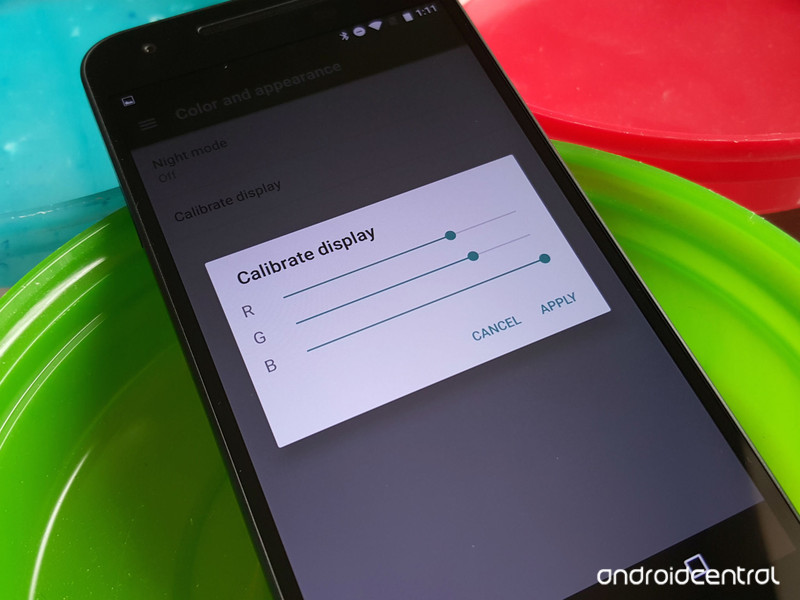
You spend hundreds of dollars on a new phone. You take it out of the box and the display looks yellow. What do you do?
Your options used to be limited: you could take the shiny new phone back and hope the second one doesn’t have that tint, assuming that the store will let you do the exchange. You could root it and use a color calibration tool in a third-party ROM or root app. Or you could keep the device and hope a future system update fixed the color calibration.
No more. Now, we can calibrate the display to our own liking in the Android N Developer Preview.
Unlike Night mode, this is the first time screen calibration has appeared in a Developer Preview, and as such there’s always a chance that this feature may not make it to the final build. It may also change over the course of the Developer Preview, and it would be welcome as there are some improvements that can be made to the tool as it stands now.
In the System UI Tuner, there’s a new category called Color and appearance. It hosts Night mode and an option to Calibrate display. When you tap Calibrate display, a screen will pop up with three bars: Red Green and Blue. All bars are automatically set at full, so if you want to increase the blue in your screen, you’ll bring the red and green down rather than pull the blue further up.

At the moment, the controls are a bit hit or miss, and at least part of that is because you can’t see the changes until you hit Apply. Thankfully, if you went overboard with your corrections, there’s a 10-second window to preview your changes, and if you don’t accept them in that window, they’ll revert to their previous settings.
It may take a few tries to get it right, between not seeing the results till you apply and the controls not being as fine as some people may like, but it’s more than we had before, and there’s always room to improve it with feedback. Remember that, folks: the Android N developer preview is about giving feedback, so if you see something you think needs changing, say so. You can submit feedback in the main settings tab by tapping the menu button and selecting Help & feedback.
Android N Developer Preview
The Android N Developer Preview is just that — a developer preview. It is not intended for daily use. That doesn’t mean it’s not cool, and that you shouldn’t poke around. But know that things will break. Tread carefully. (And have fun!)
- What’s new in Android N
- All Android N news
- About the Android Beta Program
- Download system images
- Android N easter egg
- Join the Discussion

Samsung’s experimental headphones send electric impulses to your brain
Not to be outdone by Sony’s experimental Future Lab hardware, Samsung is showing off a trio of projects from its C-Lab teams. The most intriguing of these three is definitely the Entrim 4D hardware. It looks like a basic pair of over-hear headphones, but they use electrical signals to trick you brain into feeling a sense of motion.
In the back of the two headphones are two slightly damp sponges that cover up the electrodes; these electrodes and the sponges line up just below your ears. The technical term for what these headphones do is “Galvanic Vestibular Stimulation,” but basically the headset sends electric signals to a specific nerve in your ear. Samsung showed off the headphones in conjunction with a Gear VR to show off a demo of a car racing around a track. First, you’d watch the VR video with the motion simulation off to get a baseline. But then, the Entrim 4D effect kicks in, and as the car went around the curves, both my head and stomach felt the unexpected and familiar feeling of motion.
While it was a bit of a disorienting feeling, it definitely added a sense of realism to the experience. And Samsung believes that such effects can actually help combat motion sickness that people often feel when trying VR. The team believes that there’s a “mental discrepancy” between seeing things in virtual reality and not feeling the other senses kick in to complete the picture, and something like the Entrim 4D might help to make VR even more realistic and less disorienting.
A video posted by Engadget (@engadget) on Mar 14, 2016 at 11:20am PDT
Samsung also had a few other more lighthearted, app-based projects to show off. The Hum On app lets you hum a melody into your smartphone speaker; it’ll then record the melody and play it back to you with a piano-like sound. From there, you can pick a number of genres (think rock, R&N, symphony) and fill out the sound of your melody with some background instruments and effects. It’s a classic weird Samsung app, but musicians might appreciate the ability to quickly hum a melody popping into their head and have it saved for later review.
‘Hum On’ turns your hums into actual music compositions! @SamsungMobile #SXSW #EngadgetSXSW @mmsuperflyjr https://t.co/zg7Efc4xXu
— Engadget (@engadget) March 14, 2016
The last app on display was called Waffle, and it’s a collaborative social app. One person starts a waffle by adding a picture and sharing it to a group of friends. You can add text and draw on the image, like Snapchat lets you. But it gets more interesting when your friends start contributing. They basically add photos all along the outside edge of your picture, making a large grid of images (hence the Waffle name). It’s a cute but entirely inessential app, though it’s possible that users could find ways to make some visually interesting collages.
As these projects are in the experimental phase, it’s not clear when they might be out as fully-fledged products. A beta of the Waffle app is already in the Google Play Store, but there was no word on when Hum On would be out. Similarly, it’s not clear if or When Entrim 4D will become an actual, shipping product. The team behind it is already working on another version that has more electrodes to help create a more realistic sense of rotational movement. I”m not sure if I want VR to get that real, but it’s worth trying out at the very least.
Mallory Johns contributed to this report.
Source: Samsung
Mr. Robot has an FBI consultant to make hacking look authentic
A long line of people snakes through the halls until it winds down a flight of stairs. Over a thousand fans anxiously wait for the doors to open inside the Austin Convention Center. They’re here to see the creator and lead actors of Mr. Robot, the most compelling TV show about hackers in recent memory.
A little later, the crowd now settled inside a massive ballroom roars as the Mr. Robot trio — Sam Esmail, Rami Malek and Christian Slater — walked onto the stage at SXSW Interactive to talk about the authenticity of coding in the psychological thriller. Dozens of smartphone-wielding hands went up in the air to record the moment in synchronicity.
Mr. Robot has made nerd culture popular. What seemed like a niche show about computer geeks at the time went on to win Golden Globes and Critics Choice awards this year. When it first aired on USA Network last summer, it predictably drew in a thriller-loving audience while the poignant portrayal of a deeply troubled hacker named Elliot Alderson captivated more code-illiterate viewers. But, above all, Mr. Robot connected widely with coders and hackers who finally found accurate representation of their skills.
That connection is one of the main drivers of the show. “I grew up a nerd,” says Mr. Robot creator Sam Esmail on stage at SXSW. “A lot of my friends are nerds and coders in InfoSec. Some of them are hackers. I made a poor attempt at hacking in college and was on academic probation. I wanted to tell a story about that culture because I found those people very interesting. I was watching all this cheesy crap — TV shows and movies — some of it I adore but they’re not great at representing who those people are and what that world looks like and what hacking really is.”
Mr. Robot tackles the world of hacking in a way that hasn’t been done in mainstream culture before. The show uses real codes that have gone through a rigorous vetting process. Esmail works with tech experts including people from InfoSec; a cyber security expert (who was recently promoted to being a writer on the show); and an FBI crime unit consultant to get the computer language right. They help ensure that the plots are grounded firmly in reality.
“We go heavy on the tech details,” Esmail says. “My production designer hates me because we create all these screens and at the end of the day we only see a few seconds of it.” He believes doing intensive groundwork adds to its credibility. Once the codes are worked out, what makes those lines look believable is the absence of a green screen that is often slapped on later for a pseudo complex code to flash on the screen. So the actor pretends to furiously type lines of code while shooting a scene. “They’re not seeing what they’re typing which actually throws me off,” he says. “On top of that there’s some bullshit on the screen which doesn’t make sense anyway. It was really important to us to add credibility.”
Rami Malek, who plays the show’s protagonist Elliot, types in the parts of the actual codes on the screen as the camera rolls. It’s a choice that lends to the believability of his character, which steers clear of the clichés. “A ‘nerd’ is an outcast and is bullied — that’s not true to life,” Esmail says. “There’s something there that people are missing. [Rami and I] talk about the darkness of it. Part of the reason Elliot is on the computer all the time is that he’s lonely. It’s not because people don’t won’t to talk to him … There’s something about him and his insecurities.”
It’s those vulnerabilities that make Elliot relatable. “I was drawn to this incredibly complicated character, a guy that was suffering and struggling to survive in his own skin,” Malek says. “We’ve shot some scenes in the pilot, where I remember [Elliot] staring at Angela’s [his childhood friend on the show] Facebook account and wishing he had that life. It really got me sad … We can all relate to being distanced by technology and the manicured Facebook pages that we create. I think people have found his honesty very endearing.”
Through the first season, the show exposes Elliot’s inner demons while tackling the larger hacking issues that have made headlines over the past few years. For the second season that’s currently being shot in New York, Esmail says the theme will be encryption and privacy. “Elliot committed a crime in the first season,” he says. “We’re going to see the ramifications of that in the second season.”
“The problem is that people don’t understand the nuances of that debate between Apple and FBI.”
Dealing with “rights to privacy” feels like a natural progression for the show. It also mirrors current events like Apple’s feud with the FBI, a parallel that Esmail discusses candidly. “Privacy is going to be a huge issue in the next decade,” he says. “The problem is that people don’t understand the nuances of that debate between Apple and FBI. We talked to our FBI consultants about this and they have a very strong point of view that encryption should allow for this sort of third-party side door thing, which I’m opposed to. I’m on Tim Cook’s side.”
When asked if the encryption theme is an intentional commentary on Apple’s case, Esmail says the idea was baked into the show before the incident. But he hopes that the theme will contribute to the debate and could potentially help people see both sides of it. It’s that kind of handling of sensitive but significant topics that has led to the popularity of Mr. Robot. “I love that all my nerds out there are getting into it,” Esmail says. “I love that they appreciate the authenticity of tech. Those are the people that I grew up with. So that means more to me than anything else.”
[Image credit: Heather Kennedy, Getty Images (top); Peter Kramer, USA Network, Getty Images (center)]
Microsoft will let Xbox, PC gamers play online with other platforms
It finally happened. Microsoft is officially opening up its network gaming capabilities, allowing developers to have Xbox One and Windows 10 games play online with other console and PC platforms. Yes, we could soon live in a world where Xbox One and PlayStation 4 players could fight each other to the death outside of comment sections (if Sony actually agrees to cooperate). It’s entirely up to developers to implement this cross-platform capability, but I wouldn’t be surprised if it ends up getting widely adopted. Psyonix’s Rocket League will be the first game to take advantage of the feature, starting with Xbox One/PC network play later this spring.
“Cross-network play has been the number-one most requested feature our community has asked for since Rocket League was first announced on Xbox One, and now that we are able to pursue complete online unity on all platforms, today’s announcement is a dream come true,” Psyonix’s Jeremy Dunham said in a blog post today.
Chris Charla, director of Microsoft’s Independent Developers for Xbox program, also noted that gamers will have the option to only play against other Xbox Live players, if they wish. And he also says the “invitation is open” for other networks to participate. All eyes will be on Sony to see how it responds at GDC this week.
Source: Microsoft, Psyonix
 AIVAnet