Details regarding Huawei and Xiaomi’s next flagships emerge

Information regarding handsets from Huawei and Xiaomi has emerged from China. A source on Weibo, the Chinese social media platform, has revealed specifications for both the upcoming P9 and Mi 5. Based on the information provided, it seems that neither Huawei nor Xiaomi are going to hold back with these flagships. You can expect crisp displays, top-of-the-line processors, and the latest version of Android.
Alleged Huawei P9 specifications:
- 5.2-inch 2K or 4K AMOLED display
- Huawei Kirin 950 processor
- 3GB of RAM
- Android 6.0 Marshmallow

Alleged Xiaomi Mi 5 specifications:
- 5.2-inch @K or 4K AMOLED display
- Qualcomm Snapdragon 820 processor
- 3GB of RAM
- Android 6.0 Marshmallow
The arrival of either handset is unknown; however, Xiaomi President Lin Bin has commented that the company will be announcing a new Redmi device soon. This could indicate that the wait for the Mi 5 has been extended to early 2016. Huawei’s P9 could follow in March or April of next year.
Via: GizmoChina
Come comment on this article: Details regarding Huawei and Xiaomi’s next flagships emerge
[Deal] Get a free remote with your purchase of NVIDIA’s SHIELD set-top box

The holidays season is upon us and that means you’ll probably need to entertain guests multiple times over the course of the next month or so. Why not serve up content from Google’s platform built for the living room? Now is your chance to get NVIDIA’s SHIELD set-top box that runs Android TV with a sweet freebie.

NVIDIA is bundling the set-top box’s remote, which is normally sold separately for $49, with all SHIELD purchases. You’ll get access to thousands of apps and games, some of which that are actually built specifically for this beast of a set-top box. The SHIELD is capable of outputting 4K video and everything operates smoothly as NVIDIA’s own Tegra X1 processor is inside. And, if you ask NVIDIA, this is way better than Apple’s set-top box.
The company does not say when this promotion will end.
[NVIDIA]
Click here to view the embedded video.
Come comment on this article: [Deal] Get a free remote with your purchase of NVIDIA’s SHIELD set-top box
Pandora Acquires ‘Key Assets’ and Employees From Rdio for $75 Million
Two of the biggest Apple Music competitors and most notable names in the streaming music industry are joining forces, with Pandora today announcing its $75 million acquisition of “key assets” from Rdio.
According to a press release on the acquisition, Pandora has gained unspecified “technology and intellectual property,” and a number of Rdio’s employees will be given roles at Pandora. Pandora plans to use Rdio’s assets to “offer fans greater control over the music they love,” with an expanded Pandora listening experience set to launch in late 2016, depending on licensing. Pandora wants to become the “go-to destination” for wherever and however its fans want to listen to music.

“The Rdio team built an acclaimed product and technology platform that has consistently led innovation in the young streaming industry. I’m pleased that many members of the Rdio team will continue to shape the future of streaming music, applying our tradition of great design and innovative engineering on an even larger stage with Pandora,” said Anthony Bay, chief executive officer of Rdio.
Pandora has more than 80 million users and continues to be one of the most popular streaming music services. Pandora offers its users the ability to listen to free, ad-supported radio stations centered around particular artists or songs rather than offering on-demand listening like Apple Music.
Rdio offered a similar ad-supported free listening tier, but it also included Rdio Unlimited, a service that let users listen to any song on demand as is possible with Spotify and Apple Music. With its acquisition of Rdio’s assets, Pandora may be angling to expand into the on-demand market to better compete with other streaming services.
The acquisition hinges on Rdio obtaining permission for the transaction from the United States Bankruptcy Court. With approval, Rdio will wind down its Rdio-branded operations in all markets as Pandora is only acquiring assets and not the Rdio brand.
Discuss this article in our forums
HP taught Movado’s new Bold Motion what it knows

For a smartwatch to be considered a smartwatch, it has to be smart. Traditional designers and watchmakers have looked to companies familiar with consumer technology to develop their smartwatches for them. Movado, the company that makes high-end watches, has enlisted HP to make a smartwatch with brilliant design and software. This comes more than a year after HP worked with Gilt to produce a Michael Bastian-designed smartwatch.
Click here to view the embedded video.
Despite not having an interactive display, Movado has key smartwatch features in the Bold Motion:
Infused with Movado’s modern design aesthetic and harnessing HP’s performance technology, Movado BOLD Motion is the BOLD way to stay connected. Movado BOLD Motion notifies users of incoming phone calls and texts, manages time and priorities and monitors daily steps and tracks progress through app-enabled functionality,
The Bold Motion will be sold for $695 in two unisex styles online starting sometime during the holiday season.
Movado: “Always In Motion” Brings Iconic Modern Design To Two Smartwatch Collections In Collaborations With Fullpower / MMT And HP Inc.
NEW YORK, Nov. 16, 2015 /PRNewswire/ — Movado Group, Inc. (NYSE: MOV) takes an innovative approach to wearable technology where design is first and foremost. In collaboration with two premier technology leaders, two distinct smartwatch collections were created with iOS and Android compatible apps: MotionX-365 end-to-end solution created by Silicon Valley’s Fullpower Technologies, Inc. for Movado Swiss timepieces, and HP Inc.for Movado’s BOLD collection. Both collections will be available for the upcoming holiday season, and supported with a comprehensive marketing program.
“Movado Group has always been committed to providing our consumers with exceptional innovative design and we are extremely excited to show the world how we have merged modern iconic design with technology,” said Efraim Grinberg, CEO and Chairman, Movado Group. “The partners we collaborated with execute smart technology in a user-friendly way understanding that today’s consumers have differing needs regarding how connected they want to be.”
Simply intelligent – Movado Motion merges Swiss made elegance into the wearable technology segment for men and women. Powered by MotionX® innovative technology platform, Movado Motion features two striking Swiss made designs: Museum Sport for him and Bellina for her. These iconic Movado watch designs deliver 24/7 MotionX® activity monitoring and offers the following functions: steps activity tracking, sleeptracker® sleep monitoring, sleep cycle alarms, get-active alerts, dynamic coaching, 2 year battery life and automatic world clock with time/date setting through sync with paired device. There are six timepieces in the collection with an opening price point of $995.
Infused with Movado’s modern design aesthetic and harnessing HP’s performance technology, Movado BOLD Motion is the BOLD way to stay connected. Movado BOLD Motion notifies users of incoming phone calls and texts, manages time and priorities and monitors daily steps and tracks progress through app-enabled functionality, Movado BOLD Motion is offered in two different unisex styles for $695. This illuminating design for the modern world maintains up to a full-week of smart module battery life.
The new Movado Museum Sport and Bellina smartwatches are available on Movado.com starting today and the BOLD smartwatch will be available on Movado.com in time for the holidays.
A brand long identified with Modernism and closely associated with the performing arts, Movado has achieved a proud 134-year history of design excellence and innovation. Movado has been a major supporter of New York City Ballet, Lincoln Center for the Performing Arts, Jazz at Lincoln Center, and The John F. Kennedy Center for the Performing Arts. Additionally, Movado has supported the Miami International Film Festival, Miami City Ballet, The Joffrey Ballet, Ballet Pacifica, and the Cooper Hewitt, National Design Museum.
Movado Group, Inc. designs, manufactures, and distributes Movado, EBEL, Concord, Coach, HUGO BOSS, Lacoste, Juicy Couture, Tommy Hilfiger, and Scuderia Ferrari brand watches worldwide.
Come comment on this article: HP taught Movado’s new Bold Motion what it knows
Smartphones make communication easier, not necessarily better

Technology has changed the way we think, act and communicate with each other, and that’s not entirely a good thing.
There’s no doubt that the widespread of mobile technology has made communicating with each other much, much easier. Back in the 1950’s, getting a hold of someone meant calling them on their house phone, work phone or visiting them at their home. There were no pagers or mobile phones, and certainly no texting, email or instant messaging of any kind. If these three methods of communication were a no-go for any reason, you’d need to resort to sending a letter… in the mail. Today I wouldn’t wish this fate on my worst enemies, but years ago, it was actually a (somewhat) useful form of communication.
Then our main communication methods began to drastically change around the mid-to-late 90’s. With flip phones from Motorola, candybar phones from Nokia, and very early PDAs from BlackBerry, T-Mobile, Palm and others, it was easier than ever to reach anyone we needed to at any given moment.
 Don’t miss: Throwback Thursday: a very special hands-on
We’ve progressed quite a bit since then. Now we have the ability to reach out to one another through text messaging, Facebook, Twitter, Snapchat, Skype, Hangouts and the list goes on. But now that it’s easier than ever to talk to each other as much as we want, are we really getting better at communication?
Before we dive in, we should acknowledge something that’s become all too familiar for most of us. You’re sitting in a room with friends, everyone on their smartphones. You’d like to bring up a conversation topic, but risk getting ignored by your peers because they’re too engulfed in other forms of communication with other people. To get a good idea as to what I’m talking about, be sure to check out comedian and actress Charlene deGuzman’s video entitled “I Forgot My Phone.”
This may be an over-dramatization of what really goes on in our lives, but it’s still difficult to not see what’s happening here. There are too many social networks, too many different forms of communication. To keep up with all of them can be exhausting, and that’s what many of us have fallen victim to over these past few years.
There have been numerous studies that show smartphones are affecting the way we communicate with each other face-to-face. One of which was performed by Shalini Misra, a psychology professor at Virginia Tech in Blacksburg, where she found that in conversations where someone pulled out a smartphone while talking, participants generally rated the conversation as less fulfilling than in conversations where no one pulled out a phone. Misra’s research team writes:
Mobile phones hold symbolic meaning in advanced technological societies. In their presence, people have the constant urge to seek out information, check for communication and direct their thoughts to other people and worlds.
The test consisted of 200 coffee shop attendees which were divided up into pairs. Every pair was assigned either a casual or serious topic to talk about for roughly 10 minutes. Misra’s team didn’t record the content of the conversation, but whether or not a participant would pull out a phone or set one on the table. The researchers reported that someone pulled out a smartphone in 29 out of the 100 groups.
After each conversation, each group filled out a survey describing how close their relationship was, how close they felt to the other person and how well they thought the other person understood them throughout the conversation. In conversations where someone pulled out a phone, participants reported they felt less fulfilled and felt less empathy for the other person, no matter the age, gender, ethnicity or mood of the participants involved. It didn’t matter which conversation topics were discussed, either; all participants said they felt less connected in conversations where someone pulled out a phone.
The researchers also reported that the presence of a phone more negatively affected conversations held between good friends, more so than in conversations held between two strangers.
Cultural norms

As a society, we’ve all ushered in mobile technology with open arms. There’s nothing wrong with that, but it’s a big reason why people think it’s acceptable to spend more time on their phones more often than not. Take, for example, the radio. Back in the 1920’s, radio became a widely accepted form of entertainment for the entire family and ultimately began replacing other forms of social activity.
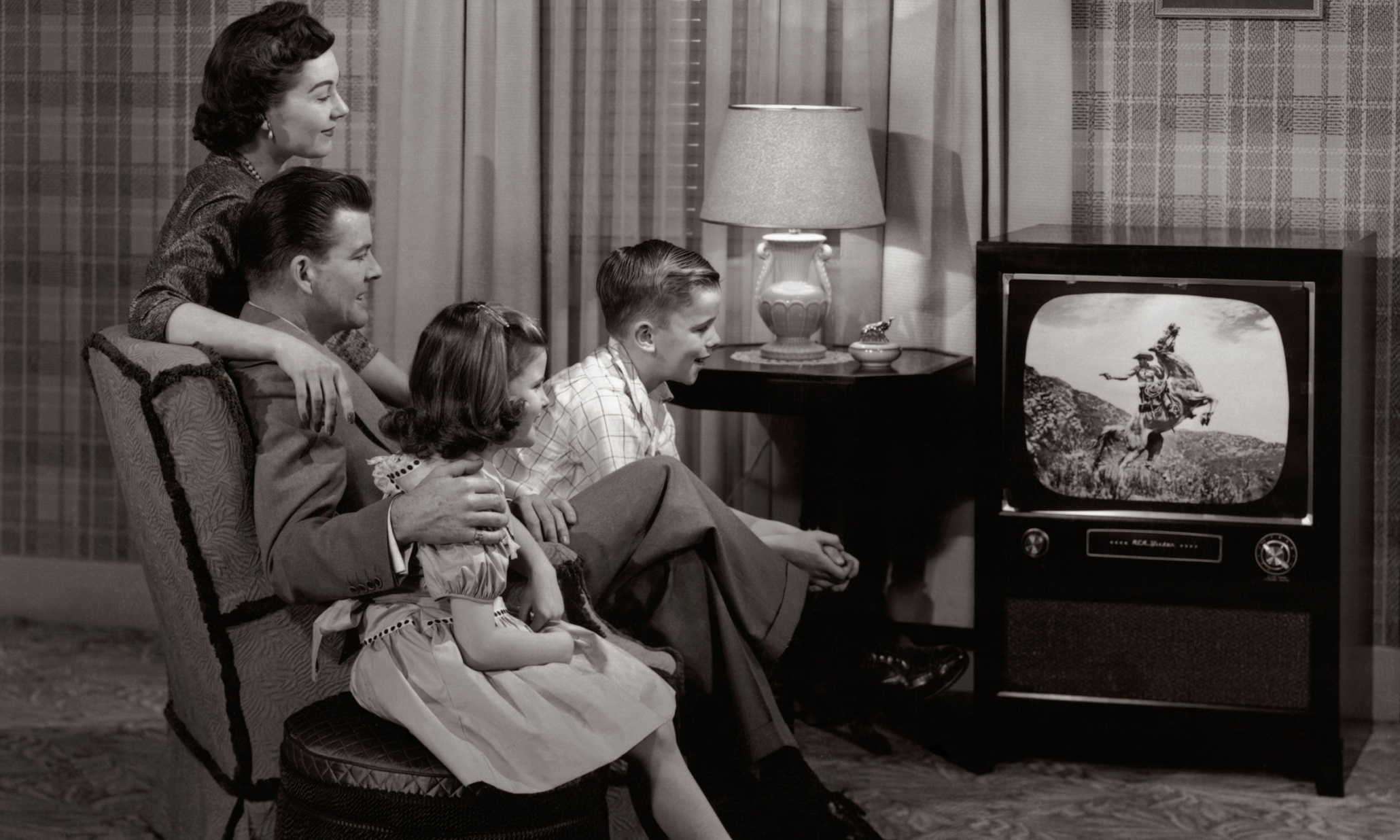
Then in the 50’s and 60’s, the television came to be. Although not widely adopted until the 60’s (for the most part), the TV eventually became the pinnacle of in-home entertainment. It was completely normal (and still is, for that matter) to sit around the television when eating dinner with the family, when guests are visiting, or when you just need to relax.
Families could still ‘spend time together’ while watching TV in the kitchen
The TV eventually moved into the kitchen, where families could sit around and spend time watching shows with one another while still “spending time together.” Eventually this became bad manners, so many U.S. families moved the TV back into the living room where it belonged. One could argue that smartphones are similar to TVs in this sense – now that smartphones are affecting the way we act around one another, should it become socially unacceptable to have our phones out around each other?
 See also: Are smartphones affecting your relationship? Researchers believe they could be
Not enough real conversation
It’s not a surprise that we’ve fallen deeply in love with these digital communication tools, though some would argue that we’ve completely lost sight of the people behind these tools. Geoffrey Tumlin, author of the wonderfully informative book called “Stop Talking, Start Communicating”, explains that while our mobile communication devices are great, they might not help us out as much as we think they do.
Aside from offering up some helpful communication habits and ways to improve our conversations as a whole, the book also lays out some interesting viewpoints on how our devices are affecting our standard of communication. For starters, he says that just because the technology we use nowadays makes it easier to send a message to someone, that doesn’t mean communicating with them is any easier.
…actually getting the message across is a whole other story
It’s incredible to think about having the ability, at any given moment, to ping someone across the world, no matter what time of day. But actually getting the message across is a whole other story. “We’ve been lulled into believing that communication is becoming easier because technological advances make it easier to send and receive messages,” Tumlin says. “But because our interactions involve quirky, emotional, and sometimes unpredictable people, we can’t eliminate imperfections from communication.” He goes on to say that communication is fundamentally imperfect, and no matter how advanced our devices become, they’ll never be able to eliminate misunderstandings, confusion and errors that occur when people talk.
How many times have you sent a message to a friend and they’ve taken what you have to say the wrong way? This probably happens much more over texting than it does in real life because there’s much more to communication than just getting the message across. Facial expressions, voice inflection, etc, are just a few of the many ways that help us get our point across when talking to someone face-to-face. Sure, there’s FaceTime and Google Hangouts that can be used for quick video chats, but people tend to text each other far more than they video call each other.
Some communication is just plain hard. Like, when we have to communicate bad news, tackle a sensitive topic, or have a conversation to address a difficult problem.
So yes, it’s easier to send and receive messages today, but it’s important to remember that communication is as hard, and may be even harder, than it ever was.
It’s becoming easier than ever to get distracted
Although our mobile devices greatly simplify the sending and receiving of messages, communication doesn’t just occur when you hit the “Send” button. Tumlin explains, “We want to plow through our inboxes, respond to new text or voice messages as soon as they come in, and get face-to-face conversations over quickly so we can move on to the next thing. The communication tasks that pile up every day make it awfully tempting to fire off quick messages or speak abruptly and think that our work is done.” He adds that if we were to include an extra step – considering whether or not the message is understood – will be able to make us much better at communicating.
Smarter phones don’t guarantee smarter communicators.
As technology advances, it’s becoming easier than ever to get distracted. Speaking from personal experience, I’m incredibly distracted by my smartphone way more than I ever was with my old LG flip phone. “Smarter phones don’t guarantee smarter communicators. Better communication happens only when our communication skills improve,” he says.
With the ability to communicate with someone whenever we want, the most important ideas we need to get across to one another tend to get lost in translation – especially when communicating to a wider audience. For instance, saying something to a friend is different than saying something to your entire group of friends. Due to the ease of simply typing out an email and instantly sending it to whomever we’d like, we tend to forget that communicating to multiple people might require some extra thought. “More people means more perspectives to consider,” Tumlin says. “When we fail to account for these additional viewpoints, we run the risk of talking, texting, or typing right past each other, or worse, upsetting someone with a thoughtless message or a hasty reply.” He adds that while it’s not entirely practical (or possible) to think through every possible perspective your friends may have before posting something to Facebook or Twitter, we should still take an extra step to consider what a few people might think.
If you’d like to hear what else Tumlin has to say, I’d definitely recommend picking up your own copy of “Stop Talking, Start Communicating”. You can purchase it from Amazon for just under $16.
Communication has changed, but is it all bad?

Today’s tools help us not only stay in touch with those that would have otherwise been near impossible to reach, such as those halfway around the world, but they make it easier to plan activities, reach out in emergencies, and so much more. It’s obvious that there are tons of benefits to today’s communication tools, and so I am by no means saying that technology is a bad thing, or that we need to stop communicating with one another through our smartphones in any way.
What I am saying, though, is that perhaps instead of relying solely on texting each other, maybe we should be a little more careful about what we’re saying and who we’re talking to. When in a face-to-face conversation, maybe it’s better to turn that phone off, or at least resist the temptation to reach for it immediately.
What are your thoughts? Are smartphones ruining the quality of communication, or are they just enhancing the way we speak to one another? Be sure to let us know your thoughts in the comments below.
Artist portrays disturbing images of faces being absorbed by smartphones

Artist Antoine Geiger has created an unsettling series of digitally altered photographs showing people’s faces getting sucked into their devices.
The images are striking, and they speak to a common concern in our culture: are we becoming too concerned with our smartphones and tablets? Are we losing genuine human experience in exchange for a cheap substitute? Is this the beginning of a dark spiral into nested simulated existences that strip us of our humanity and identity?

“This work is called « SUR-FAKE »” the artist writes in the series’ explanation. “It [places] the screen as an object of ‘mass subculture,’ alienating the relation to our own body, and more generally to the physical world. I wanted to come back to the idea of these faked identities, over-exposed, sucked by the digital gulf that breaks the relation to ‘real’, to bring back a self-focused image of the individual. What interests me in this texture of sucked faces, is the the over-exposure gradually allows a very organic dimension, as well as digital, to render something quite disturbing.”
 See also: Selfies now kill more people per year than sharks
Conceptually, this is nothing new. Artists and social critics have decried smartphones since their creations. But in terms of social patterns, this is downright ancient. As an XKCD comic articulately points out:

What we’re seeing here is just another case of juvenoia. If you just brushed over that link without clicking it, you should seriously give that video a watch because that man knows himself some knowledge. Basically, this is just part of a cycle of needless panic that comes with each generation in which the old distrust the social norms of the young.

“This polymorphous inter-face is turning into a dialogue between your neurosis and your psychosis,” Geiger writes. But is it really? Or are our devices making us more connected than ever before? Every day we are exposed to more humanity than is unprecedented in history. We watch each other’s videos, read each other’s thoughts, share each other’s ideas. I argue that in this era of ever-falling violent crime stats, our devices are helping us build empathy, not isolate ourselves.
What do you think? Are we sacrificing ourselves to these devices, or are they drawing us together? Let us know in the comments!
Complex questions can be answered by Google Search

Serving basic, straightforward questions to Google Search has always returned solid results. Need scores to that Houston Rockets game? Wondering when Eddie Murphy was born? Easy. Rarely has the search engine faced difficulties answering questions that require simple facts. Complex questions, though, have been troublesome as Google Search wasn’t drawing upon different areas to supply a direct answer. Most of the time, a complex question would return a myriad of generic search results. Google announced today that complex questions are now welcome to Google Search.
The Google app is starting to understand the meaning of what you’re asking.

Google’s piecing it all together
Google Search is now able to respond to superlatives, ordered items, particular points in time, and complex combinations.
Try out these example complex questions:
- Who are the tallest Mavericks players?
- What songs did Taylor Swift record in 2014?
- What was the U.S. population when Bernie Sanders was born?
Since this feature is completely new and rather complex itself, Google understands there will be mistakes. The Knowledge Graph is always growing and Google is working hard to make sure that your searches and questions have a clear answer.
Source: Google
Come comment on this article: Complex questions can be answered by Google Search
T-Mobile preparing band 12 support for the Nexus 6P

Owners of the Nexus 6P on T-Mobile’s network should prepare themselves for a software update that will enable the handset’s band 12 support.

On the carrier’s dedicated page for Extended Range LTE (700MHz spectrum), T-Mobile listed the Nexus 6P as one of the devices compatible. But being compatible does not mean that the handset is operating on band 12 at the moment. Google will need to push a software update to the Nexus 6P that will activate functionality. It’s very likely that band 12 support for the Nexus 6P is included with Google’s next security update for all Nexus devices.
The Nexus 5X has not been listed by T-Mobile; however, that does not rule out its chance to receive a software update activating band 12 support.
Band 12 support is very important for consumers because it allows them to expect solid coverage in buildings and rural areas. Just ask buyers of the OnePlus X how disappointed they are about OnePlus’ decision to not include band 12 support.
Source: T-Mobile
Via: /r/Android
Come comment on this article: T-Mobile preparing band 12 support for the Nexus 6P
Get the most out of Nova Launcher: Changing Icon Sizes
Nova Launcher is an app that millions of people use and it’s full of tons of features and options that allow the user to do so much customization to their devices when it comes to their homescreens, docks at the bottom of the screen, gestures and even icons. The list is nearly endless and while a lot of people know about these features and options and how to use them, there are still a lot of folks out there that don’t know. That’s why we’re starting a new series on how to get the best out of Nova Launcher so we can show you some stuff that you might not know that the launcher can do.
We’re going to start the series talking about icon sizes and how you change them in a couple of different places and in various ways that gives you quite a few choices of how they might look on your device(s).
Icon Sizes on the Homescreen
Most everyone uses icons on their homescreens in some form or fashion. There are many that change their entire homescreen setup around daily, or even several times per day. So something that might be useful would be different sized icons on the homescreen. Some people aren’t aware that this is something that is very easily accomplished thanks to Nova Launcher.
To get started, once you have Nova Launcher and Nova Launcher Prime installed (Prime costs $4.99 currently, but it’s a must have app for everyone in my opinion) then go to Nova Settings -> Desktop -> Icon Layout and let’s take a look at what we have waiting for us there.

Now, as you see in the screenshot above, there are several options for you to choose from and all of them make your icons display slightly different on the homescreen depending on which you have enabled or disabled. We’re going to start at the top and work our way down.
Icon Size: As you see above, my Icon Size is currently set to 100%. What this means is that they are displayed on the homescreen in regular size. They aren’t reduced or enlarged in any way. I keep it this nearly all the time as I really have no use for making my icons larger or smaller.
You’ll also notice that to the bar with the red slider on it is filled in half way, then the rest of it has dashes. What this is telling me is that I have the possibility of making my icons larger than what that solid bar shows, which if I slid it all the way to the end of the solid line would be 124%. You’ll see in the next screenshot that it tells me “Further increase icon size by reducing grid size or disabling labels”. Grid sizing will be another post all together, but I currently have mine set to 10 x 9, so that’s why I’m limited to 124% icon size.
If I change my grid size to something like 5 x 4 for example, I can then increase my icon size up to 150%. Again, just not something I have a need or use for, but others might.

Labels: In the screenshot above you see I’ve now turned on the Labels feature. What this does is allow you to show the app name of each icon such as you see above with the Calendar, Clock and so on. This is very helpful if you have icons that are somewhat close or similar in looks to each other and you aren’t sure which icon belongs to which app.
Again, you see quite a few options that we’re able to change once we turn the Labels feature on such as the weight of the font that’s used, color of the font, if the fonts have shadows and if the text is on a single line or multiple lines.
Font: Here you have 4 choices: Normal, Medium, Condensed and Light. What these represent are the font weight that’s being used. Normal is just as it states, normal font with nothing added to it. Medium is a bold font, Condensed is slightly thinner than Normal and Light is even thinner.
Once you have your desired font weight set, then you can change the size of that font using the slider under where it says Size. The further you slide that bar to the right, the larger the text gets. So if you have a problem reading small text, then chances are you’ll want to slide it pretty far to the right.
Also note that the larger you make the text, the smaller your icons will get. This is important to note if you’re focusing on icon size itself for various reasons.
Color: This is where you can select any color you desire for the color of the font itself. When you first tap on the circle to the right where you see mine as white, it will come with a screen that has 19 pre-selected colors. Then there is one circle that has 3 dots on it. If you click that one, that’s where you can select any color you want by sliding the circle around to the color you want or by simply entering a color code of your choice.
Shadow: This option allows you to have a shadow on the label text or to not have a shadow on the text of the labels. It’s one of those either on or off settings. I know some folks have requested that there be a choice of how much shadow you can use here, but currently that’s not a feature, though could be in an upcoming update possibly.
Single-Line: This option tells the label to either be placed all on a single-line, or to use multiple lines. Of course depending on the name of the app will depend on how many lines the text takes up. Another thing to note here is that if you deselect the Single-Line option then your icons will reduce in size.


I would recommend you play around with the combination of all of these settings to see what works best and looks best for you. I prefer to not have labels showing because I have my apps arranged in an order that I know exactly what they are just by looking at them and by where they are located.
There are other places in which you can change icon size as well, such as on the dock which is at the bottom of your homescreen as well as in the App Drawer. The options are all the same for all three places which makes it very simple to make them all uniform across the board if you are like me and like to see your icons the same size every place they appear.
There is so much more that you can do with Nova Launcher, but this was just the first little tip and how-to of many to come. Stay tuned next time as we dive into the Dock and show you what all you can do to it to make it look different. You’ll be shocked at the awesome things you’ll see in the follow-up post to this one.
Google Play Store: Nova Launcher
Google Play Store: Nova Launcher Prime
The post Get the most out of Nova Launcher: Changing Icon Sizes appeared first on AndroidGuys.
Indiegogo and Brookstone want to deliver crowdfunded products faster

One of this biggest issues facing crowdfunded products is the amount of time between backing a project and when you actually receive the goods. Indiegogo is looking to do something about that with the help of the tech-minded retail store Brookstone. Aspiring startups and makers can submit ideas to a specific page of Indiegogo’s site where the retailer will offer design, manufacturing, packaging, distribution, sales and customer support to selected projects. As you might expect, Brookstone won’t just back any ol’ idea, as the store is looking for items that fit its reputation for technology, wellness, home and travel wares. There will also be a “Funded with Indiegogo” section of the company’s retails stores that’ll include products like the Fizzics beer dispenser and Axents’s Cat Ear Headphones. The partnership seems like a win for both companies as Indiegogo’s inventors have the opportunity to tap into an established product chain and Brookstone can use the crowdfunded projects to stock its shelves with new items.
[Image credit: LA Times via Getty Images]
Source: Indiegogo
 AIVAnet