A new age of transportation is upon us and it’s self-driving

We’re on the cusp of change: Self-driving cars have begun to hit the streets with the goal of making transportation safer. The dream of a self-driving-car future, it would seem, is becoming a reality and it’s been a long time in the making. A steady flow of engineers have, over the years, successfully chipped away at the problem of autonomous vehicles as the requisite technology’s shrunk in scale and grown in capability. So what better time to look back at some milestones in autonomous-vehicle development than in the wake of this new age of transportation?
Slideshow-312063
Tags: autonomous, self-driving car, selfdrivingcar
Huawei Nexus 6 renders leak, fingerprint scanner identical to the rumored LG Nexus 5

We’re coming up quickly around the timeframe a new Nexus device gets unveiled, and thus, leaks are becoming more and more frequent. In its latest leak, we’re seeing a very detailed render of what is is allegedly the Huawei Nexus 6, and it seems to be taking design hints from the iPhone 6.
The new report furthers our suspicions that we’ll see two Nexus devices this year, however, the only similarity between the Huawei Nexus 6 and the LG Nexus 5 (2015) will be the fingerprint sensor on the back of the device.
The report from uSwitch claims Huawei has been testing two Nexus 6’s, one that comes in 5.5-inches and another in 5.7-inches. Huawei is supposedly still deciding which one will make the final cut come launch day.
The only other real details we can gather from this is that, from the schematics, there seems to be a port large enough to support USB Type-C.

While this is by no means the final rendition, the design is identical to the iPhone 6 in multiple ways, and that could prove to be an issue in the case that Apple decides to pursue legal action.
As we get closer to launch day, we’ll no doubt see leaks like these become more frequent. In the meantime, it’s difficult to tell what’s legit and what’s not.
Click here to view the embedded video.
What do you think of these renders? Could this be the Huawei Nexus 6 we’ve been hearing about? Let us know in the comments below!
source: uSwitch
Come comment on this article: Huawei Nexus 6 renders leak, fingerprint scanner identical to the rumored LG Nexus 5
Why Android Auto scares me

For those who do not know, Android Auto, is a car information/entertainment system, that allows car owners to connect to their Android devices. Then, through the car’s dashboard unit, Android Auto provides access to compatible apps, as well as data and features on the device. Android Auto provides a means for users to answer and make calls using voice commands, receive and have messages read to them, dictate and send new messages, as well as access to the device’s maps and navigation. Android Auto is designed to minimize distractions for drivers, by providing a means for users to perform essential actions, without necessary taking their hands off the steering wheels, or their eyes off the road. It accomplishes this by using large widgets that can be easily touched without a need for high precision, voice assisted commands, and by offering apps a limited API set. After all, we don’t want drivers playing Flappy Bird while at the wheel. Talk about road rage! But I digress.
The manufacturers that have signed up to support Android Auto reads like a who’s who of the auto industry, and includes Abarth, Acura, Alfa Romeo, Audi, Bentley, Chevrolet, Chrysler, Dodge, Fiat, Ford, Honda, Hyundai, Infiniti, Jeep, Kenwood, Kia, Maserati, Mazda, Mitsubishi, Nissan, Opel, Pioneer, RAM, Renault, SEAT, Škoda, Subaru, Suzuki, Volkswagen and Volvo.
Without a doubt, Android Auto is a fantastic idea. Rather than drivers taking their eyes off the road, searching for their phone when it rings and trying to answer a call, all while driving with one hand, using Android Auto, the driver simply glances over at the dashboard, sees who is calling, and can answer or reject the call with a simple voice command as appropriate. Drivers can also have incoming messages read to them, as well as dictate and send messages. Another great feature of Android Auto is access to your media files, as well as streaming services. There is a lot to be excited about regarding Android Auto, and I was one of it’s biggest fans. However, a few recent developments have left me questioning the readiness of both Google and the car manufacturers. Recently, my disquiet has grown into outright fear at the prospect of Android Auto and the increased use of software in modern cars.
HackingTeam and RCS Android
But what is worse is that Hacking Team itself was hacked.
Hacking Team is a company based in Italy that sells intrusion and surveillance software to governments around the globe. Their software suite includes tools to compromise Windows, Macs, iOS and Android devices. For Android, they could gain control of a device through the installation of a seemingly innocuous app, that initially contains no malicious code. However, once installed, the app uses dynamic loading to download and execute their spyware payload. This spyware, called RCS Android (Remote Control System Android) has been described as the most sophisticated Android malware so far exposed. RCS Android can listen to and record conversations using the device’s microphone, capture screenshots and photos, record voice calls, track the device’s location, capture both WiFi and online account passwords, collect SMS, MMS, Gmail and IM messages, as well as device contacts. In addition, it can upload all this data to a command server, upgrade itself, gain root access, and uninstall itself.
It is scary enough that there is malware out there that can do all this, but what is worse is that Hacking Team itself was hacked, and over 400GB of company data was posted online. This data trove contains the source code for their apps, spyware, botnets, as well as company emails and other data. Thanks to Hacking Team, all this code is in the wild, and will be studied, modified, and used.
Stagefright (and others)
Stagefright, is a truly frightening Android vulnerability. It was discovered by Joshua Drake, a researcher from Zimperium’s zLabs. Drake discovered that a specially crafted MMS can be sent to a vulnerable Android device, and, before a notification is even shown, the device can be compromised. The Stagefright vulnerability uses the fact that by default, messenger apps automatically download MMS images.

It is estimated that approximately 95% (950 million) of Android devices where vulnerable at the time of it’s disclosure to the press. The 5% of devices not vulnerable are really old devices, running Android versions less than Android 2.2. Stagefright is every hackers wet dream, wherein a device is compromised completely remotely, without user interaction, allows an arbitrary payload delivery, and all traces of the hack can be completely wiped.
Although Drake has been in contact with Google regarding the vulnerabilities, and sent patches to Google as early as April 9th, Google Nexus devices (the poster children for fast updates and upgrades) are just getting patched five months later.
Although the Chrysler hack is the most recent, there has been a steady stream of car related software glitches in the past few years.
To compound the issue, there is CVE-2015-3825, discovered by IBM’s X-Force Application Security Research Team. It affects Android devices from 4.3 and above, including the as yet unreleased Android M version. An app with no permissions (yes you read that right), can escalate it’s privileges and become a super app, essentially owning the device (almost like Hacking Team’s app, but even more sinister). This covers about 55% of Android devices available today. Thankfully, this vulnerability is still under wraps, but we can only hope and pray that the bad guys haven’t found and/or are not currently exploiting it.
With Stagefright and RCS Android, an attacker could infect virtually every Android phone on the planet, without anyone noticing. In the movie Ex-Machina, Nathan (who owns a Google-type search engine) says he hacked every cell phone on the planet to get camera and audio. What should be just fiction, now doesn’t sound that far fetched any more.
Chrysler Hack and Ford Recall
Wired’s Andy Greenberg also had a run in with a couple of hackers, Charlie Miller and Chris Vasalek, who demonstrated their ability to compromise a Jeep Cherokee completely remotely. In case you are too busy to go read the full article, the hackers sent commands through the car’s entertainment system, and ordered the car to turn on it’s AC at maximum, changed the radio station, changed the dashboard display to a picture of themselves, turned on the windshield wipers, cut the car’s transmission and disengaged the brakes. Note that this was a car they had not modified in any way, and all the above was done over the internet, using a vulnerability in the entertainment system. Allow me to emphasize that, over the internet, hackers where able to cut the car’s transmission and disengage the car’s brakes.
While the researchers have been sharing their work with Chrysler over the past nine months, it doesn’t inspire much confidence in me as far as the future of connected cars go.

Although the Chrysler hack is the most recent, there has been a steady stream of car related software glitches in the past few years. In June, for example, Ford had to recall more than 430,000 cars (including the 2015 Focus, C-Max and Escape models) to update the software, because removing the ignition key may not be enough to turn off the car’s engine!
None of these hacks, so far, involve Android Auto, however they are worth mentioning to show that auto makers have issues with software in vehicles. Although I cannot help but acknowledge that software in vehicles has incredible benefits (ABS, improved fuel efficiency, etc).
Why so serious?
With the amount of information our smartphones hold related to our lives and finances, a hacked smartphone is a major source of worry and headache. However, having a completely compromised smartphone is not necessarily life threatening, for either myself or the people around me.
When a car decides to arbitrarily break these given set of rules, it poses a great danger not just to its occupants, but to other vehicles, as well as pedestrians.
Admittedly, a lot of my activities using my smartphone, or in close proximity of my phones, could be embarrassing if made public. More importantly, a very high number of smartphone owners perform financial transactions through their phones, and a hacked phone can result in massive financial losses. With a hacked automobile, the potential for damage, injuries and loss of life is far greater.
At the moment, Android Auto is a strictly information/entertainment system, and cannot be used to control, manage and/or monitor car operations. However, the Android Auto APIs indicate that querying car diagnostics is part of the future plans. Both the Auto makers and Google have to take extra steps to ensure Android Auto is properly isolated and sandboxed. Unfortunately, with their track record thus far, I’m not holding my breath.
Conclusion
The scary part of this is not the software in automobiles or Android itself. Individually, they are a concern, but the idea of both together is quite troubling. And the same can be said of both Apple’s CarPlay and Microsoft’s Windows Automotive.
Microsoft, arguably the biggest and most important software company in the world today, still has issues surrounding it’s most lucrative software (Windows if you haven’t guessed), and this is with their ability to push out updates regularly. How frequently can auto companies push out updates? How are the updates going to be installed? Can users decide to reject an update? Who becomes accountable when a user rejects an update, for whatever reasons, and the car is compromised in the middle of a commute? Who is accountable if the car is compromised using Android Auto?
Don’t forget that even if you refrain from purchasing one of these monsters, any other car on the road can be one of these, and happen to be the unlucky machine infiltrated by the bored teenager in his mother’s basement in East Africa (replace with virtually any where else in the world). The safety of our roads are predicated on the belief that every driver follows a set of rules. When a car decides to arbitrarily break these given set of rules, it poses a great danger not just to its occupants, but to other vehicles, as well as pedestrians.
BlackBerry Venice shows up again, this time showing its virtual keyboard
(adsbygoogle = window.adsbygoogle || []).push();
For weeks, we’ve been hearing about an Android-powered BlackBerry device called the BlackBerry Venice and it looks like the leaks are starting to pile up. The latest leak to join the party is a photo posted on the CrackBerry forums showing the curvy profile of the Venice once again, but this time showing off its virtual keyboard – that might seem inane seeing as the Venice is a smartphone, but it’s rumoured it will also come with a slide out keyboard. Check out the photo in question below – note that everything apart from the device itself has been blacked out:
 In yet another confirmation that the Venice going to be running Android, the back soft key at the bottom of the display is a clear indicator that the Venice is going to be running at least Android Lollipop when it launches – if it launches. We have very little information about when this device could be showing up and it’s not likely we’ll know until it is released, but it’s rumoured that the device will be out sometime in November.
What do you think about the BlackBerry Venice? Let us know your thoughts in the comments below.
Source: CrackBerry via Phone Arena
The post BlackBerry Venice shows up again, this time showing its virtual keyboard appeared first on AndroidSPIN.
The Samsung Galaxy Note 5 and Galaxy S6 Edge+ come with about $300 worth of content
(adsbygoogle = window.adsbygoogle || []).push();
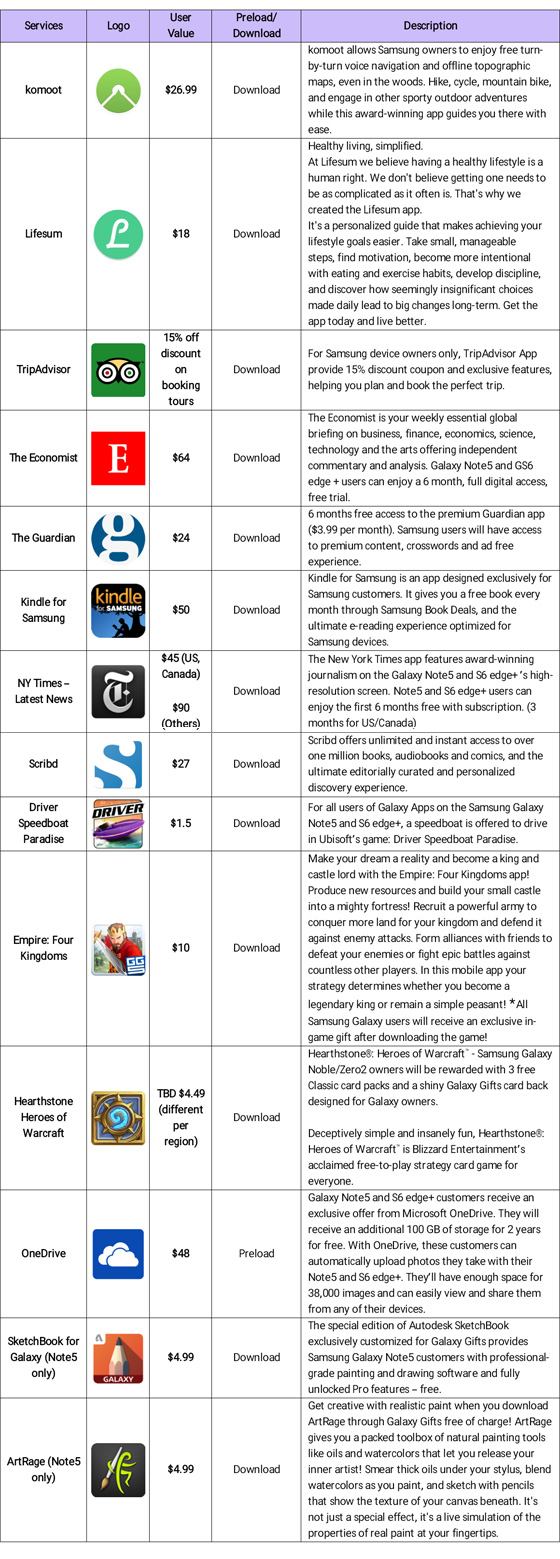
In case you weren’t already aware, Samsung announced the Samsung Galaxy Note 5 and Galaxy S6 Edge+ just the other day and as Samsung is wont to do with its flagship devices, has stuffed it full of bonus content for its users to take advantage of. This usually includes limited-time subscriptions and apps from companies that Samsung has partnered with – this year’s list includes the likes of Lifesum, The Economist, The Guardian, but also a surprising number of games are included. Check out the whole list below:

The whole list of apps adds up to around $300 worth of content, which is quite a lot if you think about it, but it’s unlikely that everybody that buys one of Samsung’s new phablets will be able to use everything on that list – then again, there are worse perks to have and let’s be honest, who doesn’t love free stuff.
What do you think about the $300 worth of content that Samsung has included with the Samsung Galaxy Note 5 and Galaxy S6 Edge+? Let us know your thoughts in the comments below.
Source: Mobile-Review via TalkAndroid
The post The Samsung Galaxy Note 5 and Galaxy S6 Edge+ come with about $300 worth of content appeared first on AndroidSPIN.
Recommended Reading: Watching football without cable

Recommended Reading highlights the best long-form writing on technology and more in print and on the web. Some weeks, you’ll also find short reviews of books that we think are worth your time. We hope you enjoy the read.
Unbundling: Beginner’s Guide to Football without Cable
by Joe Ovies
WRAL Sports Fan
As football season approaches, live sports remains a stumbling block for fans who are eager to cut the cord. If you’re looking to examine your options ahead of kickoff, this piece takes a look at the current state of streaming in regards to both college and NFL action.
|
Uber is Serving New York’s Outer Boroughs More than Taxis Are The rift between NYC and Uber rages on, but now there’s some real data about the rides Uber is providing the city’s boroughs. |
How an Analog Photo Company Can Thrive in an Instagram Age Most photos snapped today are captured with a mobile device. However, Lomography is working hard to offer retro-styled film gear. |
|
What Went Wrong with ‘True Detective’ Season 2? Reactions to the recently completed season of True Detective were mostly negative. Rolling Stone tries to make sense of where the show went off course. |
It’s Not Easy Making Green: Why the ‘Sesame Street’ Deal Hurts Parents More Than Kids Did this week’s HBO/Sesame Street news throw you for a loop? You’re not the only one. And now, parents will likely suffer most. |
[Image credit: Harry How/Getty Images]
Filed under:
Misc
Tags: cordcutting, football, hbo, lomography, ncaa, nfl, sesamestreet, truedetective, tv, uber
Samsung takes to YouTube to share its first commercial for the Galaxy Note 5

Samsung just shared its first commercial for the Galaxy Note 5 on its official YouTube channel. The 30-second video solely focuses on the endless uses of the redesigned S Pen, which is arguably the most recognisable feature of the Note lineup. Some of these uses include navigating the operations system, cropping images, sending a text message, creating sketches and split-screening a video.
Check it out after the break.
Click here to view the embedded video.
Come comment on this article: Samsung takes to YouTube to share its first commercial for the Galaxy Note 5
ASUS ZenFone 2 gets Stagefright fixes in new update

ASUS has released a new update for the ZenFone 2, patching up the Stagefright exploit and bringing with it a handful of new features, bug fixes, and performance enhancements.
The newest feature to come to the ZenFone 2 is the Mobile Manager, and similar to most Android phones, it helps monitor your data usage. ASUS has also added some additional functionality to the flip cover.
Here’s some of the changes made straight from ASUS:
- Fix WIFI info sync-up issue
- Improve System UI and lock screen stability
- Improve Launcher App stability
- Fix Alarm function issue after set up in Snap View mode
- Improve Task Manager
- Optimize Multi user and Do not disturb mode function stability
- Fix camera sphere panorama issue
- Improve Auto Start Manager stability
- Fixed when AC removed, UI still shows in charge mode.
You can find the full list of changes and enhancements from ASUS at the source link below.
If you haven’t gotten the update just yet, be sure to head into Settings to manually check for the update. Let us know in the comments below if you’ve noticed any serious changes or any bugs that arise from this new firmware upgrade!
source: ASUS
via: Android Central
Come comment on this article: ASUS ZenFone 2 gets Stagefright fixes in new update
ICYMI: Google’s face-policing API, Rage Rooms and more

Today on In Case You Missed It: Google’s new API for Android applications comes with face detection that can tell if you’re smiling or not. Then there’s the trend in Rage Rooms that looks like too much fun to keep to ourselves. And a hoax of an amazing prototype: A supposed adoption of Volkswagen technology birthed a stroller to follow you around, using collision sensors to avoid people or objects. This thing should really exist in some form, yes?
Next up, a lot happened in news this week, which we cover in rapid-fire fashion in TL;DR, yet we’re still most interested in Google’s decision to restructure into Alphabet.
If you come across any interesting videos, we’d love to see them. Just tweet us with the #ICYMI hashtag @engadget or @mskerryd.
Filed under:
Cellphones, Misc, Handhelds, Peripherals, Transportation, Science, Internet, Software, Google
Tags: Android, AndroidS, API, babystroller, engadgetdailyshow, engadgetvideo, golf, google, GoogleAPI, GooglefaceAPI, GoogleMobileVision, icymi, InCaseYouMissedIt, Japaneserageroom, MobileVision, RageRoom, Reddit, robots, stroller, video, Volkswagen, Volkswagenstroller
Samsung bundles $300 worth of content with the Galaxy Note 5 and S6 Edge+

One of the things Samsung is noted for is bundling a heap of free and paid for apps and services with its devices, and the Galaxy Note 5 and S6 Edge+ are no different. Join us after the break for the full list of apps and services that add up to around $300 worth of content.
It’s fair to say that not all Note 5 and S6 Edge+ owners will use all the included apps and services, but seeing as the bundle is worth up to $300, surely there’s something for everybody?

Source: Mobile-Review
Come comment on this article: Samsung bundles $300 worth of content with the Galaxy Note 5 and S6 Edge+
 AIVAnet