



First: LG to roll out Android 5.0 Lollipop update for LG G3 this week
 Google. Motorola. These are names that we expected to be saying when we announced the first smartphone to be officially updated with Android Lollipop, but it appears LG has something to say about that. LG has today officially announced that the Android 5.0 Lollipop update for LG G3 will roll out this week in Poland with other markets soon to follow, which could definitely make it the first smartphone to be updated to the new version of Android seeing as Google has been radio silent on updating the Nexus 4 and Nexus 5, and Motorola has just pushed its soak test out. In their official announcement, LG detailed a few of the new features that the LG G3 will see after the update:
“This latest Android OS delivers a host of improvements including a new design language with added depth, shadows and animations. Notifications are improved with a new layout and color scheme and will be available on the new lock screen. A new security feature to strengthen the connectivity between devices will include enabling users to unlock their smartphone when it is physically near a pre-registered Bluetooth device such as the LG G Watch or G Watch R.”
This is pretty impressive form from LG, who says that it will announce a schedule for its other devices in the near future. Naturally though, the LG G3 was prime candidate to receive the update first, and it appears LG is keen to stress that they are the first manufacturer to offer an Android Lollipop update. We are impressed, LG; we are impressed.
What do you think about the Android 5.0 Lollipop update for LG G3 being the first smartphone update? Let us know your thoughts in the comments below.
Source: LG
//<![CDATA[
ord = window.ord || Math.floor(Math.random()*1E16);
document.write('‘);
//]]>
The post First: LG to roll out Android 5.0 Lollipop update for LG G3 this week appeared first on AndroidSPIN.
Cute robots make good filmmakers and maybe better companions

What is the last risk you took? Who do you love most in the world? If you died tomorrow, what would you regret the most? Posing those questions to your friends would probably net you a snide rejoinder, and a stranger would walk away in a huff (if you were lucky). Artist and engineer Alexander Reben wanted to explore what kinds of relationships could arise between humans and robots, so he did the only logical thing: he and his team build a legion of cute machines to ask those very questions.
Reben and his team unleashed 20 of the little guys (called Blabdroids) to collect people’s reactions, and what they recorded was just astounding. The end result was collection of incredibly sincere, honest moments – what people would loathe to admit in a probing conversation, was offered freely to a tiny robot with wheels and a quirky smile. After confessing that she wanted to lose weight so her mother could see her healthy before she died, one woman’s face contorted in surprise and for a moment seemed to forget who — or what — she was talking to.
“You asked!” she yelped, before lightly smacking the droid’s head as if it could feel anything at all.
#fivemin-widget-blogsmith-image-952024display:none; .cke_show_borders #fivemin-widget-blogsmith-image-952024, #postcontentcontainer #fivemin-widget-blogsmith-image-952024width:630px;display:block;
 trydocument.getElementById(“fivemin-widget-blogsmith-image-952024″).style.display=”none”;catch(e)
It’s not a surprise to see people reacting so openly to a machine – history has shown that it doesn’t even have to be that cute. Created at MIT in 1964, ELIZA was basically one of the world’s first chatbots, a bit of code that could basically mirror your statements back at you in the form of a question (“ELIZA, I don’t think my dad likes me.” “Why doesn’t your dad like you?”). It sounds rudimentary, but students and staff eventually talked to her for hours on end, transfixed by the idea of something that would listen but couldn’t judge. Blabdroids don’t judge either, and the meticulously designed face – with its wide head, half smile, and cutout ears – was designed to give people a sense of safety and control. Once that was established, they talked as if they couldn’t help it.

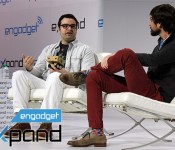
Reben told Engadget editor-in-chief Michael Gorman on-stage at Expand NY 2014 that he’s exploring where else a robot with the capacity to listen endlessly would be able to help people. He’s had a few conversations about getting those Blabdroids into places where people don’t have anyone to talk to (like hospices), or into the hands of people who can’t express themselves well (like those with autism). We’ve already seen the elderly take a shine to a seal-like robot in Japan, and an autistic child build a not-so-one-sided relationship with Siri. The value to these people seems clear, but the ethical questions aren’t insignificant. After all, isn’t it exploitative to use unfeeling machines that tug on very primal parts of the brain to emotionally manipulate people? To provide with them with the impetus to divulge distasteful truths or trick them into thinking something cares about them? The jury’s still out on that, but Reben offers one example of a genetically conditioned companion that no one bats an eyelash at.
“A lot people say things like social robots and forming relationships with them is a net bad for society. As a species we’ve already created a companion – the dog.”

More than 120,210 German voters have successfully brought the Samsung Galaxy Note Edge to Germany
 Petitions don’t seem to normally work, but it appears this one has, and has made Samsung reconsidering bringing the Samsung Galaxy Note Edge to Germany. Okay, so it wasn’t exactly a petition since it was started by Samsung themselves, but thanks to over 120,210 voters (which actually totals 145,531 votes now), Samsung has decided it is going to bring the Note Edge to Germany after only confirming availability in the US, Japan and South Korea. What’s more, Samsung says it is going to offer the “premium” version of the device starting in late November, ending on December 31st with the standard version going on sale in early 2015 – we’re not sure what the premium version entails, but we know it will be available in Charcoal Black and Frost White colour variants.
It’s actually a pretty unusual ploy to see whether a target market wants to get a certain device, but it appears to have paid off for Samsung, assuming these 145,531 votes translate in some way to sales for the Note Edge. Of course, the Note Edge’s defining feature is its curved screen, which doesn’t quite achieve the novelty of last year’s Samsung Galaxy Round, but instead adds a surprisingly functional side bar down the length of the device. Throw in the same specs as the Galaxy Note 4, and you have a pretty impressive (albeit expensive) device.
What do you think about the Note Edge being released in Germany? let us know your thoughts in the comments below.
//<![CDATA[
ord = window.ord || Math.floor(Math.random()*1E16);
document.write('‘);
//]]>
The post More than 120,210 German voters have successfully brought the Samsung Galaxy Note Edge to Germany appeared first on AndroidSPIN.

Learning circuits and programming with the Geek Squad

If you’re ever made a gadget purchase at Best Buy, you’ve likely heard of the Geek Squad: the retailer’s in-house fleet of tech support and repair specialists. Well, helping with your hard drive issues isn’t all they do. Here at Expand NY, the crew is showing off some of the tools used at Geek Squad Academy events where kids can learn about technology — from circuits to programming and more. Being the type to roll up our sleeves, we headed over to take a look. Jump down after the break to take a look at the banana-powered piano and video game controlled with a pair of watermelons.
Here’s the banana piano. That piece of fruit on the right is the ground and tapping the others makes the sounds. The system uses a $50 MaKey MaKey board that features two sides for different skill levels to help with the learning. In terms of software, the Geek Squad uses Scratch, a basic programming app, to sort the intended behavior.
The MaKey MaKey can also be used to create circuits that double as video game controllers, using watermelons or aluminum foil to make jumps or navigate a maze.
Filed under: Misc

Virtual reality has a future beyond video games, and it’s already started

With devices like the Oculus Rift and Sony’s Project Morpheus driving the public’s interest in virtual reality, it’s easy assume the future of VR lies in video games. It’s a safe prediction, but it isn’t right: “It’s a broad category,” Matterport’s Matt Bell said at Engadget Expand. “I think it’s going to go in about ten directions at once.” Bell compares the future of VR to the history of the internet — in the early days, we had no idea how pervasive the technology would become. Now it’s wormed its way into every aspect of our lives. Bell isn’t alone in his optimism: LindenLab’s Ebbe Altberg and BeAnotherLab’s Marte Roel joined us in New York City to talk about the future of VR beyond gaming.
#fivemin-widget-blogsmith-image-845701display:none; .cke_show_borders #fivemin-widget-blogsmith-image-845701, #postcontentcontainer #fivemin-widget-blogsmith-image-845701width:570px;display:block;

trydocument.getElementById(“fivemin-widget-blogsmith-image-845701″).style.display=”none”;catch(e)
All three of the entrepreneurs have wildly different takes on how to use VR — Bell’s Matterport 3D camera strives to capture the physical world and make it virtual; Altberg’s vision for Linden Lab and Second Life is to create a platform for creating new experiences within virtual spaces. Roel’s goals are even further reaching: with projects like the Gender Swap Experiment, he hopes to use VR to help humans get along better. “If you can better understand the other you can better understand yourself,” he says. “We’re even applying it for conflict resolutions with partners in the United Nations and other key people.”
Despite the differences in the companies approach to VR, none of them were willing to actively claim they had found the technology’s “true calling,” as it were — the virtual reality has too much potential to be limited to one major use case. “When people ask what’s the killer app,” Altberg explains, “well, there’s going to be lots of killer apps. I think of VR as a horizontal thing that you’ll be able to apply to almost anything.” That future isn’t here yet, but it’s coming – and men like Roel, Bell and Altberg are helping make to make it a reality. Check out the video above to watch the full panel.
Filed under: Misc

A colony on Mars will be the ‘next giant leap for mankind’

Bas Lansdorp, CEO and co-founder of Mars One, is nothing if not ambitious. His dream is the stuff of science fiction — not only does he want to put humans on Mars in 2025, but he wants to leave them there to establish a self-sufficient settlement. And he plans to fund the enterprise, in part, by televising everything from pre-mission training to daily life on the Red Planet. Or as much as the colonists want us to see, anyway, as they’ll ultimately be in control. As you can imagine, he’s a pretty interesting guy to talk to, which is why we were psyched to have him on the Engadget Expand stage to articulate his vision, and what he hopes it’ll mean for humanity.
#fivemin-widget-blogsmith-image-422346display:none; .cke_show_borders #fivemin-widget-blogsmith-image-422346, #postcontentcontainer #fivemin-widget-blogsmith-image-422346width:570px;display:block;
 trydocument.getElementById(“fivemin-widget-blogsmith-image-422346″).style.display=”none”;catch(e)
Building a human settlement on Mars doesn’t just sound challenging, it sounds nigh on unachievable. But, as Lansdorp explains, the technology that would allow the Mars One project to succeed already exists, so it’s not as far-fetched a goal as it might initially appear. And, of course, the plan isn’t just to blast a rocket in the right direction and hope for the best. The first Mars One probe is due to touch down in 2018, and two years later, a rover is expected to start scouting out potential colony sites. In 2022, life support systems and various essential equipment will be sent to Mars ahead of the first manned mission, scheduled to launch in 2024.
Technically, the concept might be sound, but with so much investment required, why even bother? To Lansdorp, it’s simple: “Progress.” The reason we’re such a successful species, he says, is because we’re always pushing the boundaries, and Mars One is just an excuse to indulge our collective need to explore. He also hopes the adventure will do something to unify the world, too, bringing everyone together through “one common goal.” Just maybe, sending people to Mars will inspire children to want to be astronauts again, “not popstars,” and by televising the journey of the first off-world settlers, we can live it with them. “It’s literally the next giant leap for mankind.”

The biggest obstacle to Mars One’s success is not the technology involved, according to Lansdorp, but finding the right people for the job. After all, it’s a one-way ticket, and the team dynamics will have to be perfect to give the colony any chance of thriving. The explorers that will eventually be selected and trained over the course of the next decade will be put through some rigorous tests before being sent into space. Part of that training will involve living in a mock colony, cut off from all support, with problems artificially inserted into the situation — including what’s apparently one of the toughest things to deal with psychologically: A broken and smelly toilet.
[Image credit: Mars One]
Even you can build your own social wearable

It’s easier than you think to create your own wearable gadget — assuming you’re handy with a needle and thread. At Engadget Expand this weekend, Kate Hartman, an associate professor at OCAD (Ontario College of Art and Design) University led workshops focused on building social wearables. Unfortunately, I quickly learned that my inability to sew well would hinder my wearable dreams. But, as you can see in the gallery below, others were far more successful.
I received a small bag of supplies at the beginning of the session — including a watch battery, alligator clips, LED light, and conductive material — as well as quick instructions on how to create basic circuits. Wiring up the light to the watch battery was easy enough. Even young children in my session managed to get their lights flickering. But it was when I had to figure out how I wanted to shape my wearable that things began to fall apart. By the time I figured out a design and started putting conductive thread to cloth, our time was up.
Hartman tapped a recipe from her recent book, Make: Wearable Electronics, to show us how we can create gloves that light up when we high-five a friend. Some attendees took the idea to another level by creating complex sleep bracelets with the same basic idea, while others made gloves that buzzed when they completed a circuit with other conductive wearables.
So far, the wearables trend has mostly focused on young and hip techies obsessed with tracking their daily activities. But Hartman’s workshop showed there are plenty of other things they can do. We may not all want clothes that light up, but the same basic techniques could be used to customize clothing and accessories in a variety of ways. And the audience, which ranged from families with young children to senior citizens, seemed eager to explore all of those possibilities.
Filed under: Wearables

Moto X now available with football leather backing, but for Verizon only

If you’ve not gotten your hands on the new Moto X (2014) just yet then perhaps a new football leather-backed Moto X offering from Verizon might just tempt you.
For football fans out there, this new Moto X is available online and in-store for just $119.99 after a $50 on-contract rebate, exclusive to Verizon.
You’ll have to deal with the Verizon logo on the back, but does give another tasteful design to accompany the leather and wood designs.
As a reminder, here are the Moto X (2014) specs:
| Dimensions | 5.54 x 2.85 x 0.39 in | 140.8 x 72.4 x 10 mm |
| Weight | 5.08 oz | 144 g |
| Display | 5.2 inches (1080 x 1920) 424 ppi |
| Camera | 13 megapixels (rear) | 2 megapixels (front) |
| Hardware | 2.5 GHz Qualcomm Snapdragon 801 – quad-core |
| Battery | 2300 mAh |
| RAM | 2 GB |
| Storage | 16/32 GB |
| Operating System | Android 4.4.4 KitKat – Upgradable to 5.0 Lollipop |
| Durability | N/A |


The post Moto X now available with football leather backing, but for Verizon only appeared first on AndroidGuys.

The top 9 tablets you can buy right now

The tablet market hasn’t seen the turnover that smartphones have enjoyed, but there’s still a steady stream of new and improved slates coming out. However, this time around we’ve only seen fit to add a couple of new devices to our buyer’s guide tablet listing — for the time being, at least. If you’re still in the market for one, or looking to trade up, we’ve still got you covered. You can peruse the entire list in our official guide or head on down to the gallery below for a quick tour of the best options on the market.
Filed under: Tablets, Apple, Samsung, Sony, Microsoft, ASUS, Acer
DARPA goes beyond killer robots with prosthetics and Ebola research

DARPA, the military’s mad science division, is also a master of PR — we all cheer them on, even though they may be building a robot army that one day hunts us down. But the robots have become a cliche, of course. DARPA was actually founded to “prevent technological surprises” of any kind after the Soviets launched Sputnik in 1957. As a result, it also supports beneficial projects only peripherally related to defense, like Ebola research, brain-controlled prosthetics and space exploration. Here at Engadget’s Expand NY, we sat down with Director Arati Prabhakar to learn about how its pushing boundaries with its, shall we say, less terrifying work.
#fivemin-widget-blogsmith-image-900377display:none; .cke_show_borders #fivemin-widget-blogsmith-image-900377, #postcontentcontainer #fivemin-widget-blogsmith-image-900377width:570px;display:block;
 trydocument.getElementById(“fivemin-widget-blogsmith-image-900377″).style.display=”none”;catch(e)
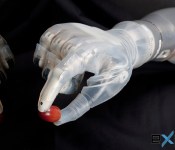
Prabhaka started with the history of Jan Scheuermann, a Pittsburgh area woman who’s been unable to move any of her muscles from the neck down for a decade. Thanks to two “ports” on top of her head, she’s gradually gained finer and finer control of a specially developed robotic limb using her mind. She can now manipulate it to the point where she can drink from a cup, open doors and even shake hands. DARPA sees the tech as eventually helping disabled soldiers, though Prabhaka admitted that practical applications are still a long ways off.
Also little-known is DARPA’s work with biotech and infectious diseases. Its researchers are trying to short-circuit the time it takes to develop vaccines and even cures for Ebola and other nasty plagues. For instance, rather than waiting days for a regular vaccine to trigger your natural defense system, why not just create the antibodies in the first place? It’s also working on instant disease diagnoses via paper strips, for instance — a military application to counter germ warfare, but something obviously handy for civilian outbreaks as well.

Nowhere is DARPA more interested in cutting down wait times and costs than in space. That frontier has become critical in nearly every aspect of the US military as well as civilian telecommunications and navigation systems. Rather than having to wait up to three years and spend tens of millions of dollars for a single launch, DARPA is trying to cut down the window to as little as 24 hours. Since technology has significantly reduced the size of satellites, one team is aiming to get micro-satellites to high altitudes on conventional aircraft, then launch them the rest of the way into space using a small rocket. For midsized payloads of 3,000 pounds or so, another project is shooting for a 24-hour launch window and cost of $3-5 million — a huge discount in time and money over a normal launch.
Finally, Prabhakar discussed DARPA’s work with big data. It assisted law enforcement in taking down a human trafficking ring by crunching vast amounts of information, eventually tracing the network to North Korea. All of those projects show that the DoD’s wing of crazy researchers isn’t just about jetpacks, brick-hurling robots and laser-guided bullets. Instead, it’s focused on a huge quest to uncover new tech — the best way to “prevent surprises,” she said, is to unleash them yourself.
[Image: DARPA (prosthetics)]
 AIVAnet