


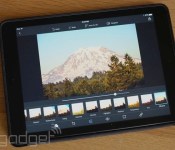
Photoshop Express blemish removal and RAW support boosts mobile editing

Adobe has been making quite the heavy-handed push with its mobile apps as of late, and one of its older no-cost options just received a significant update. Photoshop Express for both Android and iOS tacked on blemish removal and defogging tools to further enhance edits on the go. There’s also a new intensity control that allows you to tweak how much of those built-in presets are applied — a feature similar to Instagram’s recent add-on. Last but not least, the software can also import RAW files for editing purposes; however, it’s unclear whether you’re tweaking a smaller “thumbnail” version that remains tied to a desktop, as is the case in Lightroom mobile. At any rate, those files are uploaded through the free tier (unless you’ve committed funds) of Adobe Revel before syncing with the app. If those trusty mobile devices have yet to alert you to the update, both versions are available for download via their respective repositories.
Filed under: Tablets, Software
Via: 9to5Mac
Source: iTunes, Google Play

One for the future: playing with the new Adidas miCoach Smart Ball

I still remember my old, favorite football like it was yesterday. It wasn’t made by Nike, Adidas or even Diadora, but it lasted me for about seven years, from when I was 7 until about 14 or so. And even though, toward the end of its life, it started to look as if it had been living in a waste dumpster, never, ever did it let me down. Despite the battle scars collected over the years, like the faux-leather gradually falling off or needing to get pumped up every time before a game, that cheap, low-tech ball always did what it was supposed to: Be, well, a ball you could have fun with. In recent years, however, things have changed quite drastically. As technology evolves, sports balls continue to get smarter and smarter, with a great amount of research and development money being spent by manufacturers. Here’s where Adidas’ recently announced miCoach Smart Ball comes in.
“The miCoach ecosystem is rooted in making athletes better.”
With its new intelligent sphere, priced at $299, the sporting goods giant aims to give players not only something to use as a playing ball, but also a tool to improve their skills. A key part of the ball, naturally, is integrating the Smart Ball into Adidas’ miCoach environment, one that focuses on keeping track of your data during workouts or training sessions. “The miCoach ecosystem is rooted in making athletes better,” said Christian DiBenedetto, senior innovation director at Adidas. In this case, the Smart Ball’s miCoach app, which is only available for iOS at the moment, pairs with the ball over Bluetooth and lets you view how fast you’re kicking the ball and its trajectory, as well as set challenges for yourself and save records so that you can compare them at a later point.

“Today, if players want to improve their kicking, they may take some balls to the local field and just kick over and over again trying to produce the kick intended and if they do, they have to try and figure out what they did differently to make it happen. The Smart Ball already understands how to do the kick that the player wants to learn, so after every kick, it coaches the player on what exactly they need to do to achieve the kick,” explained DiBenedetto. “This makes the learning process much more efficient. In the game, the player only gets one chance to make that free kick; with the Smart Ball, we are turning good luck into good technique.”
In my experience, the general feeling while playing with the Smart Ball was a great one. Adidas’ miCoach app works really well; it shows where exactly you struck the ball and your most recent shots, all while sending the info to an iOS device almost instantly after taking a shot. The wait between measured shots, though, is something I found to be cumbersome — for example, after taking a kick, you have to wait for the application to collect that data before moving on, otherwise it disrupts the process and fails to record your stats. Still, since this is meant to be for training, after all, it is a requirement to get the most out of the ball — and seeing those neat numbers makes it worthwhile. Given its features, it’s worth noting that the Smart Ball does need to be charged every now and then, but this process is made easier with the included wireless charging station.
We’re talking about a company that has designed every official World Cup ball since 1970.
For now, Adidas is taking a shot at the everyday consumer with its Smart Ball, but it does intend to bring the technology to professional pitches all over the world. Theoretically, it shouldn’t be a problem to do that, especially since we’re talking about a company that has designed every official World Cup ball since 1970. “The Smart Ball is the first step to a ball that understands the game,” DiBenedetto told me. “Imagine World Cup 2018 and on the pitch is the Smart Ball able to tell which player passed it or shot it; who intercepted it or received it; where on the pitch it is; and, of course, how fast it’s traveling, in what direction, [with] how much spin and trajectory. Every play broken down by the ball and shared with the fans in the stadium and anyone connected to the internet that wants to understand the game.”
“A Smart Ball on the pitch would be able to enlighten the fans to the true art and skill required to play on this global stage. How did [Lionel] Messi make that free kick against Nigeria? The Smart Ball would break it down and coach any player that wanted to learn how to do that shot for themselves,” he added.
[Images: Daniel Orren for Engadget]
Filed under: Misc, Peripherals
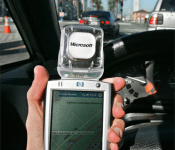
Microsoft kills off ‘Streets & Trips,’ hopes you’ll use Bing Maps instead

Microsoft MapPoint has been around a long time. How long? So long that a stock-image search pulled up this gem from 2005 — a photo of “Streets & Trips” running on a Pocket PC. In fact, the mapping platform is even older than that: It was first created by a company called NextBase in 1988, which MIcrosoft later acquired in 1994. Incredibly, it’s lived on, even long after people stopped storing maps on CD-ROMs. Finally, though, the software is going the way of the floppy disk: The company has discontinued MapPoint, Streets & Trips, and AutoRoute, with users encouraged to use Bing Maps instead. And, ya know, that kind of makes sense, considering CEO Satya Nadella only yesterday posted an open letter describing Microsoft as a mobile- and cloud first company. Somehow, knowing Engadget readers, we suspect this won’t affect you much, but in the event that you do still use Streets & Trips, you’ll continue to have support through at least July 2015. After that, you may need to get with the times.
Image credit: Associated Press
Filed under: Internet, Software, Microsoft
Via: Re/code
Source: Microsoft

Buyer’s Guide: Discounts on Retina MacBook Pro, iPad, Apple Accessories, and More [Mac Blog]
There are some good deals on Apple-related accessories this week, as well as some decent discounts on the Retina MacBook Pro and an iPad deal from Target that includes free gift cards.
Retina MacBook Pro
Like last week, several retailers are offering $100 to $150 off most Retina MacBook Pro models. The 13-inch Retina MacBook Pro with 4GB of RAM and 128 GB of storage is $1,199 at Amazon, Adorama, and B&H Photo. The 13-inch Retina MacBook Pro with 8GB of RAM and 256GB of storage is $1,399 at Amazon, Adorama, and B&H Photo. The lower-end 15-inch Retina MacBook Pro with 8GB of memory and 256GB of storage is $1,849.99 at Amazon, Adorama, and B&H Photo, while the higher-end model with 16GB of memory and 512GB of storage is $2,449 at Amazon, Adorama, and B&H Photo.
Buying from Adorama and B&H Photo gives the benefit of no sales tax in many states, as these two stores only charge tax in New York/New Jersey and New York, respectively.

iMac
There aren’t many deals on the iMac this week, but both Adorama and B&H Photo are offering the 21.5-inch iMac with 8GB of RAM and a 1TB hard drive for $1,349, a savings of $150 off the standard price.
MacBook Air
Apple’s 11.6-inch MacBook Air with 4GB of RAM and 256GB of storage is available for $999 from Adorama, a savings of $100. The 13-inch MacBook Air with 256GB of RAM can be purchased at $1,099.99, a $100 savings, from Adorama or B&H Photo.

iPads and iPhones
Target is currently offering a $100 Target gift card for customers who purchase an iPad Air or a Retina iPad mini (WiFi or WiFi + Cellular) in any capacity. Though Target is charging full price at $499 and $399, respectively, the gift card is a good deal for regular Target customers.
Target is also offering a $20 Target gift card with the purchase of a 16GB iPhone 5s or 5c. The iPhone 5c is available from Target for $30 and the iPhone 5s is $100. Target’s deals last through July 12.
Accessories
Jawbone’s Jambox speaker can be purchased via Groupon for $89, a discount of $21, while Meh.com is offering the JBL OnBeat Micro Speaker dock for $15. The Apple TV is available for $89 through Best Buy, a $10 discount.

Apps
This week marks the sixth anniversary of the App Store, and several developers are offering sales on their apps. Popular games like Threesand Monument Valley are available at low prices, so make sure to check out our anniversary post to get a look at all the deals.
Before making a purchase of a Mac or iOS device, make sure to consult our Buyer’s Guide to find out if it’s a good time to buy. For example, because the MacBook Air was updated in April, the Buyer’s Guide indicates that now is a good time to purchase.
MacRumors is an affiliate partner with some of these vendors.

Samsung keeps its distance from the Android pack with Galaxy Apps store

Samsung has spent the last several years trying to separate itself from the rest of the Android pack. Of course, that was much to the chagrin of Google. And while the two apparently reached an agreement to reduce the amount of bloat and branded services, Sammie is quite ready to give up on building its own ecosystem just yet. The company announced a major redesign and rebranding of its own app store, which is now known as Galaxy Apps. The goal, according to WonPyo Hong, president of the media solution center at Samsung Electronics, is to provide “differentiated solutions and services.” And that including delivering “hundreds of apps exclusively available to users of Samsung Galaxy mobile devices.” Though, what compelling apps are included in that and whether or not anyone will use them is still not exactly clear.
The move seems particularly interesting in light of Samsung’s apparent decision to hand over the reins of its enterprise friendly Knox project to Mountain View. Elements of the security suite are going to be incorporated into the next version of Android and security features for the OS will be entirely controlled by Google. But that leaves Sammie in a slightly awkward spot, it doesn’t want to be a commodity handset maker, but ways to stand out are increasingly hard to come by. Whether or not a streamlined, exclusive app store will be enough to do that is debatable. And there’s always the chance that this will rub Google the wrong way and lead to another round of tense negotiations between the maker of Android and its largest hardware partner.
Filed under: Software, Mobile, Samsung, Google
Via: Telegraph
Source: Samsung

Are we there yet? A century of the smartwatch in pictures

With two Google-powered smartwatches currently on sale, and the circular Moto 360 already causing a stir among design geeks, wearables are one step closer to securing a place on our wrists. And while many of us aren’t ready to strap on a Gear Live, G Watch or Pebble just yet, that doesn’t mean the smartwatch is a new concept. In fact, depending on your definition of “smart,” these gadgets have been fusing time-telling with extra functionality since the early 20th century. From wrist-borne spy cams to radio-controlled timepieces, here’s a look at this wearable’s evolution.
Filed under: Wearables, Mobile, Apple, Samsung, Microsoft, Google, LG

Angry Birds Star Wars 2 picks up 30 new levels in ‘Master Your Destiny’ Update
Rovio has a new update awaiting your download. 30 new levels have been added to Angry Birds Star Wars 2, 15 for the bird side and 15 for the pork side. The new set of levels is called ‘ Master your destiny’ and allows you to pick from your saved characters or from telepod characters. This means you are in control of what bird, or pig, you toss at the opposing side.
Get ready to MASTER YOUR DESTINY! Start as a Jedi Youngling or Sith Hopeful and rise the ranks in this all-new chapter! This time you choose what bird or pig to sling into battle from your saved characters or by scanning your Telepods! Plus, it’s now free to download on both iOS and Android!
It seems there could be some confusion with that “Free to download on both iOS and Android” statement. While ABSWII has always had a free and paid option for the main app, it was the add-on levels that required a lot of work in collecting the slingshot coins or some real world cash to buy a bunch. The Master Your Destiny update is unlocked from the get go.
//<![CDATA[
ord = window.ord || Math.floor(Math.random()*1E16);
document.write('’);
//]]>
The post Angry Birds Star Wars 2 picks up 30 new levels in ‘Master Your Destiny’ Update appeared first on AndroidSPIN.

Google Maps for iOS Updated to Display Search Results, Gmail Appointments On Map [iOS Blog]
 Google today updated its Google Maps app to version 3.2.0, adding several new functions to improve the utility of the app. Search results now appear with descriptions on the map to make choosing an option easier, and search results can be viewed on the map or on a list.
The locations of reservations and appointments drawn in from Gmail are also displayed directly on the map. While Google mentions Explore in the release notes to draw users to try the feature, the local point of interest feature is not new.
What’s new
– Search results appear with descriptions right on the map, to help you make choices quickly
– View search results on the map or in a list and easily switch between them
– See your reservations and appointments from Gmail labeled on the map -Try the new Explore, a local guide that shows you different places and activities depending on the location and time of day
Google Maps can be downloaded from the App Store for free. [Direct Link]

Smartphone Manufacturers ‘Lukewarm’ on Sapphire, Call Material Impractical Due to Cost and Supply
Rumors have suggested that Apple is using the sapphire garnered from its partnership with GT Advanced to produce sapphire crystal displays for the iPhone 6, and if true, such a move would normally inspire competitors to produce their own devices with sapphire displays.
It does not appear, however, that other major smartphone manufacturers are ready to adopt sapphire as a display solution, due to the expense of the material and its quality compared to the more popular Gorilla Glass.
Engadget, in an in-depth piece on sapphire displays, contacted multiple representatives from major smartphone companies, who had researched sapphire as a possible material and largely decided against it. LG, for example, said the material was too expensive.
“The cost and supply aren’t where we’d like them to be for sapphire to be practical just yet,” said Ken Hong, Global Communications Director for LG. “Sapphire’s durability and scratch-resistance are certainly attractive, but Gorilla Glass isn’t going to be displaced anytime soon.”
Sapphire is astronomically expensive compared to alternatives like Gorilla Glass, with a pane costing $30 compared to $3. Apple’s partnership with GT Advanced has allowed Apple to help fund advanced sapphire production methods that significantly lower manufacturing costs, however, a feat that most manufacturers will be unable to match.
A look at how GT Advanced produces sapphire
Sapphire is an appealing option due to its extreme hardness and its scratch resistance. Rated at a nine on the Mohs hardness scale, few materials aside from diamond can scratch sapphire, but as one representative pointed out, sapphire is highly brittle. “The sapphire is too hard to withstand bending. It’s easier to break during drop tests when the size of sapphire increases.”
Gorilla Glass manufacturer Corning has heavily criticized sapphire for the same reason, noting that its own product can withstand 2.5 times more pressure. Corning has also pointed out that Gorilla Glass is cheaper, far lighter, and more environmentally friendly as it takes less energy to produce. Sapphire also transmits less light, making it both dimmer and less clear unless specially treated.
 Strength test conducted by Corning, showing sapphire shattering at 161 pounds while Gorilla Glass survives
Yet another representative suggested that sapphire simply doesn’t make sense except from a marketing standpoint, which would certainly work for Apple as a way to distinguish itself as a more luxury smartphone option. Apple has always stood out from other manufacturers with its insistence on quality over price, setting it apart as a premium brand.
Though rumors have indicated Apple is planning to use sapphire displays in its smartphones, it remains unclear if the iPhone 6 will indeed feature a sapphire screen. It is possible the company’s sapphire is reserved for a different project, the iWatch, and it is also possible, based on circulating rumors, that only the larger 5.5-inch iPhone 6 will be equipped with a sapphire display.
Either way, it’s likely we will get our first glimpse of an Apple product that utilizes sapphire crystal later this year and as Engadget points out, it is likely that manufacturers will take advantage of sapphire for products like smart watches, later transitioning to larger products as supply techniques and production improve.

Sharp Seeking to Reduce Reliance on Apple, Regain Control of iPhone Display Plant [iOS Blog]
 Key display supplier Sharp is reportedly seeking to reduce its reliance on Apple, with sources telling Nikkei the company has offered Apple 30 billion yen ($293 million) to purchase the equipment located in Sharp’s Kameyama Plant No. 1 that currently churns out displays for the iPhone. Apple contributed roughly half of the 100 billion yen (~$1 billion) cost to convert the plant from large TV panels to small iPhone displays in 2012, with Apple owning the plant’s equipment.
By taking a leadership role in running the plant, Sharp apparently seeks to diversify its customer base. Being able to supply panels to Chinese smartphone manufacturers, for example, would make Sharp less dependent on Apple. The U.S. technology giant is said to be demanding that the Japanese company not supply panels to Samsung, Apple’s biggest smartphone rival.
According to the report, the plant is currently running at 90% capacity producing displays for the iPhone 6, giving Sharp some flexibility in the negotiations until demand from Apple starts to slow down with the natural cycle of iPhone production.
Apple typically sources its displays from several suppliers, and Apple’s main iOS device assembly partner Foxconn has reportedly been looking to partner with Sharp to begin some of its own production of iPhone and iPad displays. It is unclear how willing Apple will be to give up the display equipment, but if it does provide Sharp with some more flexibility there are still a number of display partners that could help fill any void left by Sharp’s diversification.
Reliance on Apple is major issue for many suppliers, both in terms of managing the cyclical nature of the business given Apple’s product release patterns and the potential for major disruptions of the companies’ revenue streams should Apple suddenly decide to change suppliers. As a result, it’s a delicate balancing act for many companies happy to have Apple’s business but looking for other opportunities to sustain themselves when Apple’s demand wanes.
 AIVAnet