


iTunes Pass links your credit to iOS’ Passbook app (but only in Japan)

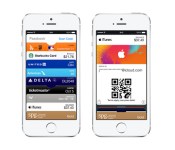
Scratch-cards are fun. Inputting lengthy serial codes, less so. We’re not sure why Apple’s testing this out in Japan first, but iTunes Pass marks another effort in the direction towards smoothing mobile payments — something that country knows plenty about. Spotted on Apple’s Japanese iTunes page by 9to5Mac, the company describes how users can now deposit money directly to their iTunes account inside bricks-and-mortar stores. Apple sales assistants will scan the Passbook card (seen above) and the payment will go through then and there, ready to be used instantly. The Passbook app can already be installed from the iOS iTunes Store app in Japan and as 9to5Mac notes, with only eight stores, the country could be the easiest way to gauge the service before deciding whether to take it global. Oh yeah, and it’s completely different to Apple’s 2009 iTunes Pass.

Filed under: Cellphones, Tablets, Mobile, Apple
Via: 9to5Mac
Source: Apple Japan
Google strikes smart contact lens deal to track diabetes and cure farsightedness

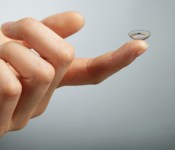
With Glass and Android Wear, Google has already invested a lot of time and resources into developing the next-generation of wearables, but it’s another of its eye-focused projects that has today received its first major boost. The search giant’s secret Google[x] team has confirmed that it’s licensed its smart eyewear to healthcare specialist Novartis, which will develop the technology into a product that can improve eye care and help manage diseases and conditions.
As part of the agreement, Google[x] and Novartis’ eye care division Alcon will create smart lenses that feature “non-invasive sensors, microchips and other miniaturized electronics” and focus on two main areas. The first will provide a way for diabetic patients to keep on top of their glucose levels by measuring the sugar levels in their tear fluid, feeding the data back to a smartphone or tablet. The second solution aims to help restore the eye’s natural focus on near objects, restoring clear vision to those who are only farsighted (presbyopia).
Google’s role will be to develop the tiny electronics needed to collect data and will also take care of the low-power chip designs and fabrication. Alcon, on the other hand, will apply its medical knowledge to develop commercial versions of the smart contact lens. “Our dream is to use the latest technology in the miniaturization of electronics to help improve the quality of life for millions of people,” says Google co-founder Sergey Brin. “We are very excited to work with Novartis to make this dream come true.”
Filed under: Wearables, Google
Source: Novartis

Nest, Samsung and others team up for better home automation

A group of tech companies including Samsung, Google’s Nest Labs and chipmaker ARM are teaming up to create a unified system to run all of your connected home gadgets. Thread uses low-power mesh networks to run all of your devices, promising greater reliability and cloud access for every piece of hardware in your house. The name might be new, but an early version of the protocol is already used to drive Nest’s thermostats and smoke detectors. The group also believes that a simple software update would enable plenty of other existing smart home products to join in the fun. Of course, this isn’t the only group trying to marshal the disparate forces that are trying to make in-roads into our homes. For instance, Qualcomm and Apple all have rival platforms in various stages of development — so perhaps the next generation of forum debates arguments will be about which connected washing machine is “better” than the rest.
Filed under: Wireless, Samsung, Google
Via: Yahoo
Source: Thread

Apple Launches ‘iTunes Pass’ at Japanese Stores, Enabling Customers to Refill iTunes Credit With Passbook
Apple today debuted its new iTunes Pass service in its Japanese retail stores, allowing customers to purchase iTunes Store credit directly without the need for physical gift cards, reports 9to5Mac.

A photo about the feature from Apple’s Japanese website (Google Translate)
To use the service, customers add a new iTunes Pass inside of the existing Passbook application found in iOS, and then locate a Specialist inside an Apple Retail Store. Once the iTunes Pass is presented to the Specialist, the customer can say how much money they want added, which is then instantly transferred to an iTunes account.
It is not known when the new service will be rolled out to Apple Retail Stores worldwide, however it is likely that the company is testing the program in Japan ahead of a larger rollout. In 2012, Apple enabled users to store Apple Store gift cards in Passbook, and also allowed users to email Passbook enabled gift card to friends through the app.
Earlier this year, it was also reported that Apple was working on its own mobile payments service, which could be similar to iTunes Pass. According to that report, the company’s mobile payment solution would be integrated directly into iOS, allowing people to use their devices to purchase physical goods on the web and in physical retail stores.

Apple Searching for Retail Employees to Test Upcoming Photos App for OS X
Apple is actively looking for retail employees that are “passionate photography enthusiasts” to test the upcoming Photos app for OS X, reports 9to5Mac.

We are seeking a technical and passionate photography enthusiast to join our Quality Assurance team working on Photos for OS X. You will be part of a fast moving team of specialists tasked with delivering the next generation of photography tools for Apple.
Photos for OS X was briefly introduced at WWDC 2014, as Apple will launch the software early next year. It was also reported last month that the new Photos app will be replacing Apple’s existing iPhoto and Aperture programs. Apple revealed that Photos would feature a number of professional-grade features, including image search, editing, effects, and support for third-party extensions.
Apple has invited retail employees to try pre-release software for the past few years. Last year, the company offered beta access to OS X Mavericks and iWork for iCloud last year, which followed access to OS X Mountain Lion in 2012.
This new carbon nanotube material is the darkest thing on the planet

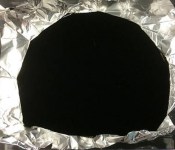
We know what darkness is: it’s the absence of light, and something we each encounter when the sun goes down. Seeing darkness in broad daylight on the other hand, that’s weird. It’s also, astonishingly, a completely possible thing. Sitting on a piece of aluminum foil in Surrey NanoSystems’ lab is something called Vantablack — a low-temperature carbon nanotube material that absorbs 99.96% of all light that touches it. It’s effectively the darkest material on the planet, and anything draped in becomes non-reflective, losing any and all surface detail. So, what’s the point? This new ultra dark material uses a low-temperature process, which allows it to be applied to things like stealth vehicles or telescopes, allowing them to avoid detection or see farther, respectively. The firm says it’s scaling up production for customers in the defense and space sectors. The company says it’s already delivered its first orders, and says its working on an even darker version of Vantablack. Well, here’s to a darker future.
[Image credit: Surrey NanoSystems]
Filed under: Misc
Source: Surrey Nanosystems, Independent, The Guardian

Virgin Media rolls out more Sky Sports HD and entertainment channels

If you’re a Virgin Media customer who enjoys Sky content both at home and on the move, we have some good news. Following the announcement that they’d expanded their existing content deal back in May, Virgin Media has today begun rolling out new Sky Sports channels, adding Sky Sports 3 HD, Sky Sports 4 HD and Sky Sports F1 HD to customer set-top boxes. The new Sky Sports 5 channel will also take its place in the lineup, delivering football from Europe’s top leagues in high-definition when it launches in the coming weeks.
In order to accommodate them, the company has made slight changes to its electronic programme guide, but you shouldn’t notice too much of a difference. If catching up on your favourite shows from your mobile is more your thing, Virgin’s enabled access to Sky’s entertainment channels (not including Sky Atlantic) from its TV Anywhere app, allowing you to watch Sky 1, Sky 2, Sky Living, Sky Living it, Sky Arts 1, Sky News and Sky Sports News on your iOS or Android device. Movies and sports are said to be coming to the app too, but you may have to wait a little while longer to get more free stuff.
[Image credit: Sport On The Box]
Filed under: Cellphones, Home Entertainment, Tablets, Internet, Software, HD, Mobile
Source: Virgin Media

Data thieves want to track what you type at hotel business centers

You may not want to use your hotel’s business center to check email on your next big trip. The Secret Service has warned the hospitality business that thieves are installing keyloggers on hotel PCs to steal guests’ data. In a recent Dallas area bust, authorities caught multiple people swiping account logins, banking info and other personal details from travelers typing away at compromised business center systems. The culprits didn’t even have to exploit security holes to get in — the key-tracking software required “little technical skill.”
The Secret Service recommends that hotels do more to clamp down on theft, such as giving guests limited PC accounts that prevent them from installing apps. As security guru Brian Krebs notes, though, that’s not going to help much. Even if the PCs wipe their data clean after every session, it’s not hard to run code from a CD or USB drive to thwart most defense mechanisms. The best solution may simply be to do what many already do — use your own devices to check sensitive info, and use a hotel’s public computers only for content you’d be comfortable showing to strangers.
[Image credit: João Lavinha, Flickr]
Filed under: Internet
Source: Krebs on Security

Lab-grown ‘real’ cheese made without milk

Real vegan cheese. An oxymoron, but maybe not for long. A group of biohackers, which is a thing now, reckon they can make cheese without milk. Better still, it apparently tastes like proper, legitimate cheese, and not some vegan-friendly substitute mess. The SF-based iGEM group say it’s made from baker’s yeast. The team is able to make cheese proteins using genetic sequences found in mammals, inserting the DNA blueprints into the aforementioned yeast, and it’s all vegan-compatible because it doesn’t need animal products to make the proteins.
Weirder (or creepier depending on how you view it) some of the DNA strands in some of their cheeses come from humans. The thinking there is that milk proteins made from our own species could offer reduced allergic reactions. But like synthetic meat before it, real fake food is still expensive to make: the group’s Indiegogo fundraiser has amassed over $15,000 and still has a month to go. Four different yeast variants are planned, while the team also promises to collect all their research into a public wiki. As with nearly everything delicious in life, it’ll need FDA approval before it can line shelves alongside real real cheese.
Via: Techcrunch
Source: Indiegogo
Google prepares modular phone dev kits (but your idea had better be good)

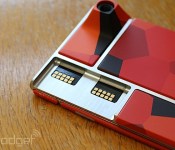
If you’re a developer eager to start tinkering with Google’s Project Ara modular phone technology as quickly as possible, it’s time to get in line. The company has started taking requests for test boards; if you fill out the form before July 18th and meet Google’s expectations, you could have (very) early hardware in your hands before the end of the month. Latecomers can get in on a second wave if they sign up no later than August 18th. Just don’t assume that you can pick up a kit purely out of curiosity. Google is prioritizing the board requests based on your know-how and the “strength” of your proposed module concept — it wants signs that there’s a real device in the works. You’ll have to sit tight if you’re simply a fan of the build-your-own-phone concept, then, but it’s apparent that Project Ara is quickly becoming a tangible reality.
Filed under: Cellphones, Mobile, Google
Via: Pocketnow
Source: Eduardo Ruiz (Google+), Project Ara
 AIVAnet
