



Take a 3D tour of London with Google’s latest Maps update

If you’ve ever wanted to explore London but haven’t been able to fund the trip, Google wants to lend a hand. As part of its latest update, the search giant has unveiled a new 3D model of the city in both Maps and Google Earth, allowing you to pan, zoom and rotate your way down the Thames and past its popular landmarks. London is actually the fifth English city to appear in 3D on Google Maps after Reading, Leeds, Birmingham and Stoke on Trent, while Apple has offered similar (but maybe not as detailed) flythroughs of the capital for some time. Google is quick to point out that its 3D imagery covers the whole city, not just tourist spots and other iconic locations, so if you have some time to kill, head on over to the source link below and get explorin’.
Filed under: Internet, Software, Google
Via: Evening Standard
Source: Google Maps

You can buy a PlayStation 4 for £300 right now

New consoles are never easy on the wallet, so anything to take some of the sting out of that purchase is always appreciated. Case in point: well-known retailer ShopTo has just dropped the price of a brand-new PlayStation 4 to a penny under £300, which is quite simply the lowest price we’ve come across yet. That’s basically a £50 saving compared with almost every other retailer (barring one that’s selling the console for £325 via Play.com). This particular deal is only available through ShopTo’s eBay storefront, and we’ve no idea how long the discount will be in effect for, so you might wanna ride that impulse straight to the checkout to be sure you don’t miss out.
Via: HotUKDeals
Source: eBay (ShopTo)
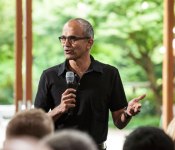
Microsoft cuts 18,000 jobs as part of its largest layoff ever

Microsoft today announced that it’s cutting 18,000 jobs, the biggest round of layoffs in its history, as part of ongoing restructuring efforts. In a release, the company says that Nokia’s Devices and Services business, which it acquired for $5 billion last year, will be most affected, with 12,500 “professional and factory positions” expected to go by the end of the year. In an email to employees, Microsoft CEO Satya Nadella explains that the company’s new strategy is designed to make it “more agile” moving forward, allowing teams to work more freely.
Nadella also hinted that Microsoft could end development of Nokia’s Android-powered X smartphones by shifting “select Nokia X product designs to become Lumia products running Windows.” As for the Xbox and Surface divisions, they’ll see “limited change,” as the company intends to continue building on plans it implemented earlier in the year. Nadella believes today’s cuts will go some way towards helping Microsoft realign itself, allowing it to pursue its goal of innovating both in mobile and the cloud.
Source: Microsoft

Microsoft will abandon Nokia’s Android smartphone project

It’s a day of upheaval over at Microsoft as the company has announced that it’ll cut 18,000 jobs in the near future. At the same time, however, Satya Nadella has cast doubt on the long-term future of Nokia’s X series of Android-powered smartphones. In an email, the Microsoft CEO says that the company will refashion “select” Nokia X designs as Lumia smartphones that run Windows Phone. There’s no word on if the other handsets in the range will continue, but it seems unlikely given that the phones run Android, Microsoft’s biggest rival in the mobile space. If you’re still on the hunt for one of these devices, don’t worry, as Stephen Elop has added that the company will continue to support and sell the existing range of X series devices.
Filed under: Cellphones, Mobile, Microsoft, Nokia

Read the books that inspired Darwin’s theory of evolution

Charles Darwin’s Galapagos expedition is one of the most famous scientific voyages in history and now you can see how he fed his mind aboard the Beagle. Darwin Online, which houses the world’s largest Darwin collection, has now published (in PDF format) what it believes to be all 404 books that Darwin had access to on the ship’s library. They comprise some 195,000 pages with 5,000 corresponding illustrations in French, English and Spanish from encyclopedias, history books, literature and even a racy Spanish novel. Darwin called his years aboard the Beagle a crucial a period that helped him create his seminal theory of evolution, On the Origin of Species. Though you may not have as much time as Darwin did on the infamously long trip, it’s worth a look just for the spectacular hand-drawn illustrations.
Filed under: Science
Via: The Guardian
Source: Darwin Online

A Robot Swarm descends on NYC’s Museum of Math

Roboticist-in-residence James McLurkin offered an advanced preview of his Robot Swarm at NYC’s Museum of Mathematics this week. The presentation detailed the background and programming concepts of these sensor- and speaker-laden bots — which have a habit of spitting out 8-bit-style tunes while they work. The digital creatures exhibit group behaviors much like ants and bees, working together to map out their surroundings and communicating with each other — and there’s a definite hierarchy to their organization. The Robot Swarm exhibit will be open to the public when it’s completed later this year and will be displayed beneath a transparent floor so you can watch the action happen from your own god-like perspective. Head on down to the gallery for a closer look at how the Robot Swarm will organize itself when the robopocalypse finally arrives.
Filed under: Science

Futurama’s intro rendered in 3D is gorgeous

Stop wondering what Futurama‘s intro would look like if it were rendered in 3D and prettied up ten quadrillion percent: it’s here. Well, part of it is anyway, care of Russian animator Alexey Zakharov. He took the spaceship intro to Futurama, references to “Mom’s Old-Fashioned Robot Oil” and all, and applied a suite of computer animation tools (3ds Max, Nuke, Photoshop, After Effects). What you see above is just a mere snapshot into the gorgeous 32-second video we’ve embedded below. Get out your sunglasses, y’all: the future’s so bright, you’re gonna need shades.
[Image credit: Alexey Zakharov]
Filed under: Misc, Software, HD
Via: Sploid
Source: Behance
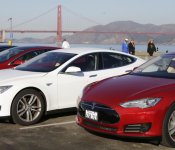
Why Tesla Motors can’t sell cars in most of the United States

Tesla Motors makes beautiful, quality electric automobiles. Don’t just take it from us; Consumer Reports rated the Tesla Model S the “best overall” car in its 2014 Top Picks report (which includes all non-electric cars as well). Yet, despite Tesla CEO Elon Musk’s ongoing effort to expand his EV empire, state after state in the United States is pushing back. Not because those states are against electronic vehicles, Musk or even Tesla; it’s about the way Tesla wants to sell its cars. Specifically, it’s about money.
WHAT TESLA WANTS
You know how Apple has stores where it sells its computers, tablets, phones and other stuff? “Apple stores?” you ask. Yes, Apple stores. Tesla wants to do that. This is Tesla’s business model:
- Make things.
- Sell those things directly to consumers in stores owned and operated by Tesla.
The first part of that business model isn’t the problem; it’s the second bit. Specifically, Tesla wanting to both own and operate stores — rather, dealerships — in the United States. When it comes to new cars, the concept of “direct-to-consumer sales” is illegal in many US states. Some states are even adding provisions to ban them: This past March, New Jersey Governor Chris Christie signed into law a bill that specifically makes direct-to-consumer car sales illegal.
WHY THAT ISN’T POSSIBLE
Why do so many states have provisions against direct-to-consumer car sales? Because of the way the car dealership system works. Early in the automotive industry, carmakers needed individual franchise owners to invest and set up a system for consumers to buy vehicles. Without highways, transporting vehicles was difficult. Additionally, cars required far more maintenance early on. Thus, the franchise model was born.

The companies making cars — Ford, GM, etc. — negotiated deals with car dealers. As The New Yorker explained in a 2009 piece, those early deals were weighted heavily against car dealers:
“In 1920, for instance, the US economy went into a deep recession. But Henry Ford kept his factories running at full tilt, and forced thousands of Ford dealers around the country to buy new cars that they had little chance of selling. The dealers knew that if they said no they’d never see a Model T again, so they ate the inventory. A decade later, when the Great Depression hit, Ford and GM used the same strategy to help keep the production lines going. They turned their dealers into a cushion against hard times.”
To protect themselves, car dealers formed associations. Laws were enacted, and it’s those laws — meant to protect car dealers — that are interfering with Tesla’s ability to sell cars directly to consumers. Here’s the logic of the argument against Tesla: If Tesla can sell cars directly to consumers, what stops the rest of the car industry from doing that? That is the heart of this, so let’s be totally clear:
The entire argument against Tesla selling cars directly to consumers is that car dealers might have to face competition from the companies they currently represent.
That’s it. It’s not really about Tesla, or electric cars. It’s about money. It’s an argument against competition that may or may not even manifest in reality.

On the flipside, Tesla could go the franchise route and give in. But should it have to? Shouldn’t Tesla be able to sell its cars directly to consumers? This side of the argument is also about money, no doubt, but there’s a control aspect as well. If Tesla gives in to the franchise model, it also gives in to all the restrictions that come with it. And 50 years of political lobbying have added quite a few restrictions, largely in favor of the franchisee. Tesla doesn’t want anything to do with it. Musk put it succinctly in a March 2014 company blog post:
“The reason that we did not choose to do this is that the auto dealers have a fundamental conflict of interest between promoting gasoline cars, which constitute virtually all of their revenue, and electric cars, which constitute virtually none. Moreover, it is much harder to sell a new technology car from a new company when people are so used to the old. Inevitably, they revert to selling what’s easy and it is game over for the new company.”
WHO IS FIGHTING TESLA?
You’ve likely guessed already, right? It’s the auto dealers associations. Not only is the National Automobile Dealers Association (NADA) number 19 on the top all-time political donations list, but sales from auto dealers account for about 15 percent of all retail sales in the US (according to 2012 data from NADA). When an industry accounts for more than one-seventh of the country’s total retail sales, that industry has some political clout. When that industry also has a heavy-hitting political lobby arm in Washington, DC, it’s far more powerful.
Last May, when Tesla fought a bill (and won) in North Carolina that would ban direct-to-consumer car sales, North Carolina Automobile Dealers Association President Bob Glaser argued in favor of it to the Associated Press. “It’s a consumer protection,” he said. “And why we say that is a dealer who has invested a significant amount of capital in a community is more committed to taking care of that area’s customers.”
 President Barack Obama and Tesla CEO Elon Musk at Kennedy Space Center in 2010
As for the White House, the Obama Administration responded to a We the People petition last Friday afternoon regarding direct-to-consumer car sales. The petition specifically asked President Obama to “allow Tesla Motors to sell directly to consumers in all 50 states.”
Special assistant to the president for energy and climate change, Dan Utech, wrote, “Laws regulating auto sales are issues that have traditionally sat with lawmakers at the state level. We believe in the goal of improving consumer choice for American families, including more vehicles that provide savings at the pump for consumers. However, we understand that pre-empting current state laws on direct-to-consumer auto sales would require an act of Congress.”
Not exactly reassuring, though technically accurate: The White House isn’t able to do much legally without Congress first introducing a bill, passing it and giving it to the president to sign. Obama could, of course, rally for such a bill either in private or public. At the very least, it looks like he’s not doing much in public.
NEXT STEPS
Back in 2010, the Obama Administration helped secure government-backed loans for Tesla to the tune of $465 million. The loan has since been paid and Tesla’s Model S is a success both critically and commercially. But with the threat of a war of attrition as Tesla makes its case from state to state, the next few years will be critical for Musk’s company in the US.
Having created recharging “corridors” along both coasts and enabled coast-to-coast driving with its “Supercharger” centers, it’s easier than ever to own a Tesla car. But will you be able to buy one?
[Image credit: AP Photo/Eric Risberg (lead image), Bill on Capitol Hill/Flickr (Old Chevrolet ad), and AP Photo/Alex Brandon (Musk/Obama)]
What do you think about Tesla’s sales fight?
Filed under: Transportation

Virgin Media customers to get Sky Sports and Movies access on their mobiles in August

As part of its expanded alliance with Sky, Virgin Media said its customers would be getting easier access to movies and sport on the go through Sky’s mobile apps. Today, the cable company’s shed some more light on how the process will work, announcing that you’ll be able to log into Sky’s Sport and Movie apps using your existing Virgin Media credentials from next month (if you’re already a TV subscriber). At launch, only Sky’s iOS apps will support this login option, meaning you’ll have to wait for a future update to enjoy the same content on your Android device. Virgin, however, recently added more HD sports channels to its TV listings and enabled access to Sky’s entertainment channels (not including Sky Atlantic) from its TV Anywhere app, keeping you sweet until that update comes.
Filed under: Home Entertainment
Source: Virgin Media
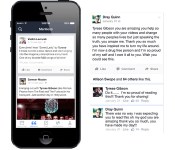
Facebook’s got a new app and you (probably) can’t have it

Though Facebook’s origins were in exclusivity, serving only college students for some time, the service has since expanded out to billions of people around the world. Today, Facebook’s launching a new approach to exclusivity, and it sounds sadly familiar to reality: “Facebook Mentions” is a new iOS app that only “public figures” can use. What’s a “public figure?” The usual suspects: especially high-profile celebrities, journalists, government officials, and popular brands/businesses. So, the rich and/or famous? Got it.
So, what does the app do? It’s a much more brand-centric approach to using Facebook (which, yes, includes people who are brands unto themselves — Kanye West, for instance). As Recode‘s Facebook-verified Peter Kafka explains it:
- “The emphasis is on posting new messages, photos and videos, instead of reading what your pals have put up.
- There is a Mentions tab that’s supposed to make it easy for stars to see what people are saying about them. It looks strikingly like the ‘@’ tab that Twitter has always had – and also uses the term ‘mentions.’ It is another in a series of moves that are … inspired by Twitter’s playbook.”
It also enables those with access to host live Q&A sessions, as well as streamlining the multimedia sharing aspects of Facebook. You’ve probably seen it in action before: apparently that Dr. Dre/Tyrese celebration video that went live just ahead of the Beats purchase by Apple was through Facebook Mentions.

In so many words, Mentions is a tool designed specifically for people who have assistants to manage their social media profiles. If you’re one of those people (or their assistant) and don’t yet have access, you can download the app and request it right here.
Filed under: Cellphones, Handhelds, Software, Mobile, Facebook
Source: iTunes App Store, Facebook
 AIVAnet