


Apple Releases OS X Yosemite Developer Preview 4, Public Beta Coming Later This Month
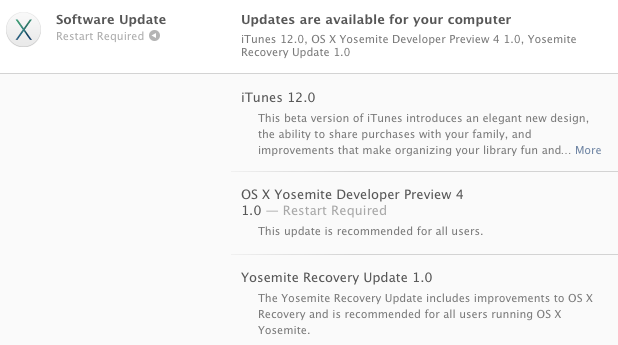
Alongside iOS 8 beta 4, Apple today released a new version of OS X Yosemite to developers, two weeks after releasing the third Developer Preview and over a month and a half after introducing the new operating system at its annual Worldwide Developers Conference.
The update can be downloaded from the Mac App Store or through the Mac Developer Center. Apple has also released iTunes 12.0.
OS X Yosemite brings a flatter, more modern look to OS X, with an emphasis on translucency and redesigned dock, windows, and more. It also includes a multitude of new features, such as improved integration with iOS 8 through Continuity, a new “Today” view in Notification Center that offers integration with third-party apps, a retooled Spotlight search with new data sources, and several new features for apps like Mail, Safari, and Messages.
Yosemite is currently only available to developers, but Apple plans to offer a beta version of the software to Mac users at some point during the summer, possibly as early as this month. A source that spoke to 9to5Mac suggests the beta is coming in late July, though it could be pushed back until early August if Yosemite is not ready in time.
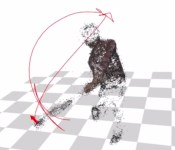
Watch a dome full of cameras capture 3D motion in extreme detail

Conventional 3D motion capture is awkward; even if you don’t mind people covered with dots or ping pong balls, you often get just a handful of data points that miss out on subtle movements. Researchers at Carnegie Mellon University might just have a more elegant solution in store, though. They’ve built a geodesic dome whose 480 cameras work in concert to track a whopping 100,000 points without the need for markers. The system uses its abundance of video footage to estimate trajectories based on changes in light, motion and shape, rather than looking for arbitrary cues or interpolating image frames. As you can see in the clips below, the resulting data is both vividly detailed and natural-looking — you can see individual confetti flakes falling to the ground, and it’s easy to follow every nuance of a batter’s swing.
The Carnegie Mellon technology is using off-the-shelf cameras to achieve its effect, so it wouldn’t be hard to expand the dome or number of cameras to accommodate specific tasks. A movie or video game studio could use it to record whole scenes with people dressed in appropriate costumes, rather than specialized suits. It may also come in handy for sports — an arena lined with cameras could help referees confirm fouls and goals using the exact positions of the players. It could be a while before a large-scale mocap environment like this becomes a practical reality, but the concept is no longer far-fetched.
Filed under: Science
Source: Carnegie Mellon University

Libratone’s wool-wrapped speakers gain Spotify Connect streaming abilities

If you fancy picking up a track where you left off on the commute upon entering your flat, and you’ve splurged for a Libratone speaker, you’re in luck. The company’s offerings (like the Loop and Zipp) are now Spotify Connect compatible, making connecting with your mobile device a breeze. As part of the streaming service’s paid subscription, the option allows direct streaming with a speaker and smartphone or tablet on the same WiFi network. Libratone’s audio gadgets already packed AirPlay and other wireless options, and this one can be nabbed thanks to an update to the speaker’s firmware — accessed through the companion app. This also means another audio choice joins the likes of B&O, Sony, Samsung and others who already offer Spotify’s enhanced connectivity.
Filed under: Portable Audio/Video
Source: Spotify
4.7-Inch iPhone 6 Rear Shell with Embedded Apple Logo Shown in New Photos
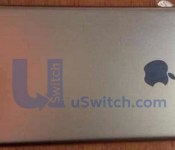
Earlier this month, we shared some high-quality photos and a video of what has been claimed to be the rear shell of the 4.7-inch iPhone 6 in rough form. uSwitch has now obtained a pair of photos showing the part in its completed state, revealing a polished finish and the removal of several interior physical features that had been part of the manufacturing process.

While the part shows a much cleaner look now that it has been polished and cleaned up, the antenna breaks at the top and bottom, previously reported to be made of a non-conductive polymer, remain quite prominent.
uSwitch primarily focuses on the shell’s Apple logo, which as seen in previous leaks will change to an embedded version similar to that found on iPads rather than the printed version used in previous iPhones. The report suggests the embedded logo shown in the photos is indicative of a lighted Apple logo as has been speculated ever since the first leaks showing a cutout for the logo surfaced nearly two months ago.

We do not, however, see any significant evidence that the logo on the iPhone 6 will be lighted. It seems more likely to us that the embedded logo is for aesthetic and/or radio transparency reasons.
Unlike the in-progress shells seen earlier this month, the finished shell also shows the full set of camera holes, including the main one for the camera itself and smaller ones for the flash and rear microphone. Consistent with previous leaks, the flash hole is round, which some have considered suspect as Apple moved to a pill-shaped flash in the iPhone 5s to accommodate the new “TrueTone” dual-LED system. It is possible, however, that Apple and its partners have developed a new round version of the TrueTone flash.
Forensic Expert Questions Covert ‘Backdoor’ Services Included in iOS by Apple
 As part of a recent Hackers On Planet Earth (HOPE/X) conference presentation, forensic scientist and iPhone jailbreak expert Jonathan Zdziarski detailed several backdoor security mechanisms that are secretly included in iOS by Apple. These mechanisms make covert data collection easier for Apple and governmental authorities, reports Zdziarski via ZDNet.
Zdziarski confirms that iOS is reasonably secure from attack by a malicious hacker, but notes that the mobile OS includes several forensic services and noticeable design omissions that make the OS vulnerable to snooping by forensic tools.
These services, such as “lockdownd,” “pcapd” and “mobile.file_relay,” can bypass encrypted backups to obtain data and can be utilized via USB, Wi-Fi and possibly cellular. They also are not documented by Apple and are not developer or carrier tools as they access personal data that would be not used for network testing or app debugging purposes.
While detailing these backdoors, Zdziarski makes it clear he is not a conspiracy theorist, but does want to know why Apple appears to be deliberately compromising the security of the iPhone and opening the door to professional, covert data access.
I am not suggesting some grand conspiracy; there are, however, some services running in iOS that shouldn’t be there, that were intentionally added by Apple as part of the firmware, and that bypass backup encryption while copying more of your personal data than ever should come off the phone for the average consumer. I think at the very least, this warrants an explanation and disclosure to the some 600 million customers out there running iOS devices. At the same time, this is NOT a zero day and NOT some widespread security emergency. My paranoia level is tweaked, but not going crazy. My hope is that Apple will correct the problem. Nothing less, nothing more. I want these services off my phone. They don’t belong there.
Zdziarski also notes that he isn’t the only one aware of these backdoors. Several existing forensic software companies, such as Cellebrite and Elcomsoft, are already exploiting them as part of the forensic services they provide to law enforcement.
Consumers who want to limit access to these backdoor services are advised by Zdziarski to enable a complex passcode in iOS and use the enterprise Apple Configurator application to set Mobile Device Management (MDM) restrictions and enable Pair locking which will delete all pairing records. This solution will block third-party forensic software, but won’t protect the device contents if it is sent to Apple for analysis.
Note: Due to the potentially political nature of this topic, the discussion thread is located in our Politics, Religion, Social Issues forum. All forum members and site visitors are welcome to read and follow the thread, but posting is limited to forum members with at least 100 posts.
Galaxy Note 4 to sport a metal body, flexible screen and a 16MP OIS camera?

Samsung’s Galaxy Note series is the most popular phablet series of smarthones out there. Samsung is basically the one who created the first phablet as we know it today with the first-gen Note 1. Note devices became extremely popular over the years and it is no wonder many people are waiting for a Note 4 to launch in order to refresh their device for the year. We’ve seen many Note 4 leaks thus far and we’re sure they’re going to keep on coming.
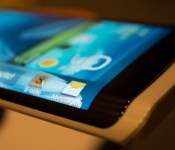
We have yet another one for you. This report is coming from a Korean publication ET News and claims the Note 4 will sport a premium metal build, a flexible screen (which Samsung presented on CES 2013) and a 16MP camera with optical image stabilization (OIS). This would actually go hand in hand with the rumored Galaxy F premium smartphone and might mean that the Galaxy S5 and Note 3 are the last plastic premium device we’ll see Samsung make. In other words this might mean a whole different approach to smartphone design by Samsung.
We’re jumping the gun a bit though, these are just rumors after all. Would you like to see a metal Galaxy Note 4 or are you happy with the device’s build as it is now? Either way, Note 4 will probably lauch at this year’s IFA in September.
Source: ET News
Via: PhoneArena
The post Galaxy Note 4 to sport a metal body, flexible screen and a 16MP OIS camera? appeared first on AndroidGuys.

Pranksters can hijack your Chromecast to show whatever they want

It’s easy for someone in your home to interrupt your Chromecast stream and play something of their own, but you can always retake control… right? Well, don’t count on it. Analyst Dan Petro has built the Rickmote Controller, a proof-of-concept device that hijacks Google’s media stick to play everyone’s favorite Rick Astley video (and theoretically, any media) on loop. The Raspberry Pi-based box simply floods the Chromecast with WiFi disconnection requests, kicking the adapter into its setup mode; after that, it’s easy for the Rickmote to make its own connection and deliver non-stop ’80s pop.
You might not see a fix for this behavior any time soon. Part of the Chromecast’s appeal is its easy configuration, and altering the disconnection response might create more headaches than it solves. As it stands, you won’t have much reason to worry. Even if pranksters build gadgets like the Rickmote, they’d still have to get within range of your Chromecast’s WiFi at the same time that you’re using it — if someone tries to rickroll you through your TV, you’ll probably catch them in the act.
Filed under: Home Entertainment, Internet, HD, Google
Via: TechCrunch
Source: Bishop Fox

Tiny device aims to tell you if your drink has been spiked

The creators of a device designed to identify if your drink has been spiked have launched on Indiegogo with the aim of raising $100,000. Similar in size to a pack of gum, the pd.id can be dunked into a drink, blinking red after a few seconds if a contaminant is found. According to founder J. David Wilson, the hardware uses the same technology that the US DEA has employed for years, just shrunk down to a smaller size. Once dunked into your drink, the pd.id collects a small sample, analyzing its density, resistance and temperature to determine if a foreign agent, like rohypnol, has been introduced.
If the $100,000 is raised, the the team behind pd.id (short for Personal Drink ID) aims to have the gear on sale within six months, priced at $75. Thankfully, the hardware is reusable, so could be employed to keep you safe throughout a night on the tiles. Wilson and his colleagues haven’t talked about how easy it’ll be to shrink the technology down, or how accurate the unit will be when it launches. If those caveats won’t deter you from supporting what could be a very worthy cause, then you can contribute at the source link.
Filed under: Misc
Via: Sky News
Source: Indiegogo
What you need to know about the Apollo 11 moon landing

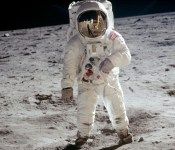
Neil Armstrong, the first human being to set foot on another celestial body, misspoke his historic line. “That’s one small step for man, one giant leap for mankind,” as it turns out, was missing a crucial letter when Armstrong spoke it to a live audience back on Earth. What he was supposed to say as he placed his foot on the surface of Luna, the Earth’s moon, was: “That’s one small step for a man, one giant leap for mankind,” thus highlighting the bigger picture of his small step onto the surface of the moon. Thankfully, the 600 million people watching weren’t quite as pedantic as us: the public easily overlooked the mistake, understood the meaning, and let it go. Hey, the guy flew to the moon, right? Cut him some slack.
WHAT IS IT?

The Apollo 11 spacecraft is most well-known in space exploration history for being the first manned spacecraft to land on another celestial body. It carried three American astronauts to the Earth’s satellite, Luna, in 1969: Neil Armstrong, Edwin “Buzz” Aldrin and Michael Collins. In fact, yesterday marks 45 years since Apollo 11 astronauts Neil Armstrong and Buzz Aldrin stepped out of the ship onto the moon.
The spacecraft itself was divided into three components: living quarters (which came back to Earth with the three astronauts), a service module (which supplied propulsion, electricity, and oxygen), and a lunar module (the crazy-looking shuttle that brought Armstrong and Aldrin from lunar orbit onto the surface of Luna). We’re focusing on the living quarters (“Columbia”) and the lunar lander (“Eagle”) in this piece.
The massive, American-built spacecraft — by which we mean “all three parts of Apollo 11 together as one ship” — weighed just under 100,000 pounds. A single Saturn V (pronounced Saturn “five”) rocket carried the hulk of metal (and three human beings) into space, and staged detonations enabled that rocket to propel Apollo 11 into lunar orbit.
After eight days — from takeoff at Kennedy Space Center in Florida to splashdown in the north Pacific Ocean near Wake Island — Apollo 11′s command module (where the astronauts lived while aboard) returned to Earth. The lunar module (“Eagle”) was left in lunar orbit and is believed to have crashed into the surface in the following years.
WHY SHOULD I CARE?

Apollo 11′s mission to bring the first human beings to Earth’s moon was the effective end of the so-called “space race” between the Soviet Union and the United States. After years of both superpowers dumping resources into said race, Armstrong’s “giant leap for mankind” definitively declared victory for the United States.
More importantly, the Apollo 11 landing signaled the opening of the next frontier for human exploration. Without the Apollo program, Elon Musk’s Space X and Richard Branson’s Virgin Galactic might not exist. The International Space Station, launched as a joint effort between fifteen partner nations (including the US and the post-USSR breakup Russian Federation), might not exist. Heck, Star Wars might not exist. And we’re quite partial to Star Wars.

But beyond the whole “glory of human advancement” business, the act of putting three human beings on Earth’s moon — safely — and then bringing them back home — again, safely — in 1969 is… somewhat unfathomable. We’re 45 years out and humanity remains far from the concept of commercial space flight.
China just last year landed its first unmanned rocket on the moon. In 2013. That isn’t intended as an insult to China, but to say, “Hey, seriously, it’s really hard to launch a spacecraft and land it on another celestial body.”
WHAT’S THE ARGUMENT?
It’s not much of an argument given that it’s been proven wrong over and over, but a group of folks claim that the Apollo 11 moon landing was faked on a soundstage. Those same folks argue that all subsequent moon landings were faked as well.
Per the Apollo 11 landing specifically, the argument is that certain photos taken on the moon show shadows that don’t go in the same direction. So the logic goes: multiple shadow directions, multiple sources of light (which is to say, “more sources of light than just the sun“). Mythbusters took on this theory in a 2008 episode, seen in part below:
There are myriad other theories, zero of which offer credibility to the side of the doubters.
WANT EVEN MORE?
And who wouldn’t? The moon, and space travel in general, has fascinated human beings for centuries. For more on the Apollo 11 mission specifically, we suggest you check out Tom Wolfe’s excellent book on NASA’s ambitious plan to put human beings on the moon: “The Right Stuff“. Oh, you’d prefer a movie? That exists as well, and it’s also really good!
For a less bombastic approach to the Apollo 11 landing, we suggest How Stuff Works‘ excellent piece on lunar landings, as well as Stuff You Should Know‘s podcast about the same subject. There’s kind of a lot of material out there on the Apollo 11 landing considering it’s one of humanity’s greatest achievements, including books from the astronauts themselves and countless tales from NASA scientists involved in the project. We’re barely scratching the surface here, so we suggest digging in on the history and branching out from there. You could spend a lifetime just studying the Saturn V rockets that propelled many American spacecraft into orbit.
[Image credit: NASA (Buzz Aldrin on the moon), NASA (moon landing video), NASA (Apollo 11 launch), NASA (lunar module), Alexis Santos/Engadget (SpaceX), “Mythbusters” S6/Ep. 11, The Ladd Company (theatrical trailer for The Right Stuff)]
Filed under: Misc, Transportation, Science

Framed gesture-controlled digital canvas debuts on Kickstarter, starting at $399

It’s shaping up to be a big month for digital art displays. Electric Objects popped up on Kickstarter with its successfully funded 23-inch LCD for $299, and now a familiar face has turned to the funding site with its own rebooted version. Framed 2.0, an update to 2011′s overpowered 40-inch model, includes integrated WiFi, a 720p front-facing camera and motion sensors, so you can interact with the frame using gestures. There’s also a companion smartphone app, for purchasing and swapping art, creating schedules and adjusting settings. The first 250 backers can take home a 24-inch 1080p screen for $399. A 40-inch version will be available for $1,500, while a “super limited” 55-inch model will go for a whopping $10,000, including dinner with the design team in Tokyo. All three frames are available for pre-order on Kickstarter now, with select models shipping in November.
Filed under: Displays, Household
Source: Framed (Kickstarter)
 AIVAnet