


OS X Yosemite Beta Usage Beats Mavericks’ Pace by 4x as New Features and Look Draw Testers
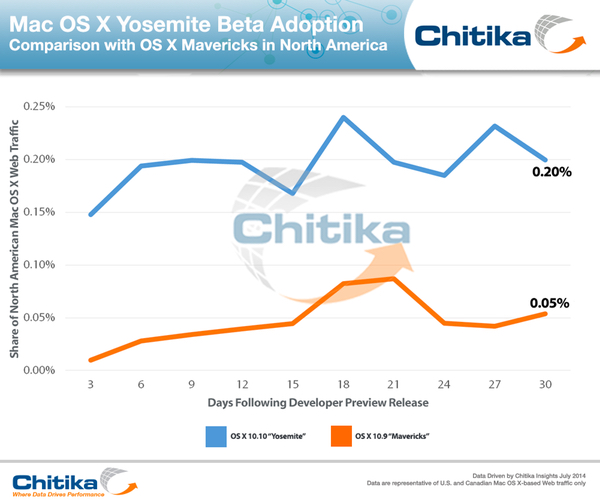
Apple announced OS X Yosemite last month during its worldwide developers conference and released the first beta version of the operating system to developers at the same time. According to web analytics firm Chitika, developer interest in Yosemite is high with an early adoption rate that is significantly greater than its predecessor OS X Mavericks and still growing.
Overall, the data point to a promising future for OS X Yosemite. In the short term, we expect the operating system’s usage share to grow in the wake of the release of the third Developer Preview edition on July 7, 2014. Additionally, with the increased level of developer activity thus far, along with the success of the similarly no cost OS X Mavericks, it’s very probable that OS X Yosemite adoption will outpace that of any other previous Mac desktop OS when it is released publicly later this year.
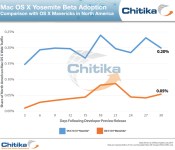
Chitika measured Mac OS X ad impressions from users in the U.S. and Canadia between June 2 and July 2, 2014. Adoption of OS X Yosemite rose quickly after release, climbing to 0.15% of total U.S. and Canadian Mac OS X Web traffic in just a few days. In comparison, OS X Mavericks last year took about 30 days to reach only 0.05% of measured web traffic.
Chitika attributes this higher adoption to curiosity about new features of OS X, especially those collaborative options that tie into iOS. Along with OS X Yosemite, Apple introduced iOS 8 with new continuity features that improve the cross-platform integration of iOS 8 with OS X Yosemite. Most notable is Handoff, which allows users to start a task on one iCloud-enabled device and easily transfer that task to another nearby device without losing changes.

FBI and NSA targeted prominent Muslim-American leaders for surveillance
 Pictured: NSA headquarters in Fort Meade, Maryland
Both the Federal Bureau of Investigation and the National Security Agency monitored the emails of five prominent Muslim-Americans, documents from former-NSA contractor Edward Snowden reveal. The Intercept detailed those documents early this morning, which show the email addresses of Faisal Gill, Asim Ghafoor, Hooshang Amirahmadi, Agha Saeed, Nihad Awad. The list ranges from a former Department of Homeland Security staffer to the executive director of the Council on American-Islamic Relations.
The Foreign Intelligence Surveillance Court, the secretive United States court that oversees surveillance requests from the intelligence community, is ruled by the Foreign Intelligence Surveillance Act. That act states that Americans can only be targeted if they are working for a foreign power, or if they’re involved in a terrorist organization. Further, said targets must be plotting or engaging in one of a variety of nefarious acts: “espionage, sabotage, or terrorism,” The Intercept states.
Beyond the five prominent, public men listed, 7,485 email addresses are identified as under surveillance between 2002 and 2008; 202 of those addresses are tied to “U.S. persons,” while 1,782 are tied to “non-U.S. persons.” Another 5,501 don’t contain identifying information. Other standouts on the US side include Anwar al-Awlaki and Samir Khan, two men accused of terrorist activity (both were killed in a US drone strike in 2011).
The scope of the US government’s surveillance efforts was widely revealed last summer when former-NSA contractor Edward Snowden began leaking classified documents to reporters at The Guardian. The documents detailed a variety of programs, including PRISM — which allows the mass collection of data on US citizens — and MYSTIC — which allows data to be retrieved from the past.
This morning’s news is especially interesting as it’s the first we’re hearing of US surveillance efforts specifically targeting prominent religious and ethnic leaders. At least in recent years: the US government, through a program named “COINTELPRO,” specifically targeted US political groups (like the Black Panthers and the National Association for the Advancement of Colored People) in the mid-20th century. The Foreign Intelligence Surveillance Act of 1978 — the law at the heart of the FISA court which approved the surveillance of five Muslim-Americans — is intended to curtail such surveillance overreaches.
Filed under: Cellphones, Handhelds, Software
Source: The Intercept
Adidas’ miCoach Fit Smart uses your wrist to measure health data

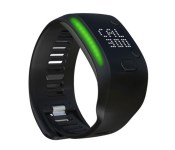
Less than two weeks after making an unofficial appearance, today Adidas is formally introducing its new wearable, the miCoach Fit Smart. Revealed in San Francisco, during the Wearable Technologies Conference 2014, this wristband is capable of measuring your burned calories, heart rate, distance covered, pace and more fitness stats. Better yet, it wants to look good while doing so. It’s going to be available in black and white, featuring a strap made of soft-touch silicon (similar to Nike’s FuelBand SE) and a small strip of LEDs which can change color depending on the intensity of a workout. While the Fit Smart isn’t Adidas’ first entry into the wearable fray, one that’s now more crowded than ever, the sports gear company says it is approaching things differently with its new product. Not only does it want to appeal to die-hard runners, like the Android-based Smart Run watch, but also to those people who would like to start running and working out on a more consistent basis.
Unsurprisingly, a big part of the Fit Smart is Adidas’ miCoach technology and ecosystem. “What we did, by working with elite coaches, was bring an experience to help people set weekly goals and training plans,” Paul Gaudio, GM of digital sports at Adidas, told Engadget about the practicality of the companion miCoach apps. “We took the things that have been very successful and implemented them here with the Fit Smart.” Gaudio also emphasized that the Fit Smart isn’t just for zealous athletes, telling us, “It is about encouraging people to get active and stay active. It can also be a motivational tool; it can coach you to be better.”
The question is whether that’ll be enough to lure you into shelling out $199/£179/€199, which is what the new Adidas wearable will cost when it goes on sale “late” next month.
Filed under: Misc, Peripherals, Wearables
Sony’s waterproof Xperia Z2 Tablet coming to Verizon for $600

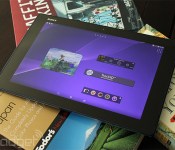
We already knew Sony would eventually release an LTE version of its super-thin, waterproof Xperia Z2 Tablet; we just had no idea which network it would work on. Turns out, the lucky winner is Verizon. That’s right, the Z2 Tablet is going to be a Big Red exclusive here in the states, at least for now. That’s something of a departure for Sony: the last-gen Tablet Z was compatible with both AT&T and T-Mobile. In any case, regardless of whether you’re already a Verizon customer, you can pre-order one tomorrow for $600, sans contract (shipments are expected to start next week, on July 17th). If you place your pre-order early enough, Verizon will also throw in a free noise canceling headset, while supplies last. For a limited time, too, you can buy the tablet for $500 with a new two-year agreement, but let’s be real: Smart shoppers don’t lock themselves into new service contracts just to get a 4G tablet.
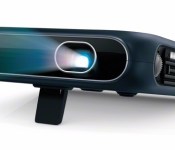
Sprint LivePro: pocket projector, mobile hotspot, power supply, and more

Sprint on Wednesday introduced the LivePro, a mobile-minded accessory that wears multiple hats.
Touted as the “world’s first commercially available pocket projector and mobile hotspot”, the unit lets users project images anywhere 10 inches to 10 feet. What’s more, it also serves as a Sprint Spark-ready Wi-Fi access point for up to eight devices at once. And, lest you believe this is merely a two-trick pony, a deeper look reveals additional features.
 Powered by Android 4.2 Jelly Bean, the Sprint LivePro boasts a 4-inch touch display with access to the breadth of Google apps and services. And, thanks to the 4GB internal storage and microSD expansion, it should be no problem to download a movie directly to the LivePro and project it to a wall.
The device also packs a 5,000mAh battery which can be used to charge up other devices via a USB cable. Other notable specifications include an internal speaker, Bluetooth and 3.5mm connectivity, and Miracast mirroring.
The LivePro will be available from Sprint starting from Friday, July 11. Qualified buyers can purchase the accessory for $0 down and 24 monthly payments of $18.75, for a total cost of $450.00.
The post Sprint LivePro: pocket projector, mobile hotspot, power supply, and more appeared first on AndroidGuys.

Sprint blesses Samsung Galaxy S5 with Wi-Fi calling

Sprint on Wednesday confirmed that its version of the Samsung Galaxy S5 will receive an update that enables Wi-Fi Calling. Slated to roll out over the next few weeks, the Galaxy S5 marks Sprint’s seventh device capable of the feature. Sprint’s Wi-Fi Calling is a free service that allows for calling and messaging over your Wi-Fi connection.
Looking ahead, Sprint plans to deploy International Wi-Fi calling in the coming weeks. Once enabled it will let customers make calls and send texts via Wi-Fi in more than 100 countries.
Other devices capable of using Sprint Wi-Fi Calling include:
- HTC One Max
- Samsung Galaxy S4 Mini
- Samsung Galaxy Mega
- Samsung Galaxy Note 3
- Samsung Galaxy S4 with Sprint Spark
- Samsung Galaxy S5 Sport (coming soon)
The post Sprint blesses Samsung Galaxy S5 with Wi-Fi calling appeared first on AndroidGuys.
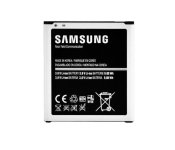
Accessory of the Day: Samsung Galaxy S4 replacement battery

Are you among the millions of Samsung Galaxy S4 owners running around out there? How’s your battery treating you these day? Does it hold up as well as it did when you first got it? Maybe you’re looking for a backup battery to charge up for days when you expect to be out and about more than usual. Why not pick up a new one?
The Samsung Galaxy S4 replacement battery is everything you got in the original model, except way cheaper than you’d expect. At 2600mAh, it’s the same amount of juice in the out-of-box experience. And, yes, the NFC antenna is also present.
At this price you might as well buy a few of them.
The post Accessory of the Day: Samsung Galaxy S4 replacement battery appeared first on AndroidGuys.

The world’s first video game arcade machine is a glittery fiberglass wonder

Computer Space sounds like a third-party PC parts wholesaler, but back in 1971 it was the world’s first video game arcade machine. Before Nolan Bushnell and Ted Dabney went off to start some games company called Atari, Computer Space was their first commercial collaboration — a full year before Pong. The coin-operated computer game was the first of its kind in arcades, even if it wasn’t the commercial success they’d hoped it would be. A recently christened game museum in Japan had not one, but four of the original arcade machines — and an extra (unfortunately beige, non-shimmering) machine to play the game itself — so we touched a bit of gaming history.

The game is like a one-on-one version of Asteroids without the debris. Controls are similar and simple, although being the first of its kind, there’s a learning curve to it all. A pair of buttons rotate in either direction, while the other two act as thrust and fire. (The green model is particularly rare, with a pair of joystick controls that actually never made it into arcades.)
There’s no RAM, processor or ROM.
Unfortunately, we barely managed to play the game at the museum’s launch: our own spaceship disappeared from the game screen completely after about five minutes’ play and the machine was then tagged with an out-of-order sign for the remainder of the press event. (We didn’t break it. Promise.)

The machine can’t be run through emulation easily on more modern machine, because the hardware itself was before the era of arcade motherboards. There’s no RAM, processor or ROM. ROM chips were expensive at the start of the 70s, so creator Bushnell substituted in diodes on the circuit board, laid out in the shape of the spaceship on the circuit board itself. Interestingly, the highest score possible is 15 — once you go over that, the machine resets. Technologizer has a supremely detailed tale of the game’s development, but if you’re wanting a taste of the arcade’s first video game yourself, then we suggest trying some of the downloadable simulators here.

ZTE’s projector/hotspot hybrid lands in the US with Sprint’s help

ZTE’s endearingly nutty 1080p projector/mobile hotspot turned a few heads back at CES, and we knew it was coming to the US — we just didn’t know when. You’ll soon have a chance to see if those two tastes really do taste great together, though: Sprint will start selling the hardware hybrid (now called the LivePro) on July 11, just in time to power those heated outdoor meetings of your Wes Anderson Appreciation Club. You can connect up to 8 devices to Sprint’s Spark LTE network via the LivePro and run your own content through it using an HDMI or Miracast connection, but don’t forget — this thing also runs Android 4.2 and packs a 4-inch touchscreen so you can hog all those movies to yourself too. Feeling more generous than usual? Magnanimously let your friends recharge their ailing phones with the LivePro’s 5,000mAh battery and pretty soon they’ll agree that Moonrise Kingdom really is better than Rushmore.
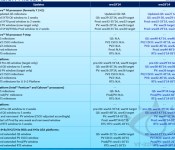
Intel’s Broadwell Chips for Most Macs Not Shipping Until Early to Mid 2015
Intel’s line of 14-nanometer Broadwell chips, which are expected to be included in future versions of the MacBook Air, Retina MacBook Pro, and iMac, have been further delayed, reports Chinese site VR Zone [Google Translate] (via CPU World).
According to the site, while Intel will begin production on its extremely low power Core M processors in July and August for a 2014 launch, production on the U and H Broadwell chip series will not begin until much later in the year.
As a result, the Broadwell U 2+3 dual-core chips with GT3 (HD 5000 or Iris) graphics, likely slated for use in the MacBook Air and the 13-inch Retina MacBook Pro, won’t be ready to ship until February of 2015. The Broadwell H 4+3e quad-core chips with Iris Pro graphics designed for the larger Retina MacBook Pro and iMac won’t be shipping until July 2015 at the earliest.
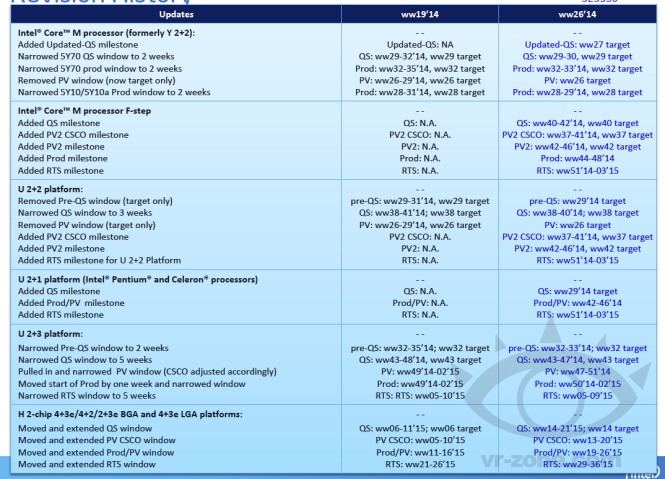
Back in May, Intel CEO Brian Krzanich promised Broadwell processors for the 2014 holiday season, but it appears that the promised chips will be limited to the company’s Core M processor series, used in ultra low power products like two-in-one computers. Broadwell chips suitable for Apple products will not make their first appearance until 2015, which Intel essentially confirmed to CNET in June.
“We expect the initial Broadwell-based devices, including fanless 2-in-1s built on the Core M processor, will be on shelves by the end of this year with more products and broader OEM availability in 2015,” Intel told CNET on Wednesday.
Intel’s Broadwell chips have seen several delays over the course of 2013 and 2014, and were originally slated to enter production in late 2013 before production was delayed until Q1 2014 and then Q3 2014. The delays are reportedly due to problems with the 14-nanometer process used to manufacture the chips.
Intel’s continual Broadwell delays are likely impacting Apple’s own release plans. Rumors have suggested Apple is planning a fall launch of a refreshed Retina MacBook Pro and a new 12-inch MacBook Air, but it is unclear which chips the company will use. Apple may only be able to offer a minor Haswell processor boost for the Retina MacBook Pro, which will be the only update the line sees until Broadwell is ready. Apple has already given the MacBook Air a Haswell refresh bump alongside a price drop with an update in late April.
On the desktop side, Apple introduced a new low-end iMac last month, but otherwise the lineup has not been updated since last September. The Mac mini has not even been updated to Haswell yet, with its last revision coming in October 2012. It is unknown why Apple has not released updated Mac mini models, as appropriate Haswell chips are readily available.
Intel’s Broadwell chips are said to be 30 percent faster and more power efficient than Haswell, offering even greater increases in battery life and performance. According to Intel, the Broadwell delays will not affect the company’s next line of processors, Skylake, as the chips are based on new architecture. Broadwell, however, will have a very short lifespan as Skylake has a prospective late 2015 release date.
 AIVAnet