


Hackers make Xbox One’s Kinect work on a PC

Microsoft famously said the Xbox One Kinect wouldn’t work on a PC, but hackers have already done the trick mere days after the release of the Kinect for Windows v2.0 SDK. As shown in the video below, they managed to rewire a USB 3.0 cable to pair it with a laptop, giving them access to the depth sensor. The pair work at Hyperkin (which happens to sell gaming accessories), and plan to make a retail version of the cable available. Kinect for Windows 2.0 is already up for pre-order, but such a cable could be handy if you can’t wait to get one, or don’t want to splurge for a redundant Kinect. The Xbox 360′s sensor was hacked in a similar way, but the Kinect 2′s hardware is far more powerful. On a PC, it could function as a motion capture device or map a 3D environment, to name just a few examples — far more interesting applications than Just Dance.
Filed under: Cameras, Gaming, Microsoft
Via: Kotaku
Source: Chris Gallizzi (YouTube)
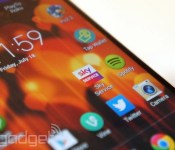
Sky’s new Service app lets you manage your account on the move

Sky’s got a plethora of mobile apps to keep you entertained on the go, but has until now neglected customers who find admin just as fun. Much like mobile carriers have apps for general account management, the new Sky Service app for Android and iOS lets subscribers view and pay bills, check the details of their TV packages and manage their broadband router restrictions. The app also allows you to reset your TV PIN if the kids have cracked it while you’re out, request a customer service call-back, reschedule an engineer visit and alter which Sky+HD box the Sky+ app records to if you have a multiroom setup. Not the most exciting tasks, but handy to have in your pocket nonetheless.
Filed under: Home Entertainment, Internet, Software, HD
Source: Sky

Google won’t call games with in-app purchases free anymore (updated)

The European Commission has said that while Google addressed its concerns around games with in-app purchasing, Apple has yet to offer a strategy. Following hordes of complaints by outraged parents, the EU asked both companies to implement changes to the way they sell such apps in their stores. Those include not misleading consumers about supposedly “free” games, not “directly exhorting” children to buy in-game items, thoroughly informing customers about payment arrangements and forcing game-makers to provide contact information.
Google has already said it would implement several of the changes starting at the end of September. For instance, it won’t use the word “free” for in-app purchase games; it’ll come up with targeted guidelines for games to prevent encouragement of children to buy items; and will implement measures to monitor breaches of EU law.
Meanwhile, the EU said that Apple has “regrettably” not provided any firm solutions or timetable to address its concerns, though it added that Cupertino has promised to attack the problem. Apple was already forced to implement alerts in iOS 7.1 warning users of in-app buys, following lawsuits and a scuffle with the FCC. It has also implemented other parental controls, as shown in its Parents’ Guide to iTunes. Meanwhile, the European Commission said that enforcement is now in the hands of individual EU nations, which will need to decide on their own how to punish developers currently facing legal action.
Update: In response to the EU’s remarks, Apple has given us the following statement:
Apple takes great pride in leading the industry in parental controls that are incredibly easy to use and help ensure a great experience for parents and children on the App Store. The parental controls in iOS are strong, intuitive and customizable. And over the last year we made sure any app which enables customers to make in-app purchases is clearly marked. We’ve also created a Kids Section on the App Store with even stronger protections to cover apps designed for children younger than 13.
These controls go far beyond the features of others in the industry. But we are always working to strengthen the protections we have in place, and we’re adding great new features with iOS 8, such as Ask to Buy, giving parents even more control over what their kids can buy on the App Store.
Our goal is to continue to provide the best experience for our customers and we will continue to work with the EC member states to respond to their concerns.
[Image credit: Philippe Hugen/AFP/Getty Images]

Vertu, maker of the $22,000 smartphone, is considering luxury wearables

Last month was a special one for Max Pogliani: Not only did it mark his first anniversary as Vertu’s CEO, but it also saw the launch of his very own baby, the Android-powered Signature Touch. This new phone’s up-to-date specs have already silenced critics; and despite the luxury market’s slowdown, the Italian exec said his team’s managed to sell more units than anticipated, and their figures for the first half of this year already beat those from all of last year. Vertu’s not stopping there, as it plans to expand its portfolio with an even more affordable smartphone, as well as new accessories like audio products and maybe even smart wearables.
Vertu’s hand-assembled phones are currently offered in three tiers: the Signature featurephone line (powered by Nokia’s Series 40 OS), the mid-range Android line (the Constellation) and the aforementioned high-end Signature Touch Android line. They all feature a varying amount of premium materials like calf leather, alligator skin, lizard skin, ceramic, sapphire (for the screen), titanium, ruby and sometimes gold; and they go through rigorous durability tests as well. The Signature Touch benefits further from camera tuning by Hasselblad and wallpapers from the National Gallery (London), on top of the pre-existing ringtones plus notification sounds produced by the London Symphony Orchestra.
The company’s next mission is to refresh and reposition its mid-range phones; but interestingly, it’s also considering an entry-level smartphone that would still be “truly Vertu.” Pogliani, who reports to chairman and Nokia veteran Anssi Vanjoki on a weekly basis, likened this to Porsche offering the 911 and the Boxster side by side: Both are priced very differently, but are quite good in their own right, and their satisfied owners wouldn’t judge those who bought the other model.

“Technology will be more and more a merging factor and not a differentiation point.”
“For me, there is space to further segment, provided that the product we put in the range will make sense in the overall spectrum, and will not cannibalize the products that are already there,” the CEO said during our interview in Hong Kong. “Technology will be more and more a merging factor and not a differentiation point. The key things will be more working on the design, materials and services part. There, we will differentiate the models, hence the product offer and therefore the price points.”
Don’t misunderstand the expansion of Vertu’s Android offerings, though. Pogliani assured us that feature phones would live on with new variants to come, as many Vertu customers still prefer using their phones just for calls, enjoying weeklong battery life and appreciating the series’ classic design. According to the exec, the voice-centric Signature series still makes up 30 percent of his overall sales.
Pogliani didn’t mention how much the potential entry model would cost, but as a reference, the mid-range Constellation starts from about $6,000, while the more premium Signature Touch has a $10,300 base model. Funnily enough, the comparatively basic Signature phones start at a staggering $16,150, which is mainly due to the extra precious materials used — especially for the buttons — plus the extra work put into polishing and assembling them. If you’re flush with cash, a maxed-out, off-the-rack Signature costs $168,450, and you can pay even more for customization; but it’s still a feature phone, of course.
It’s worth remembering that those prices cover more than just the hardware and the software. These luxury phones come with Vertu’s services, which include personalized lifestyle-content curation, exclusive access to special events and venues, Silent Circle communication encryption and one year’s worth of concierge service — with the premium models offering a dedicated agent, a feature that Pogliani implemented shortly after his appointment. To extend the concierge service, you can pay £2,000, or about $3,400, per year for the classic service, or double that to keep your dedicated agent.

Alternatively, some customers — which, according to Pogliani, generally include the likes of entrepreneurs and opinion leaders — already have multiple years of concierge subscription through buying numerous Vertu phones. As to why anyone would buy a single Vertu phone, let alone several, that’s something the rest of the population still struggles to comprehend. Echoing his predecessor, Pogliani pointed out that those buying multiple Vertus are no different from people who collect cars, watches, suits, wines or any other luxury item. And, over the years, these customers have apparently become more sophisticated. They are developing a lot of understanding behind the luxury brands they patronize, and they yearn for “something with real substance” rather than items made just for the sake of showing off.
“The essence of luxury: It’s something that you absolutely don’t need, but if you are into it, you can’t live without it.”
“Since they are exceptional people, they want to have access to exceptional things — things which are a little bit beyond the ordinary things that everybody can have — when it comes to something which is with them day and night,” the CEO continued. “Nobody has to buy a Vertu phone. You don’t need a Vertu phone, but if you like it — if you appreciate quality craftsmanship and design, and also services and technology — then you buy a Vertu phone. Like [how] you buy a Bentley car or a luxury watch. You don’t need a Bentley car to go from A to B, but it’s much better to do it in a Bentley car than in another car.
“That’s the essence of luxury: It’s something that you absolutely don’t need, but if you are into it, you can’t live without it. That’s my personal definition.”
Pogliani added that this shift in consumers’ attitude towards luxury is most apparent in China, where it remains one of Vertu’s biggest markets alongside Russia. While folks in other emerging luxury markets like Japan took 20 years to develop this discernment in their purchasing choice, their Chinese counterpart spent just two to three years to do the same. And despite the local luxury market’s hiccup due to China’s ongoing crackdown on corruption, Pogliani sees a healthier and more sustainable growth moving forward, which will be mutually beneficial for the brands and the Chinese economy.

With the launch of the Signature Touch, Vertu’s also starting to offer more advanced accessories instead of just cases and pens. We had a go with the company’s aluminum over-ear headphones co-developed with Bang & Olufsen, and while their $750 price tag is much higher than their mainstream premium counterparts, the sound quality, noise isolation and comfort were superb. Vertu’s new aluminum Bluetooth speaker also looked and sounded pretty good, but it’s harder to justify its $600 price when companies like Bose and Logitech can offer similar performance at one-third of the cost. We’d stick with the headphones for that kind of money. Then you’ve also got the Qi wireless charger that works with the Signature Touch, but with its single function and aluminum/leather design, the $600 price is hard to stomach. On the other hand, owners can proudly tell their friends that they have the world’s most expensive wireless charging pad lying on their desk.
Unlike most of our readers, Vertu’s customers aren’t early adopters of technology.
In an era where the word “wearables” is buzzing, it’s no surprise that Vertu is exploring this space as well, but Pogliani is in no hurry. Unlike most of our readers, Vertu’s customers aren’t early adopters of technology, so it needs to find out if they even want a smart wearable for what it is today. The CEO referred to the segmentation study his team conducted last year — the largest Vertu had ever done — to look at the markets from the luxury consumption and the technology consumption perspectives, in order to match and identify segments that are sizable enough to build a specific product proposition.
“So we will do the same for the accessories and extensions, and see if there is a demand and an opportunity and a credibility for us to develop in this space,” the CEO said, while implying that he wanted more truly practical functions on wearables. “For example, if we launch ourselves into luxury watches, it will probably not be very well accepted because we have no credibility in that area yet.
“Product differentiation should start from a very well-established competence and recognition of this competence in the core business where you are. From there, you can start to differentiate, but step by step, I believe,” he said.

One major market that Vertu has yet to properly tackle is the US. Right now, the phone maker graces the country with just one boutique in each of these cities: New York, Las Vegas and Los Angeles; and elsewhere, it is represented by local retail partners. But things are about to change. For one, there’s apparently an “exponential” growth in demand for the Signature Touch in the US, partly due to its wide range of supported LTE and HSPA bands.
Pogliani also believes the recently announced five-year deal with Bentley will help boost Vertu’s stateside reputation, as the British automaker has a big presence across the pond. Compared to its previous seven-year partnership with Ferrari (in which all seven limited edition models were sold out), Vertu will see a deeper integration with its new pal, going beyond design collaboration to actually making the phone a part of the car — something that wasn’t possible with Ferrari, for various reasons. The first of the five “Vertu for Bentley” phones is due in October, and chances are it’ll be a fancy variant of the Signature Touch.
No matter who Vertu hooks up with, the truth remains that it is still by far the leader in the luxury phone market — one that it pioneered as far back as 1998. Some brands, like Dior, Aesir and Mobiado have long given up, whereas those that are still around like TAG Heuer, Gresso, Tonino Lamborghini and Savelli struggle to win us over with their lazy specs and occasional lack of soul. It shouldn’t be that hard to get the basics right, but if the luxury consumers have truly evolved, then these other players have a serious amount of catching up to do — especially with Vertu now ready to take a bigger bite out of this niche market.
Filed under: Cellphones, Mobile

Photos of Construction Material Hint at Scale of Apple’s Spaceship Campus [Mac Blog]
Construction at Apple’s “Spaceship” Campus has been progressing at a rapid pace in the past few months, as the company most recently began putting up the outer walls and laying roadwork. Now, iFun.de (Google Translate) shares new photos of the steel and glass material that will be used for the campus’ facade, which are being provided by German company Josef Gartner GmbH.
 Construction material for Apple’s Spaceship Campus tested by Josef Gartner
The images show the steel and glass components being tested by Josef Gartner outside of its premises, and could hint at the scale of Apple’s new Campus 2 building upon completion. The building will have a circular, multi-story structure surrounded by greenery, additional buildings, performance stages, a fountain, and more.
 A concept image of what the front of Apple’s Spaceship Campus will look like
Apple’s Campus 2 project will be constructed in two phases, with the first phase finishing up by 2016 and including a 2.8 million square-foot ring-shaped central building, an underground parking facility, a 100,000 square foot fitness center, and a 120,000 square foot auditorium. Meanwhile, the second phase of construction will take place after 2016 and include an additional 600,000 square feet of office, research and development buildings as well as an additional parking structure with 1,740 spaces.

Google finally agrees to fix Chrome bug that drains Windows laptop batteries

Chrome may be the browser of choice for around 35 percent of the world’s internet users, but it’s not without its flaws. A report by Forbes has highlighted that the browser won’t return to an idle state if it’s not being used, demanding significantly more power than rivals like Firefox or Internet Explorer. That’s a big problem for laptop users, since their portable Windows machines are losing battery life far faster than they should. It’s apparently been a problem since 2010, but it’s only now that Google is admitting that something needs to be done about it. In a statement to PC World, the company has pushed the fault to the top of the Chrome team’s to-do list, so hopefully it won’t be long before you get a lot more browsing before you retreat to a wall socket.

Virgin Media’s TV Anywhere streaming app comes to Kindle Fire tablets

After bringing its TV Anywhere app to Android at the end of last year, Virgin Media has continually updated the list of supported smartphones and tablets. Today, it’s adding another range of Android devices to this roster, namely Amazon’s Kindle Fire tablets, as the TV Anywhere app has now dropped the Amazon Appstore. It’ll let you watch live TV over a WiFi connection (3G/4G streaming is not currently supported), manage your set-top box recordings, browse TV listings and also serve as a remote control. Virgin claims it’s the first service of its kind to come to Amazon’s marketplace (at least in the UK), with neither Sky nor YouView officially offering a separate Kindle Fire app. After a relatively quiet period, Virgin Media has begun to think about mobile streaming again. Last week, it brought Sky’s entertainment channels to TV Anywhere, and next month customers will be able to use their Virgin account to access Sky’s Sports and Movies apps.
Filed under: Cellphones, Home Entertainment, Internet, Software, Mobile, Amazon
Source: Virgin Media TV Anywhere

Amazon’s Kindle Unlimited offers all-you-can-eat e-books for $10 a month

After teasing us with a possible launch, Amazon has confirmed Kindle Unlimited, its all-you-can-read e-book subscription service. For $9.99 per month, Kindle Unlimited offers 600,000 books and “thousands” of audiobooks across a range of devices. As expected, many of the major publishers aren’t fully represented, but there are number of popular titles listed, including Harry Potter, Lord of the Rings and the Hunger Games, as well as a whole host of Kindle exclusives. Like Prime, Amazon initially offers a free 30-day trial to draw you in, but it’s also throwing in a three-month subscription to Audible and access to 2,000 audiobooks via its Whispersync service (which lets you seamlessly switch between reading and listening whenever the mood takes you). For a service that bills itself as “unlimited,” there’s a few constraints on Amazon’s Netflix-for-books service. In addition to the fact that it doesn’t have the support from all of the major publishers, of course, there’s also the small matter that it’s only available in America. At least, for now.
Source: Kindle Unlimited

This bacteria eats nothing but electricity to survive

All life is ultimately powered by electricity, albeit indirectly; most organisms consume sugars that produce electrochemical reactions. Several types of bacteria are known to skip the sweets and go straight for the electrons, however — and researchers have discovered that they may be everywhere. The New Scientist reported that biologists have grown bacteria (Mariprofundus ferrooxydans PV-1) that harvest electrons directly from iron electrodes. Several species were literally teased out of soil from a seabed floor and deep well in Death Valley, California, just by applying a charge to the ground. In a lab environment, a separate team found that they can be kept alive exclusively with electricity and no other sugars or other nutrients (see the video, below).
Scientists found that up to eight species may eat and excrete electrons, including some with remarkable properties. For instance, hundreds of thousands of bacteria can form daisy-chained “wires” an inch or so long, and tap seawater oxygen for energy. Such filaments can hold soil together and conduct electricity about as well as standard copper wire. Those properties could lead to interesting practical applications, like “SPUDs” or self-powered useful devices that clean up pollution, or bacteria that create electric “biocable” networks in the soil. Finally, the discovery is letting researchers test one of the most basic principals of biology: the minimum amount of energy required for life to survive.
Via: Gizmodo
Source: The New Scientist

Upcoming Apple Store in Hanover, Germany Likely Opening in September [Mac Blog]
Apple’s upcoming retail store in Hanover, Germany may finally open in late September, reports iFun.de (Google Translate) citing sources close to Apple’s retail team in the region. The report notes that Apple has had to fix a number of problems with the building to be used for the store, including physical defects, mold, and ventilation issues.
 Apple’s upcoming retail store in Hanover, Germany covered by barricades
According to iFun, it is also possible that the store could open to the public on September 19, which has been rumored to be the launch date for the iPhone 6. Apple originally put up its traditional black barricades for the location back in April 2013, as images showing progress on the store surfaced this past March. The layout of the Hanover store will also be similar to the Apple Store Opéra in Paris, France, which has become known as one of the company’s most visually appealing locations.
During its financial results conference call for the third quarter of 2013, Apple announced that it would be building over 30 new stores in fiscal 2014, with 2/3 of those stores being built outside of the United States. Some of those openings have included the Apple Store Zorlu Center in Turkey, the Apple Store VillageMall in Rio de Janeiro, Brazil, and the Apple Store Kurfürstendamm, Berlin, Germany.
 AIVAnet