



Engadget Daily: Sony RX100 III review, explaining crowdfunding and more!

We review Sony’s latest camera, the RX100 III, explain what this crowdfunding thing is all about, discuss whether sapphire glass is really the next big thing and look back at 100 years of smartwatches. Read on for Engadget’s news highlights from the last 24 hours.

Sony RX100 III review: a fantastic point-and-shoot, but it’ll cost you
Sony’s RX100 line of point-and-shoot cameras have always been fantastic. Zach Honig takes a look at the latest camera from Sony, the RX100 III. Does it live up to the reputation of its predecessors? Read his review and find out!

What you need to know about Kickstarter, Indiegogo and the concept of crowdfunding
From potato salads to virtual reality headsets, crowdfunding websites offer something for everyone. But how exactly do they work? Read our explainer and find out.

Sapphire phone displays are tough, but the realities are even tougher
Apple has long been rumored to have an interest in producing sapphire displays, and recent investments in new manufacturing facilities seem to confirm that. However, is sapphire glass the Holy Grail for durable displays? We got the low down from the smartphone industry’s insiders.

Are we there yet? A century of the smartwatch in pictures
Watches have long been capable of doing more than just telling time. From spy-cameras to calculators, and even fitness trackers, join us as we take a look at the past 100 years of wrist-worn technology.
You also might like:
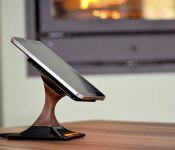
Swich proves a wireless phone charger doesn’t have to be an eyesore

Wireless smartphone chargers have been around for quite sometime, but they usually forgo attractive aesthetics and any added functionality. Those who prefer a much more attractive option now have one with Swich: an accessory that lifts that handset off of your desk without a tether, keeping all of its buttons accessible while lending a better viewing angle. The units are constructed with sustainable American walnut and ceramics, adding a mirco-suction grip to keep gadgets from slipping while they recharge. The panel on which that daily driver rests also rotates to accommodate both landscape and portrait orientations. Of course, you’ll need a Qi-compatible device or a case that adds the functionality, but those unable to pass up dapper design can snag a unit for $170 via Kickstarter.

Filed under: Peripherals, Mobile
Via: Fast Company, Cool Hunting
Source: Swich (Kickstarter)

The Big Picture: How astronauts keep things clean

What should an astronaut do when he gets dirty? Take a meteor shower [groan]. But, what does an astronaut do when their space suit gets mucky in training? They get it laundered, just like anything else. Pictured above, a staff member from the Russian Space Training Center hangs out the freshly washed space suits of Russian cosmonaut Anatoly Ivanishin, NASA’s U.S. flight engineer Kathleen Rubins, and Japanese space agency’s flight engineer Takuya Onishi. The trio picked up a few stains after landing on water in training for a mission on the ISS. So, the suits can handle the high radiation of space, but not a spin in a dryer?
[Image: Alexander Zemlianichenko / AP]
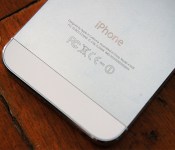
The E-Label Act may rid your future gadgets of FCC logos

Let’s try something really quickly: pull your phone out, flip it over, and maybe squint at it a bit. Chances are you’ll see a series of FCC-mandated pictograms emblazoned there, little images you’ve probably never paid attention to before. If US senators Deb Fischer (R-Nebraska) and Jay Rockefeller (D-W. Virginia) get their way though, those curious icons may soon become a thing of past. Instead, the pair wants to replace those etchings with more informative digital equivalents that users can peek at if they so chose. Alas, your gadgets might not be completely clean if the bill passes — there are still those pesky CE labels to gaze upon.
Anyway, it wasn’t long before the FCC released a set of guidelines for what should be displayed and how… but of course it did. FCC commissioner Michael O’Rielly wrote a blog post pushing to make e-labels a thing months ago. Why are these folks getting so worked up over digital vs. physical labels? There’s the design argument, for one. No longer will your shiny smartphone or terrific tablet be marred by oblique symbols. Manufacturers won’t have to worry about the very process of etching tiny logos on everything they make either, and Rockefeller thinks that’ll mean ultimately mean “lower device costs for consumers” too. We’re looking forward to seeing how right these folks may or may not be, but (just like anything involving US law-making) it’ll take a while to see anything concrete.
Filed under: Mobile
Source: The Hill

FCC’s net neutrality inbox is already stuffed with 647k messages, get yours in by Tuesday

The FCC’s controversial plans for a new version of net neutrality are still open for public comment for a few more days, and Chairman Tom Wheeler — continuing to fight charges that he may be a dingo — says it’s already received over 647,000 comments so far. The 60 day period for public comment runs out on the 15th though, so if you want your voice to be heard then about fast lanes, Title II or anything else, then now is the time. The internet may not have crashed the FCC’s website — hackers did that — but it can still have an effect on the way we connect in the future. Read the FCC’s proposal here, and send your comments in via openinternet@fcc.gov.
[Image credit: Karen Bleier via Getty Images]
We’ve received about 647k #netneutrality comments so far. Keep your input coming — 1st round of comments wraps up July 15.
– Tom Wheeler (@TomWheelerFCC) July 11, 2014
Source: Tom Wheeler (Twitter)

Playdate: We’re livestreaming ‘Divinity: Original Sin’ on PC! (update: on pause)

Welcome, ladygeeks and gentlenerds, to the new era of gaming. The one where you get to watch, and comment, as other people livestream gameplay from PCs and next-gen consoles. Because games! They’re fun!
Click. Click. Click. Wait. Click-click-click. That might sound familiar to anyone that spent a good chunk of their youth crawling through dungeons and slaying orcs and hewing skeleton skulls on their PC in role-playing games (RPGs) like BioWare’s Baldur’s Gate, and that’s what Divinity: Original Sin is all about. When the project hit Kickstarter last March, developer Larian Studios’ plea was simple: help us make an awesome old-school styled RPG. Well, the audience responded to that and over 19,000 backers collectively pledged $944,282 — more than double the project’s initial $400,000 goal. How did the game turn out? Come back here at 7 p.m. ET / 4 p.m. PT and find out for yourself as I broadcast it live!
Update: Due to unexpected technical difficulties, we’re postponing our stream. We’ll update you through Twitter when we’re ready to stream again.
Filed under: Desktops, Gaming, Home Entertainment, HD
Source: Twitch

Google Maps on iOS now plots search results, your appointments

Slowly but surely, the iOS version of Google Maps is gaining parity with its Android equivalent. With the latest update, those who use Google’s mapping application on Apple’s mobile platform will be able to see search results along with their descriptions visually laid out on the map, as seen in the image above. You can toggle between the map view and just a regular list view as well. Additionally, Gmail users will find that appointments and reservations will show up on the map too, which is handy if you want to know how to get to that dinner meeting on time. Last but not least, there’s also an improved Explore view that you can use to figure out what’s nearby, just in case you’d like to follow up the meal with after-dinner drinks. So if you’re an iOS user who prefers Google’s own email and maps offerings over Apple’s own, then you should download this update right about now.
Via: 9to5 Mac
Source: App Store

Samsung Bashes iPad’s Screen, Lack of Multitasking in New Galaxy Tab S Ads
Last week, Samsung released an anti-iPhone ad calling iPhone users “wall huggers” in a promotion for its Galaxy S5 smartphone. Today the South Korean company is promoting its new Galaxy Tab S with two new anti-Apple advertisements, bashing the iPad’s lack of multitasking and its screen.
In the first ad, Samsung features a crying baby and a dad fighting over an iPad that’s unable to display two apps at once. The baby wants to watch a movie while the dad is trying to catch a sports game. A Galaxy Tab S, which can display multiple apps at once, is swapped for the iPad, and suddenly both dad and baby are happy.
“What’s going on? Ahhh, it looks like dad’s tablet can only do one thing at a time. What if it were a Samsung Galaxy Tab S? With the Galaxy Tab S, the whole family has something to smile about.”
The second advertisement pits the display of the iPad against the display of the Galaxy Tab S. In the spot, two friends are watching the same scary movie on an iPad and on a Samsung Galaxy Tab S. A scene depicting a dark figure against a black background is shown on both tablets, with the figure not appearing on the iPad’s screen.
What went wrong here? Ahhh, It’s not a Super AMOLED. What if it were a Samsung Galaxy Tab S? Compared to many LCDs, Super AMOLEDs give you 100 times higher contrast. Instead of 1000:1, you get 100,000:1 contrast. Conventional LCDs get their color using backlight but Super AMOLEDs turn off pixel by pixel, each emitting their own light. So you get all the fine details and varied shades of black that many LCDs can’t show.
First announced in June, Samsung’s newest tablet, the Galaxy Tab S features a high-resolution (2560 x 1600) Super AMOLED display. During its presentation, Samsung touted the tablet’s display quality, suggesting it had a more accurate color range, better contrast, and higher outdoor visibility than a typical LCD display. The Galaxy Tab S is also Samsung’s thinnest tablet to date, offering a fingerprint sensor, an 11 hour battery life, and Android’s multitasking features.
The iPad Air, in contrast, features a 2048 by 1536 Retina display with 3.1 million pixels. While it is unable to run two apps at once presently, split-screen multitasking is said to be in the works. Apple is also working on a new version of the iPad Air and the Retina iPad mini, both of which are expected to come equipped with Touch ID fingerprint sensors and an A8 processor.

Government will require closed captions on video clips lifted from TV broadcasts

Over the last few years closed captions have become increasingly prevalent in online video, but now the FCC is pushing for providers to go even further. It’s already a requirement for full-length video that originally aired on TV to come with captions when it’s streamed online, but new rules approved today will extend that to clips from the videos as well. In a unanimous vote, commissioners put deadlines for compliance that vary on the type of clip being used. By January 1, 2016, “straight lift” clips that just pull one segment of a show will need captions, then in 2017 montages of compiled clips will need them and finally, by July 2017, clips of live and near-live programming will need captions (with a short grace period.) This won’t apply to your garden variety YouTube channel however, these rules are for online streams from the broadcasters and cable/satellite providers that originally aired the video.
[Image credit: Washington Post/Getty Images]
Tech and video companies have been concerned about the rules, expressing concerns about the cost and by how quickly captions can be added to internet streams (think breaking news, like LeBron James rejoining the Cleveland Cavaliers). An industry group representing companies like Amazon and YouTube claims it’s similar in cost to caption short clips and two hour movies, while the National Association of Broadcasters said in a letter that reformatting videos for different devices makes the process very time consuming. Meanwhile, the FCC is looking into applying the rules to third-party video providers as well. According to Variety, Chairman Tom Wheeler noted that TV watching over the is close to surpassing that viewed solely by antenna — something we hope he remembers while considering changes to net neutrality.
Filed under: Home Entertainment, Internet, HD
Source: FCC

New government plan for school WiFi leaves everyone unhappy

The FCC is ready to start dolling out up to $2 billion dollars in grants to American schools to pay for WiFi networks, but it doesn’t seem that anyone — especially the schools — are happy about it. The new rules under the aging E-Rate program, which is part of the Universal Service Fund, would set aside $1 billion dollars this year and another billion next year to set up WiFi networks in schools and public libraries. Chairman Tom Wheeler says the agency should be proud because, “10 million kids will be connected next year who otherwise wouldn’t.” But Republicans are concerned the program will favor urban areas, while failing to deliver much needed connectivity to rural schools. Of course, GOP lawmakers also steadfastly opposed increasing funding to the E-Rate, which had its budget capped at $2.25 billion 16 years ago and hasn’t been adjusted since.
The failure to increase funding to the program certainly rubbed Democratic FCC Commissioner Jessica Rosenworcel the wrong way, who said “I hope that going forward we will have the courage to fix this… it’s a matter of our global competitiveness.” Schools and teachers unions are equally concerned that the new program doesn’t go quite far enough to deliver connectivity and want to see the E-Rate budget increased. Both Republican lawmakers and schools are also concerned that cash strapped institutions won’t be able to afford to hire consultants who can help navigate the labyrinth of paperwork.
Filed under: Internet
Via: Re/code
 AIVAnet