



Microsoft looking for beta testers for Android version of OneNote

Microsoft have announced a new feedback program that will allow Beta testers to try out upcoming versions of its note-taking app OneNote on Android.
To get involved, you just need to join the Google+ Community Page for OneNote and click ‘Become a tester’.
Allowing the community to feedback to Microsoft about new features in versions of OneNote will be a great way to ensure any bugs or half-baked features are polished before release.
Did you sign up for Microsoft’s OneNote Beta program?
The post Microsoft looking for beta testers for Android version of OneNote appeared first on AndroidGuys.

OnePlus aren’t working on ‘Lettuce’ device just yet

We saw a leak surface yesterday that suggested OnePlus were already working on the successor to the OnePlus One, dubbed ‘Lettuce’. With such shorty supply of the OnePlus One and so soon after its release date, this understandly took a few people by surprise.
However, the community need not panic, since OnePlus have clarified the leak stating that there are “just working on the OnePlus One for 2014. Thanks!”.
Clearly they are working on ‘Lettuce’ behind the scenes – they’d be a pretty short-sighted company if they weren’t – but at least it gives satisfaction to early adopters of the OnePlus One that their devices won’t be rendered out of date after only a few weeks after all.
The post OnePlus aren’t working on ‘Lettuce’ device just yet appeared first on AndroidGuys.

Motorola talks Android 4.4.4 updates; plans a Google+ AMA

Motorola has provided a bit of insight into the Android 4.4.4 KitKat software update and how it pertains to its line of smartphones.
This latest update includes all of the goodies of 4.4.3—such a new dialer, the ability to pause during video recording, and enhanced camera image quality—and includes enhanced security for OpenSSL.
A blog post on the hardware maker’s website tells us that the update has commenced for the Moto G in Brazil and India while the Moto E is getting the same treatment in Brazil, France, Canada, and Asia Pacific. As for the United States, the Droid Ultra is the only one thus far to see 4.4.4.
Looking ahead, Motorola will be holding a Google+ Ask Me Anything event on July 17 where product manager Mark Rose will field your questions over 30 minutes.
The post Motorola talks Android 4.4.4 updates; plans a Google+ AMA appeared first on AndroidGuys.

Smappee’s £169 energy monitor can keep tabs on every device in your home

Sure, our homes are getting smarter and allowing us to be greener than before, but the cost of energy has continued to climb. Energy companies have encouraged us keep tabs on our consumption, but it’s hard to identify which appliances are responsible for driving up your fuel bill every month. That’s where Smappee’s smart energy monitor comes in, having just launched in the UK: Instead of just telling you how much current your home is consuming, this little box can identify individual devices and appliances in your home, letting you shut the offending devices down.
Similar to other energy monitoring products, Smappee requires you to clamp its sensor onto the main power cable of a household meter. If you’re not comfortable with fuse boxes or working by torchlight, you might need a professional to install it for you. Once fixed in place, Smappee’s bespoke technology monitors the electrical oscillations (or interference) in your home on a millisecond basis to recognize the individual signatures generated by each of your devices. It’ll attempt to learn about everything you use over time, meaning you won’t need to traverse your home turning things on and off again to manually add them.
While the monitor does the hard work, Smappee’s companion app displays your energy usage and costs in detailed charts and tables. It’ll also let you choose names for each device and group items depending on its type or location (if you wanted to group everything in your spare room for example). If you’ve invested in solar panels, Smappee will measure them too, letting you see at-a-glance how much of your total consumption is sourced from the sun.

It’s claimed that the energy monitor will “pay for itself in just over a year” and will reduce the electrical bill in a four-person UK household by an average of 12 percent. I reckon its “Comfort Plugs” might play a small part in helping the company arrive at that figure. Sitting between your device and the power point, these wireless adapters will let you switch a device on and off remotely, handy if you’ve popped out and you remember you’ve left the TV on.
The Smappee energy monitor goes on sale today for £169 direct from the company’s website and from Apple Stores across Europe (we’re told Apple will also list on its website soon). For that you’ll get the box itself, access to its free iOS or Android apps and one Comfort Plug (packs of three and six additional plugs are available for £34.99 and £59.99 respectively).
Filed under: Household
Source: Smappee

Samsung’s first Tizen phone slips further into the future

Samsung’s Tizen mobile OS already powers a pair of smartwatches, but what about those smartphones we’ve been promised for so long? Well the company’s first consumer-ready Tizen phone — the Samsung Z — was supposed to make its official debut at a developer event in Moscow yesterday. Of course, the key words there are “supposed to”. To hear the folks at the Wall Street Journal tell the tale, there was a Tizen event for enthusiasts, but Samsung quietly pulled the plug on the Z’s launch days earlier.
Don’t worry, the phone’s not dead yet. Samsung eventually confirmed to The Verge that it plans to keep fleshing out the OS and the ecosystem that sustains it, but phone no longer has an official launch date. Why? No one’s quite sure yet, though at least a few who attended that Russian shindig thought Samsung might’ve pushed back the launch because of a dearth of decent apps. That may well be the case, but if it is, it isn’t for lack of effort on Samsung’s part. The Korean mobile giant has a list of notable software partners and has tried to inspire developers with Tizen app contests. Maybe, just maybe that’s not enough.
This isn’t the first time a Tizen device launch has gone awry, either. Samsung originally planned to release one in Japan earlier this year before carrier NTT DoCoMo put the kibosh on it, citing an already-crowded field of competitors. That’s not going to change. If anything, those entrenched players are going to hunker down ever more as time marches on. If Samsung decides to wait for the golden moment to release its side project unto the world, we may be waiting for our Tizen phones for a long while.
Filed under: Mobile
Via: The Verge
Source: Wall Street Journal

Apple’s Next-Generation A8 Chip Said to Top 2 GHz, Remain Dual-Core
Besides a larger display, Apple’s upcoming iPhone 6 also may feature a faster A8 processor that pushes the system-on-a-chip beyond the 2.0 GHz threshold, claims GforGames citing Chinese media source cnBeta [Google Translate].
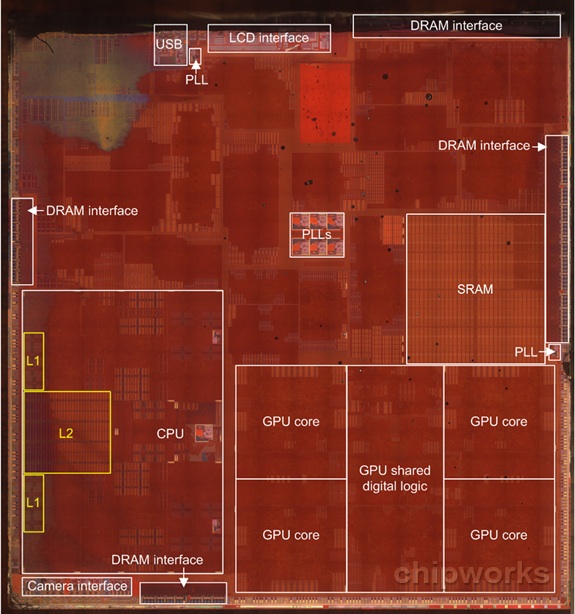
According to the latest information, Apple will reportedly increase the CPU frequency of its next-generation SoC to 2.0 GHz or higher per core, up from the 1.3 GHz (iPhone 5s and Retina iPad mini) or 1.4 GHz (iPad Air) of the A7 processor. The chip will keep the 64-bit, dual-core architecture of the current generation A7 CPU, but will be manufactured with a 20-nm process instead of the A7′s 28-nm. TSMC and Samsung are thought be the primary manufacturers that are producing the A8 chip for Apple’s upcoming iOS devices.
Though competing phones ship with quad-core processors, Apple’s possible decision to stay with a dual-core design may be the result of the company using a custom-designed chip optimized for iOS and not an off-the-shelf solution. This optimization already has been shown in the current dual-core A7, which offers “desktop class” performance that outperforms other players in the mobile phone marketplace. In its detailed analysis of the A7 after launch, AnandTech found that even though the A7′s performance is top-notch, there was still room for improvement as almost no iOS app took full advantage of A7′s available processing power.

China thinks the iPhone’s tracking features are a risk to national security

If there’s one thing that China has enjoyed doing this year, it’s taking pot-shots at the US as a result of the Snowden revelations. After banning Windows 8, allegedly pushing banks to ditch IBM hardware and calling for severe punishments on Apple and Google, the government is now gunning for the iPhone. Buried deep in iOS 7 is a Google Now-esque location tracking feature that can offer recommendations and improve the mapping experience. China, via its state television mouthpiece, believes that the system’s logs could be used by nefarious researchers to extract state secrets. Of course, as the company points out, the data is only uploaded to Apple’s servers with your explicit consent, and can be turned off — but then again, perhaps this latest bout of saber rattling is destined to direct attention away from China’s own espionage record.
Filed under: Cellphones, Mobile, Apple
Source: WSJ

DARPA wants its military gear to get tougher, sooner

DARPA, the government agency known for its robots and other crazy futuristic inventions, just announced a new project that could lead to the quicker development of advanced military vehicles. This new project is called Materials Development for Platforms, and it aims to shorten the timespan between designing tough materials that can withstand harsh environments and having them used on actual military equipment. Apparently, such a process typically takes more than a decade (that’s why the Luke arm’s relatively fast FDA approval was darn impressive). But MDP seeks to come up with the methodology and tools to cut that down to two-and-a-half years.
The folks behind the program believe that it’s possible to achieve that if researchers start developing materials with a specific purpose in mind. As it is, many of them attempt to design holy grail materials before determining their actual applications, and assessing those creations to find out what they can be used for takes a lot of time. In order to prove that the MDP metholody works, the team agreed to develop materials that can withstand extreme heat for the outer shell of a hypersonic aircraft, as it can travel more than five times the speed of sound. The group needs to be done within the next two-and-a-half years for the program’s method to be deemed successful, so watch out for any hypersonic plane news from DARPA in 2016 or 2017
Filed under: Misc
Source: DARPA, Federal Business Opportunities
Mix beats and loop vocals with Propellerhead’s Take for iOS

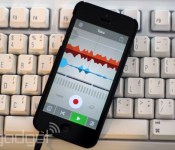
If you saw Reggie Watts’ musical set at Engadget Expand (don’t worry, there’s video after the break), then you probably noticed the table full of gear he needs to construct his loops. Propellerhead — the Swedish software company behind Reason, not the electronica duo — is hoping to lighten this load with Take, a creative vocal loop recorder that’s being given away free to iPhone users. The interface is reasonably simple, offering you a wide variety of pre-made backing loops as well as three tracks that you can rap, sing or otherwise make noise on. It’s tremendously easy to use, but it won’t compensate for your lack of musical talent, which is why we won’t be sharing our ham-fisted efforts with you.
Filed under: Cellphones, Portable Audio/Video, Software, Apple
Source: Take (App Store)

Expert Believes Alleged iPhone 6 Sapphire Front Panel Could Be ‘Legitimate’
Earlier this week, numerous videos of the alleged front panel of the 4.7-inch iPhone 6 surfaced, which showed the screen being put through stress tests involving significant bending and scratching. While those videos referred to the front panel as being made of sapphire crystal, there was no way to confirm that the display were made of the durable material.
Now, Professional Neil Alford, who is a member of the Department of Materials at the Imperial College in London, tells The Guardian that the alleged “sapphire panel” could “well be legitimate.” Alford believes that the stress tests performed on the screen indicate that the panel is made of sapphire, adding that Apple likely overcame a number of challenges in making the part thin and durable.
Alford concurs: “In my opinion the screen being shown off in the video could well be a sapphire screen. If you make sapphire thin enough, and it’s flaw free, you can bend it quite considerably because it has an enormous strength.”
He added: “I think they will be doing some sort of a lamination – binding different crystal cuts of sapphire together – boosting the toughness of the material, while they may also have induced some sort of a strain in the surface of the glass – either compression or tension – which means that it has extra strength,” he said.
Alford noted that Apple had contacted him in January 2013 to discuss sapphire screens, indicating that Apple has likely been hard at work on creating the screen afterward. Past rumors have suggested that Apple will be using a sapphire display in the iPhone 6, but other reports have claimed that the more durable material could be exclusive to the larger 5.5-inch iPhone 6 due to supply constraints.
Apple’s 4.7-inch iPhone 6 is expected to launch this September, while the larger 5.5-inch version has been rumored to be released at the same time. In addition to a larger display, both devices are likely to include a thinner housing, a faster A8 processor, and an improved camera.
 AIVAnet