


Supreme Court said Aereo is a cable company, so now it wants to be treated like one

Despite Aereo’s best efforts, the Supreme Court decided that its service was too much like cable TV and therefore its unlicensed streaming of TV broadcasts were illegal. Now, after putting its service on pause, Aereo has filed a letter with the US District Court saying that since the Court said it’s like a cable system, it is entitled to the same statutory license that cable companies pay broadcasters. CEO Chet Kanojia sent a message to users and supporters explaining “The Path Forward” with a link to the letter, but hasn’t laid out a timeline for the service’s return. That’s one of the reason’s broadcasters are still fighting the new move, saying (in the same letter) that it’s “astonishing for Aereo to contend the Supreme Court’s decision automatically transformed Aereo into a ‘cable system’ under Section 111 given its prior statements to this Court and the Supreme Court.”
[Image credit: AP]
Source: Aereo Blog, Aereo Letter

Climendo’s weather app compares forecasts to deliver the most accurate

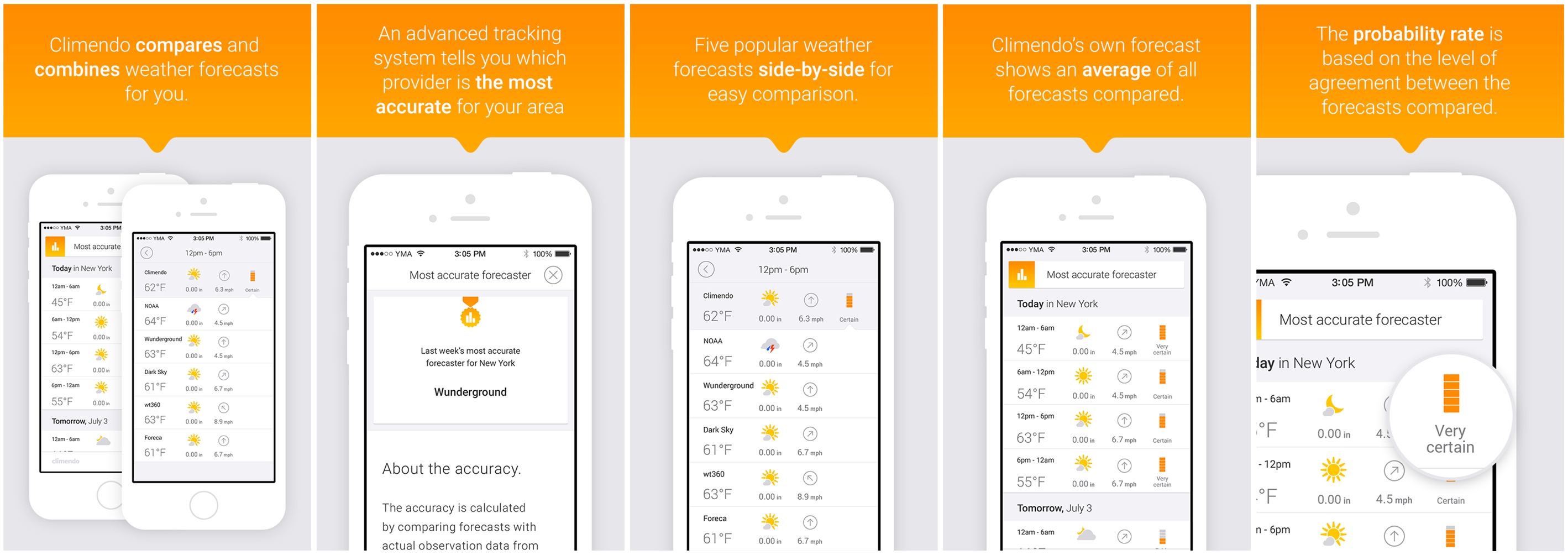
Sure, your favorite weather app might look good, but can you really tell how accurate it is? Instead of relying on just one weather source to provide you with an overview of the week’s weather, Climendo wants to do things a little differently. It compares and combines data from the most popular and/or accurate providers to give you the most precise forecast possible. On top of that, it’ll also match predictions with historic data from professional weather stations, letting you know exactly which provider you can trust.
While the app launched in Sweden last year, it’s only now making a break for global success. It’s undergone a redesign, displaying a five-day forecast with six-hourly predictions of upcoming weather, which is supplied by 12 providers located in the US and Europe. They include NOAA, Forecast.io (Dark Sky), Weather Underground, Storm and TV2.dk, with more being added all the time. Based on their predictions (drawn from 10,000 weather stations around the world), the app generates an average forecast and calculates a probability rate (fairly uncertain, certain, fairly certain etc). The more readings that are similar, the higher the chances that you’ll experience the weather it tells you to plan for.
Currently, the app displays the temperature, the current weather condition and wind speed. However, the team says more detailed statistics will come to the app, breaking the data down so that “farmers, sailors, sun bathers, surfers can dig into what they think is the most important part to keep an eye on.” While the new features and design are currently only available to iOS users, the Android and web apps will receive a similar update in the coming weeks. Climendo is $0.99/69p for a limited time and can be downloaded from the App Store or Google Play.
Filed under: Internet, Software, Mobile
Source: Climendo, (App Store), (Google Play)
Apple Environmental Report: Carbon Footprint Down 3%, 145 U.S. Stores Now Using 100% Renewable Energy
Apple today released its 2014 Environmental Responsibility Report [PDF], posting the new information on its updated Environmental Initiatives website. The report, which covers fiscal 2013, highlights the progress Apple has made towards its environmental goals, which include reducing climate change by using renewable energy sources, using greener materials, and conserving “precious resources.”
Apple notes that its carbon footprint from energy use has dropped by 31 percent from fiscal 2011 to fiscal 2013, even though energy consumption has increased by 44 percent. The company also recalculated its 2012 emissions and found that its overall carbon footprint shrank by three percent from 2012 to 2013, its first decline.

Second, while focusing on our climate data, we decided to recalculate our 2012 emissions using our newest methodology — the same model we used to calculate our 2013 numbers. The new analysis shows that our carbon footprint actually shrank by 3 percent from 2012 to 2013. This marked the first time we’ve seen a year-over-year decline since we began tracking the numbers in 2009. While we’re excited about this progress, we know our work is far from done.
145 of Apple’s U.S. retail stores and all of its retail locations in Australia are powered using 100 percent renewable energy and energy efficiency programs implemented in its corporate offices have saved 28.5 million kWh of electricity and 751,000 therms of natural gas.
In addition, with its alternative commute programs for employees, which include a $100 transportation subsidy and biodiesel-powered buses, Apple has been able to avoid greenhouse gas emissions equivalent to 15,000 vehicles. A large section of the report is also dedicated to the company’s new campus, which “will be the most energy-efficient building of its kind,” powered by 100 percent renewable energy and populated with more than 7,000 trees.

The report also highlights Apple’s commitment to recycling, its vow to use only clean, safe materials without harmful toxins, and its dedication to creating new products using less materials. Apple has now reached a worldwide recycling rate of 85 percent.
Apple ends the report with a list of challenges that it seeks to overcome, noting that its water consumption increased significantly in 2013 due to the work on its Apple 2 Campus. The company also cites the carbon emissions of its manufacturing partners as an area that it is “committed to addressing.”
Over the course of the past eight years, Apple has managed to reduce the carbon footprint of its Mac business by 27 percent, thanks to its focus on the environment. In addition to powering many of its retail stores with renewable energy, its data centers are powered with 100 percent renewable energy, as is its existing corporate location in Cupertino thanks to a 2012 energy overhaul.
Earlier this year, in celebration of Earth Day, Apple overhauled its Environmental Responsibility website and launched a “Better” video that explains its environmentally friendly values.

How To: Update the Google Play Store on your Android without an APK

It’s usually best to be on the latest version of the Google Play store app on your Android device since from time to time Google releases bug fixes, updates the UI and packs in even more new features.
 Most people either wait until the newest version hits their device or downloads an APK from somewhere on the Internet, but we wanted to tell you there’s a much simpler way and it requires no downloading APKs and sideloading the app. Here is what to do:
- Open the Google Play Store app
- Open the side slide-out menu by clicking the three lines at the top left
- Select “Settings”
- Scroll down until you see “Build version”
- Click on “Build version”
If a new build of the Play Store is available, you will be prompted to download and install it. If it’s already the latest, you will get a message that reads, “Google Play Store is up to date,” as you can see in the photo above.
The post How To: Update the Google Play Store on your Android without an APK appeared first on AndroidGuys.

Tor Project is being sued for enabling a revenge porn site

It’s almost a philosophical question: if you create a product used to commit a crime, are you as guilty as the criminal who wields it? This is the question being asked of the Tor Project, a collection of software that offers users complete anonymity online and serves as a portal to some of the web’s less reputable content. A Texas lawsuit is putting the technology under fire, accusing the organization of conspiring with an anonymous revenge porn website to shield it from “being held civilly and criminally accountable.” The plaintiff says is seeking damages of upwards of $1 million for Tor’s part in the alleged conspiracy.
Most of the lawsuit focuses on Pinkmeth, the pornography service that allegedly posted illegal nude images of the plaintiff, but Tor’s being hooked for the site’s use of its Hidden Service Protocol. Tor advertises this technology as a way to “let users publish web sties and other services without needing to reveal the location of the site,” and it’s the same kind of tech Silk Road and other illicit websites have used to hide from the long arm of the law. Tor’s privacy protocol isn’t inherently illegal, however, so the plaintiff will have to prove that Tor actively conspired with Pinkmeth to obscure illegal activities.
The plaintiff argues that Tor’s own descriptions of its services reveal that it knowingly assists websites like Pinkmeth in creating illegal services, similar to how some gun control advocates place responsibility on firearm manufactures for creating weapons that can be used for crime. It’s possible Tor’s part in the lawsuit will be tossed out under protection of the Telecommunications Act of 1996, but in the meantime it poses an interesting question: if a crime wasn’t possible without the use of a specific product, who is at fault? Let us know what you think in the comments below.
[Image credit: Bloomberg via Getty Images]
Filed under: Internet
Source: Scribd, Business Insider

Google Camera lends shutter control to Android Wear smartwatches

If you’re the type that fancies snapping selfies or group shots from a distance, a pending update to Google’s Camera app should lend a hand. The new version of the software allows Android Wear smartwatches to work as remote shutter controls. What’s more, on top of tapping the watch face to snap a picture, the wearable’s screen will display a countdown with an image preview to follow. Unfortunately, that G Watch or Gear Live won’t act as a viewfinder, so you’ll need to sort the composition beforehand. The update might not show up for you in Google Play just yet, but those eager to implement the function can grab the APK over at Droid Life.
Filed under: Wearables, Software, Mobile
Source: Droid Life, Google Camera (Google Play)

Engadget Daily: Samsung’s NX mini, the world’s first video arcade machine and more!

Today, we review the Samsung NX mini, go hands-on with the world’s first video arcade machine, take a look at Acton’s RocketSkates and learn about visual effects techniques used in the Game of Thrones. Read on for Engadget’s news highlights from the last 24 hours.

Samsung NX mini review: a $450 mirrorless cam that fits in your pocket
Samsung’s latest mirrorless shooter, the NX mini, is cheap ($450), lightweight and has a flip-up LCD that’s perfect for selfies. This camera’s compact size makes it extremely pocketable, but those with larger hands be warned — it has very petite controls.

The world’s first video game arcade machine is a glittery fiberglass wonder
They may look like Teletubbies, but these colorful contraptions are actually a few of the world’s first video arcade machines. Produced in 1971 by the minds behind the Atari, these devices had plenty of glitter and diodes, but weirdly no RAM, processor or ROM.

RocketSkates let you zip along the sidewalk at a top speed of 12MPH
Tired of simply promenading the sidewalk? Strap on Acton’s new RocketSkates and you’ll get 45 minutes of effortless cruising, at 12 miles per hour. Contrary to the name, however, these skates aren’t really powered by rockets.

See how digital effects put the spectacle into ‘Game of Thrones’
Even the incredibly deep pockets of HBO can’t make dragons real or build 700-foot tall ice walls. So Game of Thrones relies on effects house Mackevision to bring its creatures and vistas to life.
You also might like:

Uber driver takes passengers on a 10-minute car chase through Washington D.C.

We’ve had enough trips in taxis, buses, shuttles, Ubers and Lyfts to last a lifetime, but none like the one Ryan Simonetti apparently went on yesterday. The Washington Post reports that Simonetti is the CEO of Convene and was in town on business, preparing to head back to a company office in the area Tuesday afternoon. A self-described “diehard Uber fan,” he booked a trip but when they went to the car there was a D.C. Taxi Inspector discussing something with the driver. As the ride started, the inspector followed, and turned on his lights. The driver told Simonetti “I’m sorry, we’re going to have to run this red light” before take off down I-395, resisting the rider’s calls to stop, saying he would get a $2,000 fine. After an eight to ten-minute chase at “well above the speed limit,” Simonetti’s threats finally convinced the driver to let them off at an exit ramp, before he took off the wrong way on that ramp and escaped into Virginia.
The inspector stayed with Simonetti and the other passengers before taking a regular taxi the rest of the way. D.C. Taxicab Commission spokesman Neville Waters told the Post it is investigating the matter, and in a statement, Uber said it has deactivated the driver pending the outcome. According to Waters, the inspector was checking to make sure the pickup was done through Uber’s app and not as a street hail, which would be illegal.
Uber statement:
Uber became aware of a potential incident involving an UberBLACK trip in Washington, DC yesterday afternoon. Rider safety is our #1 priority. We will cooperate with authorities in their investigation and have deactivated the driver pending the outcome.
Was just kidnapped by an @uber driver in DC, held against my will, and involved in a high speed chase across state lines with police #Crazy
– Ryan W Simonetti (@rwsimonetti) July 8, 2014
Thanks everyone for the concern. We’re safe. @uber and law enforcement are dealing with it now.
– Ryan W Simonetti (@rwsimonetti) July 8, 2014
Filed under: Transportation
Via: The Verge
Source: Washington Post

Nexus 8 (Nexus 9/Flounder/Volantis) gets leaked on a shipping manifest

Last time we spotted a leak of a new Nexus tablet we were quite shocked, considering it said that the tablet will sport 5GB of RAM along with some other pretty nice specs. Even the source of that leak is usually spot on. This device keeps on leaking.
This time it leaked on a shipping database in India (image down below). It showed a listing for two “NEXUS8 PROTOTYPE TABLET SIMILAR TO NEXUS(7)” which landed in India about a week ago via Bangalore Air Cargo. The value listed for each of those was INR$16,484, which is approximately $275. This is probably not the retail price though, but we’re not sure. This might be the best evidence this thing exists thus far.

This time around we don’t get any specifications or anything of the sort. As far as we know @evleaks’ information might be spot on.
Source: GSM Insider
Via: TechnoBuffalo
The post Nexus 8 (Nexus 9/Flounder/Volantis) gets leaked on a shipping manifest appeared first on AndroidGuys.

‘Watch Dogs’ web app turns real data into a virtual surveillance state

It seems like there’s even more truth to developer Ubisoft’s ode-to-hackers, Watch Dogs, than we first thought. Like we’ve previously reported, the game’s depiction of a smart city that connects drawbridges, traffic lights and its population’s smartphones (among other things) all to a single operating system is closer to fact than science-fiction, but the game studio has taken the notion one step further. With the We Are Data web app, you can wade through maps of publicly available geo-location information like tweets, Foursquare check-ins and even traffic light and CCTV camera placement — all stuff you can find in the game’s Chicago. As of now, you can only live out your Aiden Pearce fantasies with info from neighborhoods in London, Berlin and Paris, but there’s quite a bit to click on should you be so inclined. The available datasets aren’t nearly as extensive as, say, something like Urban Observatory’s, but it’s pretty neat nonetheless. If searching for public restroom-locations from your desk isn’t quite your cup of tea, you could always leave the browser tab open in the background — its ambient city sounds are oddly calming.
Filed under: Gaming, Internet, HD
Source: We Are Data
 AIVAnet