



The Post Office will soon let you pick up a mobile SIM along with your stamps

No longer just a place to send letters and exchange money, the Post Office is set to add another service to its ever-expanding list of utilities: mobile contracts. The company announced today that it’s joining the list of providers that rely on EE’s network to launch its own phone service in the UK. It’ll initially be sold online, over the phone and in 50 Post Office branches this autumn, with a view to expanding nationwide later this year (if it’s successful). The move will see it take on supermarkets like Tesco, Sainsbury’s and Asda, which all offer mobile packages in addition to home phone and broadband bundles, but also bigger players like Virgin Media. There’s currently no word on cost, but given the large number of players in this market (currently standing at 24), the Post Office will likely need to price tariffs competitively to get customers to grab a mobile SIM along with their car tax renewal.
[Image credit: Bob Walker, Flickr]

Xbox One July update brings Achievement tweaks and improved voice control

After almost a month of testing, the July update for Xbox One is here. Committed to a rapid pace of improvements, Microsoft has delivered a number of new features, including a new Snap mode for Achievements, improved voice functionality and the ability to ‘Like’ your favorite recorded clips through the SmartGlass remote app. The new Achievement tweaks are designed to provide instant feedback while you play games, letting you track your progress and search for online solutions to help you unlock the more difficult challenges. If you’ve recently invested in a Kinect-less Xbox One, today’s update lets pull up the Snap menu with a double-tap of the home button (because you can’t issue voice commands without Kinect). That button combination lets switch back and forth between apps too, so you’ll now have more control over your multi-tasking flow. With the choice to select a spoken language, your Xbox One can also differentiate between your accent and where you live — perfect if you’re an Englishman in New York struggling to turn your console on.
Filed under: Gaming, HD, Microsoft
Source: Xbox One System Updates

Crowdfunded documentary chronicles the rise and rise of apps

In the spirit of Indie Game: The Movie, comes App: The Human Story — a documentary that looks at the people behind the digital goods we consume. The film chronicles the rise of developers following the iPhone’s release back in 2007 and runs all the way through Apple’s World Wide Developer Conference from this year. Who’s on camera? Tumblr founder and Instapaper creator Marco Arment and Macworld editorial director Jason Snell to name a few. The filmmakers know that the list skews Cupertino-heavy at the moment and have told TechCrunch that their wish is to get Google’s senior VP of Android and Chrome apps Sundar Pichai, and Android’s user-experience chief Matias Duarte in the film as well. The team is hitting Kickstarter to help finance the rest of production costs, and for a cool $50, you can get an unedited version of any one interview if you’re so inclined.
Should you be super obsessive, though, $300 will get you the raw conversations of every person the filmmakers spoke with. And that kind of insight could well be priceless.
[Image credit: Justin Sullivan/Getty Images]
Filed under: Cellphones, Tablets, Software, Mobile, Apple, Google
Source: KickStarter

Sony belatedly gets in on the selfie trend with the Xperia C3

Selfies are so popular that not only is the President getting in on the action, but ABC’s even named its newest TV show after the trend. Not to be outdone, Sony is debuting the Xperia C3, a mid-range smartphone whose most notable feature is the 5-megapixel wide-angle lens and LED flash for self portraits. Beyond the snapper itself, the company is also boasting about the software enhancements like retouching, auto-scene modes and quick sharing to ensure your Instagram friends will be, you know, totes jel. There’s a 5.5-inch 720p IPS display up, shielding a 1.2GHz Qualcomm processor, 1GB RAM, 8GB storage, with support for 64GB microSD cards and a 2,500mAh battery. Other features include dual SIM-card slots, NFC, Blueototh 4.0 and Android 4.4.2. The handset will begin its world tour in China from August, presumably meandering over to Western shores shortly after.
Filed under: Cellphones, Mobile, Sony
Source: Sony
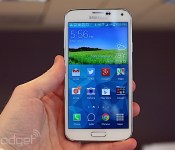
Samsung admits ‘weak demand’ for its phones is damaging profits

Samsung’s marketing budget has always been vast, but in the last quarter it was far larger than even the manufacturer itself would have liked. The company admits that it’s been forced to spend extra money on promotions for older and lower-end devices that have been filling up its warehouses due to “weak demand.” This dip in trade, combined with the extra spend on publicity, is causing the company’s recent, gradual profit decline to quicken: it now expects to earn around 24 percent less this quarter than it did a year ago, with underlying sales down by an estimated 8-11 percent.
Samsung claims the main underlying causes are stiffer competition in Europe, especially in the low- and mid-range parts of the market (presumably from the likes of Motorola), as well as a tougher climate in China, where many buyers are choosing to hold out for 4G phones rather than picking up current 3G models. The manufacturer also says that its 7- and 8-inch tablet sales, which have already been suffering from a slow upgrade cycle, are further being cannibalized by sales of 5- and 6-inch phablets.
On the other hand, Samsung claims that one of the biggest sources of its financial pain has nothing to do with smartphones or market saturation, but instead results from currency fluctuations: the won has been steadily increasing in value against the dollar, which isn’t good news for any Korean exporter. The company “cautiously” expects a “more positive outlook” later in the year, thanks to the release of a new smartphone lineup (likely a reference to the Galaxy Note 4 and other devices coming during the fall), while also hoping that its marketing spend will fall back to normal levels.
Filed under: Cellphones, Tablets, Mobile, Samsung
Via: WSJ Digits
Source: Newswire

GameStop wants to offer exclusive content with its preorder titles

“Software publishers [indicated that they] are more enthusiastic about partnering with [GameStop]… For example, by offering exclusive content on each major game release, and longer term, future models may include GameStop offering exclusive gameplay.”
Filed under: Gaming

Intel, Samsung join forces to streamline connectivity for the Internet of Things

The upside to connected devices is pretty obvious: From smart thermostats to smartphone-controlled light bulbs, these gadgets have the potential to make our lives easier. There is a downside, though and it’s a pretty significant one; with so many companies trying their hands at the Internet of Things, there’s an ever-growing list of protocols for getting gadgets connected. And considering that the IoT market is projected to reach 212 billion devices by 2020, it’s pretty much guaranteed to be a huge mess if products continue to run independently of each other. One universal spec allowing interoperability across all kinds of devices would help to simplify things, and that’s what Intel, Dell, Samsung and other tech giants hope to achieve with the just-announced Open Interconnect Consortium.
Another IoT consortium, you ask? Truth be told, there are already several groups pushing for standards in this space. LG, Qualcomm and others have put their weight behind the AllSeen Alliance, and Intel’s even involved in another called the Industrial Internet Consortium, which addresses the architecture and data requirements for connected machines on a larger scale. The new OIC, on the other hand, is more concerned with consumer and enterprise use cases (at least for the time being), and it will produce an industry standard to improve device-to-device connectivity. According to Intel, the participating companies will develop a certification program along with the new IoT protocol spec. The OIC will initially focus on open-source code for smart home and office scenarios, with specs tailor-made for connected cars and the healthcare industry to follow. For consumers, though, the bottom line is that connected devices could someday be sold with a OIC sticker on the package, letting you know that the smart door lock you’re eyeing meets the consortium’s requirements for interconnectivity.
Filed under: Networking, Internet, Samsung, Intel

Apple Strikes Deal for Third Solar Farm at North Carolina Data Center [Mac Blog]
Apple has struck a deal for a new 100-acre solar farm near its Maiden, North Carolina data center, the third such farm providing energy for the facility, reports the Hickory Daily Record. According to the report, Apple will be making an initial investment of $55 million in the solar farm, which will generate 17.5 megawatts of power.
Apple plans to have a grading permit submitted for the property by the end of the year, pending acquisition of the land and other terms of the development agreement. If everything else goes according to plan, the farm is projected to be completed within five years of the commencement date.
Apple’s North Carolina data center is the first in a series of significant data center projects the company has undertaken in recent years, with Apple also working on centers in Oregon and Nevada. Under its promise to run its data centers on 100% renewable energy, Apple has been investing heavily in energy sources such as solar and biogas while purchasing other types of renewable energy from suppliers.

The North Carolina data center was joined by a 20-megawatt solar farm across the street by late 2012, and Apple has also been developing a second 20-megawatt solar farm a few miles away. The data center is also powered by a biogas fuel cell facility that began as a 4.8-megawatt project but was later expanded to 10 megawatts.
Apple’s exact plans for this third solar farm are unclear, as the five-year planning horizon suggests it may be part of a longer-term vision for the site. The current data center primarily consists of a massive 500,000 square-foot building, but plans presented by Apple during the project’s development depicted a second building of equal size ultimately being constructed next door. Apple’s timeline for any expansion of that magnitude for the data center itself remain unknown.

Xiaomi’s next smartphone spotted, may launch this month with 4G

Xiaomi isn’t a major player in the west yet, but that could change in the coming months and years, especially if its next smartphone has LTE support and is priced just right.
GizChina is reporting that the new smartphone from Xiaomi, thought to be named either the Mi4 or Mi3S, could be announced on July 22, possibly launching in the fall.
Along with some leaked photos of the device, other rumors suggest that it will support LTE bands and have more RAM. Android Community said that according to its sources, the device could have at least a 1080p 5-inch display, a quad-core processor, possibly from NVIDIA or Qualcomm, and a 13 MP rear-facing camera.
Now you may be asking yourself, why should I care about a device that’s not available in the west (except for through importing and will soon be launching in other parts of Asia) and the reason is that it could be a device packed with the latest and greatest features, supporting not only 3G but also 4G bands and could come at a great price. This would give those looking to import an unlocked device and not be locked into a carrier contract another choice. We all know how well the OnePlus One is perceived, although availability is limited.
Xiaomi is on the up and up and its most recent device, the MiPad, which had top specs, including an NVIDIA Tegra K1 processor, for a not so premium price, was noted to sell out 50,00 units in under 4 minutes. It won’t be surprising to see Xiaomi continue to grow, especially with the new VP for Xiaomi Global, former Google VP Hugo Barra.
You can be sure that if any announcement is made, you can read about it here.
VIA: GizChina, Android Community
The post Xiaomi’s next smartphone spotted, may launch this month with 4G appeared first on AndroidGuys.

Free WiFi provider admits to making up 90 percent of its revenues

If you live in San Francisco or New York, you likely know you can connect to free WiFi in certain locations. Your cities’ governments partnered with Madrid-based provider Gowex to make that happen — the same company that has recently admitted to doctoring its accounts for the past four years. Gowex might be an unknown to most of us, but it was considered a success story in Spain and performed really well at Madrid’s Alternative Equity Market, a stock exchange for small companies. A few days ago, though, a short seller named Gotham City Research published a report that claims 90 percent of the company’s revenues are falsified and that it actually earns only 10 percent of what it says it does.
While Gowex initially denied the accusation and even announced that it earned 182.6 million Euros ($248 million) in 2013, company president Jenaro Garcia ultimately admitted the allegations and resigned from his position. On his Twitter page, Garcia wrote:
I made the deposition and confession. I want to collaborate with the justice. I face the consecuencies.
– Jenaro Garcia (@jero_net) July 6, 2014
The company used to claim that it makes its money from partnerships with local governments that want to use its free WiFi services, carriers that use its hotpots to offload data and from premium fees, among other things. It’s unclear what will happen to its hotspots in NYC and San Francisco, but the cities will likely have to look for another provider now that Gowex has filed for bankruptcy.
Filed under: Wireless
Via: Fierce Wireless, Bloomberg
Source: AFP, Fierce Wireless, Bloomberg, Euronext
 AIVAnet