



Microsoft’s new encryption makes it tougher to spy on your email

Microsoft said last year that it was tightening security to fend off the NSA and others who would scoop up your data, and today it fulfilled that promise with moves that should improve real-world security. The company now encrypts both incoming and outgoing Outlook.com email when it’s in transit. So long as the other end also supports this encryption (Gmail and other big names do), snoops can’t easily intercept messages in mid-flight. Microsoft is also implementing Perfect Forward Secrecy in both Outlook.com and OneDrive, which gives each connection a unique security key — even if people do crack a code, they won’t have a complete picture of your email or cloud storage.
Alongside the improved protection, Microsoft is also eager to show governments that it’s not creating back doors for spies. The developer has opened a Transparency Center at its Redmond headquarters that will let officials look at source code and otherwise verify that Microsoft isn’t purposefully including vulnerabilities. The tech giant would rather not worry about spying in the first place, but its new Center may prevent some of the company’s bigger customers (and their cash) from jumping ship.
Filed under: Internet, Microsoft
Source: Microsoft on the Issues

Madrid’s parking meters now charge extra if you drive a fuel hog

Madrid has an air quality problem, and it’s taking an unusual approach to getting the offending vehicles off the road: it’s discouraging their drivers from parking. As of today, the city’s smart parking meters charge up to 20 percent extra if you drive a car that’s likely to either be a fuel hog or put out a lot of exhaust fumes, such as pre-2006 diesels. Conversely, you’ll get a discount as high as 20 percent if you’re driving a newer (and presumably cleaner-running) car; it’s completely free if you’re using an electric vehicle. The system is based on a simple license plate check, although it’s accompanied by parking space sensors that make you pay more if you’re using up one of the last available spots.
In theory, the move will persuade locals to either get rid of their old clunkers or take mass transit when they can. However, there’s concerns that this is more of a revenue grab than a sincere attempt to fight pollution. Much like London’s congestion charge, Madrid’s metering won’t punish wealthier residents who can easily afford the fees; it’ll certainly hurt poorer locals who can’t afford more recent cars. The approach also doesn’t make note of the vehicle type — a brand new SUV may ruin the environment more than an aging compact. Still, the new rates may be helpful if they get people thinking about whether or not they really need to drive downtown.
[Image credit: (C)PromoMadrid, author Max Alexander, Flickr]
Filed under: Transportation
Source: El Pais (translated)

50 Cent’s new sports headphones aren’t subtle, and that’s OK

Curtis “50 Cent” Jackson was kind enough to give us an early look at his line of sport-friendly headphones on stage back at CES. Today, you get to see them out in the wild. As a refresher, there are on-ear and in-ear models and you can choose wired (Street) or wireless (Sync) varieties depending on how you roll. The on-ears come with a sweat-proof inner chamber and a rubberized coating to keep them looking box-fresh no matter how many laps you put them through, and there’s even a sports “towel” (it’s more of a cloth) included to mop your brow! The in-ears won’t come with such luxuries, but they do come in the same striking blue, pink or yellow color options. The Bluetooth variants all support aptX, which is more than can be said for the other rapper-backed sports buds we saw recently. Prices are $80/$150 for the in-ears (wired/wireless) and $180/230 for the on-ears — and we got an early look at some.
Running with headphones is a divisive subject. Some swear by it, others deplore it. Whatever camp you’re in, earbuds are usually the weapon of choice. Not me. I much prefer the extra isolation that on-ears provide. I don’t run on the roads, so traffic and other such obstacles aren’t much of a concern. The problem is, until now, there haven’t been many sweat/sport-friendly pairs of on-ears. Let alone wireless ones. These are two instant plus points for the new Sync model straight away. Not to mention that running isn’t the only activity that might cause a sweat, where the participants want to listen to their tunes, there’s a whole host of music loving active types to cater for.

The new Sync wireless sports from SMS are, unsurprisingly, very similar to the existing Sync model. The most significant difference is the finish. The shiny plastic of the current model is out, and a new rubberized nano-coating is in. It’s a decent upgrade both in therms of aesthetics (shiny plastic never really looks that good) and feel — the textured finish also feels nicer. The ear pads have been toughened up too. Not only are they covered with a perforated leather, the chamber inside is sweat-proof. The result is a sporty-looking headset that definitely feels comfortable once the heart rate (and sweat) starts to rise.
If thick, pronounced jams are what you want, then these will give it to you.
Looks are one thing, but audio is the money here, right? Already I suspect that critics are sharpening their knives, as is de rigueur when discussing any celebrity made/owned/built/endorsed headphones. The Sync wireless sport are loud and definitely “ample” when it comes to the low-end frequencies, there’s no skirting it. But, you know what? When I’m 5 miles deep on a run, that’s pretty much what I want. The bass isn’t ridiculous — it’s what you might refer to as “generous.” I’d reach for these over a pair with a flatter response every workout, every time. You may differ of course, but if thick, pronounced jams are what you want, then these will give it to you.

Despite the obvious leaning towards sporting use, the Sync’s will gladly fill the role of full-time headphone if you wish. The battery should be good for upwards of eight hours playback (or talk, given that they double as a hands-free too). If you find you do drain them, there’s a 3.5mm jack (and cable) so you can wire them in like regular headphones (which means they’re good for all devices, Bluetooth or otherwise). When it comes to sport-friendly on-ears, the Sync wireless are hard to knock. Yes, some will malign the “healthy” bass, others (like me) will appreciate it when trying to eke out that extra drop of energy. More than that, these are the best wireless model I’ve seen from SMS to date, so either way, things are looking up.
Filed under: Home Entertainment
Source: SMS Audio

Tinder co-founder hits company with sexual harassment lawsuit

The corporate culture at Tinder HQ is about to get a public airing, now that its female co-founder and former VP of marketing has raised a lawsuit over allegations of sexual harassment and discrimination. Whitney Wolfe (top right) claims that she was sent inappropriate messages by one of Tinder’s male co-founders, Justin Mateen (top left). These messages have been submitted as evidence, as you can probably tell from the spooked tone of the company’s official response:
“…it has become clear that Mr. Mateen sent private messages to Ms. Wolfe containing inappropriate content. We unequivocally condemn these messages, but believe that Ms. Wolfe’s allegations with respect to Tinder and its management are unfounded.”
Tinder says Mateen was suspended as soon as the allegations came to light, and it’s now conducting an internal investigation. Meanwhile, Wolfe’s case further includes allegations that Mateen pursued her romantically and then publicly insulted her, calling her a “whore” and a “desperate loser,” when their relationship turned sour. More fundamentally, she also says that she helped to create the dating app, including coming up with the name “Tinder,” but says she was stripped of her co-founder title in case her age and gender damaged the company’s perceived valuation. Of course, Tinder could now be exposed to precisely this sort of damage as a result of the lawsuit, especially now that Mateen’s offensive messages have been revealed to the public — just like those of another Silicon Valley heavyweight.
Filed under: Misc, Internet, Mobile
Via: TechCrunch, BBC Newsbeat
Source: Rezlaw

Apple Looks to Boost AppleCare+ Membership With New 60-Day Purchase Window
 Apple today revised its AppleCare+ support service, lengthening the time new iPhone and iPad owners have to purchase the protection plan from the previous 30-day window to an extended 60-days. The new 60-day AppleCare+ option is available both in store and online in all AppleCare+ regions, with the exception of Japan which still offers the original 30-day window, reports 9to5Mac.
AppleCare+ is a premium warranty service for iPhone and iPad owners, providing warranty support and accidental damage coverage for two years from the date of device purchase. The plan costs $99 and includes two accidental damage replacements that cost $49 per incident for the iPad and $79 for the iPhone.
Apple also is discontinuing the previous AppleCare option that extends warranty service for the iPad and iPhone, but does not provide accidental damage coverage. Going forward, Apple will only offer the standard 90-days of free support that is included with every iPhone or iPad purchase as well as the option to upgrade to two-years of AppleCare+ for $99. This change goes into effect today in the United States, Canada, and Japan.
Apple hopes these changes as well other other future improvements will boost the adoption rate of AppleCare+. To compete with carrier and insurance options, Apple may improve its insurance plans for the iPhone as well as expand AppleCare+ internationally beyond its current coverage regions. The international service now has approximately 30 million subscribers and has brought in more than $2b in revenue since its introduction three years ago.
Rumored iPhone 6 Parts Show Volume and Power Buttons on Separate Cables
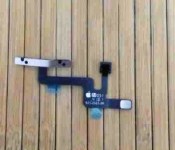
While we’ve seen plenty of mockups and more recently a few claimed legitimate exterior parts such as rear shells and front panels from the iPhone 6, little in the way of internal parts as surfaced so far. But three new photos surfacing today (via Apple.club.tw) show what are claimed to be a pair of flex cable parts from the iPhone 6.
The photos are of fairly poor quality and it is not specified whether the parts are from the 4.7-inch or 5.5-inch model, but the parts do closely resemble legitimate parts from other devices and an Apple logo and Apple-style part number are present on one of them.
 iPhone 6 volume/mute flex cable
Unlike on the iPhone 5s, where a single part houses both the left side volume buttons/mute switch and the top power button, these iPhone 6 parts show the two areas on separate flex cables. This change would seem to be consistent with the larger size of the iPhone 6 and the reported shift in the location of the power button from the top edge to the right edge.
 iPhone 6 volume/mute flex cable
One cable, which is shown from the front and back in two of the photos, appears to simply contain the volume buttons and mute switch. There appears to be greater separation between the volume buttons and mute switch than on corresponding parts from previous iPhones, but it is unclear just how much extra distance there might be in the finished product given the flexibility of these cables. Mockups and drawings have shown elongated volume buttons and perhaps a little extra distance separating the mute switch, but the difference does not appear as significant as suggested by the flex cable part.
 Separate iPhone 6 flex cable with what appears to be power button
The second flex cable shown in the photos is less clear in terms of function, but appears to include the power button, although Kyle Wiens of iFixit points out that it looks somewhat larger than on previous models.
Apple is expected to launch the iPhone 6 around September of this year, with a larger display being the key feature for the device. Other likely improvements include a new A8 chip, camera enhancements, and perhaps a more durable Touch ID fingerprint sensor.

Samsung intros four budget KitKat smartphones for international markets

Samsung on Monday introduced four new budget-friendly Galaxy smartphones in the form of the Galaxy Core II, Galaxy Star 2, Galaxy Ace 4, and Galaxy Young 2. Powered by Android 4.4 KitKat with Samsung’s TouchWiz Essence UI, these will likely be positioned in emerging markets or places where the Moto E and Nokia X2 might be offered. What’s more, they might be sold alongside some of the new Android One devices.
Of the four, the Galaxy Core II has the fastest processor at 1.2GHz (quad-core) as well as the largest display at 4.5-inches. Internal storage is listed at 4GB but a microSD card can add up to another 64GB the largest screen in the bunch as well. Internal storage is only 4 GB but can be expanded up to 64 GB through a memory card. Other specs include a 5-megapixel rear camera, front-facing .3-megapixel camera, HSPA support, 768MB RAM GPS, Bluetooth 4.0 and Wi-Fi 802.11 b/g/n.

Galaxy Core 2

Galaxy Ace 4

Galaxy Young 2

Galaxy Star 2
The Galaxy Ace 4 is a touch smaller with its 4-inch WVGA display and employs either a dual-core 1.2GHz or dual-core 1GHz processor, depending on model. The faster model also sees LTE support with 1GB RAM while the slower version gets 512MB RAM and HSPA connectivity. Both include 4 GB of storage, the same camera combo, microSD, GPS, Bluetooth 4.0, and Wi-Fi 802.11 b/g/n.
The Galaxy Young offers a 3.5-inch HVGA display, a single-core 1 GHz processor and 512 MB of memory. The back camera is dropped to 3-megapixels while the microSD is only expandable to 32GB. Also present are 4GB internal storage, Bluetooth 4.0, Wi-Fi 802.11 b/g/n, and HSPA connectivity.
The Galaxy Star 2 also has a 3.5-inch HVGA screen and single-core 1 GHz chip as well as 512MB RAM and 4GB storage. It’s not clear what sort of connection speeds will be available as it’s only listed with GSM frequencies. The rear camera slides down to 2-megapixels but the Bluetooth 4.0 and Wi-Fi 802.11 b/g/n are still present. Interestingly enough, there’s no GPS to be found.
The post Samsung intros four budget KitKat smartphones for international markets appeared first on AndroidGuys.

Get the lyrics to your favorite songs with musiXmatch [App of the Day]

You thought you knew all the words to your favorite song until you were singing loud and proud one day, and had to be corrected by someone who actually knew the song. musiXmatch makes it so you never have to worry about that again.
musiXmatch gives you lyrics that play along with music from your favorite apps so you always know your songs word for word. musiXmatch plays lyrics for its own app as well as Spotify, Rhapsody, Play Music, and rdio. You can also use the music ID feature to find out what song is playing on the radio, like Shazam.
The app is compatible with Chromecast so you can turn your next party into karaoke night.
With several more awesome features, it’s no wonder this app scores a 4.4 with a little less than a quarter of a million ratings
So go ahead and learn the real words to your songs
The post Get the lyrics to your favorite songs with musiXmatch [App of the Day] appeared first on AndroidGuys.

UK lays out plans to test robots in full view of the public

It turns out that Brits are actually ruddy marvellous at robotics, especially in automotive, aerospace, medical and military applications. Not wanting to be usurped by incumbents from overseas, the groups in charge of leading robot innovation in the UK have drawn up their first official robotics strategy. RAS 2020 (Robotics and Autonomous Systems) is its name, and it’s designed to aid the development and testing of robots, not only in laboratories but also out in the wild. It envisages the creation of real-world test zones where machines of the future can be put through their paces in plain view of the public.
The document alludes to an increase in large corporations looking to conduct robotic testing in countries where regulations support public testing. The UK government has already said it intends to adapt road laws in order for domestic and foreign car makers (think Google) to test driverless cars on Britain’s roads, but that’s just one of the “defined and controlled spaces” where robots could be unleashed. Airports, hospitals, farms, production lines, refineries and nuclear plants are all mooted as other possible test spots.
If those sites were set up, the next step would involve “Grand Challenges.” It wouldn’t quite be Robot Wars but the idea is similar, and it’s one that we’ve already seen employed in the US. Competitions would be set up to encourage collaboration and include the public, allowing you to familiarise yourself with futuristic technologies before they hit the market.
Filed under: Robots
Source: RAS2020

Russia’s new anti-extremism law targets online communications

What is “extremism”? That’s up to Russian president Vladimir Putin to decide, according to a new amendment to Russian law announced this week by the Kremlin. The law gives Putin more flexibility to punish what he deems as “extremist” behavior — on par with terrorism, legally — and it works hand-in-hand with a redefinition of online activity. Previously, Russia defined the it as, “international computer communications”; that definition was amended to also include, “information telecommunication through the internet.” This distinction is important, because it means not just websites, but also forms of online communication can be considered under Russia’s “extremist” label.
It’s yet to be seen how that redefinition applies to Russian citizens, but the amendment itself could cause a chilling effect on social media, comment sections, and other communicatory online services. Notably, these services are exactly the place where much of the “Arab Spring” protests were organized.
If someone is deemed an “extremist,” the punishment ranges from a hefty fine (approximately $8,500 – $15,000) to jail time (five to eight years, depending on the crime). Certainly more than enough to make you think twice about spreading political dissent, however tame it may be.
“Maybe I shouldn’t post that snarky political tweet, eh?”
Though the government claims the amendment is meant to crack down on “extremism” from edge groups (think: neo-Nazis), so far it’s mostly used such laws to crack down on dissent. For instance, it recently blocked opposition sites from several Putin critics, including forming chess grandmaster Gary Kasparov, after they called for protests.
And it’s impossible to not connect the amendment with the past several years of increasingly scrutinous legal challenges for protesters in Russia. The crackdown in 2013 drove many protesters online, and forced them to employ new methods of communication typically outside of Russian government surveillance. As The Washington Post reported back in May 2013, “[protesters] who haven’t been jailed or fled the country…communicate through more secure methods on the Internet.”
[Image credit: DMITRY SEREBRYAKOV/AFP/Getty Images]
Filed under: Internet
Via: Kremlin
Source: Russian Federation
 AIVAnet