


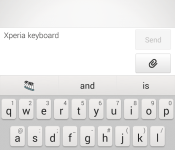
Xperia Keyboard now available in Google Play Store for Sony devices
Almost all the major brands have been releasing their core apps on to the Play Store as it becomes easy to update those parts without pushing an update to the whole system. Sony has released the Xperia Keyboard in the Google Play Store. Although it is only compatible with Sony Xperia devices running Android 4.4.2 KitKat. Which leaves out a the Xperia Z and Xperia Z1s with T-Mobile (Story gave it a look.). The latest version of Xperia Keyboard (6.4.A.0.6) comes with features such as swipe typing, language learning and predictions. It learns a user’s language through GMail, Facebook and Twitter.

 The new version also comes with data sync. It will backup and sync service with your Sony Entertainment Network account, assuming it is available in your region. This makes sure that even when you switch to a different Sony device, the typing experience stays the same. This keyboard includes all the major languages worldwide except Chinese, Japanese and Korean.
If you happen to have an Xperia device with Android 4.4.2, then be sure to update and give it a whirl. Assuming you haven’t already of course.

//<![CDATA[
ord = window.ord || Math.floor(Math.random()*1E16);
document.write('’);
//]]>

DARPA envisions a smarter, safer autopilot

Autonomous aircraft serve their purpose, but there’s no question that pilotless passenger flights are a long way off, if they ever become a reality. Still, there’s obviously room for improvement when it comes to on-board systems that assist pilots in their duties. The Defense Advanced Research Projects Agency (DARPA) is in the process of creating an advanced autopilot system called ALIAS (yes, another acronym). The Aircrew Labor In-Cockpit Automation System (there you go) would control military aircraft in all stages of flight, from takeoff to landing — even during a system failure. Pilots would interact with the system using a touchscreen and voice control, supervising a flight instead of commanding it. Of course, we’ll see this technology make its way to military planes long before it’s adopted by airlines, but ALIAS could play a key role in keeping us all safe at 30,000 feet.
Filed under: Transportation, Software
Source: DARPA
Apple’s Shazam Partnership Could Boost Advertising Efforts
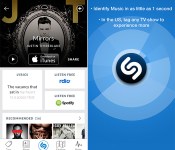
Earlier this week, Bloomberg reported that Apple has plans to integrate song identification features into iOS 8 through a partnership with audio discovery platform Shazam, but as suggested by media professor Aram Sinnreich, Apple’s ambitions may go beyond simple music recognition capabilities.
Speaking with Computerworld, Sinnreich, a media professor at Rutgers University, points out that Apple could use Shazam’s audio recognition abilities to gather information on the media that iPhone and iPad users are consuming, including music, television shows, movies, and more, for targeted advertisements.

While Shazam is known for identifying songs that are playing on the radio or through other sources, the service is also capable of identifying and tagging television shows and advertisements. Shazam works by analyzing captured sound and comparing its acoustic fingerprint to an audio database, which began including television content in 2012.
Shazam’s technology could, of course, be used to deliver music and television information to consumers, providing identification along with additional content like news, facts, and iTunes purchase links, but at the same time, Apple could also use it to gather information on consumer preferences each time a song, television show, or advertisement is “tagged” or identified by a user, allowing the company to use those preferences to deliver more targeted ad suggestions across iOS.
Sinnreich pointed out that Shazam has been indexing advertisements broadcast on television, as well as the pre-show ads shown in movie theaters, and in some cases, has stuck deals with advertisers to provide metrics of those who “tag” an ad. In some cases, tagging an ad presents the consumer with additional information, or even a special offer.
Currently, the existing Shazam app is able to run in the background of iOS, continually cataloging and identifying all of the music, television shows, and TV ads that a user watches. Apple could potentially integrate the feature in the same way into iOS 8, allowing it to run in the background to continually listen for various audio content.
This functionality would allow Apple to know what a user prefers to watch and listen to. For example, if someone was watching Downton Abbey or Game of Thrones, Apple’s media recognition capabilities could theoretically automatically identify what’s being watched, cataloging it for future use in advertisements. Sinnreich likens this functionality to an audio QR code.
“Apple could do whatever a QR code is used for now, but sonically,” said Sinnreich of the audio fingerprinting technology. “Someone tags a commercial, and that’s entered into a database, effectively targeting [that consumer] for further ads,” he said.
While Sinnreich’s theory is mere speculation at this point, it does fit in with Apple’s current advertising methods, which the company says include “exceptional targeting.” Apple has been working to expand its iAd platform in recent months, moving beyond app advertisements to encompass iTunes Radio ads as well. Further improving its targeting methods could entice major advertisers, which has been the company’s goal — recently, Apple made it simpler for advertisers large and small to sign up for the platform, eliminating the need for a developer account.
Apple’s audio recognition capabilities are said to be coming alongside iOS 8, which is expected to make its debut during the company’s Worldwide Developers Conference in June. The operating system will likely be released to the public later in the year, in September or October.

Engadget Podcast 393 – 4.18.14

We have less libations, but more tech-related news than last week’s peaty podcast and that’s just fine for your sleep-deprived hosts. First up is some informed speculation on Amazon’s new smartphone, based on a few inconclusive photos that recently surfaced. Another work in progress is Google’s Project Ara, a modular concept that looks to make swappable smartphone parts a reality. The one thing that’s all too real and in your face, however, is the recent Heartbleed exploit, which has had widespread impact across the web. While you’re racing to update all those passwords — yes, it’s OK to do that now — it couldn’t hurt to get a refresher on exactly what happened and which sites were affected. So head on down to the streaming links and get your brain fix with this week’s episode of the Engadget Podcast.
Hosts: Terrence O’Brien, Ben Gilbert
Producer: Jon Turi
Hear the podcast:
01:56 – Testing Reebok’s Checklight head impact monitor with a human punching bag
02:26 – Engadget Podcast 392: The whiskey ‘sode
02:55 – Here’s Amazon’s phone: six cameras and a 4.7-inch screen
15:25 – What is Heartbleed, anyway?
16:40 – Google has patched most of its major services from the ‘Heartbleed’ security bug
24:02 – Crooks use Heartbleed exploit to steal 900 Canadian tax IDs
25:52 – Tor’s anonymity network may have to shrink to fight the Heartbleed bug
27:19 – Bloomberg: NSA used Heartbleed exploit for ‘years’ without alerting affected websites, the public
35:30 – Google’s Project Ara wants to revolutionize the smartphone industry within a year
Subscribe to the podcast:
[iTunes] Subscribe to the Podcast directly in iTunes (enhanced AAC).
[RSS MP3] Add the Engadget Podcast feed (in MP3) to your RSS aggregator and have the show delivered automatically.
[RSS AAC] Add the Engadget Podcast feed (in enhanced AAC) to your RSS aggregator.
Download the podcast:
Contact the podcast:
Connect with the hosts on Twitter: @terrenceobrien, @realbengilbert
Email us: podcast [at] engadget [dot] com
Filed under: Podcasts

This enormous gas tank is now a wondrous, isolating work of art (video)

Once it stored enormous quantities of blast furnace and coal gas, but these days the Gasometer Oberhausen is a 385 foot tall cylindrical art gallery. Since the early 90s, the gargantuan storage tank has been host to more than a dozen art exhibitions, and its latest display puts its own absurd size front and center. 320° Licht plays on the gallery’s tar-black walls, projecting optical illusions that make the surface appear to warp and bend. “This experience is based on the vastness of the Gasometer,” explains project sound designer Jonas Wiese. “We tried to work with that expression to make the space bigger and smaller, to deform it and change its surface over and over while not exaggerating and overwriting the original effect of the room.” According to the installation’s creators, that effect is dwarfing. Viewers are left feeling small, even lost.
The emotionally taxing light show is powered by 21 Epson projectors, which collectively paint the tank’s interior to a captivating, animated display. The display is part of The Appearance of Beauty exhibition in Oberhausen Germany, which runs until late December. Can’t afford to fly out to Deutschland? No worries, the gallery has created a preview video – check it out below.
Filed under: Misc
Source: Gasometer Oberhausen, VICE

AT&T adds more data and a hotspot option to prepaid GoPhone plans

AT&T is adding more data to its GoPhone prepaid smartphone plans without raising monthly fees in the process. If you’re currently paying $60 a month for 2GB, your allotment will jump to 2.5 gigs, while those on the $40, 250MB plan will now get 500MB per month. More data is only part of the value proposition for GoPhone customers, though; the new 2.5GB plan will now offer the ability to use your phone as a WiFi hotspot.
Additionally, the carrier is adding a new $45 plan that includes 1GB of data and unlimited talk — but note that this is only available at Walmart. While these updates are good news for current GoPhone subscribers, they’re not quite as competitive as T-Mobile’s pay-in-advance plans, which start at $30 a month with unlimited (read: 5GB) data and 100 minutes of talk. That said, $60 a month for 2.5GB and hotspot functionality is a nice step up on AT&T’s part.
Filed under: Cellphones, Networking, Mobile
Source: AT&T
Tubecore wants you to hack and mod its beautiful, modular speaker

Let’s be honest: Wireless speakers are a dime a dozen. The options are seemingly endless, and new ones arrive on an almost daily basis. Companies have begun to push the boundaries of design as of late, making options that are an aesthetic step above the larger outfits. Tubecore’s Duo certainly does that, but it’s also so much more.
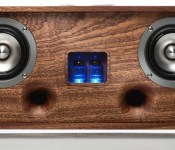
It may be easy to gloss over the Duo spec sheet and skip right over to the Moto X-esque customization page, however it’s there that the real standout features lie. What’s immediately clear from the first glance is the vacuum tube-driven preamp. It’s a 48v Class A unit that relies on that pair of tubes to deliver “vintage studio hi-fi.” The folks at Tubecore say that this allows you to beam audio from any source and get a taste of analog high-fidelity listening. A 24-bit DAC (Digital to Analog Converter) lends a hand there with the help of the standard-issue Raspberry Pi, and the signal is filtered six times to remove any excess noise that might be picked up by the system’s components.
All of that leads to uncompressed audio from all input sources in a package that’s built to be hacked, moded and upgraded based on the needs and preferences of the user. “Because Duo is high-powered, it’s definitely more expensive to manufacture, but the quality is uncompromising,” says Tubecore President Jason Perkail.

But the thing looks great, and its industrial design is more than skin deep. Perkail told me that the Duo’s cabinet was designed in a fashion similar to an electric guitar, with a heavy dose of inspiration from the analog API Legacy 4×4 console in Ben Folds’ Studio A. In fact, it’s built in a similar fashion to a six-string and this construction is what gives the speaker a full 10Hz-20kHz range.
“Because DUO is high-powered it’s definitely more expensive to manufacture, but the quality is uncompromising.”
What’s more, the controls are simple. There’s a single 4-inch aluminum dial that mimics classic hi-fi knobs up top to wrangle volume, inputs and system preferences powered by an embedded Arduino MC. In terms of connectivity, there’s Bluetooth for wireless streaming with WiFi, line-in, RIAA-equalized phono in and the onboard computer’s USB ports. This will allow you to connect nearly everything to the speaker from a TV to mobile devices and computers — easily fitting in as part of a home entertainment system. As you might expect, Android and iOS apps will accompany the Duo and will work alongside Estimote Beacons to track users as they move around the house, blanketing the same experience in configurable zones throughout.
If the aforementioned customization is what you’re after, that’s certainly a hook here too. There are 10 standard grill covers and 27 custom grill covers (for an additional $19) — all of which are magnetic — for adding a splash of color to the wooden speaker. For those looking to dig deeper with the modular add-ons, three tube upgrades range from $25 to $75, and the option to swap out that Raspberry Pi for a UDOO Quad tacks on $110. All of those bits are tacked on to the $649 base price, which is currently discounted for those willing to opt in early to an attractive $479 pre-order rate.
Filed under: Home Entertainment, Portable Audio/Video
Source: Tubecore

Camera deals of the week: 4.18.14

Snatching up a new camera can be a considerable investment, especially if you’re after a unit that combines stellar images with a host of features. Fret not friends: We’re here to help. Just beyond the break, you’ll find a handful of photo gadgets that are all available at attractive discounts for the time being.
If there are other cameras, lenses and the like you have your eye on that we haven’t included here — join us and add them to your “Want” list. Every time there’s a price cut in the future, you’ll get an email alert!
Canon EOS 7D (body-only)

Price: $879
Regular Price: $1,500
Engadget Global Score: 86
Buy: 42nd Street Photo
If you’re after a mid-range DSLR for that photo hobby, Canon’s EOS 7D is available at a handsome discount right now. Sure, you’ll have to shell out some extra cash for a lens, but you’ll likely want to nab up a couple of those anyway. The current price tag is the lowest we’ve seen in the last three months, according to our price history tool.
Nikon D600 (body-only)

Price: $1,429
Regular Price: $1,899
Engadget Global Score: 86
Buy: 42nd Street Photo
For those looking to invest a bit more in their snapshooting exploits, the full-frame Nikon D600 also has received a significant price drop. While it does require a bigger investment, the pro-grade features of this camera are going at a rate on par with the 90-day low.
Fuji X-Pro1 (body-only)

Price: $799
Regular Price: $1,300
Engadget Score: 82
Buy: 42nd Street Photo
It’s no secret that Fuji’s dapper retro stylings have caught our eye a time or two. And now, you can get in on the classic designs with the X-Pro1. This all-black model’s current discount brings the price down to the lowest our price history tool has seen over the past three months.
Samsung NX300

Price: $576
Regular Price: $800
Engadget Score: 89
Buy: Amazon
There’s a hint of classic styling to Samsung’s NX300, too — for those looking to make a more modest investment, and it’s one that includes some requisite glass (an 18-55mm lens, to be exact). The black version of the WiFi-equipped mirrorless offering is seeing the best rate, so you’ll have to pay extra if you’d prefer either the brown or white options.
Filed under: Cameras

Watch SpaceX’s second attempt at launching a reusable rocket (update: launched!)

After many “Grasshopper” tests, SpaceX’s first real try at launching a reusable rocket will attempt flight again in just a few minutes — watch the live stream here or embedded after the break. Scrubbed due to a helium leak a couple of days ago, the Falcon 9 rocket is once again facing gloomy skies, but according to launch control, everything is a go. Weather permitting, the launch is scheduled for 3:25PM ET. The Falcon 9-reusable rockets have already undergone their own testing, and you can see the latest video after the break.. Also important is what’s onboard the Dragon cargo ship this rocket is launching. Headed to the ISS, it’s bringing new supplies and a pair of extra-large, bendable legs for our friend Robonaut 2.
Update: We have liftoff. Now that the rocket is aloft, while the capsule will head to the ISS, its first stage will attempt to reenter the atmosphere, and position itself for landing somewhere over the Atlantic Ocean, before falling over into the water. This is still just a test run, but it will help scientists sort out any issues before they attempt a reentry and landing on… land in the future. The live video stream is ending, and it sounds like we’ll have to monitor the @SpaceX Twitter account for updates on the landing attempt.
F9 & Dragon vertical on the pad for today’s launch to the ISS. Weather still a concern–liftoff targeting 3:25pm ET pic.twitter.com/4wRhrtjlbN
– SpaceX (@SpaceX) April 18, 2014
Liftoff!!!`
– SpaceX (@SpaceX) April 18, 2014
Live streaming video by Ustream
Filed under: Transportation
Source: SpaceX

HTC hires marketing exec who led Samsung to smartphone dominance

It’s no secret, HTC has an image problem. Despite consistently creating some of our favorite phones, it’s failed to reach the heights of popularity of manufacturers like Samsung. That could soon change. In what is almost certainly not a coincidence, HTC has hired Samsung’s former Chief Marketing Officer, Paul Golden. The Verge confirmed the rumor, first picked up by Bloomberg, earlier this afternoon. Golden, who “created and launched the highly successful Galaxy brand for Samsung,” according to his LinkedIn profile, was reportedly hired on as a consultant to Chairwoman Cher Wang.

Among other achievements, Golden attributes his work on the Galaxy brand with “a 4X increase in market share (from 4.5% to 21.0%) in the strategically critical smartphone segment.” HTC has repeatedly pointed back to marketing as one of its weakest points. In 2013, CEO Peter Chou pointed to weak marketing as the reason for poor financial performance, and, as Bloomberg point out, Wang reiterated that issue on April 8th, saying, “We just have to communicate well with our customers. I believe if we can communicate better, we will do better.”
With Robert Downey Jr. holding down the cats and Golden’s ability to bolster the next big thing, perhaps it’s finally HTC’s time to shine.
Filed under: Cellphones, Mobile, Samsung, HTC
Via: Slashgear, Engadget Spanish
 AIVAnet