



Toyota’s Sports Drive Logger lets you relive real life races in Gran Turismo

Imagine this: you just rounded the final bend of the Fuji Speedway International Course. Pedal jammed against the floorboard, you’re neck and neck with Jenson Button, eying the finish line. Let’s face the facts, you’ll never actually race Jenson, but you can use Toyota’s new Sports Drive Logger to hone in your skills just like he does.
To use the Sports Drive Logger, you’ll need to A), own a Toyota GT86 sports car and B), have access to certain race tracks in Japan (the Fuji Speedway International Course, the Tsukuba Circuit 2000 Course, and the Suzuka Circuit International Course). Meet those requirements, and you can use the accessory to record your race digitally and replay it within Gran Turismo 6 on PS3. Similar to the Corvette data recorder we saw at CES, the device tracks real-life laps and vehicle data (GPS location, pedal input, steering angles and the like) onto a USB flashdrive, the device builds a digital representation of your performance that’s recreated in-game. And judging by the video, it’s surprisingly accurate. You can even race against friends and pros alike to learn the fastest way round the track.
The device will launch in Japan only for $900 on June 2nd, which makes sense given that the first three courses supported are found in the land of the rising sun. Thankfully, Toyota does have plans to add more circuits in the future. For folks who prefer other tracks, Toyota says that they’re in the works — speed is king, but patience is a virtue, people.
Filed under: Misc, Transportation
Via: Gizmag
Source: Toyota
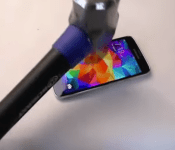
Watch a Galaxy S5 Get the Hammer in New Video [MUST-SEE]

You got to love it: when new devices get released, those dreaded durability test videos start showing up making us cringe and hate the people who make them. Drop tests, water resistance tests, even tests with knives, have been shown in recent videos for the latest in mobile tech. How about a hammer to a Galaxy S5?
In the video below, a young man decides he is going to show us just how durable the Galaxy S5′s screen is. It is a fairly short video, and he basically gives it a little force at first, and then ends it be beating the phone into pieces. What happens after that is pretty hilarious, and we can all laugh in an enjoyment, because this guy deserves what happens after destroying a new piece technology. So check it out below, and let us know what you think. GET SOME FEBREZE OR SOMETHING!
//<![CDATA[
ord = window.ord || Math.floor(Math.random()*1E16);
document.write('’);
//]]>
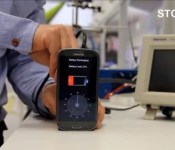
Yes, Please: StoreDot prototypes bio-organic battery that has 30 second charge Time
 The days of waiting hours and hours for your smartphone battery to fully charge could be over very soon. Israeli start up, StoreDot, has shown off the technology in a YouTube video which shows a prototype of the bio-organic fast-charging battery tech in action. Prepare to be amazed:
As you can see, the battery charges from empty to full in an absolutely ludicrous amount of time. The core concept behind the battery tech is quantum dot technology and has attracted $6.25 million USD in investments already. A commercial version of the product is still some time away, however; the prototype shown is obviously not small enough for a smartphone yet and even StoreDot’s CEO/founder Dr Doron Myersdorf has told TechCrunch “So we are talking about three years for a commercial ready device. So I assume it will be three years before you can actually purchase it on the market.”
While StoreDot’s prototype solution is awe-inspiring, it doesn’t quite address the root problem which is battery capacity. However, at least we know now that if we run out of juice in the future, we’ll be able to be back up and running in just a few minutes. What do you think about StoreDot’s technology? Let us know what your thoughts are in the comments.
Source: TechCrunch
//<![CDATA[
ord = window.ord || Math.floor(Math.random()*1E16);
document.write('’);
//]]>

Daily Roundup: Twitter’s redesign, Lightroom mobile for the iPad, and more!

You might say the day is never really done in consumer technology news. Your workday, however, hopefully draws to a close at some point. This is the Daily Roundup on Engadget, a quick peek back at the top headlines for the past 24 hours — all handpicked by the editors here at the site. Click on through the break, and enjoy.

Twitter’s new profile design kinda looks like Facebook
Today, Twitter got a facelift — and it looks a lot like Facebook. The revamp includes a larger header photo, the ability to filter between tweets with or without media and “pin” certain tweets to the top of your feed. All new accounts will launch with the design, but it’ll make its way to others “in the coming weeks.”

US Navy fine tunes seafaring laser weapon and unmanned robocopters
What’s better than a regular ole’ helicopter? A full-sized remote control helicopter, of course. The Navy’s latest robocopter can be piloted from a tablet after only 15 minutes of training and it automatically detects and avoids obstacles. In addition, the Armed Forces branch has a new laser which fires high-energy beams that cost around $1 per shot.

Lightroom mobile arrives for iPad with touch-friendly interface, realtime sync
Lightroom mobile for the iPad is here! Adobe’s latest companion app brings photographers most of the most of the funtionality found in the desktop version, and any changes you make will be pushed to your Lightroom cloud.

Neil Young on digital audio: You’re doing it wrong
Neil Young has a plan to serve up high-resolution audio, and it’s called Pono. But why would anyone spend $400 on a somewhat chunky media player and re-buy all of their music library in FLAC format? We sat down with the rock icon to find out.
You also might like:
Filed under: Misc

Implant shocks patient’s spines, restores partial use of paralyzed limbs

Remember that spinal implant that helped a paraplegic man walk (albeit in a harness) back in 2011? It’s now been tested on three more partially paralyzed patients — and it’s working. The original device was a 16-electrode array that emitted small pulses of electricity to the spine, simulating the brain’s natural impulses. With intensive therapy and training patients have been able to regain limited control over their paralyzed extremities.
Nobody is walking just yet, but the recent study’s success (published in Brain, a neurology journal) proves that the treatment works on a wider range of patients. It also demonstrates that the results of the original experiment can be replicated. It’s still a long way from a cure for paralysis, but the paper’s authors are optimistic about its future application, stating that “we can now envision a day where epidural stimulation might be part of a cocktail of therapies used to treat paralysis.” Read the study for yourself in Brain, or skip past the break to see the patients trying out their new implants.
[Image credit: UCLA]
Filed under: Misc
Via: iO9

Cellular competition shrinks as Verizon swallows another small-time carrier

While many have been fretting over the possibility of reduced cellular competition if Sprint buys T-Mobile, some real reduction has just taken place. Cincinnati Bell has sold all of its spectrum to Verizon for $210 million, removing itself from the wireless industry. The regional carrier’s network will run as usual until the deal’s expected closure in the second half of 2014, but the company plans to move customers to other providers shortly after that. It’s bowing out because it simply can’t afford to compete — it’s too “economically challenging” to build an advanced network, CEO Ted Torbeck says. The move should help Cincinnati Bell concentrate on its fiber internet and TV plans, but it’s not great news for subscribers who’d like to hold on to as many carrier choices as possible.
[Image credit: Robert Donovan, Flickr]
Filed under: Wireless, Mobile, Verizon
Source: Cincinnati Bell (1), (2)

March Madness 2014 was live streamed nearly 70 million times

Hey, look, we all know the Super Bowl is a pretty big deal. But March Madness isn’t that far off, both in terms of viewership and the great dose of excitement it injects into fans. And there are numbers to prove it too. According to Turner Sports, an NCAA partner, March Madness Live 2014 shattered all previous online viewing records for the tournament, netting a total of 69.7 million live streams. That statistic takes into account the different platforms in which the service was available this year, which included a website as well as apps on iOS, Android, Kindle Fire and Windows devices.
In retrospect, Turner reports that March Madness Live 2014 streams grew by 42 percent compared to last year, while TV Everywhere (aka sites and apps from pay-TV providers) also saw an increase in usage during the basketball tournament, with an 85 percent growth from March Madness 2013. All in all, the NCAA can be pleased by the response from people in 2014, who clearly took advantage of the streaming options it was able to provide in association with CBS, Turner Sports and cable/satellite companies.
[Image credit: Charlie Neibergall/AP]
Source: Turner Sports
Apple Calls in Experts to Explain Why Samsung Owes $2B in Damages
In the ongoing Samsung vs. Apple lawsuit, two experts hired by Apple took the stand on Tuesday to explain to the jury why Samsung deserves to pay $2 billion in damages for infringing on Apple’s patents.
First up was John Hauser, a professor of marketing at the MIT Sloan School of Management, who argued (via CNET) that the specific features patented by Apple, such as slide to unlock, made Samsung’s devices far more appealing to consumers.

To reach that conclusion, Hauser surveyed 966 Samsung device users (507 phone owners and 459 tablet owners) to measure the percentage of consumers who would buy devices with specific features, including universal search, background syncing, quick links, automatic word correction, and slide-to-unlock, among others.
Those metrics were then used to determine how much people would pay for the Apple-patented features that Samsung included in its devices, with Hauser coming to the conclusion that customers would shell out $32 to $102 for each feature.
“The features that were enabled by the patents at issue in this case have a measurable impact on consumer demand for Samsung devices,” Hauser said during his testimony Tuesday.
During cross examination, Samsung objected to Hauser’s methodology, which had concluded that Samsung largely sold devices due to the features copied from Apple, and criticized it for overlooking the importance of the Samsung brand and the Android operating system.
Following Hauser’s testimony, MIT-trained economist Chris Vellturo took the stand (via Re/code) to explain how Apple arrived at its $2 billion number. The damages, he said, are a mix of lost profits and estimated reasonable royalties on the millions Samsung devices that have been accused of infringing on Apple’s patents.
“It’s a very large market and Samsung has made a lot of sales into that market,” Vellturo said, before getting into the specifics of how he came to his estimate. Samsung’s alleged infringement, he said, came at a time of dramatic growth in the market as many people were buying their first smartphone.
“It’s a particularly significant period for Samsung to have been infringing,” Vellturo said, adding that one’s first smartphone purchase is a key determining factor in future phone and tablet purchases. He added that Samsung was behind in ease of use and took Apple’s know-how to aid its effort to be more competitive.
In the original Apple vs. Samsung trial, Samsung was ordered to pay Apple $890 million in damages. The latest suit focuses on newer devices, including the Galaxy S III, Galaxy Note II, Galaxy Tab 10.1, the iPhone 4/4s/5, the iPad 2/3/4, the iPad mini, and fourth and fifth generation iPod touch.
Following today’s expert testimony, Apple is nearing the end of its case against Samsung. Next week, Samsung will present its infringement case against Apple, where it is asking for $7 million in damages. The entire trial is expected to continue until April 29 or 30, at which point the jury will enter deliberations.

Super Smash Bros. 3DS launches this summer, Wii U version due in winter

Jonesing for a new Super Smash Bros. game? Hope you own a 3DS: Nintendo has announced that the mobile version of the series’ latest entry will land first, debuting this summer. The Wii U version will arrive this year too, but it won’t be available until winter, presumably to make the most out of the holiday season. Nintendo teased the launch windows with a tweet right before today’s Super Smash Bros. Nintendo Direct, where Masahiro Sakurai (the game’s director) updated players on the game’s latest development.
In addition to showing off the standard deluge of stages and new characters (Sheik, Zero Suit Samus, Yoshi and Pokemon’s Charizard and Greninja, specifically), Sakurai explained the new games’ disparate multiplayer modes: “For Fun” and “For Glory.” Gamers playing “for fun” will play with randomized items and stages, counting only victories to the players record – gamers looking for glory, however, will play on simple, flat stages with no items. In “For Glory” mode, both wins and losses count against the player’s record. Finally the 3DS version comes with an exclusive battle game called “Smash Run,” where up to four players navigate a timed obstacle course to collect power ups and fight enemies before ultimately facing each other in a final battle. Miss Nintendo’s live broadcast? Not to worry: we’ve embedded the full presentation after the break.
Via: Joystiq
Source: Nintendo

Authentic spacesuits, rockets and more up for auction in NYC

Imagine what your friends will say when they notice your brand new space rocket just chillin’ in the corner of your living room. Bonhams in NYC has plenty of items to make your neighbors jealous at its Space History Sale, a collection of 296 items from US and Soviet missions past. The big event celebrates Project Gemini, NASA’s first unmanned test flight, which took place on April 8, 1964 (what better way to party than to sell some stuff?).
You can grab yourself everything from a real-life space station control panel to some (pretty gross looking) coffee and tea containers from previous missions. The epic silver spacesuit pictured above already sold for $44,000, even though it’s too damaged to wear while playing a round of golf on the moon. But, if you’re in the market for a new suit there are still a few more available. You can even take home a little bit of history with one of three known casts of Buzz Aldrin’s footprint from the lunar surface. If you do buy that rocket prepare to be a little disappointed: it’s only a model.
Via: Gizmag
Source: Bonhams
 AIVAnet