


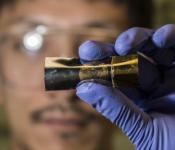
Flexible batteries right around the corner, the next step to truly flexible devices
The race for the best technology packed into the palm of your hands has been on going for decades. In the cellphone business we all watch as various companies are pushing screen resolution to 2K, and even 4K, and matching the camera to take 4k videos paired with bigger and better cameras. The next step will easily be flexible screens. LG has the G Flex, which does bend. Samsung has been showing off various concepts of unbreakable flexible displays for some time now. While screens can bend and flex, other components are pretty solid and rigid. However, a Rice University laboratory is setting their sights on making at least one major component in the portable electronic industry a bit more ‘flexible’.
 Rice chemist James Tour and his colleagues have developed a flexible material “with nanoporous nickel-fluoride electrodes layered around a solid electrolyte to deliver battery-like supercapacitor performance that combines the best qualities of a high-energy battery and a high-powered supercapacitor without the lithium found in commercial batteries today.”
In testing the team found that their square-inch little flexible creation held 76% of its capacity over 10,000 charge/discharge cycles and 1,000 bending cycles. When the team set out to create this marvel, they were looking to find a material that had the flexible qualities of graphene, carbon nanotubes and conducting polymers. All of course while finding a material that had a higher electrical storage capacity.
“This is not easy to do, because materials with such high capacity are usually brittle,” he said. “And we’ve had really good, flexible carbon storage systems in the past, but carbon as a material has never hit the theoretical value that can be found in inorganic systems, and nickel fluoride in particular.”
“Compared with a lithium-ion device, the structure is quite simple and safe,” Yang said. “It behaves like a battery but the structure is that of a supercapacitor. If we use it as a supercapacitor, we can charge quickly at a high current rate and discharge it in a very short time. But for other applications, we find we can set it up to charge more slowly and to discharge slowly like a battery.”
The team is already in talks with companies that are interested in commercializing this new flexible battery technology. We have our suspicions that LG and Samsung might be mixed in those talks. Just think, a fully flexible screen with a fully flexible battery could allow for non-flexible components to be on the top and bottoms and allow the middle to flex freely all while giving you plenty of power. it would also lead to a whole new set of not only phone and tablet designs, but watches and wearables too.
Source: Cellular-News
//<![CDATA[
ord = window.ord || Math.floor(Math.random()*1E16);
document.write('’);
//]]>
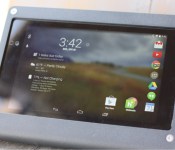
Heckler Design WindFall Stand for Nexus 7 (2013) review

If you’re a small business owner looking to use your Nexus 7 (2013) as a payment system, you may want to check this out. The Heckler Design WindFall Stand is sturdy, sleek, and offers premium security for your premium tablet. It’s specifically designed for point-of-sale use in business settings, and not much more than that.
We’ve tested this stand for a few weeks, so let’s take a closer look.
Design

The design of this stand is absolutely beautiful. It’s made from Powdercoated Steel with a sleek finish, and blends in with the tablet quite nicely. What’s more to say? This thing is gorgeous.
There are four tamper-resistant screws that hold the device in place, securing the rear brackets to the tablet. The tablet has a snug fit once it’s in the stand, so there’s no wiggle room to worry about.
The only gripe we found when using this stand is it is quite difficult to remove the tablet, even if we have the correct tools. We suppose it’s somewhat of a good thing, for security purposes. So if your business is looking to purchase this, hopefully you’re okay with keeping the tablet in the stand every night.
Other than that, all of the buttons and ports are accessible, so we’d say this is a really well-designed stand.
Functionality

This stand performs great. It’s extremely sturdy, and at a hefty 2 pounds, it feels much more premium than anything else we’ve tested. This stand is compatible with the PivotTable, PivotTrack, and Kensington ClickSafe (sold separately), allowing you to feel great about walking away from it for a little while.
It also performs especially well when the friction feet are stuck to the bottom. For mobile payments, we tested our stand with the Square card reader, though it’s compatible with a ton of others.
Overall, the WindFall stand functions just like you’d hope it would. It’s sturdy and offers compatibility with a ton of locks and cables.
Value

This stand is a great value for small businesses looking to offer quick payments to their customers. If you’re thinking of picking one up, remember that it’s a bit difficult to get the tablet in and out of the stand. However, once it’s secured, it’s not going anywhere.
The WindFall stand will run you $89 directly from the Heckler Design site, and unfortunately doesn’t come with many extras. The price is a bit steep for our liking, but it’s one heck of a stand.
The post Heckler Design WindFall Stand for Nexus 7 (2013) review appeared first on AndroidGuys.

HTC ‘M8 Ace’ looking to be a powerhouse in a plastic body with Galaxy S5 Specs
 HTC pokes fun at Samsung often about the plastic body and design of their devices when they talk about their flagship M7 and M8 phones. The HTC One M7 and M8 of course both have that sleek aluminum body that gives them a distinctive look and feel over the competitor. Apparently sources for Engadget have been leaking out a little bit of information that makes the upcoming and unannounced HTC M8 Ace, a bit of a trickster in a plastic body. The source claims that the M8 Ace will will in fact be wrapped in a plastic unibody housing vs the aluminum that everyone is in love with. Where things get a little more interesting is the specs that have been tossed out though. The M8 Ace will supposedly pack in a quad-core Snapdragon 801 processor clocked at 2.5GHz and sport a 5-inch 1080p display.
While hard fact details, like the amount of RAM, storage options and if it will still pull in the duo-camera seem to be absent from the leak, additional details emerge pegging the M8 Ace to be launched for $480. That would be full cost off-contract. The evleaks image seems to suggest that it will retain boom sound though.
We will have to wait and see what HTC is really up to, but I wouldn’t be against a more affordable off-contract priced version of the M8. Even if it was a plastic body. It would give consumers a great little device at a much more affordable price, especially if they are on a pre-paid account. It could work out to HTC’s advantage quite well. WHat do you guys think?
Source: Engadget
//<![CDATA[
ord = window.ord || Math.floor(Math.random()*1E16);
document.write('’);
//]]>

Visualized: omg hi, Phil Parsons Racing’s Dogecoin-sponsored entry, is much amaze

Josh Wise’s NASCAR entry in the Aaron’s 499 at the Talladega Superspeedway is wrapped and ready to race after raising more than $55,000 in Dogecoin, a Doge meme-inspired virtual currency. The NASCAR Ford Fusion started the season as a plain, black, sponsorless car, but some kindness from the subreddit /r/Dogecoin, miraculously transformed the car into Shiba Inu-bedecked masterpiece. Oh and don’t worry if you miss the running of the race May 4th, Lionel Racing apparently makes official die-cast replicas in two different scales of every NASCAR entry.
Here it is! Thanks to all that made it happen. See you in ‘Dega! #NASCAR pic.twitter.com/gk0YlRrnBJ
– Phil Parsons Racing (@PPR98) April 27, 2014
Filed under: Transportation
Via: Twitter

Facebook Messenger now lets you share videos and photos in an instant

Just weeks after notifying its users that Messenger will be a standalone app, Facebook has updated it with a slew of new options that makes it a whole lot faster to send a media file. Now when you start a message with someone, you’ll see an array of options underneath the text entry field that’ll allow you to snap a photo, select an image or video from your camera roll, choose a sticker, or record a voice message to include in your conversation. You can view that video and listen to the recording within the app as well.
But here’s the catch — almost anything that you choose will be sent instantly with no chance for you to preview it beforehand. For example, snapping a photo will send that pic immediately, as will recording a voice message or picking a sticker. This is pretty counterintuitive to most messaging apps — even Snapchat lets you preview a pic before transmitting it. In our few minutes testing the app, we’ve already accidentally sent selfies and voice recordings to people without realizing it. The one exception seems to be when choosing a photo or video from your phone’s Camera Roll, where it’ll at least prompt you to press and hold the image to preview it. We can foresee this being a problem, at least initially, as users get acquainted with how the new Messenger app works.
Other features of the new Messenger include improved search and the ability to download a sticker pack by pressing and holding a sticker someone sent you. Right now Facebook Messenger 5.0 is only available for iOS, but the update should be rolling out to Android this week as well.
Filed under: Cellphones, Software, Mobile, Apple, Facebook
Source: Facebook Messenger (iTunes)

AT&T will try to make in-flight internet worth a damn in 2015

There’s still something a little magical about poking around on the internet while hurtling through the atmosphere in a metal tube at a few hundred miles an hour, but it’s not quite as good as it could be. At least, that’s the stance AT&T has taken — it just announced that it’s building a speedy in-flight data service “based on global 4G LTE standards” that could go live as soon as late 2015.
Just to be clear, here’s what this announcement doesn’t mean: your phone isn’t going to tap directly into AT&T’s LTE network from 35,000 feet. No, what AT&T is doing here is building an air-to-ground network (sort of like the one Gogo has in place) that’ll let airlines provide faster airborne WiFi to passengers and potentially help aircraft transmit more real-time data back down to the ground. That latter bit sounds significantly less exciting if all you want is to down your complimentary tomato juice and watch some Netflix, but there’s no denying that keeping in touch with aircraft is a science that could use some (fine, maybe a lot of) improvement.
Source: BusinessWire
 AIVAnet