



Daily Roundup: Raspberry Pi cellphone, HP’s Android laptop, and more!

You might say the day is never really done in consumer technology news. Your workday, however, hopefully draws to a close at some point. This is the Daily Roundup on Engadget, a quick peek back at the top headlines for the past 24 hours — all handpicked by the editors here at the site. Click on through the break, and enjoy.

Raspberry Pi modded into a $160 cellphone
Combine a Raspberry Pi with a little know-how and you can build almost anything, including a phone. Programming savant David Hunt used $158 worth of off-the-shelf-parts to whip up his own touchscreen cellphone, and he’ll teach you how to do it too.

Leaked HP video hints at a 14-inch laptop running… Android
A leaked clip found by Notebook Italia teases a new HP Slatebook 14 with a 1080p display and quad-core NVIDIA chip. What’s so special about it? The laptop appears to be running a recent build of Android, not Chrome OS.

Xbox Entertainment Studios has at least 12 projects in production, committed to half
Xbox Entertainment Studio’s future plans remain ambiguous, but today, its push into original programming became a bit more clear. According to XES president Nancy Tellem, the studio has 12 projects in the works and Microsoft is “committed” to at least six of them.

E.T. unearthed: The dig for legendary Atari cartridges in pictures
A documentary crew recently traveled to a landfill in Alamogordo, New Mexico hoping to prove the existence of E.T. The Extra-Terrestrial, a legendary Atari game. And to the excitement of sci-fi enthusiasts everywhere, it appears the team was successful.
You also might like:
Filed under: Misc

Yelp now shows the local businesses that let you pay with Bitcoin

Some online retailers are quick to say whether or not they’ll accept Bitcoins, but local shops aren’t always so forthcoming — and community mapping efforts like CoinMap only reveal so much. It might not be hard to find a cryptocurrency-friendly store in the near future, though. Yelp has quietly added a flag that lets business owners identify themselves as Bitcoin-friendly, making it easier to spot places that take virtual cash.
It’s not a perfect solution at this stage. Some searches work, but you may occasionally have to visit a business page to confirm that it allows digital coinage. There’s also no guarantee that you’ll get a complete map, since locations have to both put themselves on Yelp and remember to set that flag. Even so, the addition should give you a better sense of when it’s okay to leave your old-fashioned physical money at home.
[Image credit: George Frey/Getty Images]
Filed under: Internet
Via: NewsBTC
Source: Reddit

Yahoo’s airing two comedy web shows in 2015 and daily concerts this summer

Yahoo has big plans to serve up original shows, just like Amazon, Hulu and Netflix, which have already invested serious money in original programming. In fact, the company just announced that it has two new comedies in the works, which are only the first ones in its brand new lineup of long-form shows. if you haven’t heard yet, this comes hot on the heels of Microsoft’s revelation that it’s also working on a dozen original titles for the Xbox. Yahoo’s series entitled Other Space (a sci-fi comedy) and Sin City Saints (about a Silicon Valley tycoon who bought a pro-basketball team), were created by folks with big TV shows under their belt. They sadly won’t be airing till next year, but when they start, viewers can watch eight thirty-minutes episodes per title on Yahoo’s Screen apps for desktop, mobile, Apple TV and Roku.
Those a lot more fond of rocking out to concerts than watching comedies, however, might want to brush the digital cobwebs off their Yahoo Screen app and tune in to its new Live Nation Channel instead. Starting this summer, that channel will livestream one concert everyday, weekends and holidays included, thanks to a new initiative called Yahoo Live. As a plus, Live also has a feature called NFL Now that shows the highlights of a current football game, as well as player stats and game analyses. Neither of these announcements appeal to you? Well, Yahoo’s got one last thing to offer: red carpet events and trailers of The Amazing Spiderman 2, Mockingjay Part 1 and X-Men: Days of Future Past.
[Image credit: Ethan Miller/Getty Images]
Filed under: Misc
Source: Yahoo (Tumblr 1), (Tumblr 2)

42 Peripheral Devices Connected to One 2013 Mac Pro [Mac Blog]
Since Thunderbolt ports can support up to six peripherals in a daisy chain, which is a wiring scheme where multiple devices are chained together in a certain order, Macworld Lab decided to test how many devices they could daisy chain together with the new Mac Pro’s six Thunderbolt ports, four USB 3.0 ports, one HDMI port and two gigabit Ethernet ports.
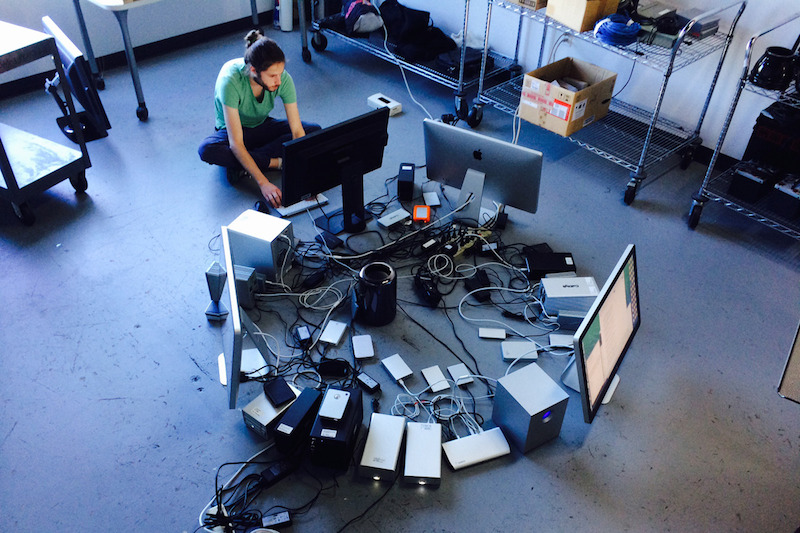
MacWorld Lab referred to the test as the Mac Pro Daisy Chain Challenge and were able to connect a total of 42 peripheral devices to the Mac Pro.
We connected 36 drives (19 Thunderbolt, 15 USB, 2 FireWire 800) with a combined capacity of 100.63TB. In addition to the drives, we also connected two Thunderbolt docks (the Belkin Thunderbolt Express Dock and the CalDigitThunderbolt Station), an Apple Thunderbolt Display, two Apple Cinema Displays, and one HP Z Display Z27i. All this to a single Mac Pro.
Only a dozen of the drives were being powered from the cables connecting them to the Mac Pro. The 24 remaining drives required external power and had to be plugged into three power strips with an attached Watts Up power meter. The combine power draw when Macworld ran a script that copied data from the Mac Pro’s internal flash storage to the drives was 865 Watts.
Through Mac OS X’s Activity Monitor, the lab found that there was a combined throughput of 3 Gbps. The rate slowed as the fastest drives, of which OWC’s Mercury Helios was the fastest, finished transferring data.
The lab also found that the daisy chains didn’t affect the performance of a single drive working alone. Rather, the location of the drive within the daisy chain affected performance. For instance, one drive’s average write speed was 709.8 Mbps when tested at the beginning of the daisy chain and without a daisy chain and only 556.7 Mbps when placed at the end of the chain.
The full list of devices connected to the Mac Pro, along with more information on the challenge and future tests can be found at Macworld.

Samsung’s giving you more to watch on that ridiculously expensive 4K TV

If Amazon, Netflix and DirecTV’s promised 4K content aren’t enough to entice you to pick up an ultra high definition TV, maybe this will help: Samsung is now giving buyers of its new curved TVs eight UHD films for free. The films are actually part of the company’s UHD video pack, a $300 1TB hard drive pre-loaded with three documentaries, Night at the Museum, The Counselor, X-Men Origins: Wolverine, G.I. Joe: Retaliation and World War Z. Sony has a similar promotion tied to its UHD sets, an effort to assuage buyer fears that there won’t be anything to watch on their expensive 4k display. Sammy’s freebie applies to all new purchases of its 55, 65 and 78-inch curved UHD sets from now until the end of June. Already have one? Check out the source link below to nab your new hard drive.
Filed under: Home Entertainment, HD, Samsung
Source: Samsung

Watch a creepy robot draw an even creepier joker

A recent Pew Research study says 51 percent of Americans believe robots will be able to create art indistinguishable from a human’s. Well, they might be surprised that robots like those already exist, and one of them’s this new mechanical Picasso called Roboartist. Obviously, this robotic arm can’t think up its own masterpieces, so its operators feed it images to draw — once it “sees” its subject, the system uses an image processing tool called Canny edge detector to determine where pen strokes go. Roboartist then uses rows of violet lights under the drawing surface as a guide to determine the lines on an A3 paper. If you’re curious how its creators assembled the whole thing, Hackaday has its full hardware list (they used an assortment of parts, including Arduino), as well as as a diagram on how its software works. As you can see in the video below, the artistic robot works great and has even successfully sketched an eerie rendition of Heath Ledger’s Joker.
Filed under: Robots
Source: Hackaday (1), (2)

This ad uses Oculus Rift to show how internet lag could ruin making brunch

We’ve seen some pretty nutty uses (and a very sentimental one) for the Oculus Rift so far, but a Swedish ISP’s might take the cake. For two days, Umea Energi had four people strap on one of the VR headsets rigged with a webcam and a Raspberry Pi, in an effort to illustrate what it’d be like if internet lag invaded real-life activities. The outfit had the lab rats do everyday stuff like go to aerobics class, make breakfast and play ping-pong while wearing the get-up and a pair of noise-cancelling headphones. It’s bananas; we know! The results are pretty hilarious — failed attempts at cracking eggs and dropping crêpe batter onto a griddle, in particular. There’s a first-person view of the shenanigans too, but if you’re prone to motion-sickness it’s probably best to steer clear. The Oculus dev kit’s second version features a powered USB port on top of it, so let’s hope that this type of experiment isn’t the last.
Filed under: Gaming, Home Entertainment, Internet, HD
Source: Umea Energi (YouTube)

Netflix pays to play with Verizon, too

After Netflix reached an agreement with Comcast for direct access to its network, several other ISPs lined up with their hands out, and now there’s another deal with Verizon. First reported by analyst Walter Piecyk based on a meeting with Verizon’s CEO Lowell C McAdam, Netflix’s Joris Evers has confirmed the deal with a statement: “We have reached an interconnect arrangement with Verizon that we hope will improve performance for our joint customers over the coming months.” There aren’t many details to go on, but it appears to be another arrangement for paid peering between their networks, as McAdam told Piecyk the deal was “like Comcast’s.” Reed Hastings has argued that strong net neutrality would let it connect to ISPs for free, but so far the (already controversial) rules the FCC is proposing don’t apply here.
That deal with Comcast has lead to improved speeds and picture quality for Netflix subscribers on the ISP… and also to a war of words between the two companies over whether the arrangement is fair. Nost recently, Comcast accused Netflix of actually being responsible for the slowdowns, while Netflix claimed it “purchased all available transit capacity into Comcast’s networks from multiple transit providers” and still couldn’t get enough, because the ISP dragged its feet on upgrades. Verizon reps also confirmed the deal but couldn’t provide any details, so we may have to wait for Reed Hastings’ next Facebook update to find out how (un)happy he is about it.
Verizon CEO confirms they have signed direct connection deal with Netflix like Comcast’s. $VZ
– Walter Piecyk (@WaltBTIG) April 28, 2014
Verizon confirms this; terms are confidential. MT @WaltBTIG: Verizon CEO confirms they have signed direct connection deal with Netflix.
– Bob Varettoni (@bvar) April 28, 2014
@WaltBTIG We have reached an interconnect arrangement with VZ that we hope will improve performance for customers over the coming months.
– Joris Evers (@jorisevers) April 28, 2014
Filed under: Home Entertainment, HD, Verizon

Harper Lee okays ‘To Kill a Mockingbird’ e-book on her 88th birthday

An important piece of American literary history, and one of the few missing selections in digital libraries, is finally becoming an e-book. On her 88th birthday, Harper Lee agreed to let her Pulitzer Prize-winning novel To Kill a Mockingbird be released in electronic form. Lee notes that this is “‘Mockingbird’ for a new generation,” and the title still sells a million copies a year thanks in large part to its popularity in classrooms across the US of A. Here’s to hoping we’ll get the e-book version of J.D. Salinger’s The Catcher in the Rye soon too.
Filed under: Internet
Via: The New York Times
Source: HarperCollins

Apple’s iPhone 6 Could Be As Thin As Current iPod Touch
Last week, a case designed for the iPhone 6 was compared to an iPhone 5s, a Nexus 5, and a Galaxy Note 3 in order to explore how the upcoming device might look compared to other large-screened devices.
Today that same case has been compared to a current generation iPod touch by Unbox Therapy, suggesting the future iPhone 6 could be as thin as the existing iPod touch. In the video, an iPod touch is placed inside of the alleged 4.7-inch iPhone 6 case, demonstrating a perfect fit when it comes to depth.
Released in 2012, Apple’s current generation iPod touch measures in at just 6.1mm thick, while the iPhone 5s 7.6mm thick. iPhone 6 rumors have already suggested the device could be much thinner than the iPhone 5s, and reliable KGI Securities analyst Ming-Chi Kuo has predicted a thickness of 6.5mm to 7.0mm.
The way the iPod touch fits in the case also suggests that the iPhone 6 could have the elongated, rectangular buttons of the iPod touch rather than the circular buttons of the iPhone 5s. This is in line with previous rumors and with a possible volume button part leak posted in our forums earlier today.
While it’s impossible to tell whether the iPhone 6 case in the video is a legitimate representation of what Apple’s next-generation device might look like, the case design does resemble previously leaked schematics, case maker’s renderings, and manufacturing molds.
Along with a thinner design and a larger, the iPhone 6 is also expected to incorporate slimmer bezels, an upgraded A8 processor, and an improved camera via optical image stabilization. While a 4.7-inch version of the iPhone 6 is expected to ship in the fall, a 5.5-inch version may also come somewhat later in the year due to production issues that have delayed its release.
 AIVAnet