


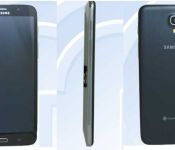
Samsung’s new seven-inch phone/tablet hybrid surfaces, promises to be a giant mid-ranger

Just when you thought phones couldn’t get any bigger, Samsung astounds us again. Last years Galaxy Mega wasn’t the most popular due to the sheer size of the thing, making it impossible to carry in a pocket while offering mid-range specifications. According to Mobile Geeks, a german mobile website, Samsung is working on something bigger than the Mega.
Shown in the picture above is the SM-T2558, a prototype from Samsung. It appears to have the body of a phone, just blown up to ridiculous proportions. It recently passed through TENNA, China’s equipment certification center, bringing a few specifications to the surface. The device is running Android 4.3 Jelly Bean, a 720p display, quad-core 1.2GHz processor, 1.5GB of RAM, 8MP rear camera, and a 2MP front camera. What’s more is that it includes TD-LTE and TD-SCDMA connectivity, making us much more confused than before. Oh, and it only has 8GB of on-board storage.
It’s still unclear as to whether this is a tablet with phone capabilities or a phone with huge dimensions. We’ll have to see at a later date as to what exactly this is.
Via: Sammobile, Source: Mobile Geeks
The post Samsung’s new seven-inch phone/tablet hybrid surfaces, promises to be a giant mid-ranger appeared first on AndroidGuys.

Anonymous’ radio-based networking keeps protesters off the grid

Despite being an internet activist group, Anonymous knows the value of avoiding traditional communication; it’s sometimes the only way for dissidents to elude surveillance and service disruptions. Accordingly, the group has just unveiled AirChat, a networking system that uses any available radio connection to share data between PCs. Nearly all of its infrastructure is based on encrypted data packets — you need encryption keys to get a spot on the network and receive any private information, making it virtually impossible to fake an address. Users can share internet access if they get it, and there’s support for both proxy servers and Tor routing to anonymize any online activity.
This isn’t quite a protester’s paradise. Broadcast radio is typically slower than cellular data or WiFi. At present, AirChat is also very barebones — you can hold voice chats, send images and even play basic games, but not much else. Anonymous does plan to expand functionality once it has a clearer sense of what users want, though, and it notes that the software could also be useful in disasters and other situations where traditional networks aren’t available. However AirChat develops, it could be the technology of choice for those determined to get their message across — no matter who stands in their way.
Filed under: Networking
Via: Motherboard
Source: GitHub

Saudi Arabia cracking down on local YouTube producers

Saudi Arabia’s youngish population isn’t crazy about local TV, so they’ve naturally turned to a substitute: YouTube. As a matter of fact, the country features three times the per-capita viewing as the US, to the point that Google reps conducted a roadshow teaching local producers how to make money. But according to the WSJ, authorities there aren’t crazy about all that since they have no control over what gets posted on the “broadcast yourself” site. As a result, the kingdom is planning to regulate content produced in the country, with guidelines on alcohol, nudity and of course, wanton “drifting” videos (as shown below). It likely boils down to “security,” though, as the nation has previously detained producers critical of the royal family. And that, unfortunately, is a movie we’ve seen before.
Filed under: Home Entertainment, Internet, Google
Source: WSJ

The gadgets that changed your life

When we asked you to tell us which gadgets changed your life, our goal was to arrive at a simple list of important devices. Instead, we learned how some of the products we talk about on Engadget every day make such a profound impact.
Remember when Facebook bought Oculus VR a few weeks ago? The news led to heated conversations about how VR technology would lose its edge and become a vessel for “branded experiences” (or in layman’s terms: fancy ads). But we’ve seen actual life-altering uses of the Oculus Rift as well. For example, before Roberta Firstenberg passed away (and far too young, we might add) this technology gave her an opportunity to relive her younger years and see the sun one more time.
Most life-changing gadget: iPhone

In what was a top 10 list full of smartphones, the iPhone came out on top. Specifically, the iPhone 3GS. When it debuted in 2009, we considered it an incremental upgrade to the 3G, but still an “unquestionably excellent smartphone.” Reader Matthias Liffers from Perth, Australia, remarked:
“This gadget finally let me address my information addiction without having to remain in front of a computer all day.”
Apple wasn’t alone however. The Droid X, Galaxy S II and Palm Pre were also well-represented. And BlackBerry had more than its fair share of fans, too.
Most life-changing gadget (that wasn’t a smartphone): TiVo

Talk all you want about how you’re going to cut the cord, but we know you can’t live without cable and a DVR filled with The Real Housewives of New Jersey. While the term “TiVo” has become synonymous with “DVR” (kind of like asking someone for a “Kleenex”), the company still does well on its own. We most recently called the Roamio Pro “the company’s best yet.”
On TiVo, Tom Paladino from Long Island, New York, said:
“It completely reorganized how I consumed television at the time, and laid the groundwork for how I would consume media over the next decade and beyond.”
Honorable Mention: Pre-paid feature phones

Charles Everett III told us about the gadget that changed his life, a Kyocera K9:
“(The Kyocera K9) was my first cellphone my parents gave me. It was prepaid, so if I wanted to keep it on, I had to work by doing extra chores, saving left over lunch money and getting good grades.”
The real story here, though, isn’t about the K9, since most prepaid phones at the time were good for one thing only: making calls. We’re more intrigued by the way Charles’ parents taught him responsibility by giving him the phone, but made him work to keep it running. We can only hope that other parents are teaching the same lessons today with data allowances. Want more data to send selfies on Snapchat? Mow the lawn, kiddo.
Tomorrow’s life-changing gadgets

If, in the past decade, phones and DVRs changed our lives, what will come of the next 10 years? Will we see a more discreet head-mounted computer that’s less likely to result in assault? Or will it be something we can’t even imagine yet, delivered to you by Amazon’s PrimeAir drones? Whatever it is, we’re pretty damn excited to tell you all about it when the time comes.
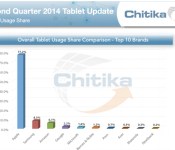
iPad Dominates Mobile Web Share with 77 Percent of April 2014 Traffic [iOS Blog]
Apple tablet sales may have been lower this past quarter than analysts expected, but usage of the tablet remains strong. According to a recent Chitika Insights report, the iPad accounted for more than three quarters of all U.S. and Canadian tablet-based Web traffic in April. Chitika derived this traffic data by sampling tens of millions U.S. and Canadian tablet online impressions across its ad network during the first week of April 2014.

The iPad is the dominant tablet in North America with a mobile web traffic share of 77 percent as compared to 8.3 percent from number two Samsung. Amazon’s Kindle Fire devices generated 6.3 percent of web traffic, while Google’s Nexus tablets accounedt for 2.2 percent. The remaining tablets from Microsoft, Asus, Acer and others contributed 4.5 percent combined.

Though the iPad is the market leader with significantly more web traffic than all the other manufacturers combined, the tablet’s traffic share fell slightly year over year from the 81.3 percent measured in April 2013. Samsung showed the biggest yearly gains, growing from 4.7 percent in April 2013 to 8.3 percent in April 2014. Amazon, similar to Apple, also lost 1.3 percentage points year over year.
The proverbial elephant in the room is iPad usage share, which still stands at over 77% of all U.S. and Canadian tablet-based Web traffic (Section 4). This is down a few percentage points year-over-year, but the current share is very notable in the context of the North American tablet market, which analyst estimates pointed to growing significantly throughout 2013 from a penetration standpoint. While it is uncertain if Apple can reverse the tide and grow its domestic tablet usage share in the coming months, it is clear that iPad users remain the most active aggregate tablet user base by a wide margin, with that likely to remain the case for the foreseeable future.
During Apple’s Q2 2014 earnings conference call earlier this week, CEO Tim Cook commented on the slight drop in iPad sales this past quarter, citing high channel inventory levels that artificially inflated the company’s March 2013 sales. Channel inventory in 2014 was significantly reduced, with a balance between iPad supply and demand achieved early in the launch cycle of the iPad Air and Retina iPad mini.
Apple is expected to introduce updated versions of the iPad Air and Retina iPad mini later this year. The company also may be developing a 12.9-inch iPad Pro that could possibly debut sometime next year.
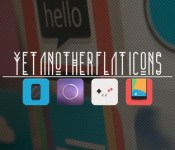
YAFI Yet Another Flat Icons Pack launches, looks a lot more unique than the name Suggests
 Flat icons are all the rage in the icon world right now; even the suggested Moonshine icons from Google are suggested to be flat too. Maybe it’s just the way they look, so simple and minimal, that keeps us coming back for more. Which brings us to the YAFI Yet Another Flat Icons pack which was recently launched by designer yackovsky who you might know from other icon packs like Flatshade as well as the wlpapR app. While the name of the pack might suggest some level of similarity between itself and other flat icon packs, the style of the icons still manages to be quite unique.
 The icon pack has launched with 900+ icons with 22 icons specifically designed for the dock, as seen above. Wallpapers aren’t explicitly included but can be pulled from the wlpapR app, which is a really neat app anyway if you’re into nice wallpapers. The YAFI pack is available normally for $1.99 however yackovsky is currently having a 50% sale this weekend which brings the price down to $0.99 which is an entirely great price for a unique set of icons. Check it out (Play Store links are below) and be sure to follow Jacek Milanovski on Google+ for all things yackovsky.
Icons: YAFI Yet Another Flat Icons
Price: $0.99
//<![CDATA[
ord = window.ord || Math.floor(Math.random()*1E16);
document.write('’);
//]]>

Nissan’s dirt-phobic paint keeps a car spotless for the duration of a PR video

For some people, washing the car is a calming pastime that induces feelings of satisfaction and fresh beginnings. For everyone else, there’s this: Super-hydrophobic and aleophobic paint, which repels water and some oil-based liquids, and which Nissan is currently trialing on one of its cars in Europe. The video below shows what happened to a car that was taken for a messy drive with half of the body coated with the new stuff (“Ultra-Ever Dry”) and the other half with regular Dulux (or whatever it is they use these days). The results speak for themselves, but they don’t say anything about how long this self-cleaning ability actually lasts. In industrial applications, where a version of the paint is already being used, it’s easily rubbed off and rarely survives longer than a year. Nevertheless, Nissan says it’s evaluating Ultra-Ever Dry’s viability and hopes to offer it as an aftermarket option on a future model — at which point it might also make sense to splash out on a self-cleaning windshield, headlights, dash system, and door handles.
Filed under: Transportation
Via: Autoblog

The world’s smallest magazine cover is 2,000 times smaller than a grain of salt

No, National Geographic Kids didn’t forget to buy colored ink — that’s a blown-up view of the smallest-ever magazine cover, created by IBM to set a Guinness world record. The tech firm used a miniscule, heated silicon “chisel” to etch a polymer image measuring just 11 micrometers by 14 micrometers, or 2,000 times tinier than a grain of salt. The image is more detailed than you might expect at such a miniscule size, too. IBM’s instrument responds to subtle changes in pressure in the same way that a 3D printer might, giving it accuracy down to a single nanometer.
The technology doesn’t exist solely for bragging rights. IBM believes its tiny carving tool could be used to prototype nano-sized transistor devices, virtually invisible security tags and light-based connections for quantum computers. Finished products aren’t likely to show up any time soon, but the ball is already rolling on further development. The company has licensed its design to SwissLitho, a startup that’s selling related hardware to other researchers; it may not be long before we see more practical uses of IBM’s small-scale machinery.
[Image credit: IBM Research, Flickr]
Filed under: Science
Source: IBM
Nokia is now officially part of Microsoft

As expected, Nokia’s devices and services business has been officially acquired by Microsoft today. The date was set earlier this week, and it seals the deal the two companies entered into last September. Nokia has long been allied with Microsoft, committing fully to Windows Phone, but as explained when the merger was announced, Microsoft’s new arm will continue to support feature phones like the Asha and Nokia X ranges, as well as smartphones (we’ll have to wait to see what “support” means exactly). The obligatory press releases from both companies don’t reveal any grand plans or shift in focus, but each side has issued some closing remarks, if you like.
Microsoft CEO Satya Nadella said:
“Today we welcome the Nokia Devices and Services business to our family. The mobile capabilities and assets they bring will advance our transformation. Together with our partners, we remain focused on delivering innovation more rapidly in our mobile-first, cloud-first world.”
Stephen Elop, former Nokia CEO who’s moved over to become head of Microsoft’s hardware division, penned an open letter with similar sentiment:
“As Microsoft and Nokia Devices and Services come together as an expanded family, we will unify our passion, dedication and commitment to bringing you the best of what our joint technologies have to offer.”
Filed under: Cellphones, Mobile, Microsoft, Nokia
Source: Nokia, Microsoft, Elop open letter (Nokia)
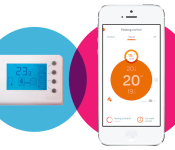
British Gas’ smart Hive thermostat can now respond to a home owner’s location

Since its launch nearly seven months ago, British Gas’ connected thermostat, the Hive, has enjoyed steady succcess. Now operational in more 75,000 British homes, it recently gained another competitor in Nest, the learning thermostat now owned by Google, so news of the company’s new feature rollout could not have come at better time. In an iOS update that went live earlier this week (not yet live on Android), British Gas added geolocation support to the Hive app, allowing users to receive notifications or set triggers depending on where they are. For instance, Hive owners now receive alerts when the heating has been left switched on and they leave the house, or set the app to automatically begin heating the house as soon as it detects the owner has left their workplace. They’re features that Nest users will already be familiar with, but will be welcome additions for those who decided to go smart with their existing energy provider.
Filed under: Household, Internet, Software, Mobile
Via: The Guardian
Source: Hive (App Store)
 AIVAnet