


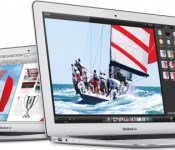
Updated 11-Inch and 13-Inch MacBook Airs Reportedly Coming Next Week
Apple may be planning to update its MacBook Air line next week, according to a new report from MacGeneration [Google Translate]. Citing reliable sources, the website notes that references have been made towards new devices featuring screens of 11-inches and 13-inches, which are the current display sizes for the MacBook Air.
Apple last updated the MacBook Air in June 2013, which featured Intel’s energy-efficient Haswell processors, faster PCI Express-based storage, and faster 802.11ac Wi-Fi.

If the claims turn out to be true, it is likely that a new MacBook Air at this point in time would feature a small speed bump among few other changes. As outlined by Intel’s processor roadmap, Apple could choose to use a number of just-launched processors for an updated entry-level MacBook Air, including the 1.4 GHz i5-4260U, 1.4 GHz i5-4350U, or the 1.5 GHz i5-4360U.
Notably, the 4350U chip has been available since last year, but Apple elected not to use it in the current MacBook Air. It is also unclear as to what processor Apple would integrate into an updated high-end MacBook Air, as leaked roadmaps have still yet to show a direct successor to the current i7-4650U chip.
Multiple reports have also indicated that Apple is working on a brand new 12-inch MacBook Air for later this year. According to KGI Securities analyst Ming-Chi Kuo, the notebook is expected to feature a thinner design than the current MacBook Air, and utilize a fan-less cooling system, buttonless trackpad, and higher resolution Retina display.
While it is unclear how a 12-inch Retina MacBook Air would fit into the current lineup, analyst Daniel Matte argued that the laptop will be exactly 11.88” in diagonal screen size, allowing Apple to offer a Retina Display (2732 x 1536, twice 1366×768) with the exact same PPI as the iPad Air (264 PPI).
Apple is also expected to update its line of Retina MacBook Pros during the third quarter of 2014 alongside the aforementioned 12-inch Retina MacBook Air.
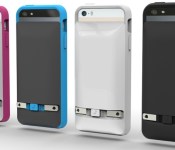
Prong Debuts iPhone ‘PWR Case’ With Built-In Plug and Backup Battery [iOS Blog]
Prong, the company behind the iPhone case with a built-in plug for easy charging, today announced an expansion to its product line up, debuting the Prong PWR case.
Like its existing PocketPlug combo cases, the PWR case includes an integrated plug for charging the iPhone, but it also comes equipped with a 1500 mAh detachable backup battery that can be used to charge the iPhone when it is away from a power source. The backup battery itself can also be detached and recharged via its built-in plug.

The Prong PWR Case includes a detachable backup battery and integrated plugs for charging in any outlet, along with a Micro USB port and cable. The backup battery is easily detachable and can be recharged without any additional accessories while the smartphone remains with the user, safe in the inner-protective bumper.
No matter how much someone uses their phone, they can have power all day with the Prong PWR case and their phone never has to leave their side. The battery can be detached and plugged into any outlet to be recharged whenever needed. Once the back-up battery is charged, it quickly reconnects to the back of the case and the phone can then be recharged while on the go.
The case itself comes in multiple colors (black, white, blue-gray, and white-pink) and can be used with or without the battery pack attached, protecting the iPhone from scratches and drops. Designed for the iPhone 5 and 5s, the case also has a retractable A/C plug that folds down flat when it is not in use, and the battery pack utilizes “Quick Charge Technology” to deliver fast charging.

The Prong PWR Case can be preordered from the Prong website for $65, but will retail for $80. It will ship during the summer of 2014.

Exetech seeks your cash to improve its clunky smartphone-in-a-watch

When we got our hands on Exetech’s XS-3, we were intrigued by the idea of cramming a smartphone into a watch, but dismayed at the execution. After all, this was a device that was in no way waterproof, had a 420mAh battery pressing directly onto your skin and wouldn’t even last half a day on a charge. Having sold 800 out of a production run of 1,500, the company found that customers loved the technical accomplishments, but griped about the build quality.
That’s why Exetech is asking for a do-over when it comes to the XS-4.
The company is re-launching on Indiegogo in order to raise the €35,000 necessary to begin producing the revamped version of the wearable device, and has pledged to fix most of the issues we found last time. First up, the unit will be coated in a fluoropolymer which, it’s hoped, will give the watch IP-67 waterproofing. Then there’s the design, which isn’t changing overall, but will get a curved touchscreen and metal buttons to look and feel a little sleeker.
One of the biggest issues that we had was with the paltry battery life, and while the unit will still be pushed up against your wrist, the XS-4 will give you the option of picking up an 800mAh unit as an optional extra. The company is also promising that the watch will gain the same perpetual solar charging technology that we saw on TAG Heuer’s latest smartphone. Most of the internals will remain the same, except that it’ll get a 4G radio and will run on Android 4.4. Founder Fabiano Zamuner says that the XS-4 and devices of its kin will be the “future of smartwatches,” and if you agree, you can back the project for €169, which’ll get you one of the first units to come off the production lines in November.
Filed under: Cellphones, Wearables, Mobile
Source: Indiegogo

Lost Andy Warhol artworks discovered on Amiga floppies from the ’80s

Rediscovered artwork like a napkin Picasso or unearthed Matisse can be identified on sight, but pieces crafted in the digital age by pop-artist extraordinaire Andy Warhol and encoded in an outdated format are far more difficult to ascertain. In fact, it took the retro know-how of Carnegie Mellon University’s Computer Club and a team of artists, archivists and curators to wrangle some of Warhol’s lost pixels into the physical world.
The retrieval process was documented by a video crew from the Carnegie Museum of Art (CMOA) and will be premiering as Trapped: Andy Warhol’s Amiga Experiments on May 10th at the museum. This is the second film produced by the CMOA’s Hillman Photography Initiative for a five-part series entitled The Invisible Photograph, which explores the hidden side of photography. It’s all about rediscovering art that has been stashed away, forgotten or nearly destroyed.
This particular batch of lost Warhol works was created on an Amiga 1000. He began working with the computer in 1985 as part of a live event touting its multimedia capabilities. The demo involved Andy sitting down at the Amiga, then capturing and retouching a digital photo of ’80s pop-punk star Debbie Harry, who joined him on stage. That particular image has been on display at the Andy Warhol Museum (AWM), but the rest of Warhol’s fledgling computer-based art from that time was spread across 41 floppies and remained unseen for decades.
The obsolete disks have been in storage at the AWM’s archive and it wasn’t until artist Cory Arcangel saw footage of the event on YouTube that he was spurred into action. Along with the help of the CMU Computer Club’s vintage expertise and senior members from both museums, they set out to exhume and revive Warhol’s old digital files. This project provides a window into the artist’s unique vision as translated through tools like Amiga’s ProPaint and GraphiCraft, and highlights the technical hacks used to extract data from dead digital formats.
The May 10th premiere of Trapped: Andy Warhol’s Amiga Experiments is at Pittsburgh’s Carnegie Museum of Art, but if you’re not in the neighborhood you can check out the documentary on its website starting May 12th.
[Lead image: Andy Warhol, Andy2, 1985, (C)The Andy Warhol Foundation for the Visuals Arts, Inc., courtesy of The Andy Warhol Museum]

Big Brother is live-tweeting you: artists turn a lightbulb into a surveillance device

When you hear a scandalous conversation, there’s always the temptation to live tweet it for the internet’s benefit — but what if your furniture could do that for you? Conversnitch is a project by artists Brian House and Kyle McDonald which reinvents the humble lightbulb as an internet-connected surveillance microphone. Running off a Raspberry Pi, the hardware records conversations in real time and pushes them to Amazon’s Mechanical Turk, where the chatter is transcribed for the project’s Twitter feed. The idea is to generate some alarm about our surveillance-heavy culture, since the bulbs have already been quietly installed in public spaces across New York — although we guess the pair still have a long way to go before they can out-do the folks over at Fort Meade.
Filed under: Internet
Via: The Creators Project, Wired
Source: Conversnitch (Twitter), GitHub
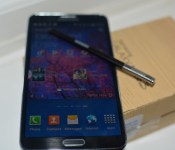
Samsung Galaxy Note 3 Review

The Dialaphone team were kind enough to send us a Samsung Galaxy Note 3 to play with so here’s our impressions of the device incase you were considering purchasing one.
Design
The Samsung Galaxy Note 3 follows the same design as the rest of the Galaxy range that we’ve come accustomed to over the years, except instead of a pure plastic back, Samsung has opted to coat it with a faux leather layer. I must admit that after reading that Samsung had taken this approach I was quite sceptical, but having used the device it is a very nice change from the traditional backs we’re used to seeing on devices; not to mention you don’t have to worry about protective cases and can leave the device naked without worrying about scratching it when laying it down.
As unique to the Galaxy Note range, the Note 3 comes with the S Pen which itself has gotten a redesign. It is now a lot flatter and thinner and just feels better to hold than previous generations found in the Note 2 for example.
You still get the same home button and touch sensitive buttons on the front of the device, but these have been almost squished down to make way for the amazing screen, which takes me onto what I like about the device. Samsung tend to get criticism for their design of their smartphones, but breaking down the components separately the Note 3 actually offers everything I would look for in a device. I’m still a fan of a dedicated home button and touch keys, since I just haven’t gotten use to the onscreen keys. The Samsung Galaxy Note 3 has a slim bezel too, which earns it a lot of points in my book. So for me at least the design of the Galaxy Note 3 works quite well; sure it doesn’t look premium, but it certainly ticks all the boxes.

Functionality
As far as the function of the device goes, we won’t spend too much time reiterating what you already know. The device runs TouchWiz so looks and feels like every other Galaxy S or Galaxy Note device, just a little bit faster and a little bit bigger. I’m not a fan of TouchWiz so install Nova Launcher as the first priority.
The Samsung Galaxy Note 3 certainly is no slouch when it comes to performance; the device is as fast as you’d expect and runs all games without a problem. Videos look smooth and vivid on that great looking screen, and it’s easy to fall in love with the device once you’ve gotten away from TouchWiz. Couple this with the battery life of around two days of solid use, and it’s easy to see why this device is so popular.
Unfortunately that’s where the love ended, since I found myself resenting the larger screen during every day activities. The footprint of it in my pocket was just uncomfortable, as way trying to use the device on the tube for example with one hand holding on for dear life, with the other hand trying to extend my thumb to the top of that giant screen to pull the notification drawer down. The harsh reality, for me at least, was that although the S Pen is a fantastic addition to the device, and I wish Samsung figured out a way of including it with the Galaxy S smartphone range, the screen is just too big for me.
Overall
Whilst the Galaxy Note 3 ticks all the boxes when it comes to performance and design, I found myself longing for my portable Galaxy S4, which minus the S Pen pretty much did everything the Galaxy Note 3 could. I would certainly recommend the Note 3 for anyone who is looking for that Phablet hybrid, but for me the device was just a little too big.
Thanks once again to Dialaphone, and if the Samsung Galaxy Note 3 is a device you’d like, then check out their website for pricing and availability.
The post Samsung Galaxy Note 3 Review appeared first on AndroidGuys.

Sony background defocus app released to the Play Store

Sony have today released a new version of their app which allows users to defocus the background of their photos after they’ve been taken at a tap of the screen.
The update has been issued to the Google Play Store and is available to Sony Xperia phones running Android 4.2 or later.
How to use Background defocus:
1. Start the Camera and select Background defocus as camera mode
2. Tap the object you want to focus on in the viewfinder
3. Tap the camera key to take a photo
4. Change the blur level and blur effect with the controls on the screen
5. Tap the save buttonTips for best photos:
For best results, Sony recommends users to focus on objects that are 15-45cm away with a background at least 5 metres away from the subject.
The post Sony background defocus app released to the Play Store appeared first on AndroidGuys.

France is plotting to take Uber’s car-tracking tech and hand it over to taxis

While taxi services like Uber may be flat-out unwelcome in Belgium, neighboring France is still trying to figure out how to manage them. Under pressure from traditional cab drivers in the country, a new law was introduced that required the likes of Uber, LeCab and SnapCar to wait 15 minutes before picking people up, giving normal cabs a better shot at landing the business. It didn’t survive very long, not that it did much to calm some old-school cabbies anyway. Now, a new report, due to be presented to the French Prime Minister today, suggests disarming the newer services of one of their greatest weapons, and turning it over to regular taxis.
In addition to the idea of bringing in a costlier registration process for Uber and friends, as well as straight-up declaring ride-sharing setups like UberPOP illegal, the report moves to abolish any kind of pick-up delay. Instead, though, it recommends the competitive balance be restored by stripping modern taxi services of GPS tags, meaning users can’t track nearby cabs within their company’s respective apps. Furthermore, the report wants to add this user-friendly feature to traditional cabs, in the hope live-tracking will encourage ride-seekers to use them. Any and all of these proposals would need to be spun out into formal laws before any implementation, of course, but it sounds to us like taking power from one party, and giving to another. Then again, we’re buried in email, so what do we know?
[Image credit: Pimoo/Flickr]
Filed under: Transportation
Via: TechCrunch
Source: Liberation

Hacker-turned-FBI informant may have orchestrated foreign cyberattacks

The hacker subplot in House of Cards’ second season might have felt out of place, but from the sounds of a recent New York Times report, Frank Underwood’s methods for putting captured hackers to work might not be too far-fetched. After being busted by the FBI, top LulzSec hacker Sabu may have conscripted at least one former accomplice to carry out a string of cyber-attacks against foreign banks and government websites, according to interviews and documents obtained by the Times. Sabu’s seemingly indirect involvement suggests that he may have acted as a federal informant, helping to exploit the likes of the Heartbleed security flaw for state-sponsored cyber-terrorism. For the full report, be sure to head over to the source link.
Filed under: Internet
Source: New York Times
Sony’s streamer lets you watch one show (House of Cards) in 4K for £350

If you spent a fortune on the first Sony Bravia UltraHD TVs, it may have hurt to find out that Netflix was only streaming 4K using a format (H.265) that doesn’t work on those sets. Sony has now righted that wrong with the FMP-X5 4K media streamer, specifically made for European-only owners of the KD-84X9005, KD-65X9005A and KD-55X9005A Bravia TVs. House of Cards is the only 4K show available for it from Netflix (or anywhere else) right now, but the streaming outfit said that others, like Breaking Bad, will be arriving soon. The other drawback is a rather hefty £350 sticker (direct from Sony), but if you were an early adopter for one of those models, we think you can manage it.
Filed under: Home Entertainment, HD, Sony
Via: Techradar
Source: Sony
 AIVAnet