



Sprint to Make All Devices Launched After February 11, 2015 Unlockable
 In an updated unlocking FAQ found on its website (via Android Police), Sprint has stated that it will make all of its devices released after February 11, 2015 unlockable for use on other domestic networks such as AT&T or T-Mobile.
The move is a part of the agreement that the five major U.S. wireless carriers and the Federal Communications Commission signed in December in order to allow customers to unlock their devices and switch carriers if they wish.
I’ve been told by another carrier that Sprint needs to unlock my SIM slot in order to use my phone on the other carrier’s network.
For eligible devices, Sprint will unlock the SIM slot, to the extent that a device SIM slot is capable of being unlocked. It is important to note that not all devices are capable of being unlocked, often because of the manufacturers’ device designs, and that even for those devices capable of being unlocked, not all device functionality may be capable of being unlocked. Specifically, devices manufactured with a SIM slot within the past three years (including, but not limited to, all Apple iPhone devices), cannot be unlocked to accept a different domestic carrier’s SIM for use on another domestic carrier’s network. Sprint has no technological process available to do this. In accordance with Sprint’s voluntary commitment contained within CTIA’s Consumer Code for Wireless Service (“Unlocking Commitment”), Sprint is working to ensure that all devices developed and launched on or after February 11, 2015 are capable of being unlocked domestically.
Last year, the Library of Congress ruled that it was illegal for certain mobile phone owners to unlock their phone unless given permission by their wireless carrier. However, the Obama administration filed a petition with the FCC last September asking that carriers be required to unlock mobile devices, which was then followed by the agreement [PDF] between the FCC and the five major U.S. carriers.
Sprint’s move to implement domestic unlocking in all of its future devices will likely be followed by similar moves from other U.S. carriers, as all wireless providers pledged last December to implement the changes within 12 months.

Viber’s first major redesign makes it look right at home on the iPhone

Internet calling and messaging service Viber does a solid job of constantly bringing new features to its apps, regardless of the platform. Now, some seven months after iOS 7 was released, Viber is finally changing the looks of its iPhone app to match that flat, minimalist appearance of Apple’s OS. Aside from overhauling the UI, the Viber application now also lets you create a list of numbers you’d like to block and send longer video messages to people. The company’s CEO, Talmon Marco, tells us this update isn’t just about iOS 7, however. “This is the first time we are introducing a new look and feel for Viber. Our goal was to create a simple and friendly interface but at the same time establish a solid foundation for future updates,” Marco stated. In other words, don’t be surprised when you see some of these design cues make their way to other Viber apps, like those on Windows Phone 8 and Android.
Filed under: Cellphones, Internet, Software, Mobile, Apple
Source: App Store
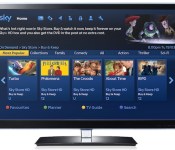
Sky launches its movie download store that also pops a DVD in the post

Sky’s explored almost every way of serving up TV and film possible, but today it becomes a true movie retailer for the first time. The new “Buy & Keep” store Sky announced at the beginning of the month is now live, so anyone with a Sky+HD box can buy and download movies to own forever. They won’t just sit on your set-top box’s HDD though, as within a working week, you’ll also receive a physical DVD copy through the post. Slightly unorthodox, yes, but it’s likely why Sky can offer digital copies of films on the same day as the DVD release. Titles range from £8 to £14, with a couple of hundred from studios 20th Century Fox and NBCUniversal populating the store today. New movies will be added each week and TV box sets, too, albeit later. The next step for Sky is to liberate the films from your living room by adding support for tablets and mobiles, as well as adding other way to access Buy & Keep through Rokus, YouView boxes and its own Now TV puck.
Filed under: Home Entertainment

Japan Display promises 4K tablet screens that won’t kill your battery

If we draw an almost totally arbitrary line in the sand and call it “500 pixels per inch,” then smartphones now stand proudly on one side of it, while tablets still languish on the other. Japan Display is gently nudging the market forward, however, with the 4K 12-inch tablet panel we saw last year (which offered 365 ppi) and now with a 4K 10-inch prototype that delivers a much higher pixel density of 438 ppi. That’s good news for Chuck Yeagers who reckon they can spot the difference, but Japan Display is promising something even more important: It claims its 4K (3,840 x 2,160) screens have just the same appetite for energy as the regular 2,560 x 1,600 panels found in many tablets today. That means 4K slates could arrive at no cost to battery life, relative to current technology, leaving us with just the pesky financial and computational overheads to deal with instead.
Filed under: Displays, Tablets, Mobile
Via: FarEastGizmos
Source: Japan Display
The Samsung Galaxy S5 makes up 0.7 percent of all Android devices in just one Week
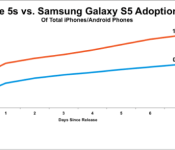
 We always knew that sales for the Samsung Galaxy S5 were going to be astronomically high. If there was any doubt of that, reports that the Galaxy S5 is outdoing even its predecessor, the Galaxy S4 (at least in Europe), and being traded-in for iPhones are probably an indication that all is more than just good for Samsung‘s latest smartphone. If you needed even more evidence of exactly how good the Galaxy S5 is doing, Localytics is today reporting that, according to their data, the Samsung Galaxy S5 makes up 0.7 percent of all currently active Android devices after only one week.
That’s a pretty impressive feat considering the iPhone 5S only managed to achieve 1.1 percent penetration of all iOS devices. And why are we saying “only”? To put that in perspective, current estimations put Android at having 80% of the entire smartphone market. Even if we assume that iOS makes up the other 20% of the market, 0.7 percent of 80 is an absolutely massive chunk of that pie and an incredible number of devices to have sold in a week. Despite what you may think of the Korean smartphone giant, you have to give credit where credit is due. And again, that’s just after a week.
 Localytics goes on to report that of the Galaxy S5′s that have been sold, 64% of them have been sold in America, distantly followed by another 23% sold in all of Europe. No doubt the Galaxy S5 is going to continue its barnstorming to the top of the Android sales leaderboard.
What do you think about these sales figures? Let us know your thoughts in the comments below.
Source: Localytics via SamMobile
//<![CDATA[
ord = window.ord || Math.floor(Math.random()*1E16);
document.write('’);
//]]>
New Renders Show Off ‘iPhone 6s’ and ‘iPhone 6c’ Concepts [iOS Blog]
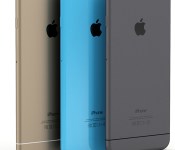
Following a concept that showed off a possible look at the iPhone 6 based on recent leaked info, French website Nowhereelse.fr [Google Translate] and graphic designer Martin Hajek have once again teamed up to showcase renders for an “iPhone 6s” and “iPhone 6c”, which are based off of Apple’s current iPhones and alleged iPhone 6 design drawings posted by Japanese magazine MacFan.

The renderings show iPhone 6s devices in gold and space grey colors, which retain the same tint as seen in the corresponding iPhone 5s models but adopt the thin, rounded profile that has been rumored for the iPhone 6. Like the previous renders, the power button is located along the upper right side of the device, with the iPhone 6s sporting rectangular volume controls similar to that of the fifth-generation iPod touch.

Renders for an iPhone 6c concept are also shown, which depict the device in the same blue colorway adopted by the iPhone 5c. Like the iPhone 6s, the iPhone 6c appears to have the same rounded profile with similar button placements, but is shown with a glossy plastic enclosure instead of an aluminum one. The concept is also similar to iPhone 6c renderings done by designer Ferry Passchier, who we commissioned to rethink the rumored design of the iPhone 6 as if it were modeled after the iPhone 5c with colorful plastic backings.

Apple is expected to launch the iPhone 6 later this year in two different sizes of 4.7 inches and 5.5 inches. Recent reports have noted that the smaller 4.7-inch version will ship in the third quarter of 2014, while the larger version may ship later this year or early next year due to issues with the device’s display and battery.
Along with a larger screen, both models of the next-generation iPhone are said to feature a thinner profile, new A8 processor, Touch ID fingerprint sensor and an improved camera with optical image stabilization. According to a claim from Jefferies analyst Peter Misek, Apple is also negotiating with carriers to increase the price of the iPhone 6 by $100.

Hitachi is building the world’s fastest elevator: 95 floors in 43 seconds

In 2016, Hitachi will take over Toshiba’s title as the maker of the fastest elevator in the world. The Japanese company’s slated to install two lifts that move at a swift 45mph inside China’s Guangzhou CTF Finance Centre, currently under construction. Apparently, you can reach the 95th floor (the building will have 111 floors in all) straight from the ground in just 43 seconds on one of these zippy elevators — hardly long enough to freshen up before reaching the office. Toshiba’s current record-holding lifts in Taipei 101 (a skyscraper in Taiwan) ferry people up and down floors at only 38mph.
While you might typically associate 45mph with a relaxing Sunday drive, that speed takes on a whole new meaning when it comes to lifts. Would these speedy elevators trigger vertigo or cause passengers’ stomachs to drop like they would on a roller coaster? Construction won’t be done until 2016, so we don’t quite know. Hitachi, however, says the vertical speed demons have the technology to prevent ears from popping and to reduce any side-to-side-shaking. The company assures that its creation is perfectly safe to ride, as it’s made from heat-resistant materials.
The elevator also come with equipment (amazingly) called the “governor” which activates brakes when the system detects excessive speeds — Hitachi even built a 698-feet tower simply for testing in 2010. Room for improvement? Well, these elevators would be even better if they had Mitsubishi’s wheelchair-friendly add-on, but well, you can’t have everything.
Via: Wired UK
Source: Hitachi
Meet the One, OnePlus’ $299 Nexus killer

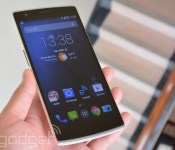
Rarely do we see a tech startup spending five months actively hyping up an unborn product; and when we do, most of them end up being vaporware. Luckily, that’s not the case with OnePlus. Today, the Shenzhen-based company has finally unveiled its first smartphone, the One (not to be confused with the HTC One). While the device’s impressive specs have already been listed in detail beforehand, OnePlus had remained tight-lipped about the actual prices (unsubsidized) until today: $299/€269 for the 16GB model, and $349/€299 for the 64GB flavor; both due mid to late May. This aggressive pricing is obviously going right after the Nexus 5 ($349 for 16GB, $399 for 32GB), but is this too good to be true?

Let’s take a look at the specs again. As promised, the One packs Qualcomm’s latest SoC, the Snapdragon 801 with a quad-core 2.5GHz CPU, Adreno 330 GPU and 3GB of RAM. The display uses JDI’s 5.5-inch 1080p IPS LCD panel, and it’s protected by a layer of Corning Gorilla Glass 3. You’ll also find a built-in 3,100mAh battery, a speedy 13-megapixel f/2.0 camera (Sony Exmor IMX214 sensor with a 6-lens module and dual LED; 4K video; 720p slow-motion at 120 fps), a 5-megapixel wide-angle selfie cam, loud stereo speakers (tuned by JBL) and tri-microphone with noise cancellation. These are all flagship-level features, though we would’ve liked to see microSD expansion, USB 3.0 and Quick Charge 2.0 here.
On top of the usual NFC, dual-band WiFi, Bluetooth 4.1 plus GPS radios, the One’s international version also supports LTE bands 1/3/4/7/17/38/40, as well as WCDMA bands 1/2/4/5/8. Yep, that’s pretty much the whole world covered.
The external design of the phone is just as nice. In fact, the One is built by CEO Pete Lau’s former company, Oppo, so you’ll spot some similarities in terms of build quality, appearance (the back reminds us of the Find 5) and ergonomics. We totally dig the subtle curves on the back that contribute to a comfortable grip, plus these shave the phone’s 8.9mm thickness down to just 4.6mm on the tapered edges, making the phone appear slimmer.

What’s more, OnePlus took one step further and applied corresponding textures onto the back of the “silk white” and “sandstone black” versions. The white one is our favorite, as its special coating — apparently made out of powdered cashew nuts — gives a “baby skin” feel, which is most noticeable when you gently stroke it with your cheek. If you do get bored of the default covers, you’ll be able to swap them out. You do so by first pin-ejecting the micro-SIM tray, followed by somehow prying open the back cover — which we found to be quite tricky with our early production unit. As you can see, there will be a few nice genuine wooden covers, along with a denim version and a Kevlar version not shown here; though the company has yet to announce their availability.
On the software side, the One’s international version is powered by CyanogenMod 11S — the “S” indicating customization for the One — based on Android 4.4; whereas its Chinese counterpart runs on a customized Color OS from Oppo, with the main difference being the icons and some settings. For those who aren’t familiar, CyanogenMod is essentially a plain, slick Android ROM with some nice enhancements and handy customization options. While the Oppo N1 had a CyanogenMod limited edition, the OnePlus One is truly the first phone that is shipped with this popular ROM and its branding on the back.
CyanogenMod alone comes with goodies like SMS encryption, themes, app privacy guard, audio equalizer, file manager, enhanced camera app and more. With CM11S for the OnePlus One, you also get screen-off gesture controls (circle for camera, “V” for flashlight and gestures for music playback; as featured on the Oppo N1), option to toggle between capacitive Android buttons and on-screen buttons, voice wakeup (activates Google Now by default) and a card-style lock screen. These all sound pretty nice, but we’ll have to see how well they fare in the final firmware.
For the record, Lau said OnePlus is open to working with other ROM makers in China, including MIUI (by Xiaomi) and Smartisan OS, in order to offer more options for his users. The international version, however, will only receive official support for CyanogenMod initially.

With the likes of Xiaomi, Meizu, Huawei, Nubia and IUNI all participating in the fierce price war in China, it may seem like there’s barely any space left for a newcomer. But OnePlus’ Lau disagrees, claiming that while the competitors offer attractive prices, they aren’t serious enough about their products in terms of design, battery life, build quality, software and camera performance.
Having seen how successful Oppo did in the overseas market via the e-commerce channels, Lau decided to give it a shot both locally and internationally by forming OnePlus, which is totally separate from his former company (with the exception of the current OEM relationship and a few common investors up top). His company’s mantra is “never settle,” in the sense that consumers shouldn’t have to settle with lesser quality and limited options for the sake of cheaper prices.
“We want to be the MUJI of the tech industry.”
“We want to be the MUJI of the tech industry, this is our direction,” Lau said, while praising the Japanese lifestyle brand’s simple yet well-made products. He added that in China, MUJI is a bit expensive for the local young consumers, so he aims to deliver MUJI quality at a lower price. While Xiaomi and similar Chinese e-commerce brands are targeting the same market, the OnePlus CEO said he’s doing it with style, as consumers are now longing for higher standards.
Lau is well known in the industry for his attention to detail. The exec confessed that his team spent almost four months just to fine tune the USB cable for the One — he wanted to perfect its texture, plug design and other small details. The same goes for the anodized bezel that surrounds and protects the screen — the former is carefully recessed by a fraction of a millimeter, which apparently took the team a few goes to get it just right. Even the camera is carefully optimized on the One: when Lau spotted this author’s HTC One (M8), he quickly grabbed it to compare camera focus and capture speeds, which turned out to be just as fast or even slightly faster on his phone — the spec sheet claims it has a 0.3-second autofocus. We’ll save the image analysis for our review later.
On the software side, Lau realized two personal requests: one is hardware-accelerated scrolling in WeChat, which is apparently missing in most other phones; and the other is a pop-out window feature in AutoNavi’s navigation app, which offers you basic navigation instructions while you switch to other apps during slow traffic. Of course, the exec didn’t forget to pimp the ability to toggle between capacitive buttons and on-screen buttons, which will no doubt please both camps. He mentioned several other sensible software tweaks, but you’ll have to stay tuned for those.

Even before his mobile days, Lau was already famous for one incident back at Oppo’s AV division, where he smashed a Blu-ray player’s logic board to, well, express his disappointment in a seemingly minor issue. This was pretty surprising to us, given how humble the man actually is.
“The circuitry wasn’t laid out neatly, and I didn’t feel good about it no matter how I looked at it,” Lau explained to this author. “We compared ours with Denon’s — theirs was laid out beautifully, but ours wasn’t. When I had a word with my team, they gave me a bunch of excuses: this would affect the performance, that would be difficult to lay out. Eventually, I went to the head of R&D and smashed the logic board on the floor, stamped on it twice.
“They then tweaked the design right away,” the exec chuckled.
As for the smartphone spec war, Lau is concerned that many competitors only care about numbers and are neglecting other important factors — most notably, software smoothness. The exec added that right now the One has the fastest processor (2.5GHz) in the market, but if his next product doesn’t, he will still ensure that it will at least have the slickest user experience, which is what users ultimately want in a smartphone. He likened this to a saying in the marketing world: if you’re selling electric drills, you should know that the consumers are actually “buying” nicely-drilled holes instead of buying just the drill.
“You can use all sorts of marketing tactics, but when you’re back to making a product, you must take users’ actual needs into consideration,” Lau said. “They are the ones who will actually use it, so they know best. You can exaggerate when you’re selling a product, but when the buyers use it and are left disappointed, they’ll still complain, right?
“Therefore products should go back to basics: the users must feel good when using our products. If the users want something, we’ll do it.”
Filed under: Cellphones, Mobile

Pelican S130 Sport Elite Camera/Laptop Bag is a serious approach to travel [Review]
As Android users, tech enthusiasts and travelers, we often find our selves needing things that aren’t so much Android specific, but more life and work specific. A large majority of you have your phones, tablets and a laptop, probably a Chromebook even. Another percentage of you are also either pro or amateur photographers with some lens and such. A number of bags out there cater to one need or the other. While many camera backpacks will have some room for a laptop to travel along with you, they aren’t always designed to protect it. The same is true on the other end of the spectrum. Why not have one bag that can easily transport your camera, your laptop and slew of other things? With spring creeping in and summer right around the corner, it is time to start planning how you will get out there and enjoy the world we live in. The Pelican S130 Sport Elite Camera/Laptop divider bag is a pretty good place to start.
I usually start off with a ‘what’s in the box’ section, but, really, it is bag. So I am going to skip that and lead you right into the physical specs of the bag.

Pelican S130 SPort Elite spec overview
- External dimensions: 18.50 x 13 x 10 inches ( 47 x 33 x 25.4 cm)
- Internal Hardshell Case Dimensions: 15.15 x 10.40 x 1 inch (38.5 x 26.4 x 2.5 cm)
- Weight: 7.14 lbs (3.24 kg)
- Bag Volume: 25L (Durable Rip-Stop Nylon)
- Hardshell Case material: ABS
- Bag Material: 1000 Denier Kondra Nylon PU Backed
- Front Plate Material: Polypropylene
It is a pretty serious bag if you ask me. The S130 has quite a few little secrets to it that make it a rather interesting bag to have handy. The main focus of the bag is a way to protect your laptop and keep your camera gear organized while making both easily accessible. Before I get into details, let do a quick walk through around the bag.
The top of the bag is where you will find a heavy duty handle and the latch that opens up the watertight crush-proof laptop case. The case runs the whole height of the bag and there for, your entire back. The case is rated waterproof to 1 meter for 30 minutes as long as you close it and lock the clip down.

Also on the top, more towards the front, you will find zipper access to a pocket that is lined with a very soft soft material.


If we continue moving down the front of the bag you will notice the two sets of clips. These unhook and open up the top half of the bag which also gives you access to another organization pocket that is zipped. This pocket has your typical business card style slots, pen slots and larger pocket to carry various things. The clips are adjustable depending on how stuffed your bag is to help ensure it stays closed up.

The final zippered access point on the front is where you find the Polypropylene front plate. It is basically just a hard plastic. This is the primary access point to get to your camera goods quickly and easily. The Polypropylene front plate is there to help protect your camera gear from being banged on. I will get to what the inside holds and how that looks opened up in just a minute.

If we move around to the sides we have matching pockets ideally for water bottles, or what ever else it is you drink while out shooting. You could stuff whatever else it is you might need in there too, but they are open pockets without zippers. You also have an adjustable strap that on either side that can be loosened or tightened to ensure the things in the top half of the bag are secure.

On the back you have three main cushions that are designed to give you pressure and support of the weight you will be carrying. It also ads a buffer so that the laptops flat case isn’t sitting directly on your back. They are also there to help keep the air flow on your back… flowing. Keeping gaps between your shoulders and your lower back. The padding is also housed in a mesh material and the inside, rubberish, padding looks like Swiss cheese with plenty of holes for ventilation. The shoulder straps have the same material in the, and they float.


The shoulder straps are fairly thick and padded. They adjust at the top and the bottom allowing you more control to make the bag fit your back. There is a chest clip that can be re-positioned to better help pull the shoulder straps in further on your shoulders and keep it comfortable. Not to mention to help keep it on your shoulders and distribute some of the weight. Further down is a removable hip belt, for similar uses.


Now we can get to the unique inside aspect of the bag. Remember that front panel that unzips and is covered by the Polypropylen material? Well, here is what you get when you open it up.

Inside that front panel is direct access to the camera carrying bag that is placed inside the S130. The camera compartment offers up a photographer a soft lined, padded divider box that can be manipulated in any fashion you need. Every divider is removable and can be re-positioned since each end is velcro. Even the straps you see over certain compartments int he photo are velcro. Also, the whole thing comes out of the bag, only through the top, and can be zipped closed and carried by its self with the handle. If you need something a bit more over-the-shoulder there are are two hoops on either side to attach a longer shoulder strap from, say, another older camera or laptop bag.


What I like about the Pelican S130 Sport Elite
The bag is a serious piece of packing hardware aimed at getting your camera, some outdoor gear and your laptop into nature safely and securely. The look and feel of the material makes it look mean and that you are there for business. You have easy access to your water bottles while hiking, and just as easy access to your camera for those opportunistic image grabs without necessarily needing to have your camera hanging around your neck.
I greatly appreciate the care taken to design the bag with load compression in mind. With the dual adjustable straps, hip belt and chest strap, you can can get the bag placed in the right spot on your back and distribute the wait more evenly. Nothing takes the fun out of a hike if your shoulders are on fire from a heavy bag that slips to the edges of your shoulders and forces you to hunch to hike.
The crush-proof watertight laptop case is always a nice touch. I previously reviewed the Pelican ProGear U140 which was aimed at netbooks and tablets. Having the full size slot for a laptop, or your Android tablet, is nice. Pelican also sends along a set of pads to help custom fit the inside of the case for your laptop.

What I don’t like about the Pelican S130 Sports Elite
There are always a few things about just every product I review that I am not so much a fan of. My only real gripe about the bag is the material change from the U140 in terms of the adjustable straps. On the U140 the sliders to adjust the houlder straps are metal and the S130 is made from thicker hard plastic. The plastic is fairly thick and it doesn’t feel like they have much of a chance of breaking, at least not very easily.
Overall thoughts
I have 4 or 5 trips planned for this summer where this particular bag is going to be perfect. While I don’t personally own a high-end DSLR ( All these images are with the Xperia Z1s from T-Mobile) I will be borrowing my neighbors Canon. I know he will be pleased to know his camera will be safely tucked away on the trips. Being able to easily carry the camera and the laptop, I can get out and take photos and edit them in the great outdoors. Heck, if I have a shred of service I can turn around and get them shared too. Even if I don’t get my hands on a camera to take on the trip, the resizable compartments can still function as a way to keep cables, battery banks and my lunch all separate from each other.
You can pick up your own Pelican S130 Sport Elite bag through Amazon right now for a pretty stellar discounted price tag. It is up for $169 vs the usual $305. Hit the link below and be sure to check out the gallery for more images.


//<![CDATA[
ord = window.ord || Math.floor(Math.random()*1E16);
document.write('’);
//]]>

2k Games tries to save Civilization, Borderlands from GameSpy server shutdown

Gamespy’s impending server shut-down might be cutting off Wii and DS multiplayer at the head, but not all games have to suffer this fate: PC publishers are starting to migrate their multiplayer servers to new platforms. Three of EA’s Battlefield games are already slated for transition, and now, so are two of 2K Games’ biggest franchises: Civilization and Borderlands. On May 31st, Civilization III, IV (and their expansions) and the PC version of Borderlands will all begin transitioning to Steamworks, temporarily disrupting online services for a few days.
2K says it’s looking into moving the PS3 version of Borderlands and Civilization Revolution to new servers too, but it isn’t sure if it’s technically feasible. That said, a number of 2K games are still getting the online axe, including Rune, Stronghold 2 and a handful of sports titles. Care to see the full list? Check out the source link below.
Filed under: Gaming
Source: 2K Games
 AIVAnet