



Trip down memory lane: Google Now wallpapers by Brent Couchman
 In the past week, we’ve featured two sets of Google Now-inspired wallpapers; the first set was designed by Alex Pasquarella and the second was done by Spiderfly Studios as part of their Stormfly app. Seeing as these wallpapers have been so popular, we thought it might be worthwhile to take a trip down memory lane and revisit the original Google Now wallpapers which were created by designer Brent Couchman. Here’s just a small snapshot of the many wallpapers that are available through Google Now (including the one above too):


As you might expect, in Google Now, the displayed picture will vary depending on your geolocation, however you can download the wallpapers for a whole host of cities including London, Seattle, and even Berlin at the source link (check it out here). Couchman’s uniquely designed wallpapers continue to be some of the most striking around and have really become the default image when we think of Google Now.
Let us know if you decide to rock one of these Google Now wallpapers and feel free to share your thoughts on the wallpapers in the comments below.
Source: XDA via Android Authority
//<![CDATA[
ord = window.ord || Math.floor(Math.random()*1E16);
document.write('’);
//]]>

University wants you to capture the ‘soundscapes’ of Earth

Remember when Ridley Scott asked people to record videos to be compiled into the Life in a Day movie? Bryan Pijanowski, Purdue University’s Soundscape ecologist, wants to repeat the task today, but with audio rather than video. He’s developed the Soundscape Recorder app for iOS and Android and is asking people to suck down three minutes of ambient noise to help measure the changes to the sonic environment. Once you’ve recorded your moment, you’ll be asked to describe what you heard and how it made you feel — something that Pijanowski hopes will become an annual event every Earth Day. Just don’t follow our example and try and record the ambience of an empty room, because that’s not helping.
Filed under: Cellphones, Science, Software
Via: Wired
Source: Global Soundscapes
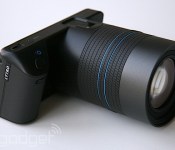
Lytro’s new light-field camera looks like an actual camera, costs $1,599

If Lytro’s first camera offered us a sneak peek at the promise of light field photography, the company’s second-generation product swings those doors wide open. A far cry from the toy-like appearance of its predecessor, the $1,599 Lytro Illum looks and feels like a genuine full-fledged camera meant for a more professional crowd. The innovation doesn’t stop at just looks either, as the Illum is a much more serious effort at light field photography, with cutting-edge optics, a larger sensor and a whole lot of computational power that might make the Illum the most technologically advanced camera to land in consumer hands.
When Lytro first introduced its light field camera two years ago, it shook up not just the world of photography, but of technology in general. Bundled inside a tiny rectangular block was a groundbreaking image sensor that could capture millions of rays of light along with their color, intensity and direction — a task that previously required hundreds of cameras and a supercomputer. That hardware combined with some complex software meant that you could not only get a 3D image from a single shot, but also the ability to refocus a photograph after you take it. It’s this latter trick that is arguably the Lytro camera’s most identifying characteristic, and the one that put it on the technological map.
Fast forward to 2014 however, and there are now several smartphones that can imitate this refocusing trickery, albeit via software and some clever workarounds. Nokia’s Refocus app, for example, snaps several photos in a row with varying depths of field and is then able to suss out focus after the fact. Others, like LG’s G Pro 2 and Samsung’s Galaxy S5 utilize software to blur out photos. Indeed, all Android phones with 4.4 KitKat and up can fake a bokeh thanks to a new Lens Blur option in Google’s default camera app. Rather than being upset by this phenomenon, however, Lytro sees it as a positive sign. Lytro CEO Jason Rosenthal and founder Dr. Ren Ng tells us they’re flattered and humbled by the fact that their technology has been emulated by some of the “largest, most powerful consumer electronics in the world.”

Thankfully, however, refocusing is hardly the only benefit light field photography brings to the table. “Light field photography is about capturing the richest information, fundamentally richer than we’ve ever had” said Ng. “This is so we can bring a whole new set of capabilities that were impossible before, because we can turn physics into software.” This means, Ng said, that they can now entrust once physical characteristics of cameras entirely to computation.
It is this capability that’s being introduced for the first time in the Lytro Illum and it’s been applied to the lens itself. What do we mean? Well, a classic Canon camera lens that has a zoom range of 70 to 200mm has about 22 pieces of glass. The Illum lens, on the other hand, has a zoom range of 30 to 250 mm with a very wide f/2 aperture across it — and only has 13 pieces of glass. That same Canon lens would likely weigh around eight pounds. The entire weight of the Illum? About a pound and a half. According to Ng, that’s because in the Canon lens, “a lot of the glass is used to work correcting aberrations in light. It needs the curvature of the light to make the photons land on the sensor to form the image that you want.” With the Lytro’s unique image sensor, however, it’s able to figure out the direction of the light ray using computation and software instead.

“It’s thinner, lighter, and it has a bigger zoom range and a bigger aperture than you could’ve ever gotten conventionally,” said Ng. “We’re doing in software what physical pieces of glass had historically had to do.” Ng added, “To design something like this with a conventional camera would essentially be impossible.”
And what a design it is. The Lytro Illum looks like something out of a museum or a designer piece from a Parisian fashion house. It’s a sleek and stylish thing, with a unibody magnesium chassis that’s attached to a gorgeous anodized aluminum lens barrel equipped with both zoom and focusing rings. The grip and aforementioned rings are wrapped in what appears to be silicone rubber, which is supple enough to be kind to our hands and fingers. Over on the top right by the grip is a large shutter button along with a Lytro button that offers a visual depth assist histogram (more on that later). Rounding out the physical controls are two adjustable dials (they default to setting the exposure and the ISO, but you can customize them), lock buttons for both autofocus and autoexposure and a couple of other programmable keys. Sitting atop the camera is a hot shoe that’ll fit any standard flash, while the SD card slot and USB 3.0 port are on the left side in a hidden compartment. The Illum has built-in WiFi for wirelessly transmitting those living light field images to Lytro’s servers, your desktop, or directly to your iOS device.
If you’re wondering why there’s a focusing ring on a camera that lets you refocus the image after the fact, well, it’s because depending on the depth of field, there might not be a lot of difference between the foreground and the background. If you turn on the Illum’s depth assist histogram, however, you’ll be able to see a depth overlay that color codes things that are up close and in the refocusing range in green, and things that are at the far edge of the range in orange. Ideally, what you want is a nice gradient of green to orange for the most amount of depth and maximize the drama in your shots.

What’s perhaps more astounding than the camera’s chassis, however, is the 4-inch touchscreen on the back. As we know, most DSLRs have a rather incomprehensible user interface for most camera newbies. The number of buttons and dials that you have to remember can be quite complicated, which is a stark contrast from the camera apps on most tablets and smartphones. Lytro, however, has taken a cue from those apps and have integrated that same simplistic usability approach to the interface on the Illum. All you have to do is tap on an image to autofocus, and toggling through the different settings is just a touch and a scroll away. Rosenthal tells us they’re still working out the kinks in the software, but right now it looks like you can change the artificial horizon, adjust the grid, switch from continuous to single shooting mode, set a self timer and change between Program, ISO, Shutter and Manual control.
On top of that, the entire touch screen is actually angled slightly so that the screen faces you when you hold the camera to your waist. “We think a new shooting style should naturally evolve,” said Rosenthal. “We’re so used to holding the camera to our face, or holding it away from us — we think that a natural evolution would be to hold the camera around hip height.” If you want to adjust the screen even more, however, you can actually pop the screen out and articulate it to even more angles. If you’re into selfies, however, you’re out of luck as the display doesn’t actually swivel all the way around.
At the heart of the Illum is a giant 40 Megaray light ray sensor, which means it’s able to capture 40 million rays of light (in contrast, the original only has 11 Megarays). This gives it about four times the area size, with a lot more light capture efficiency and more pixels and resolutions to play around with. The refocusing, for example, is much finer and more granular — we were able to focus in so tight on a labrador’s nozzle that we could see its pores. In addition, the Illum has a mechanical shutter with a speed of 1/4000ths of a second, which Rosenthal says would make it great for sports photography. He showed us an example of a Lytro image where it captured a cloud of dirt as a motorcycle went around a dirt track. If you’d rather shoot things up close, the Illum has an extremely close-up macro capability as well, allowing us to zoom in really close on a pair of jeans and hone in on the stitches. Powering it all is one of the highest performance chipsets available; Qualcomm’s Snapdragon 801, which is incidentally in Samsung’s new Galaxy S5 as well as the HTC One M8.

Of course, all images on the Illum are captured in the same light field format as before, and you’ll need to use Lytro’s own software to process them. You get all of the same software tricks as before, like 3D imaging and post-shot refocusing, but you’ll also now be able to adjust the depth of field in order to widen or narrow the focusing area. Additionally, Lytro has worked out a deal with Adobe and Apple so you can transfer those images to Lightroom, Photoshop or Aperture if you wish to work on them after you’ve adjusted the image’s focus and depth of field to your heart’s desire.
More than just taking a good photo, however, Rosenthal and Ng believes that light field photography allows for living art. It’s one of the reasons Lytro is also introducing something called Light Field Animations, which are video-like capabilities that essentially animate the effects of image refocusing. “If you think of how pictures work today online, it’s as if we took our parent’s photo albums, ripped out the 4 by 6 prints, and just shoved them up on the web,” said Ng. “We’re on this long term journey of taking these advanced hardware and software capabilities to just make storytelling and photography more immersive, more interesting and more interactive.”
As for who’s the target audience for the Illum, Rosenthal and Ng says that they’re aiming for a group of people they’re calling “creative pioneers.” These are people who’ve embraced the original Lytro for its unique capabilities, of course, but also folks who are willing to take a chance at a new way of looking at photos. The ideal audience for the lllum is someone who’s probably already well-versed in photography, but Rosenthal and Ng say the camera should also be simple enough for the curious amateur as the next step up from smartphones and point-and-shoots. In order to demonstrate this, Lytro has given an early version of the Illum to a group of professional photographers whose work you can see in the album above.
When asked if Lytro plans on selling the technology to a third-party camera manufacturer like a Canon or a Nikon, Rosenthal simply replied: “What we want to do, is focus on the transition from digital to computational. We want to deliver the most outstanding end-to-end consumer experience, so that they can pick it up and go ‘Wow’.” However, he did hint that there might come a time when light field will dominate as an imaging medium “that’ll enable other people to build cameras” similar to theirs, but “that time is still a ways from now.”
The Lytro Illum will be available starting July 15th for $1,599, which sounds expensive, but the closest professional camera with a similar lens will likely cost thousands more. And if you pre-order before that date, you can snag one for the introductory price of $1,499.
“If Camera 1.0 was film-based, and Camera 2.0 was the transition from film to digital, we’re at Camera 3.0. It’s about collecting very rich information about the world,” said Rosenthal. “We’re only just getting started. We can do much much more in the future.”
Filed under: Cameras
Source: Lytro

Mailbox’s Auto-swipe archives and deletes on iOS so you don’t have to

When Mailbox hit Android earlier this month, it came with a new feature called Auto-swipe that wasn’t on the iOS version — until now, that is. Yes, iOS users who just can’t be bothered to wrangle those cluttered inboxes anymore: Mailbox for iPhones and iPads can now learn what kind of emails you usually archive or defer until later, so it can eventually do all the dirty work for you. All you need to do to activate Auto-swipe is to link Mailbox to a Dropbox account after you’ve updated the app. Once that’s done, the email app will also use Dropbox to remember your preferences and sync them across Android and iOS devices. While it sounds like a tool for the lazy at first blush, we hope it ends up great for nuking spam and preventing unread missives from piling up.
Filed under: Cellphones, Tablets, Mobile
Via: 9to5mac
Source: iTunes

Apple Reportedly Delaying Launch of 5.5-Inch ‘iPhone Air’ Due to Battery Issues
According to Taiwan’s Industrial and Commercial Times [Google Translate, via G for Games] Apple’s larger 5.5-inch inch iPhone 6 has been delayed and will launch in 2015. The report notes that the company is struggling with finding a sufficient battery that measures 2 mm or less to fit in the device’s “very thin” profile.

Renderings of iPhone 6 (4.7”) and iPhone 6 (5.7”) based on leaked schematics
The report also notes that Apple suppliers are referring to the 5.5-inch iPhone 6 as the “iPhone Air”, which has not been finalized as an official name for the device. If the claims are true, however, an iPhone Air would join Apple’s MacBook Air and recently released iPad Air in carrying a similar name and delivering a product with a slim chassis.
Past reports have indicated that Apple’s 4.7-inch iPhone 6 will launch first this fall, and have shared similar details about the 5.5-inch version being delayed due to production issues. A report from Reuters last month noted that Apple was having issues with in-cell production technology in the 5.5-inch version’s display, with Japan Display, LG Display, and Sharp set to produce screens for the device.
In addition to a larger screen and thinner design, Apple’s next-generation iPhone is expected to include a new A8 processor, Touch ID fingerprint sensor, and an upgraded camera featuring optical image stabilization. Apple is also said to be negotiating with carriers to increase the price of the iPhone 6 by $100.

Google tweets screenshot of new Dialer app

It seems like the Google Nexus account may have accidentally tweeted out an image of the new Android Dialler app in response to a support request on Twitter.
Ok so it’s not the most exciting leak in the world, but it shows yet another app that may be updated independant of the Android Operating System itself, and also shows that the Dialler app is due to get a splash of blue colour.
@karlyeh26 To get to this screen on your phone, go to: Phone > Clock Icon > click phone # you want to see pic.twitter.com/IFxjwmKa40
— Google Nexus (@googlenexus) April 17, 2014
I wonder what else Google has up it’s sleeve for redesigning the look of Android as it moves into a flatter UI design?
[Via Phandroid]
The post Google tweets screenshot of new Dialer app appeared first on AndroidGuys.
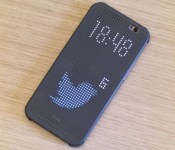
HTC One (M8) Dot View case hacked to show more notifications

The HTC One (M8) was released with a very unique cover called Dot View which contains a bunch of tiny holes in the front allowing a user to view limited information from their device by simply double tapping on the front.
Traditionally, the information the user could view was limited to weather, missed calls, time, and any incoming messages.
However, Shen Ye has managed to open up the Dot View case to show more notifications when using the case. He posted a picture earlier today showing his HTC One (M8) protected by Dot View with a notification from Twitter.
Whilst he’s yet to share any information about how he managed to achieve this, and if it relies on root access or a hacked APK file, Shen Ye did say “Sense already hooks into social networking APIs, it shouldn’t be hard to get DotView to show those notifications.” It does therefore appear that it’s pretty easy to achieve, and consequently we’ll hopefully see something released into the wild pretty soon.
SOURCE: +Shen Ye
The post HTC One (M8) Dot View case hacked to show more notifications appeared first on AndroidGuys.

Science! Charging your device wirelessly from across the room may soon be a Reality
 Wireless charging has so far only been a novelty rather than a convenience in the mobile world, though it can be said that it’s far easier to simply place your phone on a charging plate rather than rummaging for a cable tip. So far, we have been tethered to the charging plate, literally and figuratively, but some clever folks at the Korea Advanced Institute of Science and Technology may have found a way of charging your device wirelessly from across the room.
 Using a technology called the Dipole Coil Resonant System (DCRS), the system is able to not only charge one mobile phone from 15 feet away, but up to 40 different mobile devices simultaneously. The use of magnetic fields even allows the system to power TVs and laptops from a distance, though understandably due to the physics of magnetic fields, the strength and efficiency of the powering capabilities decreases with distance. While the progress of this research is exciting, commercial implementation of this is still a while away due to several glaring side-effects. One known side-effect is the fact that credit cards will have their information wiped every time they enter the magnetic field and it’s also unknown what kind of effect a magnetic field of this magnitude would have over a long period of time on humans and animals. Good thing I bought a pair of lead plated underwear then…
Still, it’s incredible to imagine just entering a room and having your phone charged while you are within it, whether it’s your own house or a coffee shop; the possibilities are limitless. What do you think about being able to charge your device simply by being in a designated area? Let us know your thoughts in the comments below.
Source: EurekAlert via Phone Arena
//<![CDATA[
ord = window.ord || Math.floor(Math.random()*1E16);
document.write('’);
//]]>

Nations gather to decide who gets the keys to the internet

Many countries are (understandably) unhappy with the influence the US wields over the internet, and in particular its control of ICANN, the web’s “back end.” The Department of Commerce has agreed to give up its oversight of the body, and is meeting various nations at Net Mundial in Brazil this week to discuss exactly how to do that. The gathering itself is controversial, as US political figures from the right and left, including ex-President Bill Clinton, oppose moves to give up ICANN control. Specifically, Clinton thinks it could lead to many states “protect(ing) their backsides instead of empowering people.” Similar concerns over censorship have been expressed by the EU and others, especially given the recent goings-on in Turkey and elsewhere.
Ironically, Turkey is one of the participants in the discussions. Two that aren’t — Russia and China — want to put the United Nations in charge of ICANN. That idea is vehemently opposed by the US, which has said it would prefer to keep control itself for another four years rather than pass it to another governmental body. Instead, the US supports a so-called multistakeholder approach, in which private enterprise, academia and government all have a say. That option is backed by other nations including host country Brazil, which itself was the target of some high-profile NSA snooping. For now, the multistakeholder option has the most support and has been drafted into an “outcome document” for further discussion. However, the EU’s digital head Nellie Kroes called parts of it “weak” on human rights and sent a big list of proposed changes. Given that nations like Russia would prefer to keep a tighter grip on the net, that could signal a long road ahead before the US passes the internet torch.
Filed under: Internet
Source: WSJ

Apple Takes Jab at Samsung in Full Page Earth Day Newspaper Ad
Apple is honoring Earth Day in a new ad found on newspapers across the UK that appears to also include a jab at rival Samsung, reports CNET.
The ad, which comes with a headline stating “There are some ideas we want everyone to copy,” includes two paragraphs that allude to the company’s ongoing patent trial with Samsung. Apple notes that there is “one area” where the company “encourages others” to imitate, calling for initiatives that are similar to its recent environmental efforts.

There’s one area where we actually encourage others to imitate us. Because when everyone makes the environment a priority, we all benefit. We’d be more than happy to see every data centre fuelled by 100% renewable energy sources. And we eagerly await the day when every product is made without the harmful toxins we have removed from ours.
Of course we know we can continue to do better. We’ve set some pretty ambitious goals for reducing our impact on climate change, making our products with greener materials and conserving our planet’s limited resources. So the next time we come across a great idea that can help leave the world better than we found it, we look forward to sharing it.
Apple and Samsung are currently in their second legal battle over accusations of patent infringement, with the former requesting $2 billion in damages from the latter. In its defense, Samsung stated that it only owes Apple $40 million, as the trial is expected to conclude and head into jury deliberations sometime this week.
The ad is one part of Apple’s “Better” environmental campaign launched yesterday ahead of today’s Earth Day event, which included a video about the ecological efforts of its Apple Campus 2 project and the expansion of its recycling program to include all products at its stores. Apple will be updating its store logos with green leaf accents and encouraging its employees to wear commemorative green shirts, as an event at its headquarters in Cupertino, California is also planned.
 AIVAnet