


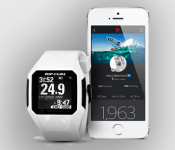
Rip Curl’s new watch tallies waves, tracks speed in the surf

Whether you’re a runner, swimmer or cyclist, there are plenty of fitness tracking wearables to choose from, ripe with features to help you make the most of a morning run or laps at the YMCA. But what about something for the surfer? Well, Rip Curl aims to let athletes of the ocean “track every wave” and “know every tide” with its new SearchGPS surf watch. Until now, surfers were limited to much more generic (dumb) wristwear preloaded with locational wind, temperature and swell statistics. The SearchGPS brings the watersport into the connected age, allowing users to record top speed, distance traveled and even their wave count. Then, by the time you’ve shed the wetsuit and hosed off your board, you can re-live your entire run with customized maps and graphic charts on Rip Curl’s website or stylish iOS Search app. Convinced you need one? The SearchGPS isn’t available just yet, but you can sign up to be notified when it hits shelves at the source link below.
Filed under: Misc, Wireless, Internet
Via: Uncrate
Source: Rip Curl

Xplore’s latest Windows 8 tablet is tough enough for a warzone

When a company sends you a tablet buried under a half foot of sopping-wet turf, you can be reasonably sure that the hardware’s going to be sturdier than your average kit. Xplore Technologies makes computing devices for the harshest of environments, including warzones, so we thought we would spend some time with the company’s latest slab. The XC6 is the most powerful unit the company has ever released, packing Intel’s Haswell internals and a 1,300-nit display. Like Lady Gaga, the XC6 likes it rough, so we grew out our beard, grabbed a sledgehammer and did some extreme computing for our enjoyment.
If the most that you do with your tablet is check Twitter while sitting in a restroom stall, then it shouldn’t be a surprise to learn that the XC6 is a tad overkill. Since it’s been designed to be used by oil-rig workers, soldiers, census takers and civil engineers, among other dangerous professions, it’s designed to take a lot of rough treatment. Weighing in at 5.4 pounds, it’s got a magnesium-alloy chassis, coated with liberal amounts of rubber over the port bays and corners. It’s rated for IP67 and MIL-STD-810G, so it should be able to handle being submerged into a meter of water for half an hour, as well as hot, cold, sand and extreme humidity. What we were able to do is leave this machine in our freezer for a few hours, only to find it still cheerily working, as well as take it into the shower with us for a casual spot of surfing while we rinsed ourselves clean. Reportedly, this unit is able to withstand drops from seven feet onto concrete, something that we tested with glee. There’s a 5-megapixel camera on the back with a fixed focal length that’s great for taking pictures of barcodes, and useless for anything else. There’s a 720p front-facer, which is perfectly acceptable for Skype chats, but not much else.

Despite the austere construction, there are a few surprising additions to the input list, with Gigabit Ethernet and HDMI-out alongside the usual complement of a fingerprint scanner, a pair of USB 3.0 ports and a 3.5mm headphone jack. In order to ensure that the device can withstand gloves and extreme temperatures, Xplore has eschewed a capacitive touchscreen in favor of a heavy-duty resistive one. Thankfully, there’s a pair of styluses available that’ll help you navigate around the device, and while it can work with gloves, it’ll require a hefty press. We did find that gestures in Windows 8 (for the Charms Bar) didn’t work unless we used the stylus, unfortunately. That 1,300-nit display is also strong enough to hold its own in direct sunlight, making it much more visible than the average laptop in similar conditions — although it’s by no means comfortable if you’re without shade for long periods of time. Another thing that we noticed is an odd amount of ghosting, with the previous screens lingering on the display as we flicked between various applications.

We didn’t have time to run any in-depth battery life tests, but were able to run the XC6 through 3DMark 11 to offer us some indication of its ability to handle tasks. You may be surprised to learn that it managed to crank out benchmarks of E1,801, P898 and X299 — figures that put it very close to Lenovo’s IdeaPad Yoga 2 Pro. Given that it’s packing a 1.9GHz Haswell Core i5-4300U with 4GB RAM and a 128GB SSD, we can be sure that while it may look like a piece of farm equipment, it’s certainly no tractor. It’s launching today, with the base model setting you back a whopping $5,299 — and more if you want to add in a Core i7 or other accessories like a card reader, or, who knows, maybe a rocket launcher.

Tesla opens 100th Supercharger… in a state where sales are banned

You can’t buy a Tesla in New Jersey, but now you can Supercharge one up! Tesla’s 100th Supercharger just came online in Hamilton, located just a few miles from the NJ state capital of Trenton. The Garden State’s very first Supercharger sports six stalls, and, since it’s positioned just a few miles from the New Jersey Turnpike, can accommodate Tesla owners traveling down the East Coast, from Connecticut to Florida. Of course, while you can fuel up your Tesla in Jersey, you can’t make a purchase — direct-to-consumer sales are still banned, following a shady (Jersey-esque) backroom deal between politicians and lobbyists just last month.
Filed under: Transportation

What you need to know about Aereo’s battle with broadcast television

Today, the United States Supreme Court will spend one hour hearing the latest arguments in an old, important debate that affects everyone watching television in the US: who owns the airwaves?
ABC, CBS, NBC, Fox and others use the broadcast frequencies our TV antennas pick up, the government regulates those frequencies, and cable companies pay broadcasters to re-broadcast those frequencies, but the answer to who owns them remains nebulous. That is at the heart of today’s case — “American Broadcasting Companies, Inc., et al. v. Aereo, Inc.” — being decided by the highest court in the United States. And the decision stands to leave a massive impact on how Americans consume television, regardless of which side wins.
WHAT IS IT?

Aereo charges customers $8/month to rent a physical antenna in a remote location that offers local channels and cloud DVR service, which is then streamed live to smartphones, tablets, and computers. Broadcasters and the federal government say that violates copyright law; that re-broadcasting content from the airwaves via the internet is a crime.
The biggest names in broadcast television, from CBS to Disney and the federal government too, have 30 minutes to present their case: that New York City startup Aereo is stealing content and re-broadcasting it without paying a fee. Aereo has the same 30 minutes to defend itself; an attempt to uphold previous rulings in its favor from lower courts. What the Supreme Court decides doesn’t just affect Aereo customers, but the future of television as we know it.
WHY SHOULD I CARE?
The decision leveled by the Supreme Court ultimately affects much more than Aereo. Do you like cloud DVR services? How about competition in the world of broadcast TV? They’re just two potential targets for impact.

First: cloud DVR functionality — once the subject of its own hard-fought legal battle — could be deemed a “public broadcast.” Should the broadcasters group win, services that millions of people use will be suddenly illegal in the eyes of US law. At very least, those services would be up for re-evaluation in terms of legality. The US government doesn’t think so, because cloud DVR services re-broadcast already played content, while Aereo offers streaming of live content with a slight delay.
Second: if what Aereo is doing is illegal, then what hope do we have for innovation in broadcast technology? Over the last half century or so broadcasters and distributors have slowly rolled out technological advancements like HD and surround sound, a pace which looks even slower compared to changes in wireless or internet services.
Even minor tweaks to the existing formula like VCRs, DVRs and internet streaming were slowed or crippled by legal challenges that exist to keep the existing broadcast model afloat. Worse, the broadcasters themselves have been slow to adopt the new technology.

Consider that only one broadcast network (ABC) offers a live stream of its over-the-air broadcasts — and that’s only in select markets, with a pay-TV login. New innovations are being considered as a response to Aereo should it prevail, but if the startup loses, there is little incentive for the existing patchwork of studios, broadcasters and distributors to provide real change in response to customer’s demands.
WHAT’S AT STAKE?

The US public doesn’t “own” the airwaves, but broadcasters are dependent on both the US government for logistical regulation (i.e. who broadcasts on which frequencies) and the US public for ad dollars (viewers equal ad dollars, in broad terms). The signals are open to anyone with a receiver, and at least one of the stations is partially funded by taxpayer dollars (PBS).
The public doesn’t “own” the airwaves, but we do own all the mechanisms that enable companies to profit from their existence. And that’s pretty powerful stuff.
WHAT’S THE ARGUMENT?
When Congress enabled broadcasters to start collecting re-transmission fees from cable companies in 1976, a new cash stream was born. Cable companies began paying broadcasters directly for feeds of their content. That revenue stream now accounts for anywhere from 10 percent of a given broadcast company’s annual revenue to 50 percent, according to both sides of the case. Aereo argues that it can sidestep paying to re-broadcast content by using individual antennas; since it’s receiving thousands of signals, it’s attempting to skirt re-transmission laws.
Here’s what that 1976 copyright law says you can’t do with what’s transmitted over broadcast signals:
1: to perform or display it at a place open to the public or at any place where a substantial number of persons outside of a normal circle of a family and its social acquaintances is gathered; or
2: to transmit or otherwise communicate a performance or display of the work … to the public by means of any device or process, whether the members of the public are capable of receiving the performance or display receive it in the same place or in separate places at the same time or at different times.
By using individual antennas, Aereo isn’t taking one signal and re-transmitting it to thousands of customers; Aereo takes thousands of individual signals and re-transmits them to thousands of people. Broadcasters, who have spent over 30 years reaping financial rewards in re-transmission fees, say Aereo is violating copyright law in “performing” their content (the re-broadcast). One side’s arguing legal technicalities, the other’s arguing technological minutia. All for the future of broadcast television.
WANT EVEN MORE?
The SCOTUS Blog has a great piece diving into the history of broadcast legislation, and the site’s catalogued all of the case filings thus far right here. Longtime television industry executive turned investor Barry Diller, whose company invests in Aereo, wrote an interesting (though certainly biased) op-ed about the case at The Wall Street Journal. Finally, the federal government’s filing is surprisingly readable (for a legal document). We’ll also have updates as the Supreme Court makes its decision in the coming months.
Filed under: Home Entertainment, Internet, Software, HD

[Download] Get all the Sony Xperia Z2 Tablet wallpapers here Now
 While we heard that Sony has finally announced availability of the Sony Xperia Z2 Tablet in the U.S. today, some lucky people around the world have already gotten their hands on the devices and the first impressions have been good. Most people have been commenting on how insanely light it is and how clear the screen 1920×1200 resolution, Triluminos display is. With each release of a new device, many of us wonder about the hardware and how the UI performance is; others of us just wonder what new wallpapers have now been made available. And thanks to a system dump by XDA forum member, bbarou, we got our hands on the system dump for the new Sony tablet and extracted the wallpapers. So, without further ado, here are the Sony Xperia Z2 Tablet wallpapers (all 30 of them):


As you can probably tell, there is a bit of overlap with the wallpapers that were available with the Z2 Tablet‘s smartphone brethren, the Sony Xperia Z2, however there are quite a few new ones too. Sony’s full frontal assault on the Android market continues with the Z2 Tablet and marks the first tablet device available with the new Qualcomm Snapdragon 801 processor (see its full specs here). It’s also being boasted as the slimmest tablet on the market, which is likely to account for the comments about its incredible lightness. And despite this, the Z2 Tablet retains Sony’s trademark waterproofing that makes it once again one of the most formidable tablet entries on the market.
What do you think about the Sony Xperia Z2 Tablet wallpapers? Let us know your thoughts in the comments below.
Source: XDA
//<![CDATA[
ord = window.ord || Math.floor(Math.random()*1E16);
document.write('’);
//]]>
Why You Should Consider Using VoIP Phone Systems?
As everyone knows, communication plays a pivotal role in keeping businesses successful and ongoing. Besides this factor, there are number of attributes which play a crucial role in making any business successful. But in this post, we will discuss about the significance of advanced phone system and how it has become indispensable part of every business.
To fulfil the basic needs and requirements of communication, businesses have started using advanced phone systems. Phone system in Sydney proves very beneficial for the prosperity of several businesses. With these systems, you can stay in touch with your valuable clients, other concerned parties and employees. With advanced phone systems, you can carry out communication process, without facing any hassle.
Different phone systems are designed with sophisticated characteristics to satiate varied communication requirements of every small or big business. Besides this, their basic features are very helpful in enhancement of business.
If you are very serious at analyzing different business phone systems for meeting your communication needs, then VoIP phone systems can indeed prove the best choice. There are number of significant factors that prompt you to prefer VoIP over other phone systems.
VoIP system
It provides your business with plethora of useful features that helps in improving your business efficiency and boost productivity. Further, it provides extraordinary features such as activity reports, call recording, call conference and CRM (Customer Relations Management) software integration.
When in remote locations, you can operate this phone system with Wi-Fi-enabled handsets, soft phones, headsets and laptops. The clarity of voice you get with this system is crystal clear and is affordable too, making it must-have for several businesses to compete in this fast-paced world.
Benefits offered by this phone system to businesses:
- Affordable – This phone system proves financially savvy choice for several businesses. It has excellent potential to reduce amount of expenses, a business usually spends on phone services.
- Greater access – Phone systems allow you greater access for your prospective business employees. You can access this phone system for communication, whenever you like. Besides this, it doesn’t have any limitations like traditional phone systems.
- No Boundaries – Besides making phone calls, you can conduct video conferencing through this system. This system allows you to stay in touch with your clients and employees to discuss important things related to workplace. Even if you are travelling abroad to attend corporate meeting, you can still attend other important meetings, without getting worried about being physically present over there.
This advanced phone system is worthy of investment and if you want to achieve success in your business, then it is very important to consider purchasing VoIP phone systems. Thus, it can be said that your business can benefit from huge savings and increased functionality by harnessing the flexibility and power of this system.
Author bio: Irving Mitchell is a chief engineer at local radio station in Sydney. He often writes articles and blogs stating significance of VoIP phone system and benefits offered by this phone system to businesses.
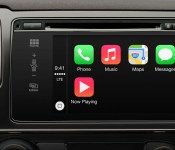
Apple Patents Technology to Disable Certain Phone Functions While Driving [iOS Blog]
Apple today was awarded a patent by the U.S. Patent and Trademark Office (via AppleInsider) that describes technology to partially disable a phone when the user is driving. The patent details several different lockout mechanisms that block functions like texting and SMS in order to reduce distracted driving.

U.S. Patent No. 8,706,143 describes two main methods to block select iPhone features. The first method requires no input from the car and uses the iPhone’s accelerometer and other on-board sensors to determine when a user is driving. Another method uses direct input from a car, which sends a signal to the iPhone that blocks a user from text messaging and using other mobile phone functions while behind the wheel.
The lock-out mechanisms disable the ability of a handheld computing device to perform certain functions, such as texting, while one is driving. In one embodiment, a handheld computing device can provide a lock-out mechanism without requiring any modifications or additions to a vehicle by using a motion analyzer, a scenery analyzer and a lock-out mechanism. In other embodiments, the handheld computing device can provide a lock-out mechanism with modifications or additions to the vehicle, including the use of signals transmitted by the vehicle or by the vehicle key when engaged with the vehicle.
The technology would contain a provision that would allow a phone to be used in a car by the passenger. This feature uses visual input and sensor data to determine whether a person is in the driver’s seat or sitting in the passenger seat of the car .
As with all patents, this is proposed technology that may or may not make its way into a future device. Apple’s in-car efforts now focus on the Siri-controlled CarPlay, which provides voice-controlled access to Maps, phone, messages and music.
The in-car technology initially debuted as a factory-installed option in new 2014 luxury models from Ferrari, Mercedes-Benz and Volvo and will be available as an aftermarket add-on via Pioneer and Alpine-branded receivers. It also will debut in 2015 Sonata models from Hyundai.

Apple May Be Using ‘Brightflash’ Shell Company to Pursue iWatch Trademark Protection
Following our report yesterday about Apple expanding its trademark protection to use the “Apple” name in association with jewelry and watches in a number of countries, MacRumors has discovered that Apple may be quietly continuing to pursue trademarks on the “iWatch” name itself.
Evidence of Apple’s interest in the iWatch name surfaced last June as the company began registering for trademarks on the “iWatch” name in a number of countries. Several major countries including the United States were not included in that list, and it was unclear whether Apple was holding off due to conflicts with pending trademark applications in those countries or if there were other issues in play.
At the time, reports mentioned several of those conflicting applications in the United States, but we now believe that one of those applications may in fact be Apple itself operating in disguise using a shell company by the name of Brightflash USA LLC. While MacRumors has yet to discover a smoking gun linking Apple to Brightflash, there are several pieces of circumstantial evidence pointing in that direction, thereby suggesting that Apple is indeed continuing to quietly lay the groundwork for an iWatch launch.
– Timing: Brightflash filed its iWatch trademark application in the United States on June 5, 2013, alongside the surge of applications by Apple in other countries during the span of June 3-5. While it is possible that the timing is a coincidence or the result of a separate company moving extremely quickly to apply for the mark after news of Apple’s applications in other countries started breaking on June 5, this would appear to be unlikely.
– Concealed company structure and location: Brightflash is registered in Delaware, a common location for incorporation due to the state’s business-friendly laws. According to state records, Brightflash was formed on June 27, 2012 and the company uses the Corporation Trust Center in Wilmington, Delaware as its address. That building serves as the home of hundreds of thousands of companies, streamlining the process of locating in Delaware and providing a level of anonymity for companies registering using the firm’s services.

– Few leads on company representatives: Efforts to determine Brightflash’s executives and representatives have proven difficult as well, with the initial trademark application using attorney John Sullivan at the same Corporation Trust Center address. Last month, Brightflash filed a change of attorney form with the U.S. Patent and Trademark Office listing a David Harris also at that address, with that document signed by a manager “J. Yori”. It is possible that this is Joan Yori, an executive with Stewart Management Company, a firm offering services for establishing so-called special purpose entities.
SMC offers a full service domicile management package including office space, employees, officers and directors, accounting services, and coordinates services with recommended local legal and banking providers.
– Legal links from Ecuador: As we noted yesterday, Apple filed for a trademark on the “Apple” name in Class 14 (jewelry and watches) in Ecuador last December, and the attorney who facilitated that application was Alejandro Ponce Martinez, a principal attorney with Quevedo & Ponce in Quito. Ponce has helped Apple with a number of other trademark applications, including recent filings for iOS 7 icons and iPad Air, and just weeks prior to the Apple jewelry filing he helped Brightflash file its application (PDF: page 164) for the “iWatch” mark.
In an initial response to Brightflash’s U.S. application for the iWatch trademark, the examiner cited several prior pending applications from other firms that would potentially be confusing with Brightflash’s desired usage. As a result, Brightflash late last month filed its own response requesting that its application be put on hold until the other pending applications were either granted or abandoned. Last week, the patent examiner issued a letter granting the suspension of Brightflash’s application for the time being. If Brightflash is indeed Apple, the company would very likely make an effort to acquire the rights to any of the other trademarks if they are granted.
Brightflash continues to file trademark applications in other countries, including Australia and Macau. And just last month, United Kingdom and Denmark were added to the list, indicating that the firm is indeed still interested in protecting the iWatch name. As noted by French site Consomac [Google Translate], Brightflash is pursuing registration of the iWatch name in at least four dozen countries around the world.
Brightflash is also attempting to trademark the “Brightflash” name itself in a number of countries, and it is unclear whether this is simply part of the process of pursuing the iWatch mark or if there is an additional feature or product that could use the Brightflash name.
In the background of any efforts by Brightflash or Apple to secure a U.S. trademark on the iWatch name is a years-long battle between Swiss watchmaker Swatch and New York firm M.Z. Berger. MZB applied for a U.S. trademark on the iWatch name back in July 2007 and the application was nearly approved before Swatch opposed the mark on two fronts: potential confusion with the Swatch brand and a lack of intent by MZB to actually use the iWatch name.
An appeals board has ruled that MZB should not be awarded the trademark on the basis that there is no evidence of MZB’s intent to use the iWatch name at the time of filing, although Swatch’s claim of potential confusion was not found to be warranted. Both parties appealed the respective decisions against them late last year, and the case remains unresolved.
Apple’s potential use of Brightflash as a shell company to hide its efforts to protect intellectual property would certainly not be the first time the company has engaged in such tactics. Last November, the company created an entity by the name of CarPlay Enterprises to file a U.S. trademark application on the term “CarPlay”, which last month became the new name for the previously named iOS in the Car feature in iOS 7.1.
In an earlier example leading up to the launch of the iPad, Apple used a shell company by the name of Slate Computing to protect “iSlate” and “MagicSlate” while using a separate firm under the name IP Application Development to secure the “iPad” name.
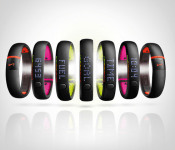
Nike Could Partner With Apple to Bring NikeFuel Features to iWatch [iOS Blog]
Nike is said to be trimming its Fuelband team as the company moves its efforts away from hardware in order to focus on its NikeFuel and Nike+ software. What is next for Nike for may be a partnership with Apple to produce a Nike fitness app that could pair with Apple’s iWatch hardware, theorizes GigaOm.
If Nike exits the physical wearable market, as now seems likely, Apple will be the primary sensor maker for Nike’s future wearable apps given the length and depth of the two companies’ close ties. Although there are a handful of Nike apps available for Android, there is no app (on any other mobile platform aside from iOS) that supports NikeFuel, which Nike describes as the “heart of the Nike+ ecosystem.” In many ways, this is the culmination of a process that’s been taking place between the two companies for the better part of a decade: Nike will design the fitness app experience, and the hardware will be made by Apple.
In arguing for a Nike and Apple tie-up, GigaOm points out the long history between the two companies, which includes the 2006 Nike+iPod product, which paired a Nike sneaker first with an iPod Nano and later with the iPhone 3GS and iPod Touch second generation. Most recently, Nike was a featured partner in the iPhone 5s launch, releasing its M7-compatible Nike+Move app shortly after the smartphone’s launch last September.

Nike earlier this year also announced plans to open up its Fuel fitness system to third-party developers as part of its Nike Fuel Lab initiative. Though not mentioned as being included in the program, one of these Fuel Lab partners theoretically could include Apple. In this scenario, Apple would bring the hardware expertise that Nike lacks, while Nike has the name recognition among the fitness crowd and slick marketing that Apple could leverage.
Apple is rumored to be releasing its iWatch with a late 2014 target launch date. Recent predictions from KGI Securities analyst Ming Chi Kuo suggests the iWatch could be Apple’s most important product of the year, surpassing even the highly anticipated iPhone 6.


Screenshot of Beta Dialer app gets leaked out by @googlenexus Twitter Account
 Over the last few updates, we’ve seen that Google is trying to inject some more colour into its core Android apps. This has been most evident in apps like Google Keep where the main bar has traded in its bland grey for a much more appropriate and striking yellow. It looks like the dialer app could be getting some love in the near future as a screenshot of what could very likely be the beta dialer app was leaked out on the @googlenexus Twitter account earlier today.
Whether this was accidental or intentional is entirely up for debate, however the change from the ordinarily grey dialer to blue is a welcome one. There’s no real telling how far away this colour change is or whether it will even eventuate, but it’s nice to know Google is trying new things. Of course, only devices with stock Android (or near as stock like the Moto X) will ever see the update to the dialer app, but presumably Google’s colourful updates will also be coming to its other apps soon too. I vote that Hangouts change to green next; anyone with me?
What do you think about this new dialer app colour scheme? What apps would you like to see updated next? Let us know what you think in the comments.
Source: Twitter via Android Police
//<![CDATA[
ord = window.ord || Math.floor(Math.random()*1E16);
document.write('’);
//]]>
 AIVAnet