



Apple and Google Vying for Exclusive Games from Developers With Promotional Perks
A new report from The Wall Street Journal today highlights the increasing competition between Apple and Google to gain exclusive games for their respective iOS and Android platforms. According to the report, both companies have been offering developers promotional perks, such as premium placement on their app store home pages, in exchange for the first rights to a title.

For instance, the popular title Cut The Rope 2 was reportedly part of an exclusivity agreement between Apple and and developer ZeptoLab:
ZeptoLab’s sequel to its popular puzzle game “Cut the Rope”, introduced in December, reflected a similar pattern. The company and Apple agreed to about a three-month window of exclusivity for Apple’s App Store, in exchange for the store prominently promoting the game, one person familiar with the matter said. ZeptoLab launched an Android version in late March.
The report also notes a promotional agreement between Apple and EA to launch Plants VS. Zombies 2 on iOS two months before its release on Android. This is in line with a story from Giant Bomb last September that shared similar details. However, while both companies denied the claims and stated that no money was exchanged as asserted by the original story, The Wall Street Journal notes that Apple doesn’t offer money for game exclusives, but rather just marketing and promotional assistance.
Plants VS. Zombies 2 was prominently featured by Apple during the week of its release, as it was mentioned on the App Store Facebook page and featured in top banners on the App Store itself.
Amazon has also carried out similar practices, offering promotional spots on its Amazon Appstore in order for the rights to launch games on its Kindle family of devices. An Amazon spokeswoman corroborated these claims, stating that the company “works with many developers to bring their apps to the Amazon Appstore.” The company’s new Fire TV media streaming box, which was released earlier this month, contains dedicated support for games, even offering a $39 wireless Fire game controller.
The news also comes as the amount of money spent by consumers on mobile content grows. According to the results of a study done by research firms IDC and App Annie, mobile games accounted for $16 billion of app sales, jumping 2.3x over the past year.

More Google Now inspired wallpapers, this time from Stormfly for Android and Spiderfly Studios
 Yesterday, we featured some Google Now inspired wallpapers courtesy of Alex Pasquarella, which a lot of you seemed to like. Today, we’ve got a few more Google Now inspired wallpapers, but from a slightly different source. That source is the Stormfly for Android app, developed by Spiderfly Studios, which is effectively a live wallpaper for your device (although the wallpapers themselves are static) that changes dynamically based on the time of day and weather that is currently at your location.
 It’s a pretty interesting app, one which helps make your device seem a bit more in tune with your surroundings, and as you can see, the wallpapers they use are beautiful and very familiar given their inspiration. The Stormfly app will run you $0.99 on the Play Store (links are below), which is pretty cheap in this realm of apps. Make sure you visit the Stormfly Google+ page, which is where they first featured these wallpapers which are going to be added to the app soon.
If you pick up Stormfly, or are already using it, be sure to let us know how you find it in the comments.
Source: Google+
Application: Stormfly
Price: $0.99
//<![CDATA[
ord = window.ord || Math.floor(Math.random()*1E16);
document.write('’);
//]]>

The battle for exclusive games has come to smartphones

It’s like Sega and Sony all over again. We don’t mean the hardware arms race (although that’s certainly happening), but how the smartphone world’s two top players are now fighting over the most popular games… and their sequels. Gaming is one of the top money-spinning app categories on smartphones and tablets and according to a WSJ report, both Apple and Google are trying to get popular games and their developers on their side. The companies promise headline placement in their respective online stores and prominent ads around the app portal, in exchange for exclusivity, or at least a lead. This was apparently the case for Plants Vs. Zombies 2 last year, where Apple got a two-month lead over the Android version — and it’s not the only one.
The Cut The Rope series followed a similar pattern, while Gameloft, the company behind titles like Asphalt, had apparently discussed the exclusivity angle with Apple, but eventually decided to launch on both Android and iOS at the same time. “We haven’t found the case where it makes sense for us,” said Gonzague de Vallois, head of sales and marketing. In contrast to the console battles from the last few decades, neither platform has managed to nail down anything resembling a talismanic mascot character or series — we’re not expecting hell to freeze over in this new fight.
Filed under: Gaming, Mobile, Apple, Google
Source: WSJ

How would you change Blackberry’s Z10?

With the advent of touchscreen smartphones, BlackBerry lost its position as king of the mobile world. In response, the company bought QNX and hibernated, plotting a reinvention centered around BlackBerry 10. When the business emerged with the Z10, everyone knew that this was the device that the company’s future relied upon — and we know how that ended up. When we reviewed it, we found that every element of the hardware was solid, adequate and pleasing. Unfortunately for BlackBerry, nothing stood out as being better compared to the devices that launched in its stead, nullifying any attention the handset’s big launch had garnered. It’s been just over a year since the Z10 launched, so we thought we’d ask all of you what it’s been like living with this device. Hop over to the forums and let’s chat some BlackBerry.
Filed under: Cellphones, Mobile, Blackberry
Source: Engadget Product Forums

Moto G LTE and Moto G Ferrari variants look like they’re on their way Soon
 One of the primary pitfalls of the Moto G despite being the best budget Android smartphone on the market is the fact that it doesn’t have 4G LTE support. While this isn’t particularly an issue in some regions, or even for some customers, it’s undeniable that having 4G would make the Moto G by far the best option for accessing LTE speeds on a budget. Thankfully though, with the the Moto G LTE and Moto G Ferrari variants, it looks like Motorola may be readying a version with that capability, as well as a marquee branded version.
In terms of hardware, it looks like the Moto G LTE won’t be changing that much (see the hardware specs here), only that the updated processor will give the device LTE capability and only be offered as a 16GB model. The Moto G Ferrari is a bit more of a rumour, with no specific details given about the hardware configuration, however it is likely the device would come with a Ferrari emblazoned red back cover. It’s red so it should go faster right? This won’t be the first time that Motorola has teamed with Ferrari who also collaborated to bring you the Motorola i867 Ferrari (below).
 What do you think about the Moto G LTE and Moto G Ferrari? Would you get either of these phones? Let us know what you think in the comments.
Source: Xataka via Phone Arena (1), (2)
//<![CDATA[
ord = window.ord || Math.floor(Math.random()*1E16);
document.write('’);
//]]>

Behold the internet’s power: Quentin Tarantino to rewrite movie ending after script leaks

What the internet giveth, it also taketh away… and then giveth back again (sort of). Back in January, the script for Quentin Tarantino’s next film, a western called the Hateful Eight, showed up online and Defamer drew the web’s attention to its presence. In response, the filmmaker sued for copyright infringement and shelved the project. It appears time has caused Tarantino to reconsider that initial reaction, however, as Deadline Hollywood reports that he’s simply going to rewrite the ending to the movie and film it next winter. (The lawsuit remains pending, though the parties are currently trying to settle things via court-ordered mediation.)
News of the Hateful Eight’s lazarus act came from a live staged reading of the leaked script in Los Angeles last night, where Tarantino informed the crowd that he was working on a second draft of the script and he going to make a third pass at it as well. And so, the internet’s power in Hollywood continues to grow. Crowd funding movies, providing theaters with pre-roll content from Twitter and Vine, and now the web’s forcing a rewrite of a feature film. What’s next? You tell us, digital denizens: sound off in the comments below.
[Image Credit: Amanda Edwards/WireImage]
Via: The Verge
Source: Deadline Hollywood
Motorola Moto E specifications leaked, to be priced similar to the Moto G
After being acquired by Google, Motorola feels like a completely different smartphone brand. Its past few releases such as the Moto X and the Moto G have been very well received. The Moto X was a high-end smartphone with a twist, while the Moto G was solidly performing a mid-range smartphone with focus on the basics. Motorola is now reportedly working on the Moto E which will be priced at $230 (unlocked off-contract).

Motorola Moto E Leaked Specifications
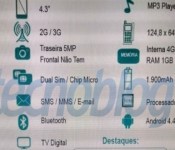
According to the leaked image, the Moto E will be equipped with a 1.2GHz dual-core processor, 1GB of RAM and 4GB of ROM. A screen measuring 4.3 inches diagonally might feature an HD (1280 x 720 pixels) resolution, similarly to the Moto G. It will come with a 5MP primary rear-facing camera and a front-facing secondary camera as well. The battery is tipped to be a 1900 mAh one. Software wise, it will come with Android 4.4 KitKat, similar to all the Motorola smartphones that are on sale right now. Along with Wi-Fi and Bluetooth, connectivity also includes dual SIM card slots, a feature which has huge demand in countries like India and China.
Similar to the Moto G, this device could be heading to developing countries like China and other Indian sub-continent countries. The Motorola Moto G which was priced at ~$200 (INR 12, 499) in India turned out to be a huge hit due to its affordable price tag, inclusion of dual SIM card slots and getting the basics right. The device appears to be very slim at just 6.2mm which might also mean that it could be a more stylish version of the not-so-attractive Moto G. Not only Motorola, even Google is working on a cheaper variant of its Nexus smartphone powered by a MediaTek processor.
//<![CDATA[
ord = window.ord || Math.floor(Math.random()*1E16);
document.write('’);
//]]>

Entry-level HTC Desire 210 to be revealed soon in India
In spite of releasing a great high-end smartphone last year, HTC is still in a financial trouble. The main reason for this is that they focussed only on the high-end market with the HTC One, HTC One Max and the HTC One Mini. They lost focus of the entry-level and mid-range market which is a formidable source of cash-flow. But looks like HTC won’t be repeating the same mistake this year. They’ve already announced a great device in the mid-level price range, the HTC Desire 816. We’ve learnt from BGR India that HTC Desire 210, an entry-level Android smartphone will be revealed shortly in an “exclusive preview” press event which is to be held in India.

According to the report, the Desire 210 will feature a 4-inch WVGA screen, a 1.2GHz dual-core MT6572 processor from MediaTek, a 5MP camera and a VGA front-facing camera. It could be released with a price tag of INR 8,990 ($150). With the said specifications and price, the HTC Desire 210 will compete directly with best-sellers such as Samsung Galaxy S Duos 2 and Sony Xperia E1 Dual.
Source: BGR India
//<![CDATA[
ord = window.ord || Math.floor(Math.random()*1E16);
document.write('’);
//]]>

Drones help find World War II’s missing soldiers

The BentProp Project has spent years finding American soldiers who went missing in the Pacific during World War II, but available technology has limited its success. Team members have frequently had to scan wide areas themselves, slowing down their efforts to find downed aircraft and unexploded bombs that might hide human remains. However, the outfit’s searches have just taken a big step forward after it got cutting-edge drones from both the Scripps Institution of Oceanography and the University of Delaware. BentProp can now automate much of its scanning, and CNET notes that the organization’s latest expedition found two Navy airplanes. That’s a breakthrough for a group that only occasionally makes a big discovery.
The biggest breakthrough this year was underwater. Instead of towing a side-scanning sonar device behind a boat, BentProp used Remus robots that generated 3D sonar maps of search areas on their own. If the machines found clues to a wreck, a diver with a GoPro action camera could provide visual proof. The team also has a better idea of where to look in the first place; it now uses accurate LIDAR imagery and statistical models to determine where aircraft went down.
On both land and sea, BentProp used 3D Robotics octocopter drones equipped with both GoPros and infrared cameras. The machines both mapped environments and picked out heat signatures from metal that might represent still-active bombs. While the team still had to comb ground sites with metal detectors, the drones gave workers a better idea of where to begin.
Searches are still slow, and there’s no certainty that the efforts will be completely successful. Stephen Ballinger, whose Cleared Ground Demining group has been working with BentProp, tells CNET that it’s unlikely we’ll completely prevent old explosives from threatening both MIA recovery efforts and local residents. However, the newer technology could give lost soldiers’ families some closure sooner than expected — and it might just save a few lives in the process.
[Image credit: Greg Bishop, Flickr]
Filed under: Robots
Source: BentProp

50 years ago today, the public got its first taste of video calls

It seemed like the inevitable future at the time, we’re sure. On April 20th in 1964, Bell Telephone showed off the Mod 1 Picturephone — a precursor to the Skype and Hangouts video calls that have become a standard but under-utilized feature of modern communications. The demonstration was part of the World’s Fair in Flushing Meadows, visitors were able to step into a booth and have a conversation with a person thousands of miles away in Disneyland. But instead of just talking into a handset, users sat in front of an oblong device that housed both a video screen and a camera. The service delivered a 30 frame-per-second black-and-white feed to wowed Fair-goers. A few months later, in June of the same year, AT&T took the service commercial.
Of course, as we all know the service was a flop. At $16 for three minutes of video calling, Picturephone was prohibitively expensive. Despite pumping millions of dollars into the effort, Bell could never get any traction. Mod II released in 1969 also failed to capture anything more than the imagination and a corporate videoconferencing descendant also proved to be too costly. Others tried and failed as well, it wasn’t until decades later that Skype finally seemed to make video calling a practical proposition. Still, if you’re wondering where the whole thing got its start, you need look no further than Queens, just a few minutes walk from where the New York Mets make their home.
Filed under: Misc
Source: Mashable
 AIVAnet