


Nike reportedly killing the Fuelband to focus on fitness software

Just days after Nike announced the launch of its Fuel Lab location in San Francisco to enhance partnerships with other digital services for athletes, there’s a report that it’s fired much of the team behind its FuelBand wristwear. CNET reports that, according to a person familiar with the matter, as many as 55 people from its 70-member hardware team are being laid off, and plans for another version of the FuelBand to follow the SE have been shelved. All of this comes just as the wearables market is heating up, with products already arriving from Samsung, LG, Motorola, Pebble and more, while activity tracking integrated with phones is also becoming more popular. At the same time, not all of Nike’s tech initiatives have worked out, and Nike+ has largely disappeared from its shoes in the last year.
A Nike spokesman confirmed to CNET a “small number of layoffs” as its “Digital Sports priorities evolve.” Given Nike’s close relationship with Apple, one could wonder if the prospect of an upcoming wearable from Cupertino had a hand in swinging the apparel company’s focus towards “simpler data-powered experiences” — or they just spent all the money on tonight’s sweet 3D projector intro to the Jordan Brand High School All-Star Game.
Nike reportedly is killing the Fuelband. Thoughts?
Filed under: Wearables
Source: CNET
HTC poaches Samsung Galaxy marketing guru, looking for “The Next Big Thing”
 HTC‘s marketing in the past year has been wildly hit and miss; the slightly absurd Here’s To Change campaign featuring Robert Downey Jr. was met with very mixed opinions though its HTC Technical Translations videos seemed to be a lot more popular. Either way, HTC is probably planning to really break through with their own marketing and to that end, they’ve hired Samsung‘s former Chief Marketing Officer, Paul Golden, the man who proclaims he “created and launched the highly successful Galaxy brand for Samsung”.
Golden was reportedly hired by HTC very recently and will serve as an adviser to HTC chairman, Cher Wang. Wang has previously said that “We just have to communicate well with our customers… I believe if we can communicate better, we will do better,” which is a sentiment we can all agree with, though it can be said that Samsung’s communication and marketing is generally extremely vague. Regardless, we look forward to what could be a resurgence in HTC marketing and hopefully a brighter future for the Taiwanese manufacturer.
What do you think about HTC’s acquisition of Paul Golden? Do you think he can really help HTC’s position in the market? Let us know what your thoughts are in the comments.
Source: Bloomberg via engadget
//<![CDATA[
ord = window.ord || Math.floor(Math.random()*1E16);
document.write('’);
//]]>

Labels claim Pandora owes money for streaming old songs, probably won’t get it

Pandora can’t catch a break, it seems. Just weeks after the streaming radio service escaped paying higher royalties to songwriters, record companies and musicians have sued it in a New York court for allegedly violating state copyright laws by refusing to pay for older song recordings. The labels argue that Pandora is subject to state rules on compensation whenever it streams tunes recorded before February 15th, 1972, when federal law took over; right now, it’s only paying for those newer works. The suing parties claim that Pandora is both depriving artists of income and wielding an “unfair advantage” over on-demand competitors like Rdio and Spotify, which have no choice but to negotiate royalties for classic tracks.
Pandora says it’s looking at the claims, and it hasn’t provided a formal response so far. However, you shouldn’t assume that it will fight the lawsuit tooth and nail — the legal action may not do as much damage as you’d think.
As Santa Clara University law professor Tyler Ochoa tells us, the labels are likely suing in New York because it’s one of the few states with existing case law that addresses royalty issues like this. While some other states have their own relevant copyright rules, the music companies wouldn’t have a good precedent to work with in these territories. They would be “starting from scratch” and face a greater chance of losing, Ochoa says. As such, you shouldn’t count on seeing a state-by-state litigation campaign. Even a New York victory isn’t guaranteed, since the local law doesn’t offer perfect clarity on how to handle radio-like internet services.
The record companies may also collect relatively little cash if they do win. As this isn’t a federal suit, Pandora might only have to shell out for songs that New York-based customers play. Any retroactive payments would be limited to the past three years, and there would be questions as to why the music outlets didn’t push for compensation much sooner. Pandora could theoretically avoid any new royalties by blocking New York customers from streaming pre-1972 songs, although it may not want to risk a backlash from angry listeners.
To Ochoa, these factors make it “pretty likely” that the lawsuit will end in a settlement. There’s enough uncertainty that neither side would get much value from duking it out in the courtroom. The odds are that Pandora won’t take a serious blow, and that the labels will only have limited success in getting money for their golden oldies.
[Image credit: Dustin Gaffke, Flickr]
Filed under: Internet
Via: New York Times
Source: RIAA

Apple Offering Some Developers Second Chance to Buy Unclaimed WWDC Tickets
Apple is offering some developers a chance to buy unclaimed WWDC tickets, according to a report from 9to5Mac and several Twitter users. Apple has emailed certain developers to offer them WWDC tickets, giving them 24 hours to pay the $1,599 ticket fee.
This year, because of nearly immediate ticket sellouts in past years, Apple decided to offer WWDC tickets to registered, paid iOS and Mac developers through a lottery system. Developers who won the ticket lottery had until April 14 to complete their purchases.

Now Apple is reportedly reaching out to developers who didn’t win the lottery and offering them a chance to buy unclaimed tickets. Some developers are starting to get phone calls from the company informing them that they have been randomly selected to buy one of the tickets that winners failed to claim before the 14th.
It is unknown how many WWDC tickets went unclaimed by lottery winners, nor how the company is choosing developers to receive a second chance at tickets.
The annual Worldwide Developers Conference will be held from June 2-6 at the Moscone West convention center in San Francisco
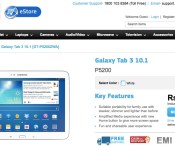
Samsung Galaxy Tab 3 10.1 finally listed on Samsung India eStore for INR 36,340
We are finally getting hints of official availability of Galaxy Tab 3 10.1 in India. The device has been listed on Samsung India eStore at a price of INR 36,340. The device is currently out of stock but will be available very soon. It was officially announced way back in June 2013 and released in other international markets by Q3 2013 but we are not sure why it took Samsung almost an year to release it in India. The 7 inch and 8 inch versions of Galaxy Tab 3 were made available in India by July 2013.

Samsung Galaxy Tab 3 10.1 On Samsung India eStore
Samsung Galaxy Tab 3 10.1 Specifications & Features
- 10.1 inch TFT Display, 1280 x 720 pixels, Multitouch Capacitive Touchscreen, 149 ppi
- Android v4.2.2 Jelly Bean, TouchWiz UI
- 1.6GHz dual-core Intel Atom Z2560, PowerVR SGX544MP2, 1GB RAM
- 16/32GB internal storage, microSD card slot
- 3MP primary camera, 1.3MP secondary camera, 720p video recording
- microSIM slot, 42Mbps HSDPA, dual-band Wi-Fi b/g/n, Wi-Fi Direct, Bluetooth v4.0
- MicroUSB v2.0 port, MHL, USB Host
- IR Blaster, Stereo Speakers with Dolby Digital Sound
- Accelerometer, Compass, Ambient Light Sensor
- 8mm thin, 510 grams, 6800 mAh battery
The Galaxy Tab 3 10.1 comes with a dual-core processor, a 10.1 inch HD screen and Android 4.2.2 Jelly Bean on board. None of these features are seem attractive right now as most of the competition has now moved to relatively better hardware. Devices like Nexus 7, Nexus 10, Sony Xperia Tablet Z and Asus Transformer Pad come with latest version of Android, higher resolution screens and more powerful processors. Moreover, details about the upcoming Galaxy Tab 4 have already started flowing in. Would you buy an year old tablet with 2 generations older version of operating system? Let us know in the comments below.
Hit the Samsung India eStore
//<![CDATA[
ord = window.ord || Math.floor(Math.random()*1E16);
document.write('’);
//]]>

Metro PCS Launches the Galaxy S5 for a Whopping $649.00
The key to Samsung’s success and pure domination of Android phone sales is there ability to get the device everywhere. I mean seriously, EVERYWHERE. All four major carriers have the device, U.S. Cellular, Boost Mobile and Virgin Mobile will have it shortly, and now we have Metro PCS. That covers a good portion of consumers just here in the states.
 They have the Galaxy S5 listed for $649.00 outright, since Metro PCS is a pre-paid style service it isn’t surprising. They do offer free two shipping with your order though, minus weekends of course.
Any Metro PCS customer out there digging out their tax return cash to pick one up? Head over to the Metro PCS website for other details and ordering info.
//<![CDATA[
ord = window.ord || Math.floor(Math.random()*1E16);
document.write('’);
//]]>
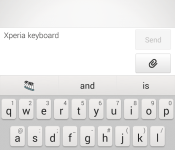
Xperia Keyboard now available in Google Play Store for Sony devices
Almost all the major brands have been releasing their core apps on to the Play Store as it becomes easy to update those parts without pushing an update to the whole system. Sony has released the Xperia Keyboard in the Google Play Store. Although it is only compatible with Sony Xperia devices running Android 4.4.2 KitKat. Which leaves out a the Xperia Z and Xperia Z1s with T-Mobile (Story gave it a look.). The latest version of Xperia Keyboard (6.4.A.0.6) comes with features such as swipe typing, language learning and predictions. It learns a user’s language through GMail, Facebook and Twitter.

 The new version also comes with data sync. It will backup and sync service with your Sony Entertainment Network account, assuming it is available in your region. This makes sure that even when you switch to a different Sony device, the typing experience stays the same. This keyboard includes all the major languages worldwide except Chinese, Japanese and Korean.
If you happen to have an Xperia device with Android 4.4.2, then be sure to update and give it a whirl. Assuming you haven’t already of course.

//<![CDATA[
ord = window.ord || Math.floor(Math.random()*1E16);
document.write('’);
//]]>

DARPA envisions a smarter, safer autopilot

Autonomous aircraft serve their purpose, but there’s no question that pilotless passenger flights are a long way off, if they ever become a reality. Still, there’s obviously room for improvement when it comes to on-board systems that assist pilots in their duties. The Defense Advanced Research Projects Agency (DARPA) is in the process of creating an advanced autopilot system called ALIAS (yes, another acronym). The Aircrew Labor In-Cockpit Automation System (there you go) would control military aircraft in all stages of flight, from takeoff to landing — even during a system failure. Pilots would interact with the system using a touchscreen and voice control, supervising a flight instead of commanding it. Of course, we’ll see this technology make its way to military planes long before it’s adopted by airlines, but ALIAS could play a key role in keeping us all safe at 30,000 feet.
Filed under: Transportation, Software
Source: DARPA
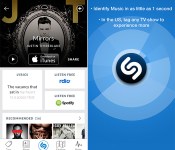
Apple’s Shazam Partnership Could Boost Advertising Efforts
Earlier this week, Bloomberg reported that Apple has plans to integrate song identification features into iOS 8 through a partnership with audio discovery platform Shazam, but as suggested by media professor Aram Sinnreich, Apple’s ambitions may go beyond simple music recognition capabilities.
Speaking with Computerworld, Sinnreich, a media professor at Rutgers University, points out that Apple could use Shazam’s audio recognition abilities to gather information on the media that iPhone and iPad users are consuming, including music, television shows, movies, and more, for targeted advertisements.

While Shazam is known for identifying songs that are playing on the radio or through other sources, the service is also capable of identifying and tagging television shows and advertisements. Shazam works by analyzing captured sound and comparing its acoustic fingerprint to an audio database, which began including television content in 2012.
Shazam’s technology could, of course, be used to deliver music and television information to consumers, providing identification along with additional content like news, facts, and iTunes purchase links, but at the same time, Apple could also use it to gather information on consumer preferences each time a song, television show, or advertisement is “tagged” or identified by a user, allowing the company to use those preferences to deliver more targeted ad suggestions across iOS.
Sinnreich pointed out that Shazam has been indexing advertisements broadcast on television, as well as the pre-show ads shown in movie theaters, and in some cases, has stuck deals with advertisers to provide metrics of those who “tag” an ad. In some cases, tagging an ad presents the consumer with additional information, or even a special offer.
Currently, the existing Shazam app is able to run in the background of iOS, continually cataloging and identifying all of the music, television shows, and TV ads that a user watches. Apple could potentially integrate the feature in the same way into iOS 8, allowing it to run in the background to continually listen for various audio content.
This functionality would allow Apple to know what a user prefers to watch and listen to. For example, if someone was watching Downton Abbey or Game of Thrones, Apple’s media recognition capabilities could theoretically automatically identify what’s being watched, cataloging it for future use in advertisements. Sinnreich likens this functionality to an audio QR code.
“Apple could do whatever a QR code is used for now, but sonically,” said Sinnreich of the audio fingerprinting technology. “Someone tags a commercial, and that’s entered into a database, effectively targeting [that consumer] for further ads,” he said.
While Sinnreich’s theory is mere speculation at this point, it does fit in with Apple’s current advertising methods, which the company says include “exceptional targeting.” Apple has been working to expand its iAd platform in recent months, moving beyond app advertisements to encompass iTunes Radio ads as well. Further improving its targeting methods could entice major advertisers, which has been the company’s goal — recently, Apple made it simpler for advertisers large and small to sign up for the platform, eliminating the need for a developer account.
Apple’s audio recognition capabilities are said to be coming alongside iOS 8, which is expected to make its debut during the company’s Worldwide Developers Conference in June. The operating system will likely be released to the public later in the year, in September or October.

Engadget Podcast 393 – 4.18.14

We have less libations, but more tech-related news than last week’s peaty podcast and that’s just fine for your sleep-deprived hosts. First up is some informed speculation on Amazon’s new smartphone, based on a few inconclusive photos that recently surfaced. Another work in progress is Google’s Project Ara, a modular concept that looks to make swappable smartphone parts a reality. The one thing that’s all too real and in your face, however, is the recent Heartbleed exploit, which has had widespread impact across the web. While you’re racing to update all those passwords — yes, it’s OK to do that now — it couldn’t hurt to get a refresher on exactly what happened and which sites were affected. So head on down to the streaming links and get your brain fix with this week’s episode of the Engadget Podcast.
Hosts: Terrence O’Brien, Ben Gilbert
Producer: Jon Turi
Hear the podcast:
01:56 – Testing Reebok’s Checklight head impact monitor with a human punching bag
02:26 – Engadget Podcast 392: The whiskey ‘sode
02:55 – Here’s Amazon’s phone: six cameras and a 4.7-inch screen
15:25 – What is Heartbleed, anyway?
16:40 – Google has patched most of its major services from the ‘Heartbleed’ security bug
24:02 – Crooks use Heartbleed exploit to steal 900 Canadian tax IDs
25:52 – Tor’s anonymity network may have to shrink to fight the Heartbleed bug
27:19 – Bloomberg: NSA used Heartbleed exploit for ‘years’ without alerting affected websites, the public
35:30 – Google’s Project Ara wants to revolutionize the smartphone industry within a year
Subscribe to the podcast:
[iTunes] Subscribe to the Podcast directly in iTunes (enhanced AAC).
[RSS MP3] Add the Engadget Podcast feed (in MP3) to your RSS aggregator and have the show delivered automatically.
[RSS AAC] Add the Engadget Podcast feed (in enhanced AAC) to your RSS aggregator.
Download the podcast:
Contact the podcast:
Connect with the hosts on Twitter: @terrenceobrien, @realbengilbert
Email us: podcast [at] engadget [dot] com
Filed under: Podcasts
 AIVAnet