



LG’s top-end G3 phone will rock a Quad HD display

So far, we’ve only come across beyond-1080p panels in a couple of Chinese phones, like the Oppo Find 7 and the Vivo Xplay 3S. But the spec is definitely about to go mainstream, as LG has just confirmed to us that the successor to the G2 will deliver a “Quad HD” resolution, with four times as many pixels as 720p (that’s 2,560 x 1,440, if you want to count ‘em). Based on earlier leaks, it’s likely that the G3 will have a 5.5-inch display, which means we’ll be looking at a pixel density of around 530 ppi — not far off double what you’d get from a printed glossy magazine.
What’s the point? Well, with the Chinese phones it was all about the rendering of the complex alphabet, which really benefited from the extra detail, but on global phones we’re not so sure. Onscreen photos also tend to get a boost, to the point where they look almost analog — a bit like the way 35mm prints used to look on a lightbox — but ultimately we’ll just have to wait and see how well LG implements the technology. Based on last year’s schedule for the G2, we might see an official launch in the summer, with availability by the fall.
Filed under: Cellphones, Mobile, LG
Via: Android Community, Ubergizmo
Source: Sprint (UAProf)
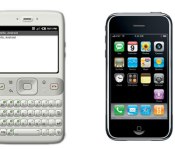
Before the iPhone was announced, Android didn’t support touchscreen input

Ahead of Apple revealing its first smartphone, Google’s plans for Android back in 2006 involved physical keys for control and no touchscreen input support. Revealed in court documents from the ensuing Apple-Samsung legal fray, the early specification says that “the product [Android] was designed with the presence of discrete physical buttons as an assumption. However, there is nothing fundamental in the product’s architecture that prevents the support of touchscreen in the future.” (The above render is from Google’s initial SDK, but by then, touchscreen integration was now part of the official spec.)
In this 2006 documentation, many of the Android staples (both in software and hardware) get a mention, including removable storage, third-party application support, widgets, notifications and all those Google services. Between the announcement of the iPhone and finalizing Android’s software requirements, touchscreen input was not only supported — multi-input touch was required, and our phones were never the same again.
Filed under: Cellphones, Mobile, Apple, Google
Via: Recode

This tiny generator can power wearable devices using your body heat

Many wearables have decent enough battery life, but you know what’ll make them even better? If we never have to recharge them at all. That’s why researchers have been developing small power sources that can generate electricity using body heat, including a team from the Korean Advanced Institute of Science and Technology. This particular group has designed a new light and flexible generator made out of thermoelectric (TE) substances printed on glass fabric. It’s far from being the first TE generator out there, but it’s a huge departure from the usual bulky and rigid ones.
As team leader Byung Jin Cho said:
This is quite a revolutionary approach to design a generator. In so doing, we were able to significantly reduce the weight of our generator, which is an essential element for wearable electronics.
Body heat-absorbing generators made from inorganic materials like this have higher power output than ones made from organic substances, making them the better choice. Problem is, they’re also typically larger and more rigid. This creation addresses both issues, and the glass fabric even minimizes heat loss and maximizes output, as discussed in the paper the institute published recently. Obviously, it’ll take a long time before we see this design in real world devices, if we even see it at all. The team believes, however, that this generator doesn’t only have a future in wearables, it could also be used in cars, factories, airplanes and other vehicles.
Via: Physorg
Source: The Korea Advanced Institute of Science and Technology
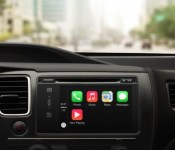
Alpine Planning to Release Aftermarket CarPlay Console This Fall
Car electronics manufacturer Alpine will begin selling a standalone aftermarket console that will support Apple’s CarPlay vehicle integration feature, reports Japanese business newspaper Nikkei. Alpine’s offering, which will likely be the first aftermarket device to support CarPlay, is said to hit the United States and Europe this year with a cost of around $500 to $700.

While CarPlay will be found in a number of announced and upcoming vehicles from manufacturers such as Mercedes-Benz, Volvo, BMW, Ford, GM, and Honda, the integration of the system into older vehicles has been a topic of much discussion in recent months. Pioneer Electronics expressed interest in implementing CarPlay compatibility with its existing and future products, only to back away from its comments soon after. Other companies, such as Kenwood, have indicated to MacRumors that CarPlay is only being looked at for integration and that adoption is not currently imminent.
Recently, automotive peripheral company Clarion also hinted at the possibility of bringing CarPlay its aftermarket in-dash systems. In an email to MacRumors, the firm noted that it has been working with Apple “from the start” and that it would be further developing its Smart Access in-car infotainment system and CarPlay for different purposes. Ultimately, the company stated that it will support CarPlay in both its aftermarket and OEM products at some point in the future.
Apple announced its CarPlay iOS vehicle integration feature last month at the Geneva International Motor Show. The feature allows an iPhone to take over the in-dash display of a car, providing Siri voice controlled access to aspects such as navigation, phone functions, messages, and music. The feature was included in Apple’s iOS 7.1 update and works with Lighting-enabled iPhones including the iPhone 5s, iPhone 5c, and iPhone 5.
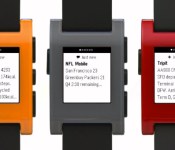
How would you change the Pebble?

Talk about Kickstarter and, inevitably, Pebble will come up. The smartwatch received over $10 million in funding, and was one of the biggest success stories to come from the site. What’s interesting, however, is that the minimalist aesthetic carries over into the feature set — offering nothing more than the odd notification and music control, and yet nailing it totally. The aim of this discussion, however, is to ask what you think and feel about the unit now that it’s been strapped to your wrist for the better part of a year? So why not head over to the forum and share your experiences.
Filed under: Wearables
Source: Engadget Product Forums
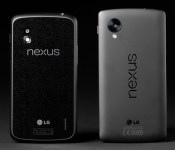
[OP-ED] Why I think it’s likely the next Nexus phone won’t be made by LG

Image courtesy of garminvs.com
For the last two years, we’ve all be witness to two of the best value smartphones the Android world has ever seen, the Google Nexus 4 and Google Nexus 5. Both were amicably manufactured by LG, though it’s not quite clear how the financials were divided up between Google and LG behind closed doors. What we do know is that it worked out very well for the phones themselves which have been extremely popular among the Android community, and have even turned some away from other platforms based on its sheer value for money. You might think this has worked out well for both Google and LG, however, I think that the next Nexus phone won’t be made by LG. Why is that? I’m glad you asked.

The Nexus 4 beside the LG Optimus G – Image courtesy of GSM Nation
It all starts with a bit of history: it’s a relatively well-known fact that both the Nexus 4 and Nexus 5 are loosely based on two of LG’s own smartphones. The Nexus 4 was based on the LG Optimus G, and the Nexus 5 shares ancestry with the LG G2. In terms of exterior design and software builds, they might not seem all that similar, but on the inside is where all the similarities are. This hardware forms the basis for which either Google or LG builds upon to create the Nexus devices which is why the trend we’ve seen for the last 2 years is LG launching their flagship smartphone, followed by a LG-manufactured Nexus phone release shortly after.
From a sales perspective, the Google-branded Nexus phones have done spectacularly. While they were never made to compete on a mass-scale with Samsung, the Nexus phones probably surprised people with just how popular they were. On the LG side of the bridge, however, things haven’t been so rosy. While Google has always been tight-lipped about exactly how many Nexus phones it has sold, LG has been very open about its sales of the LG G2 in particular.

The LG G2 next to the Nexus 5 – Image courtesy of androidmenow.com
LG had planned to sell 10 million of the LG G2′s, however at the end of 2013, they had reportedly only sold 2 million, far below their expectations. Part of the reason for this can probably be attributed to the Nexus 5; at the end of 2013, there were only a few players in the smartphone flagship space: the Samsung Galaxy Note 3, the Sony Xperia Z1, the Nexus 5, and of course the LG G2. The Nexus 5 is by far the cheapest of all of these devices, and the LG G2 is by far the least equipped of the remaining 3 devices, so it’s not exactly a surprise to hear that the G2 hasn’t quite done as expected.
By now, you can probably see the irony that has befallen LG. Even if they did take quite a large percentage of the Nexus 5 sales, they’ve effectively devalued the sales they might otherwise have achieved by selling just LG G2′s. That’s not entirely to say that had LG not worked with Google the G2 would have done better, but it does stand to reason that it definitely would have had a better chance in the otherwise high-cost flagship smartphone arena.
 There have been rumours that there will be no more Nexus devices, or maybe just one more Nexus, and that there is basically no need for Nexus devices now that manufacturers are buying into Google Play edition devices. Whatever the truth is, I think by now LG should have realized that they have played second fiddle to Google for too long, and if there are any more Nexus devices in the future, I’m willing to bet that they won’t be manufactured by LG.
//<![CDATA[
ord = window.ord || Math.floor(Math.random()*1E16);
document.write('’);
//]]>
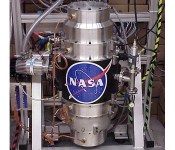
NASA is looking for an alternative to battery power for its spacecraft

NASA knows that conventional battery power won’t cut it at a certain point, especially when the agency’s vehicles travel into deep space. To that end, it’s asking both public institutions and companies to submit proposals for battery alternatives. The initiative will tackle both low-level energy cell design, such as chemistry and packaging, as well as advanced devices that could outperform existing lithium cells. Ideally, NASA will get energy storage that provides more power without taking a hit to either longevity or safety.
[Image credit: NASA]
It’s too soon to say when the organization will choose winners, but it will hand out cash awards to the four most promising candidates from the first phase of its selection process. There’s no guarantee that NASA will find the improved power source that it’s looking for. If successful, though, the effort could make deep space exploration a far less daunting prospect.
Filed under: Transportation, Science
Source: NASA

Joystiq weekly wrap-up: Fire-breathing lizards, big bad wolves and giant robots

Welcome to the first edition of the Joystiq Weekly Wrap-up, where we present some of the best stories and biggest news from our beloved sister-publication. After the break you’ll find, among other things, Pokémon, the Big Bad Wolf and the final word on Titanfall’s ongoing multiplayer examination. Our brothers and sisters in arms are on the ground in Boston this weekend for PAX East too, and you can find all of that coverage right here. Pour a frosty beverage and join us for the week’s gaming news, won’t you?
News
Arguably the biggest news this week came from Nintendo’s Super Smash Bros-themed Nintendo Direct broadcast. The franchise hits the 3DS this summer and the Wii U this fall with two online modes (For Fun and For Glory) and a unique spin on series-staple Adventure mode, Smash Run. Perhaps the biggest news, though, is the addition of all around bad-ass Charizard to the game’s roster.
One of the more intriguing games shown at Microsoft’s E3 press event last year was indie-puzzler Below. It’s being developed by Capybara Games (Super Brothers Swords and Sworcery EP) and news hit this week that if you don’t feel like shelling out $500 for an Xbox One — it was previously announced as a platform-exclusive — that the game is coming to Steam, too.

In Borderlands: The Pre-Sequel you’ll travel to the moon when it releases this fall for PS3, PC and Xbox 360. The last-gen title takes place between the first two games, and you’ll be fighting for antagonist Handsome Jack this time around.
If you’ve beaten Bastion countless times while waiting for developer Supergiant Games’ follow-up Transistor to hit, it’s almost time to let The Kid rest. The action-RPG releases on the PS4 and PC for $20 on May 20th.
Reviews
This week Joystiq reviewed Xbox One exclusive Kinect Sports Rivals and episode three of Telltale Games’ The Wolf Among Us. Critic Jessica Condit lamented Rivals is another instance of Kinect’s crippled functionality.
The Xbox One Kinect is more responsive than its predecessor, but it still doesn’t seem ready for this level of gameplay. My set-up meets the requirements – a clear, open floor and seven feet of playable space from Kinect to the front of my couch. Still, Kinect had trouble deciphering who was playing if anything moved in the background or just off to the sides, and it tracked motions inconsistently.
Joystiq‘s managing editor Susan Arendt was much more positive in her look at Biggby Wolf’s latest chapter. Although The Crooked Mile narratively occupies the middle of Telltale’s Fables yarn, that shouldn’t be held against it she says.
Taken by itself, it’s unsatisfying and half-missing, but of course it’s not meant to be taken by itself. It’s the centerpiece of a larger whole, the lock that will let everything eventually make sense.
Original stories
Road-trip season will be here before you know it, but with the price of gas still pretty high, getting out and exploring the open road can be an expensive proposition. If you’d still like to see some of the US though, Ubisoft’s The Crew will let you do just that, virtually. The constantly-connected racer lets you and three buddies drive from San Francisco to Salt Lake City and other cities (including Detroit), completing challenges and collecting cars. Joystiq‘s video preview gives an overview of the game’s look and feel.
As part of its ongoing look at crowdfunded game development, Joystiq notes that the month of March continued the space’s continued slump. What’s more, March was the second-worst month of pledges in the prior 10 (when Joystiq started the series).
PC gamers are a proud people: they tend to invest heavily in their rigs and expect the best possible experience from their games as a result. For them, playing a console game that’s been ported can be a crap shoot in terms of performance. With the brutally difficult Dark Souls 2, however, that isn’t the case. The PC version is prettier than its PS3 and Xbox 360 counterparts, and is the best version of the game that’s available.

In the wake of games like Battlefield 4 and its still-rocky performance, Joystiq has started an ongoing look at how a game’s multiplayer fares in the first month after launch. With Titanfall, the outlet says that despite a few brief outages, the experience remains solid, dubbing the game’s state of service “good.”
That’s it! Be sure to check back next Sunday for another recap, or if you’re impatient, click over to Joystiq and catch the news as it happens.
[Image credit: Miguel Angel Garrido / Flickr]
Filed under: Gaming, HD, Sony, Microsoft, Nintendo
Source: Joystiq

Photos of New Building at Apple’s European Headquarters Show Glass Exterior, Spacious Interior [Mac Blog]
Photos of Apple’s new “Building 4″ office building located at its European headquarters in Cork, Ireland have surfaced on the website of Bennett Construction. The images show off the location’s glass exterior and spacious interior that features multiple office floors, a cafeteria with kitchen, a conference room equipped with large monitors, and a lounge-type area.


Apple’s European headquarters opened in 1980 as the company’s first location outside of the United States. In April 2012, it was reported that Apple would be adding 500 new jobs at the location, bringing the total headcount at the site to 3,300. The campus was also in the news that same year after Greenpeace activists scaled one of the location’s buildings to protest Apple’s use of coal-derived power at its data centers, although the company has earned high marks from the environmental activist group since then for pursuing renewable energy.


Work of course continues on Apple’s large Campus 2 project back in the United States, as the company has begun the first phase of its construction after the demolition of Hewlett Packard’s former offices. That phase will involve a 2.8 million square foot ring-shaped main building with an underground parking facility capable of holding approximately 2,400 cars, and the assembly of a 100,000 square foot fitness center and 120,000 square foot auditorium. The project is expected to be completed in 2016.



NDS4iOS Nintendo DS Emulator Now Available to Download
NDS4iOS, a Nintendo DS emulator that runs on both non-jailbroken and jailbroken iOS devices, is now available to install through an over-the air download, reports TouchArcade.
Similar to the first version of the popular GBA4iOS Game Boy emulator, NDS4iOS requires a device’s date to be set back to a prior date, specifically February 8, 2014. The emulator allows users to play Nintendo DS ROMs directly on their iPads and iPhones, and is compatible with iOS devices running iOS 5.1.1 and above. NDS4iOS also includes features such as Dropbox integration and iOS 7 controller support, as well as a settings menu that contains options for control pad style and position.

Although several emulators such as the iMAME arcade emulator have snuck into the App Store via shell apps in the past, they are usually pulled by Apple within hours or days after being released. However, NDS4iOS is able to overcome Apple’s restrictions as it bypasses the App Store entirely. Instead, the emulator can be installed directly on an iOS device by visiting its official website and tapping a download link.
The initial release of NDS4iOS follows a major update to GBA4iOS in February, which added controller skins for Game Boy Advance and Game Boy Color games as well as iOS 7 controller support, Dropbox integration, and a in-app web browser that can be used to download games from any ROM website. The emulator also temporarily allowed non-jailbroken users to install GBA4iOS without a date change via an Apple Enterprise certificate, however that was revoked soon afterwards.
NDS4iOS is available to install now through the emulator’s official website.
 AIVAnet