



Best prices and availability for Samsung Galaxy S5

Today sees the arrival of the Samsung Galaxy S5, likely the smartphone that will outsell all others this year. You’ll be able to pick one of these up from just about any carrier you want, post-paid, prepaid, and more.
We’ve gathered up a list of various carriers, retailers, and sources for purchasing the Samsung Galaxy S5. We’ll do our best to return to this list with updates as needed. If you see some place that could be added, feel free to reach out to us via the contact page!
Note that prices may change without notification.
- Verizon
- Purchase from the wireless provider for $199.99 (BUY ONE GET ONE FREE)* (Equipment installment option available)
- Purchase from Radio Shack
- Purchase from Target for $199.99*
- Purchase from Sam’s Club for $164.88*
- Purchase from Walmart $168*
- Purchase from Samsung
- AT&T
- Purchase from the wireless provider for $199.99* (Equipment installment option available)
- Purchase from Amazon Wireless for $189.99*
- Purchase from Best Buy for $199.99*
- Purchase from Radio Shack
- Purchase from Target for $199.99*
- Purchase from Sam’s Club for $164.88*
- Purchase from Walmart for $168*
- Purchase from Samsung
- Sprint
- Purchase from the wireless provider for $199.99* (Equipment installment option available)
- Purchase from Amazon Wireless for $189.99*
- Purchase from Best Buy for $199.99*
- Purchase from Radio Shack for
- Purchase from Target for $199.99*
- Purchase from Sam’s Club for $164.88*
- Purchase from Samsung
- T-Mobile
- Purchase from the wireless provider for $660 (Equipment installment option available)
- Purchase from Samsung
- U.S. Cellular
- Purchase from the wireless provider for $199.99* (Equipment installment option available)
- Purchase from Walmart for $168*
- Purchase from Samsung
- MetroPCS
- Not yet available from the wireless provider
- Purchase from Best Buy for $649.99
- Boost Mobile
- Virgin Mobile
- Developer Edition (not yet available from Samsung)
*requires two-year service agreement on a qualified rate plan
The post Best prices and availability for Samsung Galaxy S5 appeared first on AndroidGuys.

Alleged iPhone 6 Cases Surface, Apparently Based on Recent Design Drawings
A photo reportedly showing cases designed for the larger iPhone 6 has been posted by Mobile Fun (via Nowhereelse.fr [Google Translate]. While exact sizes are not apparent from the photo and no comparison with existing iPhone cases sizes is shown, the cases are said to be for 4.7-inch and 5.7-inch iPhone 6 models, consistent with design drawings published by Japanese magazine MacFan late last month.
Most sources have been reporting that the larger iPhone 6 will carry a 5.5-inch display, although the MacFan drawings and a few other sources have continued to point to a 5.7-inch display.

It is not entirely clear whether these cases are based on the same design drawings or come from another source, but they do appear to be very consistent with the drawings. Like the drawings and our renderings based on them, the cases include a hole for a button on the left side of the top edge of the device. This has been presumed to be the power button for the iPhone 6, which would be a change from its current location on the right side of the top edge.
 Side (1) and top (2) button cutouts (Annotated by Nowhereelse.fr)
The cases also include a cutout along the right side of the case, a feature that is also shown in the design drawings. The purpose of the cutout is unknown, but it is possible that this could in fact be the power button given that analyst Ming-Chi Kuo claimed earlier this week that the power button would move to the side of the device. If this is indeed the case, then the function of the top button on the iPhone 6 drawings becomes unknown.

Apple’s Former Safari Chief Don Melton Reflects on Steve Jobs
 Don Melton has a long history with Steve Jobs and Apple, working at NeXT and then moving to Apple where he is known for his work on Safari and WebKit. To commemorate Steve Jobs’ birthday earlier this year, Melton recounted his memorable encounters with Jobs in a post he recently published on his blog.
Melton was not a confidant of Jobs, just an employee who had the opportunity to be around the Apple co-founder on occasion. Jobs likely thought of Melton as the “Safari Guy” and knew Melton’s real name, which was considered an honor.
Melton recounts the first time he met Steve Jobs at a NeXT presentation in the late 80s that unfortunately was scheduled during everyone’s lunch break. Like many encounters with Jobs, Melton remembered Jobs’ demeanor, but not a word of what he said.
Obviously he wanted us to quiet down. You could tell because he paused several times for us to hush ourselves. And out of respect, awe, and probably some fear, we all tried our best to do so. But, dammit, the room was now packed and that many people just swallowing food makes a lot of noise. Sitting so close, I felt especially self-conscious.
Who the hell scheduled him to speak at that time? Knucklehead. It’s entirely possible that person was taken out later and shot.
Anyway, I do remember Steve’s seriousness and apparent impatience that day. But not a thing he said.
Melton paints Jobs not as a “mercurial ogre or cartoon autocrat,” but as a very busy CEO with little time for “yes men,” timid employees or those who didn’t know what they were doing.
Steve expected excellence. Which is why he so often got it.
He knew when something was right, but he didn’t always tell you what he wanted when it wasn’t. And he was very clear when he didn’t like it. Some misinterpreted this behavior as being overly critical, but it was actually time-saving clarity, albeit uncomfortable on occasion.
Melton has several interesting tidbits about his work on Safari, including Jobs’ distaste for the stand-alone bookmarks window in the web browser and the decision to add a page load indication into Safari’s address bar, a design decision that eventually hurt Safari’s reputation because the “in-your-face progress bar made it seem slower to the user.”
Beyond his work persona, Melton also shares some stories about the personal side of Jobs, the real man who has children and, at one point, a cranky new puppy. Melton ends his story with his somber memories of Steve in his final years, dealing with a disease that “had ravaged him.” Melton’s piece is long, but worth a read for his insight into a corporate leader who was intense, but also real.

Apple Blocks Bloom.fm iAd Advertising Ahead of U.K. iTunes Radio Launch
London-based streaming-music service Bloom.fm says it has been blocked from advertising on Apple’s iAd network because it is a threat to the Cupertino company’s iTunes radio, reports CNET. Similar to iTunes Radio, Bloom.fm offers genre and artist-based streaming radio stations with a library of over 22 million tracks.
“We were surprised at Apple’s decision to ban us from their iAd network as their iTunes Radio service isn’t even available in the UK,” the spokesman told CNET. “Bloom.fm gives you 22 million tracks for £1 a month — the price of a single download on iTunes — so I can see why they’d want to protect their business.”
Apple may be blocking Bloom.fm as it prepares to launch its iTunes Radio service in the U.K. The service debuted in the U.S. alongside the release of iOS 7 last fall and was recently extended to Australia. It is expected to debut in the U.K. sometime in early 2014.

Over the past several months, some iPhone owners in the U.K. have reported intermittent connections to the iTunes Radio service, suggesting Apple is in the final stages of preparing the product for an imminent launch. Bringing iTunes Radio to countries worldwide is a top priority for Apple, says senior vice president of Internet software and services Eddy Cue, who confirmed the company plans to offer the service “in more than 100 countries.”

An oral history of the last 20 years of gaming, as told by PlayStation’s Shuhei Yoshida

The three weeks out of every month that Shuhei Yoshida’s in Japan, he has the same routine every day. He wakes up, opens a tablet, and gets back to work on PlayStation consumer feedback via his favorite interaction tool: Twitter. The man who heads Sony’s PlayStation group is incredibly, perhaps detrimentally, accessible on social media. It’s not his job, but a role he’s taken on. “It’s my personal time, but since lots of people tweet to me, I’m doing this almost official customer service,” he says.
After 20-plus years working on PlayStation, Yoshida’s beyond overqualified for customer service. He’s been with Sony’s PlayStation arm from its creation, and helped shepherd franchises from idea to mainstream norms: Gran Turismo, Crash Bandicoot, Uncharted. The list goes on.
Yoshida spoke with PlayStation 4 lead architect (and other game industry legend) Mark Cerny last evening in California, where he detailed his storied history in the game industry.
Before we get to that, though, it’s important to establish that Yoshida is an incredibly prolific gamer. He owns two of every game console. Why? So he can play Japanese and US games alike. He also says that he’s been banned from Nintendo’s MiiVerse social network. Twice. “The first time was because I had my Twitter account in my profile and that’s against the rules,” he says. “The second time is because I wrote, ‘I love PS.’ You’re not supposed to promote a commercial product in MiiVerse, so they correctly interpreted ‘PS’ as ‘PlayStation,’” he says with a laugh.

Life Before Sony
Prior to joining Sony, Yoshida flirted with studying physics and the work of Einstein, but his dad quickly shot that down, pushing him to a more practical major. So in college he studied economics and business — when he actually went, that is. He says that in Japan, business students don’t really attend class, and that the four or five students who would, took notes and shared them with everyone who wasn’t there. He spent six months working in Australia at the time, and when he got back to Japan he had all the answers to the tests waiting for him. “In my senior year in Japan, I didn’t go to any classes at all.”
Immediately after graduating, Yoshida joined Sony. In hindsight, his reasoning is a little selfish, though. Because his dad more or less forced him to switch majors, he wanted to get out of the country. “I wanted to run away from home as soon as possible because of that,” he says, half-joking. “When I say this, it might sound incredible… but I was thinking, ‘maybe Sony will make games in the future and when they do, I’m going to join that group.’”
Sony being an international company helped Yoshida make his decision, too. The firm sent him to study at UCLA for two years, and only then did he finally start learning about business principals like statistics and microeconomics. Since he was getting a paycheck, Yoshida had the resources to spend time traveling around the Western states and even Europe during summer break, when other students were typically working.
After graduating, he traveled back to Sony HQ in Japan where he spent nine months working with the PC group on a project that was ultimately cancelled. He bounced over to the corporate strategy group after that. It was here that he met then-Sony chairman Ken Kutaragi and work on the PlayStation began.
The formation of Sony Computer Entertainment
Sony Computer Entertainment, Yoshida says, started in Japan as a joint venture between Sony’s hardware division and its music wing. In the team’s early days, it approached signing and curating development teams much like it would a band — something that Parappa the Rapper mastermind (and J-pop singer) Masaya Matsuura loved. The scrappy PlayStation team had a lot to learn from the game industry, Yoshida admits, but it wanted to create something new at the same time.
“We believed that a game could become entertainment for everyone,” he says — not just kids. “The reason the company was named Sony Computer Entertainment instead of Sony Game Company or something like that is because we believed that games could be bigger than they were.”
Four years later, SCE had all of Japan’s major publishers signed on to make games for the platform. Yoshida explains that the big thing for the market was getting the Final Fantasy and Dragon Quest franchises on PlayStation, but after he’d achieved that goal he lost interest a bit. “What’s next? We got all the support from the industry, where do we go?” he asks. It was then that he moved from business development to a producer role on the product side.
The Birth of Crash Bandicoot
If it wasn’t for Nintendo, Crash Bandicoot might have been too difficult to play. Yoshida says that one of the benefits of being new on the scene was that Japanese publishers were keen to pass wisdom Sony’s way. The Mario-house “really helped others” by using test feedback generated from consumers play-testing in-development games. “As soon as I moved into game production, I was the heaviest user of the (testing) group,” he says.
Up to that point, Cerny says, his Crash Bandicoot team was making a game for seasoned gamers like themselves and it was too difficult for the average consumer or kid. “You (Yoshida) were not familiar with games, so you thought you had to do testing,” Cerny says. “We were familiar, so we thought we didn’t have to, ironically.”
Cerny taking his input seriously and using Yoshida’s testing more made Yoshida “so happy,” he says. One of his associate producers would count every player-death and send it to Cerny, who’d then realize where a checkpoint should be added. “We started to think about difficulty. Are our games something consumers play?” Cerny asks. “The idea was you had to find real consumers, study their real behaviors and report back in.”
Working with “The Father of PlayStation”

Yoshida spent 10 years working under Ken Kutaragi, and he admits that without him that PlayStation wouldn’t have happened. Humbly, Yoshida says that without Kutaragi, he wouldn’t have a job, either. “I have nothing but respect for what he has done for me,” he says. At dinner once, Kutaragi turned to him and said that he knew Yoshida didn’t necessarily like him, but he knew that Yoshida liked working for him because he could do exciting work as a result. “I said ‘yes, exactly.’“
Working with Kutaragi was incredibly difficult, Yoshida says, because he could do an immediate 180 in terms of what he wanted. On the engineering team, trying to predict where he might alter direction was “a very difficult job,” Yoshida says. “Every week his direction and instructions could change.”
Also tough was that he struggled to give compliments to coworkers. “I was complimented by Ken twice!” says Yoshida. “When I say this to my colleagues, they say ‘twice? That’s a lot!” Those flow much more freely from Yoshida. “For me, giving a complement is free, it’s like a smile from McDonald’s,” he says. “But still, we all love Ken.”
Working with Kutaragi was incredibly difficult, Yoshida says, because he could do an immediate 180 in terms of what he wanted.
After Kutaragi’s sudden departure in 2006, Yoshida felt threatened by internal conversations at Sony that questioned the need for its worldwide studio team’s existence. After consulting then-chairman Akira Sato, he pitched Kutaragi’s successor Kaz Hirai on leading Sony Worldwide Studios. A few years later, work began on the PS Vita and PS4 — with direct involvement from Yoshida’s army of developers.
Enough digital ink’s been spilled about the partnership between developers and the new PlayStation hardware team, though. What’s notable in this story is that Worldwide Studios went from teetering on the brink of extinction to becoming the backbone of Sony Computer Entertainment in a few short years.
Sean Buckley and Ben Gilbert contributed to this post; Image Credit: AP Photo/Kevork Djansezian.
Filed under: Gaming, Home Entertainment, Software, HD, Sony

Xbox One Titanfall bundle now costs £349, the same as a PS4 in the UK

Next-gen console price wars have officially hit the UK, and they’re getting serious. Going one better than their US counterparts, British retailers have slashed the cost of the Xbox One Titanfall edition by £50, with both Amazon and Asda currently offering the bundle for £349. For those keeping track, that means you’ll get an Xbox One and its most popular game for the same price as a standard PlayStation 4. Microsoft originally charged £429 at launch, but dropped its recommended retail price to £399 around three months later. The PS4 may still have an slight lead over its rival in terms of sales, but with recent price reductions and the appearance of weaponised mechs, Microsoft will hope it can begin to reverse that trend.
Filed under: Gaming, Microsoft
Via: Joystiq

Sony’s Shuhei Yoshida loves that Facebook bought Oculus, says it helps validate PlayStation’s efforts

“I woke up that morning and saw the announcement,” Shuhei Yoshida tells us, remembering the day Facebook acquired Oculus VR. “And I was like, yeah!” Yoshida laughs and thrusts his arms in the air like an excited child. “For me, it was a validation for VR.” As head of Sony Computer Entertainment’s Worldwide Studios, virtual reality (and Sony’s Project Morpheus) has become important to Yoshida. He wants to see it, as a medium, to succeed.
“We meant to validate Oculus by announcing Morpheus, and the Oculus guys knew what we were working on. I think they were waiting for us to make the announcement, so it would be Sony and Oculus together,” he explains backstage at the Computer History Museum in Mountain View, CA. “…but now Oculus being acquired by Facebook is helping to validate our efforts.” It’s big-picture thinking. Yoshida already liked the idea of Sony and Oculus calling attention to each other’s efforts, but adding the Facebook name to the mix broadens the duo’s exposure. “More people will know about VR!”
Oculus being acquired by Facebook is helping to validate our efforts.
Zuckerberg’s vision for the purchase intrigues him too. “Mark said be believes VR can be the next platform after mobile,” Yoshida said. “That’s big thinking, and kind of excites our thinking.” Sony’s team has already been exploring uses for VR outside of traditional gaming, he explains, but nothing as broad as Zuckerberg’s statements. “We’ve thought of doing virtual travel or something, but talking about a new platform? What does that mean?” Yoshida says it’s given him something to think about.

Of course, a broader platform for VR means the technology will see more use — and that technology still has several usability hurdles to conquer. “VR of the past, including our own prototype, has been very difficult to use in terms of getting headaches and becoming nauseated,” he said. “Those early prototypes had larger latency and the positional tracking may not have worked as well. I feel really sorry for people developing VR stuff! They have to test it! With the kit we have now, what we demonstrated at GDC, I think its the first time we can really provide developers with something and say, you can use ours, and you’ll be alright.”
Sony’s been talking to medical professionals about overcoming simulation sickness, Yoshida explains, and wants hardware to be comfortable and usable without adjustment. “The Oculus DK1 has lots of adjustments available, but the Morpheus just works, the optics design. We’ll continue to improve it.” Eventually, the company wants to create guidelines for how old users should be, and how long they should use it for, but it’s not quite there yet. Even Yoshida admits he hasn’t spent extended periods of time in virtual reality, usually keeping his sessions at under ten minutes.
The Oculus DK1 has lots of adjustments available, but the Morpheus just works
Yoshida’s plan for building those guidelines relies heavily on collaboration. “We need to share knowledge,” he explained. “We can’t just make the hardware, it’s the game applications that need to be designed well. We need time for developers to experiment and find the killer application, and at the same time we need to learn how VR applications should be designed.” Providing the Morpheus dev kit to developers, Yoshida says, is the first step.

How to Shop For Real Estate Using Your Mobile Phone

<!–
A:link {
–>Use technology to make real estate shopping easier.
The latest trend in real estate shopping is mobile apps for smartphones. With 58 percent of adult Americans owning a smartphone, the latest trend in the real estate market has gone mobile. In fact, the online marketing firm The Search Agency says that in just one quarter, there was a 10.7 percent increase in the clicks on real estate advertisements through smartphones. The following apps are essential for every prospective house hunter.
Zillow
Zillow has been the go-to website for many home buyers, and now they’re taking their real estate knowledge and putting it in a free app. Buyers can search for homes before they even go on the market, compare prices of recently sold homes, see the estimated worth of any home, and search for homes for sale with this app.
HomeSnap
If you’re out and you drive by a home for sale, you no longer have to wait for an agent to show you around. HomeSnap is a free app that lets you upload a photo of any home on the market, and immediately see pictures of the inside, the list price, and the sale history of the home. If you’re really interested in the home, this app will even let you schedule a showing with an agent.
Mortgage Calculator
Before you fall in love with a house, it helps to know if you can afford it. Once you put in the cost of the house, the down payment, the interest rate, and the length of the loan, the Mortgage Calculator quickly figures what your monthly payments will be. You can even calculate per square foot to make sure you’re getting the best house for your money.
Dictionary of Real Estate Terms
Every industry has its own jargon, and if you’re new to real estate, you might feel overwhelmed by what you don’t know or don’t understand. This $3.99 app has over 3,000 terms and definitions specific to the real estate industry. The app is fully searchable, and has a history feature if you need to look up the same word more than once.
AroundMe
When you’re looking for one of the best places to live, it’s important to know what kinds of amenities are available. This free app uses GPS to give you an idea of the businesses in the surrounding neighborhoods. As you’re scouting out potential neighborhoods, use this app to find the closest bank, hospital, pizza joint, pharmacy, supermarket, and post office.
Sherwin Williams Color Snap
Once you find that perfect home, you might need to make some changes to the wall colors to truly make it yours. The free Color Snap app by Sherwin Williams allows you to take a picture of any color around you, and then browse the Sherwin Williams paints that closely match that color. Whether it’s from a picture in a magazine, or a flower on the street, you can find your favorite colors quickly and easily.
Buyers are increasingly comfortable using their smartphones while looking for a new home. Being in the market for a new home may feel like a daunting task, but with these latest apps, the process just got a little easier.

Magic 2015 – Duels of the Planeswalkers announced and this time you’ll be hunting bigger Game
 For the last few years, a Magic the Gathering game has been gracing the screens of gaming platforms everywhere, delighting card game enthusiasts everywhere and last year, Magic 2014, was finally released on Android (read the review of last year’s game here). This year, the Duels of the Planeswalkers series will be continued with Magic 2015 – Duels of the Planeswalkers which will be released sometime in summer this year on Xbox One, Xbox 360, iPad, PC Steam, Kindle and of course, Android. Check out the teaser trailer below:
Very ominous indeed. Magic 2015 is set around the events when “the deadliest hunter in the Magic Multiverse”, Garruk Wildspeaker comes after after you. Like the previous games, and by extension, Magic the Gathering itself, Magic 2015 will focus on deck building with new and improved features to help build your ultimate deck with a new deck builder, booster packs and what will likely be additional downloadable content. If last year’s game is anything to go by, the new game should be extremely streamlined and extremely engaging for veterans and newcomers alike to the Magic the Gathering universe.
 Are you excited to play Magic 2015 – Duels of the Planeswalkers? Let us know your fondest Magic the Gathering memory in the comments below.
Press Release
MAGIC: THE GATHERING GETS BIGGER AND BOLDER WITH MAGIC 2015
APRIL 10, 2014 – RENTON, WA – The time has come for gamers to Hunt Bigger Game. Wizards of the Coast today announced Magic 2015—Duels of the Planeswalkers, the latest installment for the popular Duels of the Planeswalkers franchise and the first version to release on the new next-generation gaming console, Xbox One. Starting this summer, Magic 2015 will put players at the center of the action as the deadliest hunter in the Magic Multiverse, Garruk Wildspeaker, shifts his hunter’s instinct away from beasts of the wild to the ultimate quarry—you!
Magic 2015—Duels of the Planeswalkers will take the game to a whole new level, deeply engaging fans like never before. With new features including the ability to build customized decks, new booster packs with premium downloadable content, and an even more robust deck builder, players will take on their fiercest opponents culminating in the ultimate battle against Garruk. Magic 2015 will offer gamers the perfect way to start playing the world’s best strategy trading card game priming them for even more action with the upcoming Magic 2015 Core Set. In addition to Xbox One, Magic 2015 will be also be available on Xbox Live Arcade, iPad via the App Store, PC via Steam, Android via Google Play, and Kindle via Amazon Marketplace.*
Fans attending PAX East in Boston this weekend will have the chance to be the first to demo Magic 2015—Duels of the Planeswalkers in the Magic: The Gathering booth, #462. Additionally, visitors to the show will have the opportunity to earn an exclusive Garruk Wildspeaker Pinny Arcade pin** by demoing the new game or participating in other in-booth activities.
Please visit MagicTheGathering.com for the latest news and updates and follow Magic on Facebook and Twitter.
//<![CDATA[
ord = window.ord || Math.floor(Math.random()*1E16);
document.write('’);
//]]>
Google gets proactive in Android app scanning

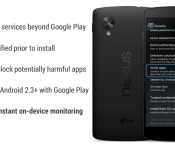
Google has pushed one step closer to cracking down on the number of malicious applications that make it onto our handsets by implementing the Verify Apps service.
Google offers a built-in service layer that offers protection to your device and Google are now building on this with Verify Apps.
Whilst Verify Apps already protects again malicious code when people are installing apps, Google are rolling out an enhancement which means they will continually check devices to make sure the apps are behaving in a safe manner, even after installation.
Google expects users will never see the warning banner which Verify Apps would flag as a malicious app, and in fact they say fewer than 0.18% of installs last year occurred after someone received the warning banner.
Proactive scanning for malicious apps on Android is definitely a welcome addition to build on the security of Google’s operating system.
The post Google gets proactive in Android app scanning appeared first on AndroidGuys.
 AIVAnet