


Apple’s 2014 Product Roadmap: New iWatch, iPhones, iPads, Apple TV, and MacBooks Coming
Apple is set to release a slew of new products during the third quarter of 2014 according to KGI securities analyst Ming Chi Kuo, who often provides reliable information on Apple’s product lineup.
In a 2014 product roadmap, Kuo suggests Apple will introduce its first new product of the year, a lower-cost iMac, during the second quarter. Soon after, during the third quarter, Kuo predicts Apple will introduce an upgraded iPad Air and iPad mini, followed by an iWatch in two separate sizes, and a 4.7-inch iPhone.
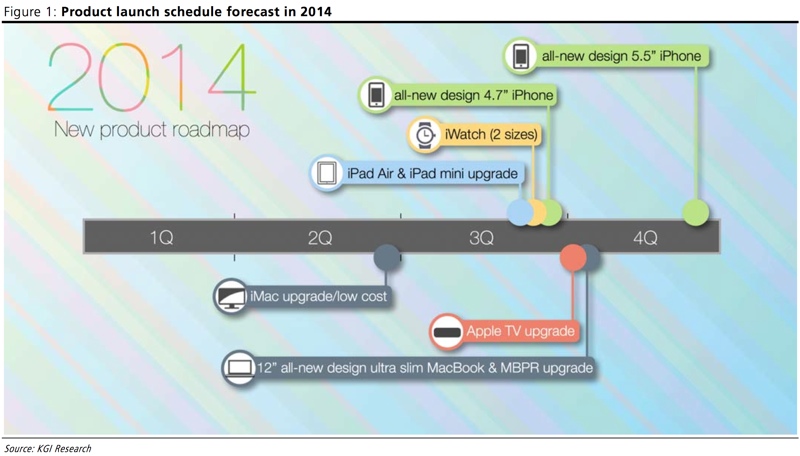
An upgraded Apple TV set-top box will come somewhat later, as will the rumored 12-inch ultra slim MacBook and upgraded Retina MacBook Pros. Later, in the fourth quarter, Apple will introduce the 5.5-inch iPhone, which is said to be delayed due to issues with in-cell display technology. Along with his roadmap, Kuo also gives specific information on each of Apple’s upcoming products.
– iWatch: Kuo believes the iWatch will ship during the end of the third quarter, offering biometric functionality, integration with the iPhone, iPad, and Mac, and a “fashionable appearance.” As has been previously suggested, he predicts the device will come in two sizes, with a 1.3-inch and 1.5-inch flexible AMOLED display. It will also include a sapphire cover lens, biometric recognition, an NFC chip, wireless charging, a 200 to 250 mAh battery, and a slim and light design. Kuo also believes that Apple will offer the iWatch at multiple price points, with the most expensive version costing upwards of $1,000.
– iPhone 6: Supporting previous iPhone 6 rumors, Kuo believes the device will come in two sizes: 4.7 and 5.5-inches, with resolutions of 1334×750 (326ppi) and 1920 x 1080 (401 ppi), respectively. Both models will come with an A8 processor, 1GB of RAM, LTPS display panels, optical image stabilization, and Touch ID. Kuo points to a 10 to 20 percent narrower bezel, a 6.5–7.0mm thickness, metal casings, and NFC integration. Mass shipments of the 4.7-inch version are expected in September, with the 5.5-inch version shipping later. Kuo suggests that only the 64GB 5.5-inch version will use sapphire displays.
– iPad Air 2: The second-generation iPad Air is expected to adopt Touch ID, an A8 processor, and an improved camera with a resolution of eight megapixels. Kuo believes the second iPad Air could come earlier in the year than the previous iPad Air, which was released in October.
– iPad mini with Retina Display: Like the iPad Air, a new Retina mini could gain an A8 processor and Touch ID, but Kuo believes it will retain the same form factor. He also suggests that the older iPad mini with Retina display could be sold at a lower cost.
– 12.9-inch iPad Pro: Kuo believes that Apple is indeed working on a 12.9-inch iPad, but he does not expect it to be launched in 2014.
– 12-inch MacBook Air: As rumored, Apple is believed to be preparing an ultrathin MacBook Air that incorporates a touchpad without buttons and functions without a fan. It is also expected to include a higher-resolution display.
– iMac: A lower-priced iMac is believed to be on the horizon, which Kuo says could help boost iMac shipments by up to 23 percent. It could be Apple’s first product launch of the year.
– Apple TV: Apple is not expected to launch a full television set this year, but an upgraded set top box with an App Store and motion control technology is expected.
While Kuo’s predictions do include many rumors that have previously surfaced over the past several months from a variety of sources, his roadmap gives a solid overview of what we might expect from Apple in 2014.
12″ Retina MacBook Air and Low-Price iMac Likely in 2014
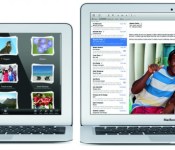
In an extensive research note covering Apple’s product roadmap for 2014, KGI Securities Ming Chi Kuo reiterated expectations that Apple is working on a ultra slim 12″ MacBook Air but also revealed a new low-cost iMac in the works.

Kuo’s predictions for the 12″ MacBook Air match what was leaked in March from a reliable Chinese forum source. The new 12″ MacBook Air will “redefine notebook user experience”:
– Thinner than current models
– No fan
– Buttonless trackpad
– Higher resolution Display
Kuo first predicted this ultra thin 12″ MacBook Air late last year.
We expect the unprecedented 12” model will boast both the portability of the 11” model, and productivity of the 13” model. The high resolution display will also offer the outstanding visual experience of the Retina MacBook Pro. The offering will likely be lighter and slimmer than the existing MacBook Air to further highlight ease of portability in the cloud computing era. We think the form factor will showcase a much improved clamshell structure, and that it will redefine laptop computing once again following the milestone created by the MacBook Air.
Besides the 12″ MacBook Air, Kuo reveals that a “low-priced” version of the iMac is coming. The new model will help compete with companies such as HP and Lenovo as well as grow market share in Asia.
The 12″ MacBook Air is not expected until late 2014, while the low-cost iMac may come mid-year.
iPhone 6 Could See Sleep/Wake Button Move, 401 ppi in 5.5″ Model, Sapphire Display in High-End Phones
In an extensive research note, the well-sourced KGI Securities analyst Ming Chi-Kuo has shared additional details about his expectations for the next iPhone model, expected to be called the iPhone 6. Perhaps the biggest change that Kuo mentions is a move of the sleep/wake button from the top of the iPhone to the side, to better facilitate one-handed operation on larger iPhones.
In line with previous rumors, Kuo believes the new 4.7-inch model will come with a 1334×750 Retina display at 326 pixels per inch, while the 5.5″ will see a 1920×1080 screen at 401 ppi. Both devices will have the same aspect ratio to the iPhone 5, meaning apps will not need to be redesigned for the second time in three years.
The iPhone 6 will include a new A8 processor, 1GB of RAM, Touch ID, a narrower bezel by 10 to 20 percent, and the phone to be thinned to 6.5-7.0mm (the current iPhone 5 is 7.6mm thick). He also expects Apple to finally include NFC chips in its smart phones.
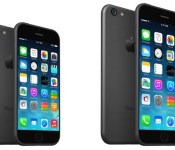
 Renderings of iPhone 6 (4.7″) and iPhone 6 (5.7″) based on leaked schematics
For the 4.7″, Kuo says the narrower bezel will still allow one-handed operation along with a better visual experience because of the bigger screen. He believes shipments could approach 60 million units by the end of the year.
The 5.5″ phone won’t be operable with one hand, but Kuo says some smartphone users prioritize the visual experience over one-handed use. He believes the more profitable phone it could cannibalize sales of the iPad mini, as well as smaller tablets and phablets form competitors. He expects the 5.5″ iPhone 6 to debut later in the holiday quarter, with shipments just below 9 million units for the year. The 5.5″ iPhone will also see a significantly larger battery — 50% to 70% more watt-hours than the iPhone 5s — to power the larger screen, and also because there will be more real estate inside the case. It’s unclear if the larger screen will utilize all the extra battery or if device life will improve.
Kuo says only high-end iPhones — like the 64GB 5.5″ iPhone 6 — may include a sapphire screen cover due to supply constraints, though he says the company will want to begin integrating Touch ID sensing into the screen in the future and will need sapphire glass for accuracy.
He expects the iPhone’s rear camera to remain at 8 megapixels and f2.2 aperture, but it will see an adoption of optical image stabilization technologies to improve image quality without increasing pixel number, a frequent goal of Apple’s in the past. Finally, Kuo expects production of the iPhone 4s and 4 to be ended, with the iPhone 5s and 5c filling as the more inexpensive options in Apple’s smartphone lineup.
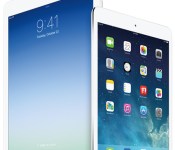
iPad Air and Retina iPad Mini to Get Touch ID This Year
Apple may be preparing to feature its Touch ID fingerprint sensor on updated models of the iPad Air and Retina iPad mini that will be released later this year, KGI Securities analyst Ming-Chi Kuo states in a new research note.

We think the upgraded iPad Air will be launched earlier in 2014 than the iPad Air was in 2013. The biggest changes will be A8 processor, Touch ID (fingerprint recognition), and main camera resolution of 8MP.
…We previously thought Apple would not release a new version of the iPad mini this year, but we now think Apple will launch an upgraded version with same form factor, A8 processor and Touch ID (fingerprint recognition) to boost shipments of iPad mini with Retina display.
Regarding the next-generation iPad Air, Kuo adds that the tablet will launch at an earlier point than the original iPad Air did in November of last year. Kuo also notes that Apple is likely to cut the price of the existing Retina iPad mini, and that the newer model will feature the same form factor with an upgraded processor and Touch ID fingerprint sensor.
The researcher also once again speaks on the possibility of the long-rumored 12.9-inch iPad, stating that Apple is actively working on the device and gearing it towards uses in entertainment and productivity. However, Kuo notes that the product is unlikely to come out in 2014, falling in line with what he stated in his previous reports from this past February and last October.
iWatch to Come in Two Sizes With ‘Fashionable Appearance’, Top End to Cost ‘Several Thousand’ Dollars
In a 2014 product roadmap that outlines all of Apple’s plans for the year, KGI Securities analyst Ming Chi Kuo revealed his predictions for Apple’s much-rumored iWatch, which may ship as soon as the third quarter of 2014.
According to Kuo, the iWatch will come in two separate sizes to accommodate different sized wrists: 1.3 inches and 1.5 inches. Multiple sizes for the device were first predicted in late 2013, though the original rumor pointed towards displays of 1.3 and 1.7 inches. Both watches will include flexible AMOLED displays with sapphire covers to protect the device from scratches.
Along with a multitude of biometric sensors, coupled in a system-in-a-package design, Kuo predicts the iWatch will include integration with the iPhone, iPad, and Mac, along with a “fashionable appearance,” an NFC chip, and a slim and light design.
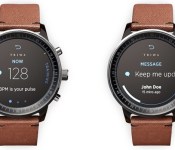
 Traditional watch-style iWatch concept by Gábor Balogh
We are confident on Apple’s ability to make wearable devices with good fashion sense, which sets Apple apart from rivals.
Kuo believes many of the iWatch’s mechanical parts may be constructed using liquid metal and that it may include an “innovative” antenna design that allows for wireless charging functionality.
Battery life has been a major challenge for Apple when it comes to iWatch development and Kuo forecasts a 200 to 250mAh battery for the device that will provide at least a one day of operating power. Earlier reports have suggested the company is aiming for three to four days of battery life, however, and Kuo does note that the battery will be longer than “most wearable devices” due to the company’s “vertically integrated operating system and key components.”
Kuo suggests Apple will release the iWatch at multiple price points and in a variety of materials, competing with low and high-end watches alike. At the high end, Kuo suggests Apple’s iWatch could sell for thousands of dollars.
Fashion is the name of the game; most expensive model likely priced at several thousand US dollars. Referring to the rules of the fashion market, we predict the iWatch casing and band will come in various materials. The most expensive model of the iWatch line will carry a price tag of several thousand US dollars.
Apple’s iWatch is not expected until the end of the year, but Kuo believes it will be the most important product of 2014, outshining even the iPhone 6. He is estimating shipments of 5.5 million units in 2014, which will rise to 30 to 50 million units in 2015.

Here’s look at the future of Google Calendar for Android

See those images above? Those could become a familiar sight in the future if you religiously use Google’s Calendar app for Android. This crisper, cleaner Google Calendar was recently spotted by Geek.com (which also spilled the deets on a test version of Gmail) on a phone loaded with unreleased features. If you notice, the new interface gets rid of the app’s busy grids and lines, relying instead on blocks of color to distinguish one entry from the other.
What’s more intriguing, however, is a new feature called daily agenda, which automatically emails you the day’s full schedule. Since the updated calendar will also come with Google+ integration, or so the source claims, daily agenda emails will also include birthdays, giving you no excuse to forget anybody’s special day. Other than these changes, you’ll also reportedly see a parallax scrolling effect while flipping through months. Of course, the final product could be wildly different from what we’re seeing here. We might have to wait a few more months to find out, though — Geek.com believes Google will launch the redesigned calendar at the I/O conference in June.

Filed under: Cellphones, Tablets, Mobile, Google
Source: Geek
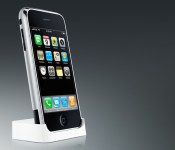
One of the iPhone’s original interface designers is leaving Apple

Greg Christie may have played a key role in developing the first iPhone, but he won’t be hanging around Apple for much longer. The company has partly confirmed a 9to5 Mac report that the high-profile interface designer is leaving the company later this year after nearly two decades of working at 1 Infinite Loop. Just why he’s hanging up his badge isn’t certain. The 9to5 story contends that Christie and senior design VP Jony Ive had a “falling out” over iOS 7′s design direction, prompting Christie to head for the exit. An Apple spokesperson, however, says that the executive has been “planning to retire” and notes that he “worked closely with Jony for many years.” If there are any sour grapes involved, it’s not apparent from Cupertino’s official position.
Regardless of who’s right, the departure may have a big impact on Apple’s future design strategy. As the VP in charge of the Human Interface team, he has significant sway over the look and feel of both iOS and OS X. His retirement may be a significant loss similar to that of Scott Forstall in 2012. However, it’s not necessarily a turn for the worse. If Jony Ive will soon have greater control over interface design, as 9to5 claims, Apple’s hardware and software teams may work together more often — a potentially important move when the company has already said that it’s expanding into new product categories.
Filed under: Cellphones, Desktops, Laptops, Software, Mobile, Apple
Source: Financial Times, 9to5 Mac

Apple Confirms Retirement of Senior Designer Greg Christie Later This Year
 Apple has confirmed the departure of Greg Christie, part of the original team behind the iPhone. His leaving the company was previously reported by 9to5Mac and was said to follow a falling out between Christie and Jony Ive, Apple’s design chief.
The WSJ reports that Christie’s “human interface” team will now report to Jonathan Ive, rather than the company’s software head Craig Federighi.
In a statement given to the Financial Times, Apple says that Christie has been planning to retire later this year and is still within the company.
Greg has been planning to retire later this year after nearly 20 years at Apple. He has made vital contributions to Apple products across the board, and built a world-class Human Interface team which has worked closely with Jony for many years.
Christie has worked with Apple since 1996 and was credited with the development of the “Slide to Unlock” feature of iPhones and iPads, though he is named as an inventor on hundreds of other patents.
New York Times reporter Brian X. Chen tweeted that Christie’s retirement was announced within the company “weeks ago”.
Was just told Apple VP Greg Christie's retirement was announced weeks ago. I don't know anything about Ive politics.
— Brian X. Chen (@bxchen) April 9, 2014
Apple’s statement doesn’t directly address the rumor that Greg Christie and Jony Ive had clashed over design direction, nor does the company specify his current role.

Apple Seeds OS X Mavericks 10.9.3 Build 13D38 to Developers [Mac Blog]
 Apple today seeded build 13D38 of OS X 10.9.3 to developers, just under a week after releasing the fifth OS X beta, build 13D33, and a little over a month after the first 10.9.3 beta.
The beta is available through the Software Update mechanism in the Mac App Store as well as through the Mac Dev Center.
Apple continues to ask developers to focus on Graphics Drivers, Audio, Mail, Contacts and Calendar sync over USB in iTunes, and Safari. As was discovered with the first beta, 10.9.3 adds new support for 4K displays, offering “Retina” resolutions that improve readability along with support for 60Hz output from the Retina MacBook Pro.
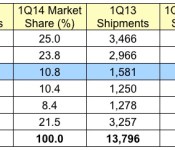
U.S. Mac Sales Fall in Winter Quarter, Global PC Market Sees Continued Sales Falloff [Mac Blog]
Apple saw a year-over-year drop of 3.8% in U.S. market share according to a report released today by Gartner, with Dell and Lenovo capturing significant growth at the expense of the rest of the market. The U.S. PC market saw a small increase in total units shipped, while internationally the PC market contracted by 1.7 percent.
In the U.S. market, PC shipments totaled 14.1 million units in the first quarter of 2014, a 2.1 percent increase from the same period last year (see Table 2). HP maintained the No. 1 position, as it accounted for 25 percent of PC shipments in the U.S. market. Dell and Lenovo experienced the strongest growth among the top five vendors, with growth rates of 13.2 and 16.8 percent.
“In terms of the major structural shift of the PC market, the U.S. market is ahead of other regions,” Ms. Kitagawa said. “The installed base of PCs started declining in 2013, while the worldwide installed base still grew. The U.S. PC market has been highly saturated with devices: 99 percent of households own at least one or more desktops or laptops, and more than half of them own both. While tablet penetration is expected to reach 50 percent in 2014, some consumer spending could return to PCs.”

The overall international PC market fared worse than the U.S., a reversal of last quarter as tablets continue to eat into PC sales. Internationally, Lenovo, Dell, Asus and HP all saw solid market share growth at the expense of Acer and the rest of the market. Gartner considers PCs to include desktop and notebooks, including x86 tablets equipped with Windows 8, but excluding Chromebooks and other tablets like the iPad.

The data is preliminary, meaning Gartner can revise its numbers based on market conditions. Last year the firm revised its preliminary Apple numbers by more than two share points because the newly introduced iMac was in extremely short supply.
Separately, IDC reported similar overall trends, with Apple seeing its U.S. PC market share dropping to 10.3%, down from 11% last year. Globally, the firm saw the PC market shrink by 4.4 percent.
Apple has not updated any of its Mac products since early last fall.
 AIVAnet