



Facebook is trying to save you from embarrassing posts

One of the first things I do before I post anything on Facebook is to make sure I know exactly who will see it. If it’s a vacation photo of me and my husband, I restrict it to friends and family. If it’s just a link to something funny on the internet, I might post it for all the world to see. It’s fairly obvious, to me at least, what’s meant to be public and what’s not. However, that’s because I took the time and energy to navigate through Facebook’s privacy settings and learn how to protect my updates. Not everyone has the foresight or the luxury to do that — especially if you joined in college, when such issues might not have mattered so much. It turns out Facebook is all too aware of this problem, and is trying to hammer out some possible solutions.
At a session with reporters on Tuesday, Facebook revealed that based on thousands of surveys per day, a significant number of its users are surprised when their posts are seen by people they don’t know. This, the company realizes, is a problem. “When people have an unpleasant surprise like this,” said Mike Nowak, Facebook’s privacy product manager, “It’s bad for them, and it’s bad for us.” When asked even further about what it is about the current system that confuses its users, a spokesperson attributes it to potential cultural differences, and simply the need for more education.

Therefore, rather than introducing even further privacy controls, Facebook has decided that the right approach is to give its existing ones more visibility. In a recent update to Facebook’s mobile app, the “audience selector” (a drop-down menu that shows who can see your updates) was moved from the lower right corner to the very top so that it’s the first thing people see. Further down the road, the company hopes to roll out a test to its desktop users that will spell out exactly what “Public” and “Friends” mean (see above for a preview). Even more than just increased visibility, Facebook also wants its users to be more aware of who can see their posts. In the near future, the company hopes to roll out a “Privacy Checkup” box to simply make sure people are sharing updates with their intended audience. The same goes when a friend reshares a post — there’ll be a notification letting you know it’ll be seen by his or her friends as well.

While these tweaks may seem rather straightforward at first glance, it’s in Facebook’s best interest to make sure its privacy controls are crystal clear. After all, Facebook’s issues with privacy have been well-documented. From accidental breaches to targeted advertising, the public has every reason to be fearful and skeptical of a company maligned by complicated privacy settings and a post setting that’s public by default. It’s all made even more crucial by the fact that Facebook encourages you to use your real name and that your profile photo along with your cover photo are always public. The reason is “to disambiguate you from other people in the world,” said Raylene Yung, a Facebook privacy engineering manager. Publicly available information such as your name allows your friends to find you, she says, and it’s arguably one of the core functions of Facebook. That said, the company does plan to let you restrict older cover photos to a limited audience in the next few weeks.
“Our goals haven’t changed,” said Yung. “We want people to be aware and be comfortable with sharing with the right people all the time.”

AT&T expanding coverage to 40 more NYC subway stations

It’s a crapshoot: if you’re descending into one of New York City’s underground subway stations, you’re probably going to drop a call. It’s frustrating, but it’ll be a little less likely soon. AT&T has expanded its contract with Transit Wireless to bring voice and data services to “as many as 242″ additional NYC subway stations, though only about 40 are going to be ready this summer. Don’t get too excited about the proposed total, either — Transit Wireless is only in phase two of a seven phase rollout, and won’t reach it’s promised potential for several years. Still, the current deal will put AT&T in several key locations, including 11 stations in mid-town Manhattan and 29 in Queens. This will equip about 70 stations total with AT&T connectivity by the end of the summer. There’s still a long way to go before the entire city is covered, but it’s a good start.
Filed under: Cellphones, Transportation, Mobile
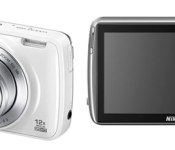
Nikon’s Coolpix S810c is a second attempt at an Android compact camera

Liked the idea of Android apps with a proper camera attached? Still itching for a Nikon camera over a Samsung one? Then perhaps the new S810c will win you over where its predecessor didn’t. To start, the rear touchscreen is bigger (3.7 inches this time) while the body of the camera is thinner than the S800c that came before it. There’s also a longer 12X zoom with a 16-megapixel sensor, while on the non-imaging side, it gets GPS and a headphone jack if you’re looking to check audio quality on video or simply play things back and use the point-and-shoot more like a media player than a camera. Compared to the model that appeared two years ago, this one’s running Android 4.2.2. Not the latest, sure, but way beyond the Android Gingerbread OS we wrestled with on the older camera. Nikon has also tacked on its own commenting system to, meaning you can type your thoughts and attach ‘em as soon as the photo’s taken. If your missives simply can’t wait for uploading to Facebook and Twitter, you’ll have to wait until early May, when the camera arrives for $350.
Source: Nikon

Unreal Engine 4 crammed into Amazon’s Fire TV – it’s possible

Let’s say you’ve paid your $19 want to see what kind of crazy shit Unreal Engine 4 is capable of. Let’s also say you have a shiny new Amazon Fire TV sitting in the living room. With some patience and a little coding, you can totally run Epic’s new software toolset on Bezos’ $99 set-top box. Over on Gamasutra, a dev has listed step-by-step instructions for getting the engine up and running and, from the looks of it, it didn’t him take a lot of extra work. This is likely due to Fire TV’s Android-based architecture and the fact that Unreal 4 was basically designed to run on every platform under the sun. As the dev tells it, you can even plug in an Xbox 360 or PS4 controller to explore the demo area. Regardless of if we ever see Unreal-powered games on the streaming box or not, this proves that its gaming capabilities aren’t as limited as one might think.
Filed under: Gaming, Home Entertainment, HD, Amazon
Source: Gamasutra

How to avoid heartburn, err, Heartbleed

Don’t change your password. It’s strange advice to hear when the so-called Heartbleed bug is leaving databases all over the web open and exposed, but it’s applicable. Yes, security has been compromised for many of your favorite websites and services (including Google, Flickr and Steam, at least initially) but protecting yourself isn’t quite as easy as changing your password. Unlike past exploits, Heartbleed isn’t a database leak or a list of plaintext logins; it’s a flaw in one of the web’s most prevalent security protocols — and until its fixed, updating your login information won’t do a darn thing to protect you. What, then, can you do to protect yourself? Wait, watch and verify.
Updating your password is a must, but only after your favorite services have patched their servers to block the Heartbleed exploit. Fortunately that’s relatively easy — the open-source SSL encryption software the bug affects has already been updated with a new, secure version. Vulnerable sites need only to upgrade to the latest version of Open-SSL to protect their users. Although some companies will notify users that their services have been patched (like Google did), not all of them have or will. That means you need to be aware of which websites were vulnerable to the bug and routinely check them to see if they’re back on track. Don’t worry, that’s not too difficult either. Sites like GitHub and Mashable have already compiled lists of popular websites, services and social networks, noting if they were affected at the time of Heartbleed’s discovery, and in some cases, if they’ve been patched. You can check manually, too: concerned coders and even some companies have made tools available to help you suss out sites that are open to attack. Coder Filippo Valsorda has created a Heartbleed checker and the folks at LastPass have a similar tool — either or both will update you on the status of a site’s security certificate. If it comes up clean, you’re safe to change your password.
Of all the exploits we’ve seen over the past few years, Heartbleed is certainly the biggest nuisance. Not only is it widespread enough to worm its way into some forgotten nook of your digital past, but it’s been lying under our noses for two years. Still, there’s no need to panic: just wait for your favorites services to patch the bug, watch for announcements from sites you might use and verify their security using freely available tools. Once that’s all done, change your password, write it down and breathe easy.

BlackBerry is willing to stop making phones if they keep losing money

BlackBerry CEO John Chen has long made it obvious that he wants to turn a profit by 2016, but it’s now clear that nothing will stand in the way of that goal — not even his company’s smartphones. While devices are still part of the plan, Chen tells Bloomberg and Reuters that he wants to avoid depending on them for revenue, and may “not be in the handset business” if the hardware doesn’t make cash. The exec is more eager to generate income from software, including enterprise offerings and an expansion of QNX’s platform beyond cars and industrial gear.
Chen doesn’t think it will necessarily come down to axing BlackBerry’s best-known products, though. He believes that crew in Waterloo can still make money on phones as long as it ships at least 10 million units per year, which is feasible if current sales figures hold steady. There’s a glimmer of hope if you’re a fan of BlackBerry’s classic smartphone designs, then — just don’t get too attached, because they might not last forever.
Source: Bloomberg Businessweek, Reuters
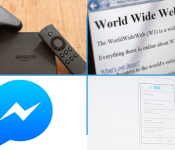
Daily Roundup: Fire TV review, our first time on the web and more!

You might say the day is never really done in consumer technology news. Your workday, however, hopefully draws to a close at some point. This is the Daily Roundup on Engadget, a quick peek back at the top headlines for the past 24 hours — all handpicked by the editors here at the site. Click on through the break, and enjoy.

My First Time on the World Wide Web
Do you remember the first time you cracked open the treasures of the World Wide Web? Our editors sure do. Read on for a look into the lives of Engadget’s biggest nerds and their first experience with the “internet.”

Amazon Fire TV review: the set-top that tries to do everything
Is it a gaming console? Is it a media streamer? Well, Amazon’s Fire TV is a little of both. Sure, the $99 set-top box is lightning fast thanks to its “ASAP” technology. But in an ecosystem all to its own, will the Fire TV be able to attract enough development and content to stay afloat in an already saturated market?

Dropbox brings the popular Mailbox email app to Android and desktop
Today, Dropbox is bringing its popular iOS Mailbox app to Android for an attractive price of $0 — and it’s got a few exclusive features to boot. The company also teased a glimpse of a desktop client, which it’s offering as a limited beta for the extra curious.

Facebook app ditches chat, moves to a standalone Messenger
Pretty soon, you’ll have to use Facebook’s standalone Messenger app to continue chatting with your friends. Zuckerberg and Co. are officially dropping message functionality within the company’s mobile app.
You also might like:
Filed under: Misc

The Solar Impulse 2 could fly around the world without a drop of fuel

The first time we flew around the world, it was 1924 and it took four pilots 175 days to do it. Flash forward some 90 years, and an ambitious crew in Switzerland is planning to take a stab at it themselves next year. The difference? They’re aiming to do it in a plane that’s powered solely by the sun.
That gangly, skeletal plane up there is the Solar Impulse 2. Its wings stretch nearly 240 feet tip-to-tip, and the whole (incredibly light) thing is festooned with over 17,000 solar panels. As it turns out, you can’t actually wring that much horsepower out of all those solar cells — the plane’s top speed while at its maximum cruising altitude is a relatively pokey 88 miles per hour. That’s like circumnavigating the globe in a Mazda. Of course, this machine wasn’t built to break speed records — it’s all about the efficiency needed to keep the Impulse 2 in the air for up to a week at a time. All that means pilots Bertrand Piccard and André Borschberg are in for an arduous ride, even considering the plane has to touch down occasionally so one man can replace the other in the pilot’s seat (which naturally doubles as the toilet). All told, their sojourn will last something like 20 full days of flying spread out over the course of a few months. Thankfully, the pair already has transcontinental test flights across Europe and the United States under their belts.
Would a successful trip pave the way for a new age of solar-powered sky cruising? That seems a little unlikely, but it would ensure a spot for Piccard and Borschberg in the annals of aviation history… and it just may get some more people excited about renewable energy.
Source: Solar Impulse

Hole-y tablets, Batman! Samsung design patent shows a tablet with a hole in It
 Patent applications can often be the place where the most innovative and weird designs show their faces. The latest of these that has shown up at the USPTO is a Samsung design patent which appears to depict a Galaxy Tab-type device, but with a very curious hole in the bottom right corner. What this hole might be used for is absolutely beyond us, unless of course pant chains are making a comeback.
 The rest of the tablet looks very standard: speakers, camera, and S-Pen, all typical of the Galaxy Tab experience. Of course, just because Samsung has taken out the patent, doesn’t mean that they will use it now or ever, but it’s interesting to wonder what they had in store when they decided to apply for the patent.
What do you think the hole would be used for? Let us know your thoughts on this Samsung design patent are in the comments.
Source: USPTO via Phone Arena
//<![CDATA[
ord = window.ord || Math.floor(Math.random()*1E16);
document.write('’);
//]]>

Google’s modular phones: hot-swapping batteries is just the beginning

Google teased us with a behind-the-scenes look at Project Ara’s progress last week, and now it’s giving would-be module makers some meat to dig into with its new Module Developers Kit. As the name implies, this release really isn’t meant for laymen: it’s a set of guidelines for how those bits should look and interact with the endo (Google’s pet name for the phone skeletons you pop those modules into), along with schematics and code samples to play with.
That said, there still a few neat morsels worth noting! Google has some awfully flexible plans for how future Ara phones will handle battery modules, for instance:
Users of an Ara phone will be able to power their device with one or multiple batteries; they will be able to swap a depleted battery with a fresh one, without powering off their phone; they will be able to charge one or more batteries in their phone from one or multiple charging devices.
We already knew that there would be three different-sized endos, but Google’s also cool with modules that stick out from the bottom or back of the phone, like the pulse oximeter (below) the company’s been mentioning for months. It seems a little odd that Google doesn’t want manufacturers crafting modules that could stick out of an Ara’s phone side, but we’re guessing that’s a concession made for grippability.

Then there’s the little matter of how we the people will actually be able to order our phone parts. Google’s guidelines make mention of an online marketplace (somewhere in the Play Store, probably) where we’ll be able to pick parts and configure our dream devices. The sales bit of this equation hasn’t been totally fleshed out yet, but the folks in Mountain View still have time to iron it out. The full document is 81 pages long and just a little more accessible than you’d think — you can download the full package here in case you’re curious. The first of three Ara developer conferences will kick off next week too, so fear not: the best is surely yet to come.
Filed under: Cellphones, Mobile, Google
Source: Project Ara, Project Ara (G+)
 AIVAnet