



Dyson plans big R&D expansion, starting with a new 3,000-person tech campus

One in every three Dyson employees is an engineer. That’s roughly 1,700 of them and the UK-based company is looking to increase that number. It’s announced plans to build a new technology campus in Wiltshire, UK, focused on science and technology research and development. The plan includes four different facilities within a single one leafy compound in Wiltshire, UK. It’ll cost £2.5 million to build it, and could create around 3,000 new tech and science jobs. Dyson will scale up its R&D efforts from here, with collaborative topics like its recently-announced robot research lab expanded and “strengthened” with help from over 10 UK universities — the company has already cooperated with Cambridge, Imperial and Newcastle while cooked up its existing products. Finely-engineered robots, new motors (and probably a few high-end vacuums) are likely just a few years away. Better watch yourself, Roomba.
Image Credit: Getty
Filed under: Household
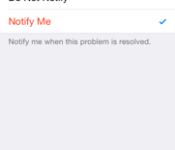
Apple Testing Maps Notifications to Inform Users of Fixed Problems
 Apple seems to be testing a new notification feature in its Maps application, based on a report and screenshots captured by a MacRumors reader.
The user reported an error to Apple in the Maps app on April 6 and was given an option to receive a notification when the issue was resolved, with Apple sending a push notification on April 8 indicating the problem had been fixed.
It appears that the feature is still in testing at this point and it is unclear when it might be made available to all users. The initial user who first spotted the feature says that the option has only appeared intermittently, but a MacRumors forum user was able to confirm that he had seen it as well. MacRumors has been unable to reproduce it.
While Apple has allowed users to report errors since Maps first debuted in September of 2012, the company has not previously provided notifications that let users know when a problem has been fixed. Notably, Google currently includes support for a similar feature in its mapping service, notifying users via email about the progress of a reported problem or suggested edit.
News of the notification feature comes as Apple continues to work hard on improving its mapping app after facing significant criticism over data inaccuracies when the app first launched alongside iOS 6. Apple CEO Tim Cook publicly apologized for Maps after the problematic launch, stating that the company was “extremely sorry” for the frustration it had caused, promising to work “non stop” until Maps was improved.
Maps notifications would allow users to know that Apple is actively listening to reports and working diligently on fixing errors. Apple’s mapping application has been notable for providing potentially dangerous information at times, as it has directed drivers in Alaska onto an airport taxiway used by the Fairbanks International Airport and directed motorists in Victoria, Australia to the middle of the wilderness.
Screenshots showing the correction notification:

Push notification and notice that Maps data has been corrected
Apple has hired dozens of “ground truth” experts around the world to improve the quality of its mapping service and acquired a number of mapping apps throughout the past year, including HopStop, Locationary, BroadMap, and Embark. It is also likely that Apple features major improvements to the Maps app in iOS 8, such as adding transit directions for the first time and enhancing points of interest.
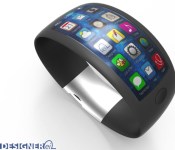
Apple Expected to Unveil iWatch in September as Suppliers Deliver Circuit Board Samples
Three Apple suppliers have delivered samples of flexible circuit boards for the iWatch as the device is now expected to be unveiled in September, reports DigiTimes.

Screen-centric iWatch concept by DesignerEI
Flexible PCB suppliers Flexium Interconnect, Zhen Ding Technology Holding and Career Technology reportedly have delivered FPCB samples for use in iWatch devices to Apple for validation, according to industry sources.
The news follows a report yesterday from Taiwan’s Economic Daily News which indicated that the iWatch will launch in the third quarter of this year, with Apple targeting production of 65 million units by the end of 2014. A reveal in September would mean that the device would be released shortly thereafter, most likely alongside the iPhone 6 and iOS 8.
While details about the iWatch have been slim, most reports have pointed to the device featuring biometric sensors to track a number of health-related statistics, including UV light exposure, heart rate, and skin temperature. Apple is also said to be releasing a “Healthbook” app with iOS 8 that will work with the iPhone and iWatch to track other health statistics like weight, heart, rate, and calories.

Scientists discover the secret behind zombie plants

If the fungal spore outbreak in The Last of Us scared the hell out of you, you’ll be doubly terrified to know that there are actual parasites in nature that can turn animals and plants into zombies. In fact, a group of scientists from the John Innes Centre in the UK just figured out how certain parasitic bacteria called phytoplasma turn their plant host into the living dead. You see, when these nefarious bacteria take over, they transform a plant’s flowers into leafy shoots, turning petals green and preventing the flowers from producing offspring. Apparently, that’s because the parasite has a protein called SAP54, which interacts with the plant so that flowers self-destruct from the inside.
John Innes plant pathologist Saskia Hogenhout says:
The plant appears alive, but it’s only there for the good of the pathogen. In an evolutionary sense, the plant is dead and will not produce offspring.
That’s not all the bacteria can do, though. In addition to changing a flower’s structure and rendering it sterile, the bacteria can also attract sap-sucking insects. Instead of dispersing pollen, these insects carry the parasite to more victims, turning more plants into green, leafy puppets.

Via: Slashdot
Source: Nature, PLOS Biology

Bing Travel’s airfare price predictor is gone, but not forgotten

Despite Microsoft’s years of effort, most of us haven’t switched from Google to Bing for our various searches. Still, one of our favorite Bing features has always been the airfare price prediction. Added in 2009 after Microsoft acquired the startup Farecast for $115 million one year earlier, it could give you an idea of the best time to buy an airplane ticket at its lowest price. That feature is gone now, as a Microsoft spokesperson told GeekWire “It was a business decision to focus resources on areas where we feel there are the greatest opportunities to serve travel needs.” It faded out earlier this year, and Tnooz mentions that key members of the Farecast / Bing Travel team left Microsoft back in 2009.
Last year, Farecast’s founder Oren Etzioni lamented the state of of the service, telling GeekWire at the time “I would have expected more [from Bing] during the past few years.” Apparently what was left didn’t survive Microsoft’s current reorganization, however travelers looking for the best time to buy can still find a similar service from Bing frienemy Kayak.com. Kayak launched a curiously similar price prediction feature last year, and now Google is beefing up its search results for travel queries with direct information on hotels, room photos and reviews. Ah well, at least Bing is still our go to for easy Bitcoin conversions.

Filed under: Transportation, Internet, Microsoft
Via: Neowin

Turkish ISPs make getting to YouTube a little easier, but haven’t unblocked it yet

Even after the unbanning of Twitter and a court ruling in Google’s favor, YouTube is still blocked in Turkey. Accessing the video streaming site did get a little easier today however, as the Wall Street Journal has confirmed residents can once again use DNS servers from Google, Level3 and OpenDNS that will route them around the block. More easily implemented than using a VPN, it finally reopens access via those servers after they were blocked ten days ago. There’s no public statement available from the ISPs or the Turkish government, but hopefully unrestricted access to the best YouTube has to offer is coming soon.
Source: Wall Street Journal

Toyota’s Sports Drive Logger lets you relive real life races in Gran Turismo

Imagine this: you just rounded the final bend of the Fuji Speedway International Course. Pedal jammed against the floorboard, you’re neck and neck with Jenson Button, eying the finish line. Let’s face the facts, you’ll never actually race Jenson, but you can use Toyota’s new Sports Drive Logger to hone in your skills just like he does.
To use the Sports Drive Logger, you’ll need to A), own a Toyota GT86 sports car and B), have access to certain race tracks in Japan (the Fuji Speedway International Course, the Tsukuba Circuit 2000 Course, and the Suzuka Circuit International Course). Meet those requirements, and you can use the accessory to record your race digitally and replay it within Gran Turismo 6 on PS3. Similar to the Corvette data recorder we saw at CES, the device tracks real-life laps and vehicle data (GPS location, pedal input, steering angles and the like) onto a USB flashdrive, the device builds a digital representation of your performance that’s recreated in-game. And judging by the video, it’s surprisingly accurate. You can even race against friends and pros alike to learn the fastest way round the track.
The device will launch in Japan only for $900 on June 2nd, which makes sense given that the first three courses supported are found in the land of the rising sun. Thankfully, Toyota does have plans to add more circuits in the future. For folks who prefer other tracks, Toyota says that they’re in the works — speed is king, but patience is a virtue, people.
Filed under: Misc, Transportation
Via: Gizmag
Source: Toyota
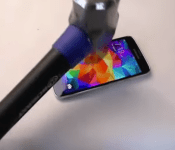
Watch a Galaxy S5 Get the Hammer in New Video [MUST-SEE]

You got to love it: when new devices get released, those dreaded durability test videos start showing up making us cringe and hate the people who make them. Drop tests, water resistance tests, even tests with knives, have been shown in recent videos for the latest in mobile tech. How about a hammer to a Galaxy S5?
In the video below, a young man decides he is going to show us just how durable the Galaxy S5′s screen is. It is a fairly short video, and he basically gives it a little force at first, and then ends it be beating the phone into pieces. What happens after that is pretty hilarious, and we can all laugh in an enjoyment, because this guy deserves what happens after destroying a new piece technology. So check it out below, and let us know what you think. GET SOME FEBREZE OR SOMETHING!
//<![CDATA[
ord = window.ord || Math.floor(Math.random()*1E16);
document.write('’);
//]]>
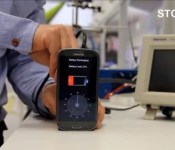
Yes, Please: StoreDot prototypes bio-organic battery that has 30 second charge Time
 The days of waiting hours and hours for your smartphone battery to fully charge could be over very soon. Israeli start up, StoreDot, has shown off the technology in a YouTube video which shows a prototype of the bio-organic fast-charging battery tech in action. Prepare to be amazed:
As you can see, the battery charges from empty to full in an absolutely ludicrous amount of time. The core concept behind the battery tech is quantum dot technology and has attracted $6.25 million USD in investments already. A commercial version of the product is still some time away, however; the prototype shown is obviously not small enough for a smartphone yet and even StoreDot’s CEO/founder Dr Doron Myersdorf has told TechCrunch “So we are talking about three years for a commercial ready device. So I assume it will be three years before you can actually purchase it on the market.”
While StoreDot’s prototype solution is awe-inspiring, it doesn’t quite address the root problem which is battery capacity. However, at least we know now that if we run out of juice in the future, we’ll be able to be back up and running in just a few minutes. What do you think about StoreDot’s technology? Let us know what your thoughts are in the comments.
Source: TechCrunch
//<![CDATA[
ord = window.ord || Math.floor(Math.random()*1E16);
document.write('’);
//]]>

Daily Roundup: Twitter’s redesign, Lightroom mobile for the iPad, and more!

You might say the day is never really done in consumer technology news. Your workday, however, hopefully draws to a close at some point. This is the Daily Roundup on Engadget, a quick peek back at the top headlines for the past 24 hours — all handpicked by the editors here at the site. Click on through the break, and enjoy.

Twitter’s new profile design kinda looks like Facebook
Today, Twitter got a facelift — and it looks a lot like Facebook. The revamp includes a larger header photo, the ability to filter between tweets with or without media and “pin” certain tweets to the top of your feed. All new accounts will launch with the design, but it’ll make its way to others “in the coming weeks.”

US Navy fine tunes seafaring laser weapon and unmanned robocopters
What’s better than a regular ole’ helicopter? A full-sized remote control helicopter, of course. The Navy’s latest robocopter can be piloted from a tablet after only 15 minutes of training and it automatically detects and avoids obstacles. In addition, the Armed Forces branch has a new laser which fires high-energy beams that cost around $1 per shot.

Lightroom mobile arrives for iPad with touch-friendly interface, realtime sync
Lightroom mobile for the iPad is here! Adobe’s latest companion app brings photographers most of the most of the funtionality found in the desktop version, and any changes you make will be pushed to your Lightroom cloud.

Neil Young on digital audio: You’re doing it wrong
Neil Young has a plan to serve up high-resolution audio, and it’s called Pono. But why would anyone spend $400 on a somewhat chunky media player and re-buy all of their music library in FLAC format? We sat down with the rock icon to find out.
You also might like:
Filed under: Misc
 AIVAnet