Dropbox Announces ‘Carousel’ Photo and Video App, Mailbox for Desktop
Dropbox today announced several new products for its desktop and mobile consumers, including Mailbox for OS X and a new photo and video sharing app called Carousel.
Carousel is a standalone app that is designed to organize a user’s entire collection of photos stored via Dropbox, separating them into an event-based timeline that also highlights important moments and supports private messages. Photos automatically backup to Dropbox and sync across all platforms. They can also be shared in batches with and saved to other users’ timelines via email or phone number, regardless of whether or not the user has a Dropbox account.

According to Dropbox, the app, deemed “one place for all your memories” backs up photos to Dropbox, with storage being tied to the amount of space in a user’s Dropbox account.
We’d like you to meet Carousel: a gallery for all the photos and videos from your life. It combines the photos in your Dropbox with the photos on your phone, and automatically backs up new ones as you take them. Carousel sorts all these memories by event so you can easily travel back in time to any photo from any date. And unlike other mobile galleries, the size of your Carousel isn’t constrained by the space on your phone, which means you can finally have your entire life’s memories in one place.
While Dropbox already allows automatic camera uploads and image storage, photos are generally dumped into a single folder that doesn’t offer many organizational options. Carousel will bring a whole new photo viewing and sharing experience that will make it much easier for users to browse through their image collections. The app will be live later today.
Along with Carousel, Dropbox has also announced plans to bring its popular Mailbox app for iOS to the desktop. There are few details available on the OS X version of the app, but it will likely function similarly to the iOS app, allowing users to “snooze” messages and organize them into lists. There’s no prospective launch date on the horizon, but Dropbox is accepting beta signups.


Dropbox announces Mailbox for Android

For quite awhile now, Mailbox has been an iOS exclusive. If you aren’t familiar with the app, it’s a very nice email client that was acquired by Dropbox about a year ago. Android users, it’s finally your day! Mailbox is officially in the Google Play Store!
The reason why it is so popular is a mixture of great design and functionality. The design is mostly white with subtle light blue accents that offers a simple interface to its users. There are a host of different gesture shortcuts available, as well. It includes the popular “auto-swipe” feature, which allows the user to archive an email with a simple swipe, while automatically archiving like emails in the future.
Stay tuned for our walkthrough of Mailbox for Android!
Source: TechCrunch
The post Dropbox announces Mailbox for Android appeared first on AndroidGuys.

Dropbox Carousel organizes your lifelong memories in one app

It’s not every day that a company shows off literal vacation slides as part of a press event, but Dropbox did it today as a way to introduce Carousel. It’s an app for both iOS and Android that takes your photos from your Dropbox account and organizes them by time, date and event, and any new photos that you take will automatically backup to the cloud. You’ll also be able to not only share all of your precious memories with family and friends, those same people can return the favor and share some of their pics and vids so you can add it to your personal deck of digital slides. The new app is available on both OSes now for free.
Developing…

Filed under: Mobile

Ultra HD’s the word at NAB 2014

Whether you call it 4K or Ultra HD, next-gen television sets are on their way to your living room. Some experts expect sales in the US alone to approach one million this year, with early adopters opening their wallets at an even greater rate overseas. But while many of us still get by with 1080p, content producers are adopting Ultra HD as the norm on set, with manufacturers focusing almost exclusively on next-gen hardware here at the National Association of Broadcasters’ annual trade show in Las Vegas.
Ultra HD cameras take every shape and size, from Sony’s just-announced Alpha A7s mirrorless camera to Blackmagic’s giant URSA, with its fold-out 10-inch screen. Even drones are snapping 4K footage, including JVC’s new gimbal-mounted Super 35mm cam. Some models, such as Red’s $14,500 Dragon cam, can capture even higher-res video — in this case, that means 6K footage from a camera you can hold in your hand.
Tools for shooting video from above were another focus here in Vegas. One of our favorite drones of the show, DJI’s Phantom 2 Vision+, only captures at 1080p, but it does so with such grace (thanks to its integrated three-axis gimbal) that the $1,300 copter should not be overlooked. NAB’s not just about cameras, though. Thunderbolt 2 made its debut here in 2013, and this year, Intel returned to demo Thunderbolt Networking, enabling 10 Gbps connections (and super-fast 4K video transfers) between Macs and PCs.

Microsoft even made an appearance to show off Skype TX, the company’s hardware/software solution for seamlessly linking up remote television guests with hosts in the studio, while HP dropped by with its DreamColor displays, capable of showing a billion colors. Finally, FCC Chairman Tom Wheeler rounded out the week with an address to broadcasters, a good part of which was spent motivating attendees to maintain their competitive edge when it comes to internet distributors, such as Netflix.
Ultimately, there was plenty to take away from these few days in the desert — filmmakers and distributors have more options at their disposal than ever before, and while Ultra HD may have yet to take off in the American living room, producers are well on their way to creating future-proofed content, guaranteeing that when you opt to update your own hardware, there will be plenty of movies, TV shows, ads and live broadcasts to enjoy at four times the resolution of 1080p.

Filed under: Cameras, Displays, Home Entertainment, HD

Join us for a Very Special Edition of the Engadget Podcast at 4PM ET on Friday

Nerds cannot live on tech news alone. That’s why, every so often, we’ll be hosting a Very Special Edition of the Engadget Podcast where we touch upon the cultural and social impacts of the technology that matters most to you. Sometimes, that means we’ll even be talking about booze. We are all onions, after all…
Hey, hey, hey! This Friday join your usual hosts, Ben, Joseph and Terrence as they sit down with Mikael Mossberg and Stephanie Moreno from Distiller, a whiskey recommendation engine. These five lovers of tech and booze will be talking about the Distiller app, the exploding craft whiskey scene and will be taste-testing three fine spirits. If you want to drink along at home, on the menu will be Springbank 10, a lightly peated single malt scotch from Campbeltown; Colonel E.H. Taylor Straight Rye, a spicy 100 proof whiskey from Kentucky; and Hudson Single Malt, an American twist on a Scottish classic.
So mark your calendars for 4PM ET this Friday, April 11th, and join us on Facebook and Google+.
Mikael Mossberg, co-founder of Distiller
Mikael Mossberg is co-founder of Distiller. Mikael comes from an entertainment background, having worked in the music industry running digital campaigns for some of the largest artists in the world. In early 2011 he left the major label system to work with Brent Stiefel at Votiv where the two discussed his idea for a whiskey discovery system that would appeal to newcomers and connoisseurs in the booming worldwide whiskey marketplace. This idea turned into what we now know as Distiller, the worlds first whiskey recommendation engine.
Twitter: @Mikaelgm
Stephanie Moreno, Tasting Table
As spirits buyer of one of the most regarded spirits shops in Manhattan, ergo the country, Stephanie was afforded an opportunity most only dream of: to be paid to taste alcohol. Tasting products from bottom shelf vodka to 50 year old Single Malt Scotch, she has tasted it all. There are, however, those spirits that speak a bit louder to her and they are often of the brown persuasion. Her love for Scotch in particular was etched permanently on her heart while visiting and touring distilleries throughout Scotland. These are the spirits that truly drive her to drink. Photo: Stephanie getting barrel samples at the Bowmore Distillery in May of 2009.
Twitter: @brooklynwino

Samsung opens its first ‘Experience’ stores across the UK

Samsung’s dabbled in creating dedicated spaces for UK shoppers a few times, but unlike arch-rival Apple, hasn’t built up any long-standing retail presence. That’s not the case in other regions, though, and earlier this year Samsung decided it was high time to set up a bunch of shops across Europe to call its own. Today sees the first of these “Samsung Experience” stores open their doors in the UK, though they’re actually operated by local partner Carphone Warehouse. The shops, which are located in London, Newcastle, Liverpool, Bradford, Bristol, Manchester, Bournemouth and Cardiff, play host to all things Samsung, from laptops to wearables, in the familiar try-before-you-buy type setting. We’re going to check out the Oxford Street store tomorrow, but if you’re close to one, head inside to get an early look at the new GS5 and Gear range before they launch on Friday.
[Note: the image above is from an Experience store in Spain]
Filed under: Cellphones, Laptops, Tablets, Wearables, Samsung

‘Transparent’ Land Rover hood shows the rubber meeting the road (video)

So far, invisibility systems for cars have been pretty lame or not terrible useful. Land Rover seems to have finally nailed it with the “transparent bonnet” (hood) on its Discover Vision concept car. It works via a heads up display, which projects a see-through view of the road from cameras located in the grill (see the video after the break). That permits a driver navigating in tight quarters to view sharp rocks or other obstacles, and even see the wheels turning below the car. The tech will be on display next week at the New York International Motor Show, and is part of the company’s (apparently see-through) vision for future models.
Filed under: Transportation
Via: CNET
Source: Jaguar

My First Time on the World Wide Web

The World Wide Web. It sounds like such a silly thing when you actually spell out those consecutive W’s. Nowadays, we just say “the internet,” but once upon a time the web was a new and exciting thing. It was a massive communications breakthrough that captivated minds both young and old with the promise of an “information superhighway,” and forced us to endure achingly slow dial-up connections.
Last month, the web turned 25 years old. Yes, Tim Berners-Lee’s simple creation has gone on to spawn this digitally connected world we live in: the social networks, mega e-tailers and search engines we all know and depend on today. Things were simpler when the web started out, but we assure you, our early experiences were no less weird.

Terrence O’Brien
 I’d certainly had brushes with the internet before the evening of August 24th, 1995, but that’s the first night I signed online with my own account and with a username that belonged to me: Lazycow18. (One that would unfortunately follow me for many, many years.)
While countless others were standing in the streets waiting to pick up Windows 95, I was already enjoying the fruits of Microsoft’s labor. My father had installed a beta version of the operating system on my uncle’s yellowing HP tower and plugged in a 2,400-baud modem from USRobotics. A couple of clicks and a few bursts of static later, and I was on The Microsoft Network — not MSN. It definitely wasn’t the bustling community that AOL had already become, but there was a smattering of others already lurking in chatrooms and posting on message boards. Mostly, people just wanted to talk about Windows 95. We were something of an exclusive club, those of us that signed in on that first official night.
On the TV in the living room, CNN showed people lined up around the block waiting to buy their boxed copy of the software that begged you to “start me up.” They were definitely what you’d call early adopters but we… we were pioneers.
Edgar Alvarez
 When I was 13 years old, I had an online girlfriend. After weeks of chatting back and forth on AOL Instant Messenger with this person (let’s call her Lola), we decided to take it to the next level: phone calls. Now, I don’t exactly recall what all of our conversations were about, and that’s probably for the best, but I do know that sometimes Lola and I would talk until 3 or 4 in the morning. We mostly talked about how badly we wanted to meet each other IRL. A relationship of sorts had formed between us and we became exclusive even though neither one of us knew what the other looked like. Sharing pictures wasn’t as easy back then.
Was Lola really 14 years old? Did her looks match her own description? These are things I’ll never know since we never did meet. But I never once doubted that someone was at the other end of the line, despite how enigmatic the whole thing was.
There were the Harrison Ford fansites, perfect for girls like me. There were the game forums where I could bone up on my Sim Tower strategy. Worst of all was the Gone With the Wind fan fiction.
Jamie Rigg
 I’d undoubtedly had some exposure beforehand, but my first memorable and impactful experience of the web was an unorthodox one. In March 1998, my dad moved from the UK to Hong Kong for work. I was 12 years old at the time and, as part of new contractual terms, his employer was obligated to spare no expense in keeping us connected. This meant I could fly out as often as I pleased on the company’s bankroll, but also, I was entitled to the latest in telecommunications tech. So, one weekend, an army of technicians piled into my bedroom as if it were a clown car, leaving behind a dual ISDN line (128 kbps), a ThinkPad laptop and a videoconferencing setup I was told was the first home installation in the United Kingdom.
The laptop was for emailing, of course, but I soon graduated to Yahoo chatrooms, StarCraft and everything else an unlimited and fast internet connection had to offer a curious youngster. Most people would laugh at the videoconferencing equipment now. A huge box with a motor-driven camera, many times the size of current-day consoles, sat atop the biggest TV I’d ever seen. You honestly wouldn’t believe the quality of that setup. My dad’s face was a barely defined pink blur most of the time, but he was right there, sitting in front of me, and that’s what mattered. He’s lived and worked all over the world since, and still, at least once a week, we jump on Skype and shoot the shit.
Dana Wollman
 Even in the early days of the internet, there was something for everybody. I should know: I was an exceptionally strange kid. There were the Harrison Ford fansites, perfect for girls like me who were too embarrassed to admit they had a crush. (He was born in 1942, eight years before my dad. I mean, ew.) There were the game forums where I could bone up on my SimTower strategy. Worst of all was the Gone With the Wind fan fiction. In fairness, I didn’t write any myself. But as a reader, I was insatiable. It all started innocently enough. Like other girls, I read the book, earmarking my favorite passages — the kissing scenes, if I’m honest. As a shy teenager, I identified with Melanie, but wished I could be Scarlett. Most of all, I wanted a boyfriend like Rhett Butler: tall, darkly handsome, a little bit of a dick, but ultimately a good guy. And if I couldn’t have him, I at least wanted Scarlett to end up with him.
Here’s where things get weird. I downloaded MIDI files with excerpts of the movie soundtrack. I owned a collector’s book showing costume fittings and script revisions. I read the unauthorized sequel, itself a piece of fan fiction, and even identified with the term “Windy.” Then, when there was nothing left to buy, I resorted to fan fiction. Most of it was terrible — cries of “fiddle-dee-dee” every other sentence, and raunchy sex scenes that left little to the imagination (not that I minded). The plot was always predictable too: Scarlett and Rhett end up together, but not before getting into another spat and breaking up again.
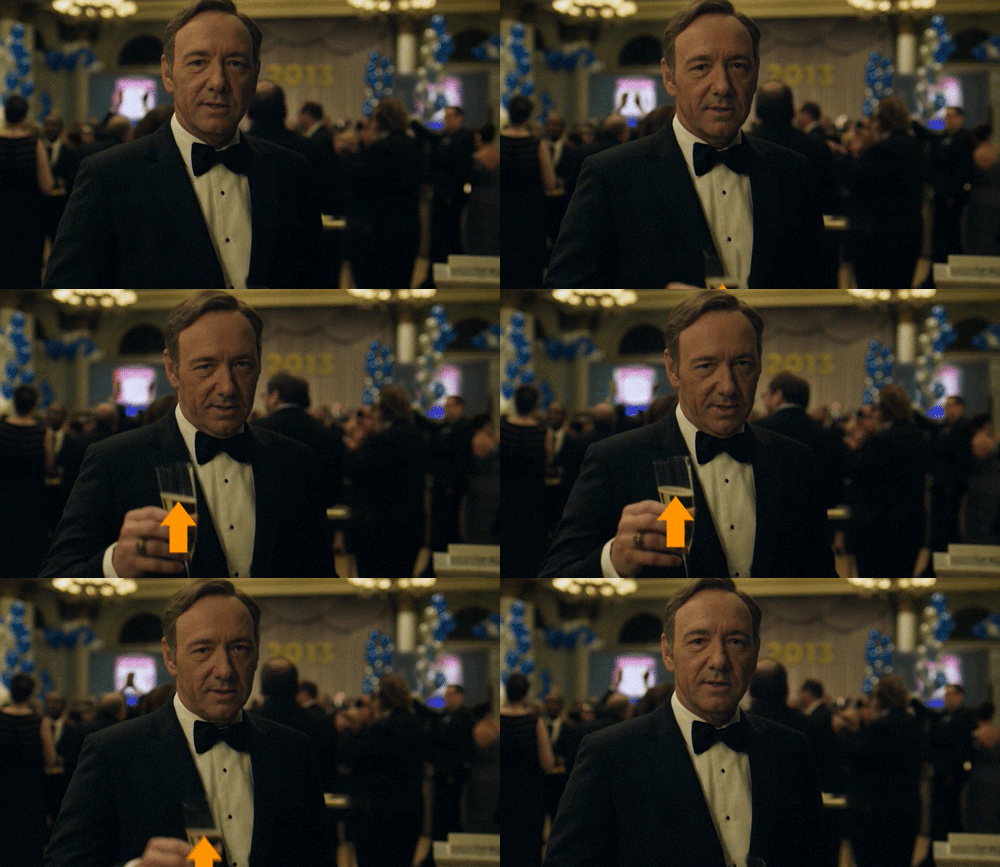
At some point, I grew out of it. After dating a Rhett Butler, I fell for a skinny redhead with good manners. And because Netflix doesn’t offer Gone With the Wind online, it’s been years since I’ve seen the movie in its entirety. But in its place have come other obsessions: Monty Python, Mad Men, Breaking Bad and now House of Cards. But if you think I read Frank Underwood erotica, you’ve got me all wrong; I’m building up my gif collection instead.
My favorite online persona was Ellen: a sheltered, gangly 17-year old violin prodigy who struggled with the lead part in Sarasate’s Carmen Fantasy while her family life fell apart.
Kris Naudus
 When I was a teenager it was still de rigueur to make fansites. These were basically personal shrines to the things you loved. And what I loved at the time was comic books.
When Wizard magazine printed a short list of songs that mentioned superheroes, I made a site to list every song that referenced superheroes. That site, in turn, got mentioned in Wizard. When one of my favorite comics at the time, Cyberella (which was a sort of Max Headroom-meets-Disney cyberpunk tale), got canceled in 1997, I made a fansite for it complete with timeline and FAQ page. The latter of which got me a slightly annoyed letter from the comic’s artist, Don Cameron, pointing out an error. It was the first letter I’d gotten from a creator about my sites, but not the last.

Philip Palermo
 My first hands-on experiences with the web were like those of, I imagine, many high school boys in the mid ’90s: at a friend’s house searching for naughty pics. I’d make up excuses to hang out at my classmate’s house, but honestly, I was there because I was told the World Wide Web was a vast landscape of adult-themed imagery. Or as my friend put it (and I’m paraphrasing a bit): “Dude you can, like, search for famous people and stuff.”
When my parents finally signed up for our own dial-up access, I used my newfound powers to search for a particular celeb: Teri Hatcher. To some, she was Lois Lane on Lois & Clark; to others, she’s… whoever she played on Desperate Housewives. But to me, she’ll always be MacGyver‘s Penny Parker. Unfortunately, I knew next to nothing about finding stuff on the web and my first attempts were complete failures. In desperation, I called my friend and he said he’d find what I wanted. The result? A 1.44MB floppy disk overflowing with two whole images of an… almost fully covered Teri Hatcher.
Yeah, you kids have it so much easier these days.
Chris Velazco
 It was 1998, in spring I think. I was in fifth grade, and thanks to my predilection for eavesdropping, I’d managed to discern my scatterbrained mother’s AOL account password. After logging in (cue the preadolescent flopsweat), I’d done it. I’d changed my own account settings to become the functional equivalent of an adult on the internet. Needless to say, things got weird fast.
I lurked in the dens of iniquity better known as AOL chatrooms trying on personas and spinning yarns to elicit responses that a small, bespectacled Asian child could hardly understand. For weeks at a time, I masqueraded as a woman, a wearied pensioner and an adult version of myself. But my favorite online persona was Ellen: a sheltered, gangly 17-year-old violin prodigy who struggled with the lead part in Sarasate’s Carmen Fantasy while her family life fell apart.
I’d come home from school and jump immediately into a chatroom to regale a group of faceless regulars with stories of how I ditched a violin lesson to meet a boy, a decision my fictional parents made me regret. Yes, I was a mildly perverted, preteen asshole. Somewhere along the way though, those trollish tendencies (mostly) evaporated, and I was left with a love of telling tales and picking out the scattered truths when others told theirs. Which may well have led me to where I am today.
(Images: AP/Getty)
Have an early World Wide Web experience of your own that you’d like to share? Jump into this thread right here, join the conversation and share your stories of the old dial-up days with us!

Filed under: Internet

Dropbox will let you split personal and business storage within the same account

If you’re the sort of person that likes to use Dropbox for Business and pleasure, your road has been a bit rough. Up until now, you had to keep them as two separate accounts and switching between the two involved signing out of one and signing into the other. If your dream is to eliminate this painful process and merge the two aspects together, then today is the happiest day of your life: Dropbox is now making it possible to separate both corporate and personal storage options within the same account. This feature has been available to beta testers for quite some time now, but it’s finally available to everyone else.
Additionally, Dropbox also announced that when collaborating with a colleague, you can both look at the same shared document and make tweaks to that file in real-time. The company showed off a Powerpoint presentation shared by two people via Dropbox, in which both people were able to chat with each other and change things without having to re-download the file in the process.
Developing…

Dropbox announces Mailbox for Android and Desktop

Dropbox is proclaiming that it’s ready to launch “a new chapter,” but what exactly does that mean for the cloud storage king? In addition to its ability to combine business and personal storage accounts, Dropbox also announced Mailbox for Android, which will be available on Google Play starting today for free. It also showed off a preview of Mailbox for Desktop as well, although it’s not quite ready for primetime yet; if you want to take a peek, it’s available in a limited beta.
Developing…

Filed under: Cellphones, Storage, Mobile
 AIVAnet