


Court rules that the EU’s data retention law violates privacy rights

The European Union has argued that telecom companies must hold on to internet and phone records for long periods to help track down evildoers, but the European Court of Justice disagrees — vehemently. It just ruled that the EU’s Data Retention Directive, which preserves metadata for up to two years, is a “wide-ranging and particularly serious” violation of the EU’s privacy rights. It collects more information than necessary, doesn’t establish firm limits and lets companies send data outside of the EU, according to the ruling. While the Directive doesn’t scoop up actual content, the court believes that the unrestricted collection allows too much insight into people’s daily activities and social connections. Sound familiar? It should. The ruling acknowledges the privacy concerns that prompted the US’ proposed metadata reforms, but goes one step further — the court is contending that bulk data retention by itself is dangerous without serious restrictions.
The ruling is a victory for privacy advocates, but it doesn’t solve Europe’s problems just yet. EU member states still have to amend their laws to fall in line with the decision, for a start. Also, the law’s invalidation leaves nations in a tricky position. They can still require that telecoms hold on to metadata, but it’s not clear what the new standard should be — or what companies should do with info they’ve been told to keep under EU rules. Until there are new data retention guidelines in place, those firms will have to deal with at least some uncertainty.
[Image credit: Gwenael Piaser, Flickr]
Filed under: Cellphones, Internet
Via: Reuters, Wall Street Journal
Source: EU (1), (2), CURIA (PDF)

Distiller whiskey recommendations launches on Android [App of the Day]

The popular iOS app, Distiller, brings whiskey recommendations to your Android.
Where do people learn about different types of whiskey? Experience?
If you’ve never come in contact with different types of whiskey, it’s very hard to pick the right one. You may find yourself staring at a shelf for too long before deciding on something you have no idea about. Besides, whiskey can get pretty pricey, so maybe it’s best to know what you’re getting yourself into. Distiller is here to help you choose the right whiskey for the right occasion.
To begin, tap the “get a recommendation” button and answer a few simple questions. Are you looking for something new to try? What’s your experience level? In what environment will you be enjoying this drink?

After the questions are answered, Distiller will give you multiple suggestions based on your answers. What’s more, is that you can view customer reviews, purchase, or rate the whisky yourself, all from the app!
The Distiller recommendation engine factors in tens-of-thousands of different points to analyze different flavor profiles, price, reputation, and “giftability” of a whiskey name.
It’s a beautifully designed app that’s functional and informative. It’s basically a mobile-optimized version of the website, Drinkdistiller.com.
Download the app and find your new favorite bottle of whiskey!
Source: Distiller
The post Distiller whiskey recommendations launches on Android [App of the Day] appeared first on AndroidGuys.

HTC M8 ‘Ace’ outed in photo leak

With the HTC One M8 hitting retail stores and carriers later this week, we’ve already started focusing our gaze on what’s next. Well, not entirely, but you get the point. Much like we had in the HTC One of 2013, we are expecting variations of the flagship device of this year. As such, rumors have started circulating lately for the so-called HTC One M8 Mini. Today sees another model joining the fray.
Called, for now, the HTC One M8 Ace, our first word of the device comes from ever-present evleaks. There’s no indication as to what is different about this model; it comes in red, though! Looking at the blurred photo we wouldn’t be surprised if this was more akin to a Max version.
We wonder what Samsung thinks of that “Ace” part of the name.
HTC M8 Ace pic.twitter.com/1KqrLA74Kp
— @evleaks (@evleaks) April 8, 2014
The post HTC M8 ‘Ace’ outed in photo leak appeared first on AndroidGuys.

Twitter overhauls profile pages, adds “cards” interface

On desktops, Twitter and Facebook have always been different, and for good reason. The type of content that flows through each feed isn’t nearly the same. That being said, Twitter is unveiling a new desktop UI for profile pages.
Complete with profile pictures tucked away in banner images, the new Twitter profile is doing almost exactly what Facebook and Google+ are doing. Not that it’s a bad thing, but one might think they’d be a bit more original about the layout. They’ve added the familiar “cards” UI to their profile pages. Tweets are now bigger, easier to read, and give more of a focus on pictures.

Along with the new layout, here are a few more features they’ve added.
- Best Tweets: Tweets that have received more engagement will appear slightly larger, so your best content is easy to find.
- Pinned Tweet: Pin one of your Tweets to the top of your page, so it’s easy for your followers to see what you’re all about.
- Filtered Tweets: Now you can choose which timeline to view when checking out other profiles. Select from these options: Tweets, Tweets with photos/videos, or Tweets and replies.
So far there are only a few popular users that have the redesigned pages, and it should begin rolling out to users in the coming weeks. If you’d like to take a look, check out Weezer’s profile. There’s no word yet as to whether or not the update will roll out to the Android app, but we’d bet it won’t. For awhile now, the web view and Android app have been so far apart in terms of UI, and we can’t imagine Twitter sending out a giant update like this one.
But who knows, maybe they’ll surprise us and push out a good update for once. Do you have any thoughts on the new web interface? Let us know in the comments!
Source: Twitter
The post Twitter overhauls profile pages, adds “cards” interface appeared first on AndroidGuys.

Lyft drops ride rates in response to Uber, plans to expand locations

Lyft’s taking a tried-and-true approach in an attempt to pirate Uber/Sidecar/other ride-sharing regulars: it’s lowering fares everywhere it’s available. The company’s offering rides for 20 percent less than usual (mirroring Uber’s price cuts earlier this year), all thanks to the $250 million funding it secured last week. Apparently, all that money enables the company to forego charging its standard commission rate — for now, at least — in an effort to attract new customers. Lyft’s not going to spend every cent it got on this particular project, though: it also plans to use the money to expand to more locations in the future. The service with a penchant for fluffy pink mustaches didn’t mention how long this promo will last, but anyone interested in a nice discount (and who isn’t?) should check the adjusted fares on the company’s website.
[Image credit: Sergio Ruiz/Flickr]
Filed under: Transportation
Via: TechCrunch
Source: Lyft
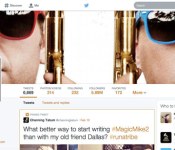
Twitter’s new profile design kinda looks like Facebook

Twitter’s forever tweaking its service with new features and visual touch-ups, and today its revealed a fresh redesign for web profiles which makes imagery ever more prominent. We actually saw much of what’s new teased on Twitter’s test channels a couple of months ago, including the larger, G+ like header photo and bigger, Facebook-esque profile pictures. There are several changes to how Tweets appear on your user page, too. You can pin a Tweet, forum-style, to the top of your ramblings as a sort of extension to your bio, which is less visible under the left-aligned profile pic setup. Furthermore, your “best Tweets,” defined by how much other users have interacted with it, will be enlarged to draw attention to them. Also, when you’re scanning the profile pages of others, you can now filter out Tweets that don’t contain any visual media, or those that don’t have replies. New accounts get the redesign straight away, and all others will see their profile pages change in “the coming weeks.” There are various celeb profiles that’ve received preferential treatment you can peek at right now, if you’d like to see what your profile’s in for. What’s the big deal with Channing Tatum, anyway?
Filed under: Internet
Source: Twitter

Gogo planning 70Mbps WiFi on transatlantic flights

If low-speed airline WiFi has you stuck playing Words with Friends, streaming Netflix on an international flight might seem a distant dream. Gogo is aiming to make it happen soon, though, with its new 2Ku technology that promises 70Mbps peak internet speeds — seven times what it can do now. It works via a system of Ku-band and satellite antennas, similar to the GTO tech that’ll soon be used for North American flights. On top of the improved WiFi speeds, that’ll also bring better access in remote areas and airline fuel savings thanks to lower drag. Trials begin soon on international launch partner Japan Airlines, with a full-scale launch starting in mid-2015.
Filed under: Transportation, Internet
Via: The Verge
Source: Gogo

Sky looks to fibre-optic networks to bring you TV without the dish

Sure, Sky’s been quick to embrace streaming, but the broadcasting giant has relied upon the humble satellite dish to bring TV to your home for almost two decades. However, there may soon be a conspicuous absence of those little black dishes in some parts of the UK after the company confirmed it’ll soon start using fibre-optic networks to deliver its TV, broadband and telephone services. To facilitate this, Sky’s teamed up with British network provider GTC to integrate its service into new-build homes, opening access to its TV packages, landline phone service and up to 300Mbps broadband in the process.
The deal takes Sky into Virgin Media territory, where its rival offers similar packages over cable networks. It could end up stifling Virgin’s own expansion plans in those areas, although the reach of Sky’s commandeered fibre-optic network will be relatively small. Sky can’t seem to shake it’s reliance on traditional over-the-air broadcasting though, as the TV signal is actually being fed from a large, centralised satellite receiver. Right now, Sky taps BT’s fibre-optic infrastructure to deliver super-fast broadband to homes across the UK, but limits TV content to online on-demand services like Sky Go and Now TV. Does this mean Sky is about to drop the satellite dish in favour of super-fast fibre for the whole of the UK? Not just yet, but one thing’s for sure, Virgin Media will be watching with a keen interest.
Filed under: HD
Source: GTC

YouTube live streaming comes to the Chromecast

It seems that Google is quietly trimming back the restrictions around sending YouTube videos to your Chromecast. In addition to being able to share private videos, you can now push live streams from your desktop to the cheapie streaming stick. According to Android Police, the feature isn’t active on Android devices, only desktops, but that’s a small price to pay to get live hummingbird videos on your box 24/7.
Filed under: Home Entertainment, HD, Google
Source: Android Police

Apple Reportedly Targeting Q3 2014 Launch for iWatch
An alleged bill of materials for Apple’s upcoming iWatch has surfaced, with supply chain sources indicating that the product will launch in the third quarter of this year, reports Taiwan’s Economic Daily News [Google Translation] (via DigiTimes).
 iWatch concept by Todd Hamilton, based on the Nike FuelBand
The report claims that the iWatch itself will be manufactured by Apple supplier Quanta Computer, with Richtek Technology and TPK supplying chips and sapphire touch panels, respectively. Meanwhile, the device’s processor is said to be developed by Apple, with chip production being outsourced to Samsung. In total, Apple is said to be targeting production of 65 million iWatch units by the end of 2014.
Notably, two suppliers mentioned in the report have been linked to previous stories about iWatch production, albeit with contrasting details. In November, Quanta Computer was rumored to have landed a contract to mass produce the iWatch for a Q2 2014 release, while a report this past February claimed that Apple had chosen TPK to supply flexible AMOLED panels for iWatch.
While the exact features of the iWatch are currently unknown, past rumors have indicated that the device will feature biometric sensors to track a number of health-related statistics, including sleep activity, UV light exposure, and heart rate. A “Healthbook” companion app is also said to be in the works for iOS 8, which would integrate with the iPhone and iWatch to monitor and track other health statistics.
To this point, most reports have pointed to a release later in the year for the iWatch alongside the iPhone 6 and iOS 8. A Q3 2014 release as indicated by the Economic Daily News would mean that the device could be unveiled by Apple sooner, possibly at the company’s annual Worldwide Developers Conference.
 AIVAnet