


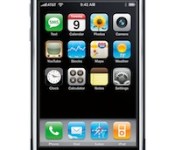
Apple Spent Years Designing iPhone for ‘Normal People’
 Apple senior software engineer Greg Christie took the stand today in Apple’s second patent trial against Samsung, where he shared some details on the development of the “Slide to Unlock” function Samsung is accused of copying and gave additional details on the development of the original iPhone.
One of Apple’s major arguments against Samsung is the fact that developing the iPhone was a serious risk for the company as it was new territory, a point that Christie reiterated in his testimony as he described the three year journey of the iPhone’s development (via CNET).
The iPhone went through hundreds of different design tweaks as Apple worked to make the phone function in a way that anyone could understand. The company’s focus on simplicity remains to this day, with Apple designing for “normal people,” as described by Christie.
“One of the biggest challenges is that we need to sell products to people who don’t do what we do for a living,” Christie, one of the inventors of the slide-to-unlock iPhone feature, said. When designing products, Apple keeps in mind that it wants “normal people – people with better things to do with their lives than learn how a computer might work – to use the product as well as we can.”
Christie helped develop some of the original iPhone’s key features and he is known as the inventor of “Slide to Unlock,” a function that prevents the iPhone from being activated accidentally while within a pocket. During his testimony, Christie also detailed the creation of the function (via Re/code), noting that Apple had originally aimed to have the device’s screen on at all times.
A screen that was always on proved to be infeasible, with Christie citing an inability to meet power requirements. “We had to resort to a power button,” he said, stating that the company was also concerned with “pocket dialing.”
“We knew we had to have a locked mode, or a locked state, where it wouldn’t let you do most things, except you could unlock it,” Christie said.
That need resulted in the development of Apple’s famous Slide to Unlock function, which Christie testified was an important feature on the phone because it is the first thing a customer sees on the iPhone, both in store and at home.
During this second patent trial, which covers newer devices, Apple was limited to levying just five patents against Samsung, making each one vital to the case. Apple is aiming to prove that each patent is highly valuable to the company and is seeking $2 billion in damages from Samsung.
Greg Christie gave additional details on the development of the original iPhone ahead of the patent trial, which can be found in his March interview with The Wall Street Journal.
     |
WSJ: Get ready for more ads in your Twitter feed

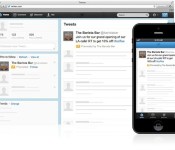
Tired of seeing inane Promoted tweets in your Twitter feed? Well, if the social media company has its way, you’ll likely see much more than that before the year’s over. According to the Wall Street Journal, Twitter plans to debut 15 new types of ad products over the next six months as a bid to gain more advertising dollars and mobile game developers over to its side. The first round of advertising will apparently be an app-install ad unit embedded within Twitter’s mobile app, which is similar to what Facebook has done. Users will see the ad in the form of an expandable tweet, or Twitter card. When they tap on the ad, they’ll be kicked over to Apple’s App Store to purchase the application, and will be reeled back to the Twitter app once the download begins. Word is that companies like Spotify are already on board, though that has not yet been confirmed. Details are scant as to the 14 other kinds of advertising Twitter wants to do, but we’ll likely see this first attempt in the next few weeks.
Filed under: Internet
Source: Wall Street Journal
Gresso’s Azimuth is the dual-SIM phone the rich have been waiting for

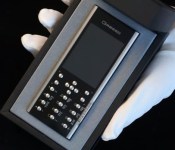
The one percent have long had smartphones from Porsche and Vertu to quench their high-end thirst, but when it comes to dual-SIM handsets the elite have had to settle for something a little more ordinary. For those in need, Gresso created Azimuth, the first dual-SIM, luxury handset. Starting at $2,000, the phone is made of titanium, with both the keys and logo crafted out of 18K or white gold. Since appearances are all that matter, you’re getting some pretty low-end specs under the hood, including 2GB of “internal memory,” a 1.3-megapixel camera, Bluetooth 2.0 and a tiny 1,100mAh battery. To put things in perspective, Samsung’s Galaxy S5 starts with 16GB of built-in storage, a 16-megapixel camera and a 2,800mAh battery. The difference being, anyone can buy an S5. Only 999 Azimuth’s will be made, because no one who’s anyone wants a phone 1,000 people can own.
Filed under: Cellphones, Wireless, Mobile
Via: Pocket-Lint
Source: Gresso
Amazon’s Dash lets you refill your pantry using your voice and lasers

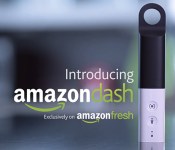
Let’s be real: Amazon isn’t going to stop until you can go your entire life without setting foot in an actual brick-and-mortar store. Now the company wants to make buying groceries and sundries from its AmazonFresh same-day delivery service even easier, and it’s doing it with a tiny little gadget called the Dash. Yes, move Fire TV — Amazon’s newest bit of hardware is a free (for now?), WiFi-capable barcode scanner.
Alright, maybe it’s a bit more complex than that. It appears to be a pint-sized laser scanner (we’re checking with Amazon on that) that’ll capture the barcode of whatever items you need, but you can add to your list by speaking the name of the product into a built-in microphone. That voice recognition bit seems like it would be better suited to generic products like apples, but the teaser video shows a young lady adding guitar strings to her cart — presumably you can fine-tune choices like that once you jump onto the AmazonFresh site or mobile apps.
Word of the Dash definitely came as a surprise (especially on a lazy Spring afternoon), but it falls right in line with Amazon’s existing hardware plans. These days the e-commerce giant is all about pushing low-cost gadgets to reduce the friction of buying more stuff. Itching to read some Feynman? Fire up the ol’ Kindle. Need to watch the last season of Luther? It’s just a few clicks away on the Fire TV. What’s really neat (if maybe a little scary) is that Amazon has finally found a way to make that formula work for real, physical products. Sadly, chances are you won’t be using one of these things anytime soon. The AmazonFresh service is still only live in parts of California and Washington State, though rumors maintain that New York will get access to the program at some point.
Source: AmazonFresh
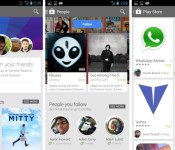
Google Play’s ‘People’ section highlights apps your friends like

You trust your friends for restaurant recommendations, so why not apps as well? That’s the idea behind Google Play’s new “People” section, which attempts to leverage Google+ as a way to show which apps your friends like enough to award a +1 (you’ll be able to see their ratings on those apps too). And it’s not just restricted to your buddies either; the section will suggest other folks on G+ that you should follow to get even more app recommendations. The update should have rolled out to your Android handheld by now, but you can view the same reviews and ratings under the “From Familiar Faces” heading on the web store as well.
Filed under: Cellphones, Mobile, Google
Source: Google Play

Rhapsody and Napster announce Chromecast capability in Android app

Rhapsody (and Napster) on Friday announced that each service is now able to stream their music to a Chromecast via the Android apps.
When you cast Rhapsody or Napster, you can play songs instantly, without the interruption of ads from our global catalog of 32 million songs. Casting music with Rhapsody and Napster is perfect for entertaining or if you are just relaxing at home, giving you the big screen advantage while keeping your music within arm’s reach.
The two companies are the latest in a series of developers to come out with support for Google’s Chromecast device. Users of the media stick can choose from a variety of sources for music, movies, and even games; the list grows longer by the day.
The post Rhapsody and Napster announce Chromecast capabilities appeared first on ChromeWatching.
Read the rest at the source, ChromeWatching.com
The post Rhapsody and Napster announce Chromecast capability in Android app appeared first on AndroidGuys.
 AIVAnet