


Build 3D printable castles and pirate ships one cube at a time with Blokify

Alright, this is pretty neat. We suspect the responsible parties won’t be mentioning the likes of Lego and Minecraft in its press material, so we’ll have to do it in this post. The conceit here is pretty simple: Blokify is an iOS app with a 3D environment where you can build models with cubes — things like castles, spacecrafts and pirate ships. And once you’re done, you can print the models at home or via the cloud through 3D Systems’ Cubify service (using the company’s ProJet 660PRo). The iPhone/iPad app is free, but additional kits and parts are available as an in-app purchase. Professional printing will be as well, with pricing based on the size of the set you build. You can grab the download in the App Store link below. We played around with it a bit earlier today — it’s fun and dynamic, even if we aren’t quite ready to drop the extra cash needed to make our tiny castle a reality.
Mozilla’s Firefox app for Windows 8 delayed again until mid-March

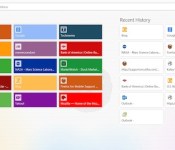
Though Windows 8 has now been out for a year and change, there’s still no Firefox browser dedicated to its tile-y interface. That situation’s not improving, as Mozilla has just announced that its ‘Metro‘ Modern UI-look version has been further delayed to March 18th. We were expecting it to arrive this month following delays that have plagued it since it was first announced nearly two years ago. However, the team pushed back all Firefox releases for two weeks to let workers enjoy the holidays, which didn’t help matters. If you’re feeling brave, you can still check it out by downloading one of the nightly builds, but judging by the logs, you’ll still need to dodge a lot of bugs.
Filed under: Internet, Software
Via: Neowin
Source: Mozilla.org

Leak shows LG’s radical new interface for its webOS Smart TVs

LG’s rumored webOS Smart TV is tipped to arrive at CES in the coming days, but that hasn’t stopped intrepid leaker @evleaks from giving us what could be an early preview of its next connected set. In what appears to be a significant departure from the smartphone-like UI utilized in its current Smart TVs, the leaked render shows off LG’s modern interpretation of the Cards interface we first saw in Palm’s webOS-powered smartphones and tablets. LG chiefs have already indicated that the company has thrown its weight behind the Enyo open-source JavaScript development framework, which it acquired from HP as part of the webOS project, in the hope it will encourage third parties to create apps and services for its next-gen TVs. If the leaked image is real, YouTube, Facebook, Twitter and Skype apps will likely be available at launch, but we’re set to find out for sure when CES 2014 commences next week.
Filed under: Home Entertainment, Software, HD, LG
Source: Evleaks (Twitter)
Switched On: The 2013 Switchies, Part One
Each week Ross Rubin contributes Switched On, a column about consumer technology.

It’s that special time of year between holiday sales and the pre-CES hype cycle that presents an opportunity to consider some of the most innovative devices of the year. Switched On is proud to present the 2013 Saluting Wares Improving Technology’s Contribution to Humanity awards, also known as The Switchies.
This installment marks the eighth annual Switchies, which are decided based on a rigorous examination of the opinion of me, and do not reflect the opinion of Engadget or its editors. For that latter honor, nominees will need to win an Engadget Award. Now, then, let’s stroll past the red carpet and tear open those envelopes.
This column will focus on TV, PC and gaming products while the next installment will focus on mobile and wearable devices.
The “Big Screen Scene” Award for Best New Video Device goes to the Google Chromecast. Taking an app-by-app approach, Google’s cheap stream-redirecting HDMI dongle took everyone by pleasant surprise with its small size and ease of use. It also helped Google show the power of bridging the assets of Android and Chrome and built momentum in a frustrating race for the living room. It’s now rapidly adding new content sources.
Honorable Mention for Best New Video Device goes to the Xbox One. Microsoft’s latest home console is not only a powerful game system, but also a living room experience that incorporates many leading-edge technologies, including speech control, gesture control, video chat and an expanding array of over-the-top entertainment. Honorable Mention also goes to the TiVo Roamio Pro, the latest generation of the venerable CableCARD DVR that can support up to six tuners and offers improved streaming and offload to mobile devices.
The “Play’s the Thing” Award for Best New Gaming Device goes to Sony’s PlayStation 4. By casting off much of the corporate baggage of the PlayStation 3, like in-house chips, 3D and expensive novel optical formats, Sony finds itself in the enviable sweet spot of offering top-notch performance without occupying the top end of the market. Sony’s simpler development proposition should also help enable a stronger flow of game titles coming into 2014.
The “Convertible Bonds” Award for Best New Hybrid Computing Device goes to Microsoft’s Surface Pro 2. Still a study in contrasts, the second generation of Microsoft’s Intel-based tablet combines high performance and dramatically improved battery life, but you’ll be spending most of your time in desktop mode to tap its potential. Honorable Mention goes to Nokia’s cellular-equipped, outdoor-optimized, Windows RT-based Lumia 2520 and HP’s Android-based Slatebook x2 “2-in-1″ detachable.
The “Guess We Just Click” Award for Best New Input Peripheral goes to the Leap Motion controller. While we continue to see many companies focus on bringing down the cost of gesture control at the expense of a rich experience, Leap Motion presented a new 10-inch paradigm that won it a partnership with HP. Leap Motion wrests this award from Microsoft, which won it for the past three years.
The “Critical Bits” Award for Best New OS goes to OS X Mavericks. In a year where Apple, Microsoft and Google all unveiled new versions of their operating systems for tablets, Mavericks was left virtually unchallenged to pursue improvements for the desktop paradigm and Apple delivered with better battery life through superior memory management and its best multiple-monitor support yet.
Ross Rubin is principal analyst at Reticle Research, a research and advisory firm focusing on consumer technology adoption. He shares commentary at Techspressive and on Twitter at @rossrubin.
Filed under: Gaming, Home Entertainment, Peripherals, Software, Apple, Sony, Microsoft, Google
Bump and Flock file sharing apps shut down this month as devs focus on Google projects

Google acquired Bump — developer of an NFC-like file sharing app with the same name and a photo sharing service called Flock — back in September, and both projects will shut down January 31st. CEO and cofounder David Lieb announced the discontinuation of both products on the Bump blog, saying his team is “deeply focused on our new projects within Google.” That bodes well for their mission of enhancing sharing on mobile devices, but the bad news for Bump and Flock users is that this shut down means everything must go.
After January ends the apps will no longer function, they’ll disappear from the App Store and Google Play and all stored data will be deleted from servers (locally saved files or photos will remain in place). Any of those millions of users can still keep their data though, just open up the app anytime in the next month, and follow the instructions shown (tap the “i” menu on iOS or “More” on Android). Afterwards, Bump will send over an email with a link to let you download all of your stored data.
Filed under: Cellphones, Software, Mobile, Google
Via: Android Police, The Verge
Source: Bump blog

Google wants to make your mundane conversations into quirky online comics

Deep down, we’d all like to believe our text-based interactions are worthy of Calvin & Hobbes-style witticisms. They’re not and you know it, but does Google? No matter, because the tech giant was just awarded a patent to format your virtual conversations into something more suited for comic strip syndication online. The concept, though gimmicky, isn’t as freshly innovative as it might first sound. In fact, both Apple and Microsoft have already had designs on the same. Anyone remember Microsoft Comic Chat?
Okay, so Google’s comic-making process is nothing new, but it does have a key differentiator: It’s shareable via email, IM or, more likely, a social network “stream” or profile page. The system, as outlined by the patent, merely repurposes conversations, either manually or automagically, between at least two people into a comic strip layout. It’s then given a title by the user, an appropriate theme as selected from the user interface and formatted for its intended destination. Beyond that, it’s all a matter of where the strip gets posted. Editing permissions can also be extended to second- and third-party users so that the strip lives on. No doubt, it’s a fun way to jazz up otherwise mundane online interactions, but that doesn’t mean we’ll ever actually see this comic generator come to light. You know how these things go. It’s a patent; it’s good for litigation.
Source: USPTO

Safety Technology to Combat Distracted Driving
Reckless driving has become a pandemic, leaving many people affected and lost lives worldwide injured, maimed and even dead due to drivers who use their phones while driving and are inattentive to the roads. Presently, technology experts have come up with innovative ways to prevent this carnage from growing- even though technology has been the problem it can now be used as the solution. Below are a list of the best application software’s available.
IZup (Eyes- up) Application
The iZup app is available for Android and Windows smartphones. The iZup app begins to work when it recognizes the car speed is over 5 mph, at this point it will block almost all phone usage- making phone calls, launching apps and reading or composing a text message will all be impossible. However, emergency calls are preapproved as well as the use of Google Maps- both necessary actions.
 Origosafe Application
The Origosafe app is currently available for the Samsung Galaxy S3, iPhone 4, 4S and the iPhone 5. Origosafe works using a universal ignition interlock system which needs a driver to insert their phone in a dock before the engine can be started- this system is completely hands-free. The device allows voice calls to be received using the Bluetooth technology, however, if the phone is removed from the dock at any time during the ride an alarm signal will be sent out and will block the current user from using the system until it is reset- this is a form of warning for any errant drivers. This technology has come as good news for parents who are worried about the high rates of teenage car accidents caused by reckless driving. Moreover, it can be tailored to each driver’s specifications.
Cell Control Application
This application software is Bluetooth enabled and syncs with the on-board diagnostic system to detect movement and dispense appropriate action. When the car is moving all mobile devices, tablets and laptops are disabled to remove all temptation a driver faces when on the road. This technology is triggered immediately a driver starts the car.
Fleet Safer Application
Fleet Safer is a software designed for corporate fleets to reduce the accidents caused by illegal and irresponsible use of technology when driving. It is comprised of Safe Dial and Safe app features that ensure one-touch and hands free calls as well as allowing companies to determine which apps can be used by their drivers during a job- this prevents frivolous use of the phone. It also send automated replies to incoming calls and e-mails.
Drivesafe.ly Application
Drivesafe.ly is an application software created by speech and is available for Blackberry, iPhones and Android smartphones. It allows for e-mails and text messages to be read aloud as they are being received in real-time and gives automatic responses. This whole process is hands-free and therefore prevents accidents caused when drivers take their hands off the wheel and their eyes off the road.
The above application software’s have been proven to work and are prime examples of technology used for the bettering of society. Technology can also be used to acquire an online driving license you can also apply directly to the Driving & Vehicle Licence Agency by logging on to their authorised website.
Microsoft’s OneNote Android app updated with native sharing and widgets

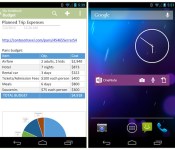
Since its major overhaul back in July, Microsoft’s OneNote Android app has languished while the company built out the Windows version of its note-taking tool. That changed today after Microsoft pushed live a new update to the Play Store, which includes new capture, sharing and widget features that Microsoft believes will help you get “more things done in less time.” The updated app now integrates with Android’s built-in sharing intents, allowing you to pull up a native sharing menu inside apps and immediately add new content to your OneNote account. Microsoft’s also added a number of OneNote widgets, embedding options to view your most recent photos, recordings and notes, let you add new content and pin homescreen shortcuts to your favorite pages or notebooks. With its revamped UI, the Android app is almost at feature parity with OneNote for Windows 8.1, giving us a real reason to consider it over rival note-taking apps like Evernote.
Filed under: Internet, Software, Mobile, Microsoft
Source: OneNote for Android

2008 NSA program to hack and remote control iPhones detailed (video)

Part of security expert Jacob Appelbaum’s Chaos Communications Congress presentation exposed NSA methods to hack systems via WiFi from long range, but we’ll also point out another segment focusing on the Apple iPhone (embedded after the break, beginning at 44:30). Along with German news mag Der Spiegel, he mentioned a program called DROPOUTJEEP which developed malware to install on iPhones that can remotely access files on the devices including email, voicemails and SMS, or perform geolocation, hot mic, camera capture and more.
While the documents dated to 2008, around the introduction of the iPhone, Appelbaum quoted the NSA QUANTUMTHEORY “toolbox” which claimed a 100 percent success rate at implanting this spyware. At the time, loading the tool required physical access to a phone but the team was already working on something it could load remotely. Details on more recently developed attacks don’t seem to be part of the package, but another Der Spiegel report back in September mentioned an example of a target captured on camera via his iPhone as in 2012. Does this news have you looking for a way around prying eyes? Good luck, since other revelations have shown programs targeting Android devices as well as Blackberry’s email servers and phones.
Here is a link to a video of my #NSA and #GCHQ focused #ccc #30c3 talk: To Protect And Infect, Part 2: https://t.co/ox5Ht3LwTP
– Jacob Appelbaum (@ioerror) December 30, 2013
Filed under: Cellphones, Software, Mobile, Apple
Via: Forbes, The Daily Dot
Source: Albert Veli (YouTube), Der Spiegel

Eric Schmidt: my biggest mistake at Google was not anticipating social

Even billionaires can get a bit wistful when a new year rolls around. In an interview with Bloomberg about 2014 predictions, Google’s CEO-turned-executive-chairman Eric Schmidt took a moment to reflect on past mistakes. Well, mistake, really. “At Google, the biggest mistake that I made was not anticipating the rise of the social networking phenomenon,” the exec confesses in the video. Wearing a black suit, blending into a black background, he adds, “It’s not a mistake we’re going to make again. In our defense, we were working on many other things, but we should have been in that area and I take responsibility for that.” But, but what about Google Buzz, Eric? And, of course, the company’s had a fair bit more success on that front with its near ubiquitous Google+ offering.
Schmidt also predicts a continued explosion in mobile usage. “The biggest change for consumers is that everyone is going to have a smartphone,” he says. “The fact that so many people are connected to a super computer means, essentially, a whole new generation of applications around entertainment, communication, socializing.” And if that socializing just happened to be through a Google Hangout or two, Schmidt certainly wouldn’t mind. The interview is embedded after the break, if you’d like to see more.
Filed under: Cellphones, Software, Google


