



LG CES press event liveblog

We hope you like TVs, because we have a feeling LG’s got a lot of ‘em to show, including huge, 4K, curved affairs that we’ve already seen teased by the company in the run-up to CES. That’s not all, however, because the company is likely to show off some new audio hardware, possibly (finally?) a webOS TV too. We haven’t heard much in the way of mobile surprises, but hey, you never know. Join us at 8AM PST — we’ll be there, and we’ll even bring the coffee.


Filed under: Displays, Home Entertainment, Software, HD, Mobile, LG

Google to bring Android to cars with a little help from Audi, GM, Hyundai, Honda and NVIDIA

Already with more than one billion activations on mobile and media devices, Google’s Android is set to make an impact on another major industry: automobiles. Following rumors that the search giant was working with Audi to embed its open-source OS inside its cars, the company confirmed today it has teamed up with five automotive and technology companies (with more expected in the future) to form the Open Automotive Alliance. Alongside Audi, Google will be joined by General Motors, Hyundai, Honda and chip-maker NVIDIA, which will all work to bring Android to cars starting this year. The coalition aims to create a common platform that will drive innovation and in turn make cars “safer and more intuitive for everyone.” With Apple and Nokia already pushing hard to bring their own software to cars — Apple already counts Honda, GM and Hyundai as Siri Eyes Free partners — 2014 could be a big year for connected cars.
Filed under: Transportation, Software, Google
Source: Open Automotive Alliance

NVIDIA K1 chip adds Unreal Engine 4 support

The Unreal Engine’s latest iteration, Unreal Engine 4, is adding support for NVIDIA’s latest Tegra chip, the K1. Epic Games’ ubiquitous engine powered much of last-generation games with Unreal Engine 3, and Epic’s promising even more with the next generation. NVIDIA CEO Jen-Hsun Huang announced as much tonight during the company’s CES 2014 press conference, and he made sure to note the much shorter gap between Unreal Engine running on next-gen consoles/PC and mobile devices.
With Unreal Engine 3, Infinity Blade was the first mobile game running on Epic’s game tech — demonstrated on-stage during an Apple keynote for a new iPad. Unreal Engine 4, however, scales both up and down right out of the gate, apparently. “We can take absolutely anything that runs on PC or high-end consoles and run it on Tegra…I didn’t think that we’d be at this level on mobile for another three to four years,” Epic Games head Tim Sweeney said of the news. Color us unsurprised — we expect to see Unreal Engine 4 running on anything that plays games in the coming years.
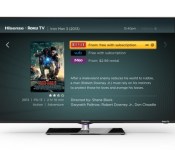
Roku renews bid for the living room with streaming-ready Roku TVs

Up until now, Roku’s bid for the living room has mainly come in the form of its puck-like streaming players and sticks. These devices, priced at below $100, are a cheap way for consumers to augment existing HDTVs and make them “smarter.” But now Roku’s getting into the TV hardware business directly. It’s partnered up with six manufacturers, of which Hisense and TCL are the first to be announced, to produce a line of Roku TVs that come pre-loaded with the company’s streaming software. These sets aren’t planned to hit retail until sometime later this fall, but at CES 2014, we’ll be getting a first look at what’s in store.
Roku’s shift from a provider of streaming players to that of branded TVs isn’t as far-reaching as it sounds. The company’s aiming to leverage its streaming software as a smart TV platform; something to license out to TV manufacturers that can’t compete with the handful of vertically integrated titans like Samsung, Apple and LG. In other words, Roku wants to supply the brains of the set and leave the design particulars mostly up to its partners.
As Jim Funk, the company’s SVP of Product Management, put it, Roku’s seeking to make a “TV for the way TVs are used by people today.” That is, a hassle-free, streaming-ready set that does away with the need for extraneous dongles, players or video game consoles. It’s ironic considering the company built itself on such peripherals, but you can’t fault Roku for accepting the inevitable. As consumer reliance on streaming becomes more and more the norm, so too will the availability of streaming-ready sets. Streaming peripherals are very nearly a thing of the past.
In keeping with its emphasis on simplicity, Roku TV’s UI is staying mostly unchanged from what’s running on current-gen products. So you’ll still find a navigable grid of streaming providers and browsable categories, but you won’t find any web browser or guide overlay for cable when you turn these sets on. That said, inputs for Blu-ray players, gaming consoles and cable boxes will all be present from atop the UI, making switching between devices far simpler.
For the first run, Roku TVs will arrive in a range of sizes from 32 to 55 inches and feature the company’s branding on the bezel. It’s not yet known if any of these initial Roku TV sets will ship with remotes capable of audio output, though they should look similar to the current setup. Design decisions like those, it seems, are entirely up to each manufacturing partner. So far, Roku’s only named TCL and Hisense as two of its six set-makers, but further partner announcements, as well as details on pricing, are planned for later this year.
Filed under: Home Entertainment, Software, HD
Source: Roku

Evernote CEO pledges to refocus on core features and fix buggy, confusing apps

There are several people here at Engadget that might actually die (or at the very least be unemployed) if it were not for their Evernote accounts. Which makes it all the more painful when the service lets us down by failing to sync notes or falling prey to hackers. Jason Kincaid, formerly of TechCrunch, posted a rather lengthy tirade on his blog about such an instance, in which the iOS app produced corrupted audio notes that were completely unplayable. And during the troubleshooting process with Evernote support, Kincaid came across a bug that captured entire notes in plain text in its log files — the very files that a support person request when trying to diagnose a problem. Let’s just say the self-proclaimed power user was understandably incensed.
Well, the post caught the attention of Evernote CEO Phil Libin, who admitted that perhaps the company had focused too much on adding features and expanding its user base at the expense of the core experience. But those days are over Libin proclaimed. In fact, he says the staff quietly shifted its focus back to squashing bugs and improving stability a couple of months ago, but that there was still plenty of work to be done. In addition to boosting performance and fixing broken features, he says updates will be rolling out over “the next few weeks” that will greatly improve and simplify the user experience. He specifically said the engineers and designers will be targeting note editing, navigation, search, sync and collaboration features across all platforms.
2013 was a big year for Evernote, and it’s safe to say it endured some growing pains. Lets just hope that 2014 is the year it grows up — without getting too big for its britches.
Filed under: Software
Source: Evernote, Jason Kincaid

Google acquires Bitspin, makes its stylish Android alarm app free to celebrate

Bitspin is probably most well known for its swish Timely alarm app on Android, and it seems that Google likes how the Swiss team is doing it, because it’s just acquired them. “For new and existing users, Timely will continue to work like it always has,” noted the Bitspin team in their announcement post, adding that it will continue to “build new products.” The more immediate news, however, is that the premium version of the app, sans banner ads, has gone free in the process. If you like the sound of a Swiss-made (digital) alarm clock, you can give it a try right here.
Filed under: Cellphones, Tablets, Software, Mobile, Google
Source: Bitspin, Timely (Google Play)
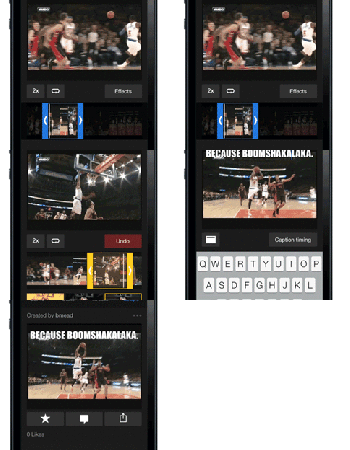
Yahoo Sports for iOS adds Loops for capturing clutch catches, epic fails

Fancy making your own social media commentary during the big game? Yahoo Sports for iOS now lets you capture those monster dunks in animated GIF form. The company has officially labeled the creations Loops, and users can add their own commentary as captions on top of the moving picture. As you might expect, files can then be shared via Tumblr, Twitter, Facebook and e-mail. Not to be left out, the app was revamped for iOS 7 with speedier performance in its sneakers. For a look at some samples, click over to the source link and take a peek.
Source: Yahoo

Wikipad breaks off controls into mobile Gamevice gamepad

In its ongoing effort to announce products people may not want long before said products are available to buy, Wikipad today unveiled its Gamevice tablet game controller. The mockup above is an example of what the Gamevice might look like when we get our hands on it sometime later in 2014 — it won’t be at CES next week and it doesn’t have a projected price or release window (other than this calendar year). Rather than focus on the larger tablet form factor, the Gamevice adapts the 7-inch Wikipad’s controls for — the company’s hoping — a variety of Android and Windows 8 devices. It sounds like iOS support is also in the works, but there’s nothing officially confirmed just yet.
Whether there’s a market for Wikipad’s Gamevice is another question altogether. There’s no shortage of mobile gamepads out there, and it’s not clear that Gamevice is any better than the competition. If anything, based on previous experience with the Wikipad’s controls, we’re a bit skeptical.
The company also announced an OTA update for the 7-inch Wikipad that adds Jelly Bean 4.2 and mappable controls. It should be available today.
Filed under: Gaming, Handhelds, Peripherals, Software, Mobile
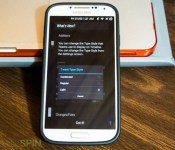
Carbon for Twitter updated, new type styling added
 You guys asked, and Carbon answered! A few days ago, we took a look at Carbon for Android, v 2.0. Well, today Dots & Lines pushed out a new version, v 2.0.8 to be exact. This version bump doesn’t add much, but it does add something that was missing and we wanted. It adds the ability to change the font styles from condensed, to regular, to light.
Was this feature holding you back from using Carbon? Well, fear not! It’s there, and live in the Play Store! So go, get it now!


Droplr’s rapid file sharing service goes pay-only

Droplr makes it easy to share files with friends, but that simplicity doesn’t come cheap, it seems. The company has revealed that it will discontinue its longstanding free tier next week; after that, customers will have 30 days before they must subscribe to a Lite or Pro plan. There are a couple of incentives for veterans to fork out some cash, though. Any existing Droplr members can get a 30 percent lifetime discount, and a referral program will let users earn free Pro access. The shift in strategy won’t please those who’ve been thriving on free sharing for years, but there are plenty of alternatives for thrifty types.
Filed under: Cellphones, Storage, Internet, Software, Mobile
Source: Droplr (Tumblr)

