


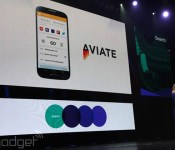
Yahoo acquires Aviate to build context-sensitive Android apps

That was quick — Aviate hasn’t even finished developing its context-aware Android home screen, and it’s already an acquisition target. Yahoo has announced at CES that it’s buying Aviate for an undisclosed amount; the web giant wants to use Aviate’s simplified, ever-changing interface as a “central part” of its Android software in 2014. While it’s not clear just what that entails, the launcher replacement will live on for the foreseeable future — in fact, the first 25,000 people to use the code “YAHOO” will get into the ongoing private beta.
Filed under: Cellphones, Mobile
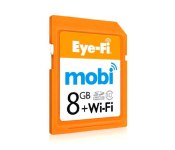
Eye-Fi brings its desktop receiver to Mac, announces Labs initiative for software beta testing

Have you been bummed for the last month because Eye-Fi’s desktop receiver for its Mobi card was Windows-only? Well you can now rest easy: The company has just announced the Mac version of the software here at CES. Now, the aforementioned wireless SD card can transfer to both desktop OSes instantly for easy photo sharing between mobile and anchored devices. In addition to catering to the Apple faithful, the outfit announced Eye-Fi Labs. This effort will allow users to test beta versions of new software for the memory cards before they’re officially released. Sound like something you’d like to take for a spin? Head to the source link to sign up.
Filed under: Storage, Software
Source: Eye-Fi

OnePlus revealed as Cyanogen’s new partner, OnePlus One coming “first half of 2014″
 The first smartphone to officially ship with CyanogenMod may have only come out at the end of the 2013, but Cyanogen Inc. has bigger plans and will be shipping its first smartphone in the first half of this year.
Early this morning, and coming after months of speculation, Cyanogen’s new hardware partner for its upcoming phone was revealed to be OnePlus, the new company of Ex-Oppo exec Pete Lau.
On OnePlus’ blog, it said that their first phone will ship with a specially designed version of CyanogenMod “with exciting new elements and features.”
Hopefully we’ll be seeing this device come to the U.S. and with support for LTE, unlike the Oppo N1 that only had HSPA+ support. No other information was given about the upcoming device at this time, except that Cyanogen and OnePlus will be launching it in select markets and then eventually expanding globally.
via OnePlus
The post OnePlus revealed as Cyanogen’s new partner, OnePlus One coming “first half of 2014″ appeared first on AndroidGuys.

A first look at the app for Canary’s web-connected home security system

You may remember Canary, an all-seeing, all-knowing, net-connected home security system that obliterated its funding target to raise almost $2 million. Now, if we were the folks behind it, we’d be celebrating in Vegas, but instead they’re here at CES showing off their progress. While the team have brought final hardware along, it doesn’t look any different from the original proposition. Canary’s CEO Adam Sager tells us, however, that many of the internal components have been swapped out for better versions as development has ramped up, and Ethernet has been added (in addition to WiFi) due to backer demand.
What we were really interested in, though, was taking a look at the companion app Canary has been crafting. Sager demoed the iOS version, which takes many design cues from Apple’s latest mobile OS, on an iPod Touch. He showed us how the app handles alerts, including that HD video recordings and all other sensor metadata associated with that event, as well as the various ways you can immediately react. We also saw how live video feeds would be presented, the feed-like alert history, and how you can set up both user and trigger profiles. Considering this isn’t “fully functional,” as Sager put it, we would call it mighty slick for something deemed unfinished. Development is being steered, in part, by an ongoing internal beta, and backers who signed up for the open beta are due to recieve their hardware within the next month. Everything is on track, too, for the launch proper in May. Head past the break for a brief video walkthrough of the app, courtesy of Sager.
Edgar Alvarez contributed to this report.

Hands-on with LG’s smart TV running webOS (video)

Since LG informed the world that webOS is coming to 70 percent of its smart TVs this year, naturally we were keen to take it for a spin. So, when they offered to let us take it for a spin, and have Director of Product Managment Colin Zhao and Head of Product Management and Design Itai Vonshak walk us through the new UI, we jumped at the chance. And, not only did we get to see it in action, we also learned a bit about the philosophy behind LG’s move to webOS on the big screen.
For folks thinking LG’s version of webOS might favor its prior mobile implementation, think again. While the underpinnings are the same, the card-based UI has been ditched — according to Vonshak “content is king on the television, and we didn’t want to pull the user out of the viewing experience” by dumping them into an all-card view. When you hit the home button on the remote, you’re greeted by a rail of parallelogram-shaped colorful icons at the bottom of the screen overlaid on top of whatever you’re watching. Those icons include a Today recommendation engine (provided by an unnamed third party) that shows content popular with the viewing public, plus any and all content sources available to the TV, be it online video, localized media, live TV, gaming console or media streamer. Naturally, Netflix is red, Hulu is green, Roku is purple, and so on. As you’ll see in our video below, navigate the menu to the left and you’re greeted by panes that show your viewing history. Slide to the right within the menu and you’ll see the rest of your video sources that couldn’t fit on the home screen. Speaking of, that home screen comes with a preselected set of apps, but it’s completely customizable by the user.
Navigating amongst the icons is fast and easy, and the LG TV swapped sources without issue. “We wanted to treat the web like a first class, not second-class citizen,” said Zhao. The aim is to provide an equally enjoyable user experience regardless of where content comes from — and from our limited demo time, we’d say that LG is on the right track. This seamless and simple switching amongst content is one of the three guiding principles in designing the UI. Along with switching, setup and discovery are the other two.
We already mentioned the Today recommendation engine, and it is the main way that LG’s discovery principle has taken form, but it’s not the only method for discovery. When hovering over the icons for various streaming services, the screen automatically populates screen shots from popular content they provide — rolling over Netflix, for example, caused a picture of the cast of House of Cards to fill the screen.
LG has taken an interesting approach in helping customers set up its new smart sets — it’s attempting to make the process entertaining. To do so, LG created a series of cute cartoon shorts featuring a little black avian character called Beam Bird. The system alternates between screens for setting up WiFi connections and streaming accounts and the aforementioned shorts. While we only got to witness a video cut together showing the process, we imagine that the cartoons will definitely appeal to many. And even for folks who aren’t super keen on the idea, Vonshak assured us that the bird will only appear at setup, and they’ve kept the cartoons short enough to avoid user fatigue: “we didn’t want Beam Bird to turn into Clippy.”
We didn’t get to spend a tremendous amount of time using this new version of webOS, but we did see enough to say that Zhao and Vonshak are definitely on the right track. In fact, we’d say its the best Smart TV UI we’ve ever used
Filed under: Home Entertainment, Software, HD, LG
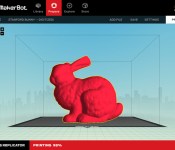
MakerBot shows off a trio of new apps: Desktop, Mobile and Printshop

Yeah, the hardware was the big reveal at today’s MakerBot press conference (in some cases, quite literally), but the company also had some software to show off; namely a trio of new apps. First off is the new Desktop app, which lets you monitor and control your prints and access MakerWare, a feature that lets you view your print. It’s set to arrive next month for free. Also new is MakerBot Mobile, an app that lets you monitor and control your printer remotely. The app also sends alerts to let you know when the prints are complete. You can also download prints directly from Thingiverse. That one’s also free and will be coming to iOS in the spring, with Android to follow later in the year.
The last addition to the MakerBot ecosystem is Printshop, a way to actually get those pesky 3D models to print. There are two ways to use it: a text feature, which lets you print out words and a bracelet maker, which, as you’ve no doubt already figured out, lets you design your own plastic wrist wearables. The app also features number of “Verified” files from Thingiverse, with easy access to good models. That one is coming to iOS this spring, with Android to follow later.
Filed under: Software
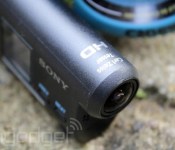
Sony Action Cam update brings live streaming to older cameras this summer

Existing Action Cam owners will net two of the AS100V’s banner features through a software update. The most significant addition, live streaming, will enable real-time video uploads to sharing sites like Ustream through a connected smartphone or tablet. Sony’s also adding a high-speed continuous shooting mode, letting you snap a “limitless” number of high-res stills with previous-gen Action Cams. Expect both new features to make their way to your compatible shooter sometime this summer.

Panasonic will bring Firefox OS to your smart TV this year

Firefox OS won’t be confined to small devices for much longer. Panasonic has announced a partnership with Mozilla that will see it launch Firefox OS-powered smart TVs and other “smart screens.” The deal potentially opens up the frequently proprietary world of TV software — since the program guide and other interface elements will be web pages, they won’t be limited to any one company’s hardware. It should also be easier to write remote control apps, personalize the interface and integrate TVs with home automation systems. Panasonic isn’t going into more detail about the hardware at this stage, but it tells us that the first Firefox OS TVs should arrive in the “latter part” of this year.
Filed under: Home Entertainment, Household, Software, HD
Source: Mozilla Blog
Our 2014 CES stage schedule is here and it’s awesome!

Sure, there’s a certain amount of creeping dread in the lead up to CES each year. It’s a sleep-deprived week spent elbowing our way through the packed halls of the Las Vegas Convention Center. The food is bad, the facilities few and far between and the hygiene practices of the tech-blogging community questionable, at best. But there are also plenty of things that make it one of the most exciting weeks of the year, not the least of which is our stage. As with the last couple of years, we’ve got a prime spot in the convention center lobby, where we’ll be speaking to some of the biggest and most innovative companies in the world of consumer electronics.
The list includes Sony, Ford, Pebble, Nokia, Leap Motion, Oculus, MakerBot, Lenovo, Samsung, AT&T and the Electronic Frontier Foundation, to name a few. You can check out the full schedule here and stay glued to our CES event hub for updates. See you on stage!
Filed under: Announcements, Cellphones, Desktops, Cameras, Displays, Misc, Gaming, GPS, Home Entertainment, Household, Laptops, Meta, Peripherals, Robots, Tablets, Transportation, Wearables, Wireless, Internet, Software, HD, Mobile, Samsung, Sony, Nokia, AT&T, AMD, Lenovo, NVIDIA
Source: CES 2014

3D printing destination Cubify hits 2.0 with curated and branded collections

Even if it completely failed in the consumer market, 3D Systems would still be on pretty solid ground thanks to its strong industrial 3D printing presence. But that hardly means the company is going to half-ass its efforts to capture mindshare from MakerBot and Thingiverse. Before CES can even officially kick off, the company has already announced a pair of new printers (the Cube 3 and CubePro) and the launch of Cubify 2.0 — the next generation of its consumer site for hosting and posting ready-to-print models. While there is a community-driven side to the portal, including user uploaded collections and profiles, there’s also a heavily curated portion that includes partnerships with brands like Nooka and Digital Dollhouse (a virtual playground for kids, who can now 3D print their creations). The collections are divided up into categories like fashion, decor and “mancave,” and include both products that you can print at home on your Cube or, for the more complex products like guitars, you can have 3D Systems print out for you on one of their giant industrial machines.
The company isn’t done yet at CES, either. There’s still a big press event to come, that will feature will.i.am and, more importantly, CEO Avi Reichental will be on our stage for an interview. Even with a trio of exciting announcements already out the door, we’re pretty sure 3D Systems still has something up its sleeve for later in the week.

