



GTA: San Andreas now available for (some) Windows Phones weeks late

Rockstar Games’ promise of an early January launch for Grand Theft Auto: San Andreas on Windows Phone devices may’ve been a bit off — the game just arrived on the Windows Phone store today, as spotted by CNET. The game carries a $7 price tag and works on a handful of WP8 devices (the HTC 8XT and Nokia Lumias 1520, 1320, 822, 820 and 810); it’s got the same touch-based, contextual controls that the iOS and Android versions employ. Should the Caricature Compton of Carl Johnson’s San Andreas entice you, you can snag it right here.
Filed under: Gaming, Software, Mobile, Microsoft, HTC, Nokia
Via: CNET
Source: Windows Phone Store

Microsoft buys Gears of War franchise, new game in development

Microsoft now owns another major franchise tied to its Xbox game consoles: Gears of War. That includes “rights to all existing and future games, entertainment experiences and merchandise,” and it looks like a new game (likely for Xbox One) is already in production at Black Tusk Studios in Canada (Microsoft actually teased that news back at E3 2013 during the company’s press briefing). The franchise’s former director of production, Rod Fergusson, will take on oversight.
The Gears of War franchise was exclusive to the Xbox 360 (and later on PC as well), and Unreal Engine developer Epic Games used the third-person shooter series to show off its engines graphical chops. Beyond being a graphical showcase, however, Gears of War developed a loyal following among online console gamers — last year’s Gears of War: Judgment was the first entry in the franchise co-developed by Epic and Bulletstorm dev People Can Fly, and it was expected to be the final entry in the series.
Beyond a new entry in the massively popular shooter franchise, we expect re-issues (perhaps prettied up re-issues) will happen at some point (a la Tomb Raider‘s “Definitive” Edition). At very least, Gears fans can rest assured that more tales of meaty space marines taking down locust are on the way care of Microsoft.
Filed under: Gaming, Software, HD, Microsoft
Source: Microsoft

Switched On: The next steps for digital wellness, part one
Each week Ross Rubin contributes Switched On, a column about consumer technology.

Some of today’s leading wearable devices are, at their core, little more than souped-up pedometers. Their once-dim monochrome LCD screens have migrated from atoms to bits that connect to the internet, allowing them to display information in a more engaging way and track it over time. They have been a big win for output, but with essentially the same input.
Indiegogo in particular has been a fertile launchpad for alternative wearables for the fitness enthusiast. One has been the Push band, which measures things such as force, power and velocity for activities like weightlifting. And the impact of that might be measured by the Skulpt Aim, which tracks muscle health. Another alternative to run monitors in development is the Atlas, which includes a digital footprint of 30 different exercises for more intelligent exercise analysis.
But even the most sophisticated and accurate exercise monitoring provides insight into a very small picture of our overall wellness. To provide greater insight into our quantified health, far more needs to be considered.
Nutrition
For the common problem of obesity, changing eating habits is likely to have a bigger payoff than the daily difference of a few thousand steps. And while there are many apps that allow people to input their food manually or even take photos of it, that is almost the equivalent of having us manually count the number of steps we take in a day.
Some of the earliest efforts in this space have come from the HAPIfork. It measures the speed and frequency with which one shovels food into one’s mouth, but it can’t distinguish between lettuce and butter-infused mashed potatoes. Then there’s TellSpec, a spectrometer that offers to analyze the nutrient and allergen content of your food. Given, that’s an order taller than a stack of Big Macs, and it’s been met with a large dose of skepticism.
Stress
Stress, and how one deals with it, can be a key factor in determining one’s level of wellness. It’s easy to detect the signs of stress such as a faster heartbeat, and many gadgets like the Basis watch can measure that. What’s more difficult is determining stress itself. Perhaps some guesses could be made about factors such as noise levels, late hours and scheduling. Companies such as Helicor, with its StressEraser, and HeartMath have developed biofeedback devices to help with relaxation and stress reduction; the latter has released a version that connects to iPhones via cable.
Environment
At CES, a couple of companies showed off app-connected air quality monitors. These included the centralized Alima air quality monitor and the tiny, distributed CubeSensors that won the TechCrunch Hardware Battlefield competition. Both do for indoor air quality what The Weather Channel reports on in terms of outdoor air quality.
The next Switched On will discuss some of the less volatile factors that have an impact on our health and wrap up with some thoughts on how we all might benefit if we can find a way for them to come together intelligently.
Ross Rubin is principal analyst at Reticle Research, a research and advisory firm focusing on consumer technology adoption. He shares commentary at Techspressive and on Twitter at @rossrubin.
Google reportedly buying artificial intelligence startup for $400 million

According to reports (and confirmed by the internet company itself), Google has bought Deepmind: a relatively small AI company from London. Re/code broke the news, stating that Google had sunk $400 million into the purchase — a figure that the company hasn’t yet confirmed. The startup’s placeholder site outlines its work on “general purpose learning algorithms,” with its first projects encompassing games, e-commerce and simulations. It sounds like the team might be working in a separate direction to Google’s recent robotics purchases, but the company (unsurprisingly) is plenty interested in the future of artificial intelligence: it teamed up with NASA to launch an AI research lab just last year.
Source: Recode

Symantec has found Windows Malware that attempts to infect Android
 The Android OS has had its fair share of malware scares over the years, often drawing comparisons with its competitor iOS, who apparently has a pretty clean sheet. A new malware has reared its head in the last few days, found by Symantec, but while most Android malware targets the OS from within, this latest one takes a slightly different route. Trojan.Droidpak is its name and it is a piece of Windows Malware that attempts to infect Android.
So how exactly does it do this? Flora Liu from Symantec explains:
The infection starts with a Trojan named Trojan.Droidpak. It drops a malicious DLL (also detected as Trojan.Droidpak) and registers it as a system service. This DLL then downloads a configuration file from [a] remote server… It then parses the configuration file in order to download a malicious APK
The file also continues to do malicious things such as downloading Android Debug Bridge and searching for Korean online banking apps, prompting the user to replace them with infected versions; all-in-all, a pretty nasty piece of code. So how do you avoid the risk of becoming victim to Trojan.Droidpak? Symantec has these suggestions for you:
- Turn off USB debugging on your Android device when you are not using it
- Exercise caution when connecting your mobile device to untrustworthy computers
- Install reputable security software, such as Norton Mobile Security
- Visit the Symantec Mobile Security website for general safety tips
What do you make of these latest Android security risks? Let us know in the comments.

LlabTooFer breaks down the likely update schedule for HTC Devices, confirms existence of Sense 6.0
 If you’re an owner of a HTC device, but you don’t own a HTC One, you’re probably feeling a little left out at the moment. While HTC has done a pretty good job sticking to their word and getting Android KitKat out to the HTC One in around 90 days, the Taiwanese manufacturer has stayed pretty quiet on what the update status of its other devices are (unless you own a HTC One X/X+; sorry!). So while HTC is busily tinkering behind closed doors, it turns to HTC guru, LlabTooFer, to appease the masses with a suggested update schedule for HTC Devices.

According to the schedule above, HTC’s second line of devices like the One Max and One Mini should be receiving Android 4.4.2 around this time as well, and HTC’s overseas devices like the Butterfly and Butterfly S will have to wait a little longer, most likely March or April for the Android 4.4.2 update.
While this was mostly expected, there are a few surprises in the document, including the fact that the Desire 601 will be receiving Android 4.4.2 and that the HTC One will be receiving an update to Sense 6.0 in “late summer/autumn”. This is probably the first time that Sense 6.0 has been mentioned, apart from rumours the HTC One 2 would be the first device with the new UI. While having the schedule is all well and good, LlabTooFer is quick to remind us that this schedule is provisional and can change at any time, so don’t get too disappointed if an update ends up being late. Well, not too disappointed anyway.
What do you think about this update schedule for HTC Devices: are there any surprises in there for you? Let us know what you think in the comments.
Source: LlabTooFer
Windows 8.1 update may speed up budget tablets

We may not have to wait long to get that Windows 8.1 interface tweak, after all. ZDNet hears from sources that Microsoft wants to release the upgrade, tentatively named Update 1, on March 11th. The patch may let you do more than pin Windows Store apps, too: Redmond’s developers will reportedly be able to optimize Windows’ memory and storage footprints for lower-end tablets. ZDNet also reports that the software will be more business-friendly, though it’s unclear how. We wouldn’t be surprised if the launch details change, but it would certainly be nice to get a significant Windows refresh at the same time that we’re picking up Titanfall.
Filed under: Software, Microsoft
Source: ZDNet
South Korea rules smartphone users can delete Android bloatware

In a move that we can only hope inspires other mobile regulators, the South Korean government has struck a major blow against Android bloatware. Yonhap News reports that Korea’s Ministry of Science, ICT and Future Planning (MISP) is bringing the hammer down on preinstalled Android apps, introducing new guidelines that will enable users to delete them. Carriers won’t be forced to make apps related to Wi-Fi, user settings, NFC or app store removable, but even with core services excluded, it puts almost 60 apps installed by the country’s three biggest providers at risk. Samsung and LG won’t escape the judgement either, with more than half of their 40 default apps facing a less than certain future.
The ministry said preinstalled apps are an “inconvenience” to users and cause “unfair competition” between operators and carriers, so it asked them to offer detailed information to users on how much storage their preinstalled apps take up. It also intends to apply the same rules to Google’s suite of apps and services, which includes Gmail and Hangouts, although the regulator is still in talks with the search giant. Samsung, LG, SK Telecom and others have until April before the rules come into effect, which could mean Korean users will be able to tweak apps installed on their new Galaxy S5, should the device launch in the coming months.
Filed under: Cellphones, Wireless, Internet, Software, Mobile, Google
Via: ZDNet
Source: MSIP
Android app learns from your phone to fend off malicious attacks

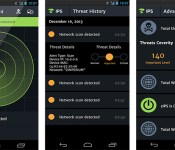
The last time we heard from Itzhak ‘zuk’ Avraham, he was at Defcon 2011 showing off an Android app that let even inexperienced users poke around networks for weak links and vulnerable computers. Now his company, Zimperium, is rolling out a new mobile intrusion protection app (or zIPS, for short) to help users figure out when their phones are subject to sneak attacks.
There’s no shortage of mobile antivirus apps out there, but according to MIT Technology Review Avraham doesn’t think the prevailing approaches are up to snuff. Many of them check downloaded files for known malware signatures, but zIPS’ machine learning system helps it figure out how your smartphone normally works and detects changes that may be symptomatic of something sketchy. That includes detecting seemingly benign apps that later download malicious payloads, man-in-the-middle-attacks and still more mobile nastiness.
Currently zIPS is enterprise-only, but a consumer version is in the works and the team hopes to hit iOS devices and a slew of connected home gadgets in short order.
Source: MIT Technology Review, Zimperium

Spotify makes an update brings artist touring Details
One of the other major streaming music apps to grace our digital lives, Spotify, has released an update to their Android app. Adding in a new section in Artist views that will keep you up to date on touring details so you don’t miss your favorite bands performances. Not only does it give you the date and location (with a quick tap to Google Maps for directions), but you can go buy tickets.

 The remainder of the update details are rather comical, not in what they are specifically, but in how Spotify delivers them. I love it.
Improved: Spotify Connect will be on its best behaviour when you play radio.
Fixed: We’ve tickled some pixels and dealt with some crashes.
Fictitious: This app was assembled from old clock parts.
Ha, tickled some pixels. The update is live in the Play Store for all who wish to pick it up. If you want to save your self a few taps, just hit the nifty Play Store image below.


