


Square Enix’s first Apple Watch RPG is stylish yet dull
There aren’t enough dedicated apps for the Apple Watch, let alone role-playing games from established publishers like Square Enix. The name alone conjures images of classic RPGs: Final Fantasy, Chrono Trigger and Valkyrie Profile to name a few. That’s why Cosmos Rings, the company’s first Apple Watch-exclusive RPG, feels like such a departure from the norm. It’s vivid, gorgeous and inspired, but unfortunately it falls victim to the very same cliches of so many mobile games that came before it.
At first glance, Cosmos Rings looks quite promising, with a narrative that’s par for the course when it comes to JRPGs. As the God of Time, you’re tasked with wandering an endless expanse called the Rift in a bid to restore time to the way you once knew it. After being moved to stop time to grant the wishes of human beings, you’ve got to repent for causing the Goddess of Time to shatter into pieces. Her crystallized remains were scattered throughout the Rift, and it’s up to you to make things right. Lost love? Check. Protagonist taking it upon himself to make things right? Double check. Now all it needs is an amnesiac to fill the rest of its RPG trope quota.

The Rift acts as the stage on which Cosmos Rings plays out. Get used to the way it looks, because you’re going to be seeing a whole lot of it. After you launch the iPhone app and open up the companion version on your Apple Watch, you’re met with a bit of expository story coupled with artwork that’s meant to move you along. These quickly introduce additional characters whose presence don’t immediately make sense in the context of the God of Time’s story, but you’ll soon realize it won’t matter much when the game basically plays itself, barring a few player-controller machinations.
That’s right — Cosmos Rings is essentially an incremental game that requires little or no input from you. The game is perfect for the diminutive Apple Watch screen, and its neon pixel art absolutely sings on the small display. But in the end, it’s little better than playing Tap My Katamari or Cookie Clicker with a few added mechanics.
The God of Time continues to run headlong into the Rift, fighting off enemies as they appear before him. This is your default screen among the three the game’s comprised of. The God will automatically attack on his own, but if you so desire you can tap the Skills button at the lower right of the screen to utilize various attacks you’ll earn along the way. If you wait for the timer to count down and then fire off a Skill right after the first one, you can chain them for additional damage. You can also rotate the Apple Watch’s Digital Crown to head to the Fragments screen, where you can spend Fragments (displayed on-screen as you collect them in battle) to upgrade your weapons, unlock additional skill slots and most importantly, earn more time.
You’ll want to keep a close eye on the time you’re allotted, especially if you don’t want to keep playing the same “days” over and over. There’s a timer at the bottom left of the screen that continually counts down. Essentially, that’s your HP gauge. Let it run out, and you’re forced to start the game from the beginning, though you’ll retain any Skills or Relics acquired in the process.

It’s more akin to a roguelike in this respect than an RPG, and is one of the most challenging elements of Cosmos Rings. If you make a mistake or forget to use Fragments to level up or augment your equipment, you can also use the digital crown of your Apple Watch in the Rift to rewind time to a specific “hour,” as the game is split into during each day, to go back and do it all again. These light strategic elements add a little variety, but the game is otherwise so hands-off you’ll wonder why you’re even interacting with it.
Bizarrely, time doesn’t cease counting down unless you’re fighting a boss, when the ticker hits 3 minutes, or during a story event where you’re given a slice of story. So if you’re planning on not playing for a long stretch of time you’ll need to make sure you do keep an eye on the game when you want to make progress. It’s almost like toting around a Tamagotchi or a Giga Pet, except you can’t let your “pet” die.
Cosmos Rings is a strange amalgam of clicker mechanics, colorful pixelated graphics and a score that you’ll want to listen to more than once, but it’s also lacking in the RPG department. When compared to its competition, a fantasy adventure called Runeblade from Everywear Games, Cosmos Rings seems feature-deficient. The former utilizes several of the same mechanics Cosmos Rings does (namely time travel), but offers an offline mode, various quests, and other reasons to keep you coming back. It’s hard to recommend Square Enix’s offering over Runeblade, especially since Runeblade is free.
If you’re looking for something to idly tap on while on the way to work or need to use your Apple Watch for a use beyond regular apps, it’s an interesting experiment. If you’re hoping for anything more than an endless grind with little input required from you, you might want to take your 3DS or Vita with you along for the ride instead. Cosmos Rings is available now as an Apple Watch exclusive.
Source: App Store
Google announces add-ons for Docs and Sheets’ mobile apps
Ever wish you could do even more work on your phone? Then today’s your day. Google just announced third-party add-on support for its Docs and Sheets Android app, allowing the mobile version of its office suite to seamlessly integrate with other productivity tools. Starting today, users will be able to sign documents, import CRM data or create apps from spreadsheets — so long as they download the appropriate add-on, that is.
Want to be able to sign documents on the go? You can download the Android DocuSign app and prepare documents for signatures from inside the Google Docs interface. Need to add complex annotations to a document while riding the train? Use EasyBib to streamline the process. Users can add ProsperWorks to import CRM data, AppSheet to generate mobile apps from data sheets, Scanbot to capture physical documents with your smartphone camera and more.
While these add-ons seem like a great way to be more productive on your phone, there’s not very many of them. Google’s Docs and Sheets add-on page on Google Play lists just nine compatible apps — a far cry from the massive library available to desktop users — but it’s a start. Check out Google’s announcement post for more details.
Source: Google for Work
Control Nest thermostats with your Apple Watch
The whole idea behind Nest’s smart thermostats is ease of use. And now in case you’d rather not fish your iPhone out of your pocket (or go on a hunt through the couch cushions for it), the smart home gadgets are controllable with an Apple Watch. The update seems pretty straightforward, right? That’s because it is. Assuming your Watch hasn’t run out of battery or your Nest gizmo works at all, of course.
Via: TechCrunch
Source: iTunes
Google reports big profits as it continues to invest in mobile
It’s been nearly a year since Google underwent a major organization do-over, with a renaming of the overall parent company to Alphabet, while Google itself was now just a sub-firm within. But, as its latest earnings results suggest, a majority of Alphabet’s profits still come from regular ol’ Google. Of the $21.5 billion it made in revenue, $21.3 billion was from Google-related ventures like search and advertising. Also, that $21.5 billion number? That’s a whopping 21 percent increase from this time last year.
Its “Other Bets” segments — which include Nest, Google Fiber and Google X — made money too, but it lost more than it gained. Specifically, it made $185 million in total but lost $859 million in expenditure. Which isn’t too surprising considering the experimental nature of most of these businesses, plus the loss is a drop in the bucket when compared to the company’s overall revenue and profit.
One of the reasons for such growth is Google’s big push in mobile. As CEO Sundar Pichai said during the investor call, mobile is the “engine” that drives much of the business. That includes advertising, YouTube, its platforms such as Chrome and Android, the cloud and of course mobile search. Indeed, CFO Ruth Porat says that ad revenue from mobile search was a big reason for the increase in profits this past quarter.
Going forward, expect to see a lot more investment in AI. Already, the company has put quite a bit of money in the area, using AI to improve everything from search to core Google products. “It’s a pivotal and transformational moment” in machine learning, Pichai said on the call. Search is smarter and more useful, he said, while GBoard (its IOS keyboard) and Google Photos are just a couple of Google products that are enhanced with machine learning and natural language processing. “Advances like these make searches even more relevant,” he said.
Pichai also called out AMP, its internal effort to make the mobile web experience faster and its work with YouTube. He says YouTube is a “thriving home for creators” and that the big part of its focus in recent years has been on live video. Though YouTube is a little late to the game as far as mobile live video streaming, Pichai says that the company is definitely committed to pushing it forward. A recent livestream of the Champion’s League in the UK, for example, was the country’s biggest ever livestream event.
As to what to expect the rest of the year, Pichai gave us few hints. He did, however, mention Daydream, Google’s VR platform. He says Google has been working with partners to turn out several Daydream-ready phones, controllers and headsets that’ll be ready by fall.
Source: Alphabet
When will LG’s smartphone patience run out?
LG is happy to announce that, thanks to its home appliance and entertainment divisions, it’s made a record quarterly profit. But the company is less delighted to concede that its mobile division has suffered another weak quarter, ostensibly down to lukewarm sales of the LG G5. But LG’s problems run a lot deeper than just an underwhelming flagship: It hasn’t booked a profit since the second quarter of 2015. Even then, it was making a measly 1.2 cents in profit on every handset it sold, which wasn’t much to write home about.
Of course, LG’s mobile division has been written off before. Back in 2013, profits fell off a cliff, but the company was able to pull back from the brink the following year and make some cash once again. But there’s a substantial difference between what happened then and what’s going on now. Firstly, this drop is deeper and longer than the last one. More importantly, the smartphone market is radically different from how it was just a year or two ago.
IDC has published its latest research on the state of the smartphone industry and the results don’t bode well for companies like LG. Growth has effectively stalled, mirroring reports from earlier in the year claiming that the smartphone boom is effectively over. The issue is simple: Everyone who can afford a smartphone already owns one, and they aren’t worried about upgrading on a fixed, 24-month cycle. People are holding onto their devices for an average of 30 months, because most decent handsets don’t turn into hot garbage precisely 730 days after buying it.
Lg handset sales vs. operating income
Samsung, LG’s Korean rival, has been able to ride through the rough tides to see its quarterly shipment volumes increase. But for the most part, a lot of the handset business is now being subsumed by a handful of Chinese companies. As a result, once-hallowed brands like HTC, LG and Sony no longer make “top five handset makers” list, having been replaced by Huawei, Oppo and Vivo, the latter two of which have the same parent company, BBK Electronics.
Those three Chinese companies managed to ship 32.1, 22.6 and 16.4 million handsets in the last three months, a combined total of 71.1 million smartphones. LG, which is backed by an enormous manufacturing conglomerate and has significant brand recognition, managed just 13.9 million in the same period of time. These firms are even stealing Apple’s lunch, whose shipments dropped 15 percent since the same quarter in 2015.
iCharts
LG has said that it’s working on a new V-Series device, which is likely a follow-up to the V10 from last year. That phone earned some middling praise when it first came out, but even so, is one new handset likely to recapture LG’s fading glory? These days, almost all smartphones are good enough, and it’s not as if highly profitable flagship devices have a monopoly on exciting features anymore. If most people are satisfied with a OnePlus 3 that costs $399, then why spend another $50 or so on a G5?
Unlike HTC, LG is backed by an enormous manufacturing conglomerate, so it’s not likely it’ll need to ever pull out of the smartphone business. But there’s a question as to how long its leadership will tolerate triple-digit losses before taking action. Sure, Nokia, Blackberry and others all hung on for years of pain, hoping that things were about to turn around. But history has shown that it’s difficult to pull out of a death spiral once you’re already in one.
Perhaps it won’t be long before someone decides to scale back its mobile arm to Sony-esque proportions, releasing one or two devices each year to keep the factories working. What’s clear, however, is that a lot of these companies that were once considered pillars of the Android market have found themselves slow to adapt to a new world order.
Source: IDC, LG
Drinkbox’s creeptastic ‘Severed’ arrives on iOS today
The days are basically numbered for Sony’s beleaguered portable console, the PS Vita, and they have been for some time. But that hasn’t stopped indie developer Drinkbox Studios from supporting it. Three of the company’s four games have been released for the Vita (including the excellent Guacamelee!), and the latest (hack-and-slash explorer Severed) came out earlier this year as a Vita exclusive.
However, Drinkbox knows that it needs to move beyond Sony’s aging handheld: That’s why Severed is coming to iOS devices as well as Nintendo’s Wii U and 3DS. The iOS port arrives today ready for the iPhone and iPad and costs $6.99. That may be a little expensive for an iOS game, but it’s less than half of what the game costs on the Vita. And it dramatically expands the number of people who’ll get a chance to play Severed.

Previous Drinkbox games eventually made their way to various Xbox and PlayStation consoles, but Severed relies heavily on the touchscreen, making iOS and Nintendo’s platforms a far better match this time out. I played an pre-release version of the game on iOS, and it seems particularly well-suited to the wide expanses of the iPad’s screen (though it works on the phone, as well). Slashing your way through enemies feels great on the big screen, and the two-finger gesture to adjust your character’s first-person view is a totally natural gesture.
Everything about the Vita version of the game is intact here, including Drinkbox’s signature bright and eerie art style and some wonderfully creepy atmospheric music. It may cost more than the average game, but Severed is a pretty extensive experience as far as iOS games go. It also has a number of new iOS features, including cloud save across multiple devices, game center achievements, graphics optimizations using Apple’s Metal technology and an easier “casual” difficulty mode.
If you’re a Vita fan, however, Drinkbox has some sad news: It sounds as if Severed will be the studio’s last game for the handheld. “We’ve talked about if we were ever to do a Kickstarter, the Vita might be a stretch goal,” Drinkbox’s Graham Smith told me. “We have an internal game engine that we use that really works well with iOS now, so now all things being equal it’s just as easy to put out a game on iOS as it is on the Vita,” Chris McQuinn from Drinkbox adds. “We love the Vita, but we also need to survive financially.”

But the good news is that Drinkbox appears to be more than capable of bringing its distinctive style to iOS. The company has made some excellent games thus far, regardless of platform, so it’ll be interesting to see what happens once they start building games from the ground up with iOS in mind. And the company’s support of the Xbox One and PlayStation 4 thus far means we’ll likely see new games there in the future as well.
Mini review: Our quick verdict on the Moto G4 and G4 Plus
Since 2013, the Moto G has been our favorite mid-range smartphone — or favorite budget phone, even, depending on how you define “budget.” Now in its fourth generation, the G series has expanded to include three models, two of which we got to take for a spin in a recent review. Indeed, the 5.5-inch G4 and G4 Plus mostly impress, but not every design decision feels like an improvement. Though the phones are more expensive than they used to be, at $200 and $250, respectively, the plastic build feels less durable than we would have otherwise expected.
What’s more, the G4 is no longer waterproof, and its camera suffers in low light, to boot. The G4 Plus at least offers a better camera and faster performance, though it too has a chintzy build that doesn’t feel likely to stand years of wear and tear. Those complaints aside, the handsets nonetheless deserve their strong scores of 84 and 86 — and they continue Moto’s tradition of holding down the “value smartphone” crown.
Mercedes gives first responders an AR view of its cars
Only advertisers love QR codes, but Mercedes-Benz actually made them useful in the real world. By putting the codes on the B-pillars and gas doors of its vehicles, firefighters can use its Rescue Assist app and quickly figure out how to help folks involved in an accident. The automaker made the latest version easier to use by adding augmented reality (AR) and 3D visualization features. That lets first responders see dangerous components — like fuel lines and high-voltage components in electric and hybrid cars — overlaid on the real-world vehicle, Pokémon-style.
The app works whether or not you have a data connection and, as before, provides “rescue cards” with safety information relevant to each vehicle. It includes details on Mercedes passenger cars built since 1990, and the QR codes can be affixed to older models. The app is probably more useful to rescue personnel in Europe, however, where a much higher percentage of vehicles on the road are made by Daimler-Benz.
Source: Mercedes
I’ve accidentally joined the cult of Pokémon
Pokémon passed me by when it arrived in the UK back in 1999, and I’ve never really been a fan. The way my friends were suddenly gripped by its cult-like lure made it seem like the worst thing ever. In my mind, 15-year-olds shouldn’t be hunched over their Game Boy Colors; they should be trying (and failing) to talk to girls. I also objected to the title on moral grounds, since it glorifies bloodsports like dogfighting for an audience that isn’t old enough to appreciate nuance. My stance between the ages of 15 and 30 was simple: fuck Pokémon. Which is why it’s so galling that I spent last weekend roaming the city for Pokéballs. Thanks to Pokémon Go, I’ve become everything that I hate.
I’m not much of a gamer, but I installed Pokémon Go out of a sense of obligation to the site I work for. I figured that at some point I’d have to cover the title, even if the only game I play is FIFA 13 on Xbox 360. But I decided to have some fun with it, using the Pikachu workaround to capture it first and then wind up my colleagues and friends. I sent them a screenshot of my captured Pikachu and told them that I’d won the game on my first try and therefore never needed to play it again.
I didn’t bother with it much after that thanks to the one-two punch of me not liking Pokémon and also thanks to Niantic Labs’ hilarious server issues. But, while out for a walk a few days later, my wife spotted a Pidgey close to our home and encouraged me to catch it. The further we wandered, the more times her phone began to vibrate, informing her of a nearby animal to capture. After the third or fourth capture, I started to enjoy the Paper Toss-esque mini-game in which you attempt to bounce a ball on the head of your prey.
At the end of that trip, I stumbled across a Golduck with a combat points rating of 165, far in excess of the 10-point minnows we’d been catching. Naturally, we both went for it, but I managed to rinse my supply of 45 Pokéballs attempting to capture this thing which kept escaping my clutches. That was probably the moment when I became lost to the cause, since I was determined not to let this creature get away. It meant, naturally, that I had to swing past plenty of Pokéstops on the way back to replenish my supply.
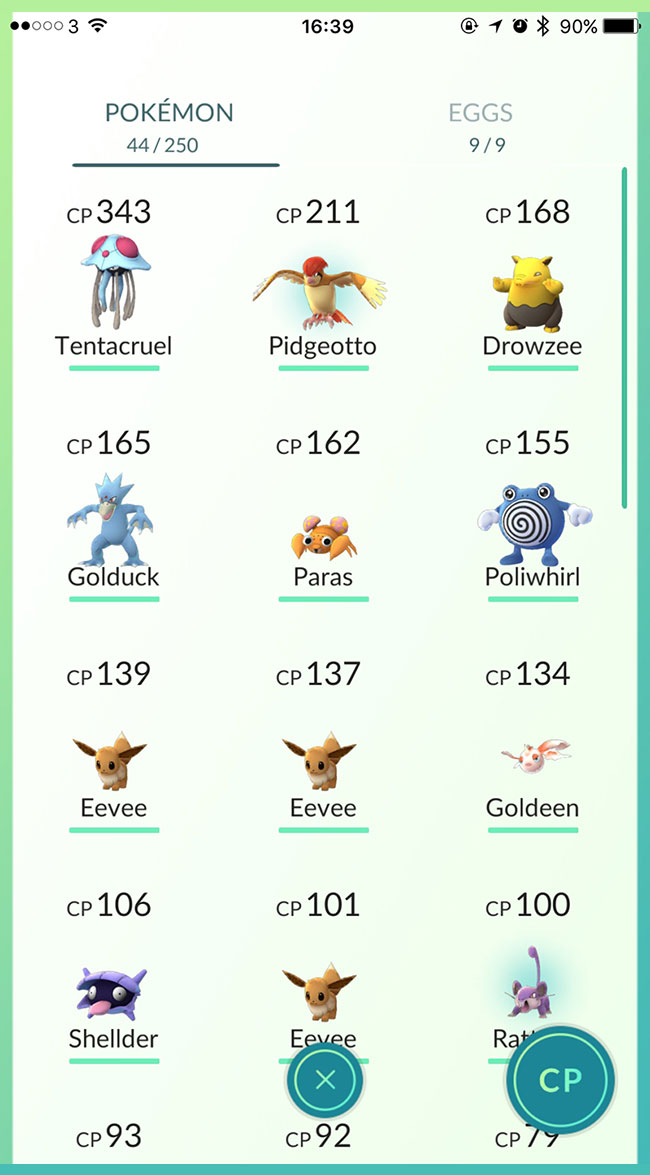
This is what a winner’s Pokédex looks like, if they suck at winning.
In the UK, it’s customary to celebrate a lunchtime Sunday roast with a long walk to balance out the Thanksgiving-level of calories you’ve just consumed. So we decided to venture out, but while we’d planned to just walk across the river, Pokémon Go had other ideas. It began suggesting that, through the older, cobbled streets that surround the cathedral, there was a litany of Pokéstops. So, we obligingly began to follow that path instead, stocking up on powerups, eggs and balls. On the way, we found a medieval defensive tower we’d never encountered before, plus a hidden riverside pathway that isn’t obvious from the road.
The walk was twice as long as planned, and I returned delighted to have found all these new spots nearby. I’d also managed to rinse my phone battery in about four hours — a new record even for me. The following morning, those same colleagues I’d ribbed the week previously were now dealing with a litany of questions. I wanted to know how best to level up, how gyms worked and what was the best way of improving my collection so that I can take over the gym across from my home.
Today, I’ve not been out on the catch, although I’ve had my phone open for much of the day picking up anything that comes within my range. When I’m done writing this, I’ll wander at least as far as my local Pokéstop to re-up on supplies, and maybe think about going a little further. I can’t believe that any game is getting me out of the house and wandering around historic sites, let alone a Pokémon game. It’ll be a while before I can get to the point where I’ll be able to fight my locals — their Pokémon all have combat points in the thousands — but I’ll get there at some point.
Wireless charging tech harvests your phone’s wasted radio waves
When you think of wireless charging, you probably think of special charging pads for your phone. But what if your phone could partly charge itself? Radient Micro-Tech claims to have managed just that. It just received two patents for technology that reportedly captures energy from a device’s wasted radio waves (those that would merely dissipate in the air) for the sake of charging. While it’s not specific about how the technology works, it would harvest those RF waves through antennas built into your phone’s screen. Radient is claiming that you’d get up to 30 percent longer battery life, which could be enough to get you through a particularly active day.
It sounds too good to be true, and there are certainly reasons to be skeptical. There’s a working prototype (needed by the US patent office), but we’ve yet to see a practical demonstration — we’ve asked for one and will let you know if we get it. Also, Radient is planning to license the concept to device makers, rather than designing physical components it can sell. It’s easy to promise a revolutionary product if you’re not the one who has to mass-manufacture millions of units. If the reality comes anywhere close to the hype, though, the invention will either extend the battery life of phones or allow for smaller batteries without taking a hit to longevity.
Source: Radient Micro-Tech
 AIVAnet