



Android 5.0 Lollipop Upgrade Watch

Wednesday was a big day in the Android world, as Google announced the biggest update to Android ever: Android 5.0 Lollipop.
While this is great news for Android enthusiasts, the bad news is this update still has to go through all the phone manufacturers, and even then the carriers before it gets to the user. While this can make one groan, the bright side is we seem to be in a time where more manufacturers realize the importance of timely updates.
We have this page that we will update whenever we get news of an update schedule from manufacturers. This is quite the task with as many manufacturers and then carriers there are, but we will do our best to be timely.
What I can tell you (at least about the major manufacturers) is this: Motorola is easily the quickest (except for Google, naturally) with updates, as last year’s Moto X got KitKat within weeks of its release. HTC has not had a great track record, but in June they announced they will bring Android Lollipop to all their HTC One (M8) and HTC One (M7) within 90 days of receiving the software from Google. Samsung, LG, and Sony all are very obscure and do not communicate regarding their updates.
Without further ado, here are all the newest details regarding Android 5.0 Lollipop upgrade:
Motorola announced not long after Google that they will be updating many of their devices released in the past year (and even past). We reported on this yesterday, but here is the link to their blog announcement here, and the page they will update with all update info here.
Below is what is confirmed by Motorola:
- Moto X (1st Gen)
- Moto X (2nd Gen)
- Moto G (1st Gen)
- Moto G (2nd Gen)
- Moto G with 4G LTE
- Moto E
- Droid Ultra
- Droid Maxx
- Droid Mini
We will update as soon as we have dates for these devices.
HTC has announced that they will follow-up on their promise, and that their last two flagships will get the update within 90 days of receiving final software from Google. After that, the update will reach “other One family members and select devices”. Here is their update page here.
Below is what is confirmed by HTC, with our estimated time of upgrade:
- HTC One (M8) – (ETA) middle of January
- HTC One (M7) – (ETA) middle of January
- Other One family members – (ETA) sometime 2015
- Select devices – (ETA) sometime 2015
We will update as soon as we have dates for these devices.
That’s all we have for now. Again, this will be updated as soon as we hear!
 |
The post Android 5.0 Lollipop Upgrade Watch appeared first on AndroidGuys.
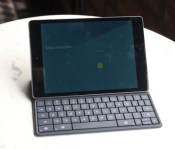
Nexus 9 finally shown off in real pictures and videos with keyboard case

The Nexus 9 is easily the most hotly-anticipated Android tablet of the year and over the past few days has shown its face in teaser videos, renders and cartoons, and while we may have to wait until later this month to get our hands on one, Techrum user tdiddy-2 has uploaded a ton of photos of the upcoming tablet to the Vietnamese forum. Thanks to Italian site Webtrek we also have a couple videos of the tablet in action. The official keyboard case also makes an appearance in the photos. Hit the break for the motherload.


As you can see from the photos, the keyboard case seems to fit quite nicely and allows the front-facing BoomSound speakers to blare media with no issue. The cover is a “smart” cover and also features a mechanical keyboard. Are any of you planning on picking one of these up? Or is that old-school 4:3 screen ratio a dealbreaker? Sound off in the comments and scroll down to see the Nexus 9 in action!
Click here to view the embedded video.
Click here to view the embedded video.
Come comment on this article: Nexus 9 finally shown off in real pictures and videos with keyboard case

HTC Dot View app gets third-party notifications, music controls, and holiday surprises

Today, HTC brings some of the most-requested features to its companion application for the Dot View case. The Dot View case will now show third-party notifications from any app. Previously, developers had to take advantage of the technology and do it themselves. In addition to having a third-party app icon appear on the display with the case closed, a user can swipe up for quick launch. Then the app will appear when opening the case. HTC also brought music controls so you do not have to open the case and hop around just to pause or skip a song.
In the changelog for the app, HTC says that it has included “new secret features.” It seems that the company is going to celebrate some holidays starting with Halloween. The app’s Google Play page shows a screenshot of a carved pumpkin. We expect that more holidays and seasons will be included over time.
Hit the break for the gallery and download links.


Come comment on this article: HTC Dot View app gets third-party notifications, music controls, and holiday surprises
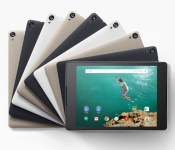
The Google Nexus 9 official with pre-orders starting Oct. 17th

Part 2 of Android Christmas is here. The Google Nexus 9 is now also officially announced and the HTC-manufactured tablet is nothing less than we had imagined. While it has seen less leaks than its smartphone stablemate, the Nexus 9 cuts an impressive figure with matte black and that 9-inch display. What was leaked, like the internals, are much more accurate, which is definitely a good thing. Powered by a NVIDIA Tegra K1 chip (with 192-cores) at 2.3GHz and 2GB of RAM the Nexus 9 looks to be a worthy successor to the large format Nexus tablet, the last of which is the well outdated Nexus 10.
The Nexus 9 officially carriers Android 5.0 Lollipop to consumers hands on the 8.9-inch IPS LCD display at 1048×1536. Being HTC designed you get the dual front facing BoomSound speakers that many have grown to love quite a bit. The Nexus 9 also carries along a 8MP rear cameras, 1.6MP front camera, 6,700 mAh battery and is showing either 16GB or 32GB internal storage offerings. Power wise the Nexux 9 packs a 6,700 mAh battery into its ultra slim 7.95mm housing with an estimated life expectancy of 9.5 hours of Wi-Fi browsing. As you can see in the above image, the Nexus 9 will be offered in three color variants, Indigo Black, Lunar White and Sand.
The Nexus 9 announcement via Google’s Blog doesn’t offer a price tag just yet though. I didn’t find anything on HTC’s site, at least not while I was looking, that offered up concrete pricing. Previous rumors stated the 16GB would be $399 and the 32GB would be $499. I will keep searching for concrete pricing from Google or HTC to that effect throughout the day. Be sure to sign-up for email news alerts from Google about the Nexus 9 at the bottom of the tablets overview page.
Source: Google Blog | Nexus 9 page
//<![CDATA[
ord = window.ord || Math.floor(Math.random()*1E16);
document.write('‘);
//]]>
The post The Google Nexus 9 official with pre-orders starting Oct. 17th appeared first on AndroidSPIN.
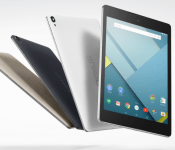
HTC’s Nexus 9 is official, complete with brushed metal design and BoomSound speakers

HTC’s often-rumored Nexus 9 tablet is official, and it looks like one of the best Android tablets we’ve ever seen. The device sports an 8.9-inch screen big enough to enjoy movies and games but still small enough to carry around throughout the day. The specs are top notch, too, including a Tegra K1 CPU, 2048×1536 resolution on the screen, and 2 GB of RAM. It’s also equipped with HTC’s fantastic BoomSound speakers, too.
Software is pretty self-explanatory; you’ll get Android 5.0 with no OEM modifications, and it’s a Nexus device, so updates will come quickly from Google. The tablet also looks like it’s getting quite a bit of accessory support, too, as Google is already showing off an official keyboard case for the device. If you’re looking for an Android tablet for true productivity, this might be the way to go.
The Nexus 9 will release on November 3rd in a few different variants. The 16 GB model runs $399 while the 32 GB costs $479, and both will come in white and black. Google and HTC plan on releasing a sand color and LTE version of the tablet later this year, too.
What are your thoughts on the Nexus 9? Is it worth the premium price tag over the Nexus 7 or other cheaper Android tablets?
source: Google
Come comment on this article: HTC’s Nexus 9 is official, complete with brushed metal design and BoomSound speakers
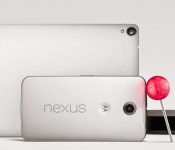
Google’s Nexus 9 available early next month with Android 5.0, starts at $399

Today’s the day Google fans have been waiting for: the announcement of this fall’s Nexus lineup. It’s essentially an annual tradition at this point, since the last few Nexus devices have arrived at the same time of year. Along with a 6-inch smartphone and a media streamer called the Nexus Player, Google’s introduced an 8.9-inch 2,048 x 1,536 tablet built by HTC aptly called the Nexus 9. This slate, which is available for pre-order this Friday and in stores on November 9th, starts at $399 for the base 16GB WiFi model; $479 for the 32GB WiFi; and $599 for a 32GB LTE variant that comes packed with penta-band HSPA+, quad-band GSM/EDGE and CDMA. As is often the case with brand-new Nexus phones and tablets, the 9 is among the first to get the latest version of Android — in this case, it’s Android 5.0 Lollipop.
The Nexus 9 will be the first in the lineup to come with 64-bit support, thanks to the dual-core 2.3GHz NVIDIA K1 chipset inside. You’ll also get 2GB of RAM; an 8MP rear-facing camera with autofocus, BSI and f/2.4 aperture; a 1.6MP selfie camera; dual-band WiFi 802.11a/b/g/n/ac; and a 6,700mAh battery. HTC was also able to slide in its signature BoomSound stereo speakers, which have been impressive on its flagship devices. The 7.9mm-thick slate will be available in black and white and weighs in at 425g (436g for LTE).
As for the external appearance, it actually looks a bit like an enlarged version of the Nexus 5, but with brushed-metal sides. The display, covered by a slab of Gorilla Glass 3, also takes advantage of a 4:3 aspect ratio, rather than 16:9, and features a double tap to wake option. When it comes to productivity, Google and HTC have designed a keyboard folio case that attaches to the Nexus 9 magnetically.
Filed under: Tablets, Wireless, Mobile, HTC, Google
Source: Google
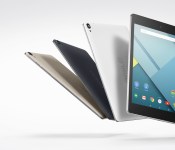
HTC Nexus 9 announced for November 3

The new Nexus family is out, and the HTC Nexus 9 brings the latest iteration of Android 5.0 Lollipop, to a beautiful tablet.
The Nexus 9 comes with the typical Nexus matte back finishing, and a metal frame, which seems to be the trend with Android devices nowadays. It has a 8.9 inch IPS LCD panel, with a resolution of 2048 by 1536 pixels, which gives it a pixel density of 288 ppi. It has a huge 6700 mAh battery, front-facing HTC Boomsound speakers, 8MP back-facing camera, 1.6MP front-facing camera, 2GB of RAM, LTE antenna, the new 64-bit dual-core NVIDIA Tegra K1 processor, which clocks in at 2.3 GHz, and the Kepler DX1 GPU.
Of course, it comes with all the perks and upgrades that one can expect from Android 5.0 Lollipop. However, this tablet seems to have taken a leaf out of LG’s book, as it comes with a feature called ‘double tap to wake’. It also has an accessory keyboard which is almost identical to the HTC Volantis keyboard patent leaks previously.

Pricing is currently unknown, and preorders will start on the 13th of October. It will be available from the Google Play Store and respective carriers will also soon announce pricing. The Nexus 9 will come in 16GB and 32GB variants, and in 3 different colours; Indigo black, Lunar white, and sand.
|
The post HTC Nexus 9 announced for November 3 appeared first on AndroidGuys.

Smartphones in one year: Project Ara (Opinion)

Smartphones have come a long way since their inception; though the idea of a portable device with internet connectivity and calling features has been around since the 1980s, it was not well received until 2006, with Blackberry’s new devices such as the Curve and Pearl. It revolutionised the way mainstream society viewed portable electronic devices and our uses for mobile phones. However, Blackberry did not enjoy this success for long, with the launch of the revolutionary iPhone, from Apple. It incorporated a touchscreen, and only 4 buttons. People were amazed by the fluidity of a device which essentially had nothing but screen on the front face. Apple’s market share grew rapidly, for example, increasing 626% globally in the smartphone sector, between the last quarter of 2008 and the first quarter of 2009.
The smartphone industry proved itself unpredictable once more in 2010, with Android’s new ‘Gingerbread’ overtaking iOS in the US, having already overtaken iOS in markets such as South Korea in 2009. With this saw the rise of OEMs such as Samsung, LG and HTC. Apple released the iPhone 4, a beautifully designed phone with ‘Retina display’ which yielded a positive response from the consumer market. Blackberry’s RIM was still going strong, however, failing to generate sales. 2010 also saw Microsoft’s attempt to tap into the smartphone market with Windows Phone, which did not meet good reception.

The home interface of Android gingerbread – image source: http://developer.android.com/about/versions/android-2.3-highlights.html
In 2011, with the release of Android 4.0.4, or ‘Ice Cream Sandwich’, Android phones finally started to be perceived as high-end, mainly due to the refreshed, sleeker interface Ice Cream Sandwich brought, and the smoother user experience, thanks to ‘Project Butter’, in Jelly Bean, 4.1. Android’s market share grew further to 36% in the US, placing them in a comfortable first position in terms of market share. Samsung also released the hugely popular Galaxy S2, and Apple released the iPhone 4S, which brought in Siri, a voice controlled assistant. By this point, Blackberry’s market share in the US decreased to less than that of Android and iOS.

The home interface of Android Ice Cream Sandwich – image source: http://developer.android.com/about/versions/android-4.0-highlights.html
Fast forward to 2014, where 80% of the world’s smartphones run on Android, and where Samsung is the biggest producer of smartphones internationally. Android Kit Kat brought performance and aesthetic improvements to Android, and Apple’s iOS got its long-awaited makeover in iOS 7 – which produced mixed opinions. HTC and LG gained a significant amount of market share, with the One M8 and G3 respectively, in markets such as the US, Europe, South Korea and Australia. However, it came as a shock that less popular manufacturers such as Huawei, Lenovo and Xiaomi had superceded manufacturers such as LG, Sony and HTC in the global market. This reiterated the influence that the Chinese market had on global business, and its sheer size.
The sudden entry of China into the smartphone market was expected, but not to the scale which it has. Not only have the consumers in China played a huge role in the global market share of OEMs, but their manufacturers such as Huawei, Xiaomi, Lenovo, Oppo, and more recently, OnePlus, have given the traditional smartphone manufacturers such as Samsung a real dilemma. Samsung is rapidly losing profits; quarterly projections going down by numbers such as 40% and 60%, and LG and HTC are struggling to keep their heads above the water. Chinese manufacturers are beginning to build great devices such as the OnePlus One, or the Xiaomi Mi3, with high-end specs, but sell for half the price of their counterparts of traditional OEMs.

The ‘flagship killer’ OnePlus One, from OnePlus – image source: http://oneplus.net/
I believe that next year will be pivotal in the smartphone industry; due mainly to the speculated release of the modular phone; Project Ara.
Project Ara will be the ‘next big thing’. It can be tailored to the needs of the individual, therefore, has the capacity to be a high-end or mid-range device. The concept of not having to buy a new handset every time a new chipset comes out, or when the screen is cracked, is intriguing. If marketed and manufactured well by Google, it will cause the idea of the ‘complete handset’ totally redundant. Consumers will only buy a new processing package, insert it into their modular phone, at only a fraction of the cost of buying a totally new handset.
This will pose a serious concern for current manufacturers. Instead of building complete handsets, companies will look for ways to monopolise the industry for a certain part of the modular phone. For example, Samsung and LG may both aim to control the displays of Project Ara, while Qualcomm with the chipsets. Unless the business can achieve a monopoly or duopoly of such industries, they will experience severe losses, provided that Project Ara is successful.
What must also be considered is the third-party, non-authorised manufacturers. These will be extremely popular in markets such as China, which, as proven before, is a market crucial to the survival of a consumer-oriented business. These ‘pirate’ manufacturers will provide parts of lesser quality, however, cheaper price, and can cause a formidable dent in the income of respective manufacturers.
The potential repercussions of the launch of the Project Ara platform to the smartphone industry are concerning. If it is as popular as it is believed it will be, it will result in the complete monopolisation of the smartphone market with Android, and with only one handset. It will minimise variation, innovation, originality and creativity; the smartphone industry will be extremely static. Therefore, I can hope another company will reciprocate Project Ara in an equally fantastic product, in order not to let Google singularly rule the industry, and maintain the dynamic, multifaceted environment of the smartphone industry, which is ultimately what renders the sector as stimulating as it is.
|
The post Smartphones in one year: Project Ara (Opinion) appeared first on AndroidGuys.

Second source claims Google to launch Nexus 9 running Android L on October 15th

An unnamed source described as “close” to Google indicates the company plans to officially announce the Nexus 9 tablet and a new Nexus smartphone on Wednesday, October 15th. The source says Google will make the announcement via a blog post instead of doing it via a big, splashy event. The source indicates the reason for the lack of a “big reveal” was to give programmers more time to iron out some final tweaks in Android L. It is worth noting though that Apple has an event scheduled for Thursday when it is thought updates to their tablet lineup will be revealed, so Google may be trying to get a jump on the press and make sure consumers have something to compare any new iPad devices against.
The new Nexus 9 tablet, built by HTC, will be available for pre-orders starting on the 17th of October with a projected delivery date of November 3rd. At least two versions are expected, a 16GB WiFi-only version that will retail for $399 and a 32GB LTE version selling for $499. According to the source, the new tablet will have an 8.9-inch display running at 2048 x 1440 resolution, it will have a 64-bit dual-core processor, an NVIDIA Kepler graphics chip, and will feature HTC’s dual front-facing boom sound speakers similar to the HTC One (M8).
The October 15th announcement date, if it occurs, is pretty close to the projected date reported last month and coincides with leaked information that surfaced a few days ago.
source: Forbes
Come comment on this article: Second source claims Google to launch Nexus 9 running Android L on October 15th

What’s in the box: Could this be the Nexus 9 that Jeff Gordon just tweeted about?
 While Google is being typically quiet around the time of its device and software releases, HTC can’t seem to stop talking about so-called confidential information. After HTC President of North Asia, Jack Tong, “accidentally” confirmed that the Nexus 9 was HTC’s springboard back into the tablet market, Jeff Gordon, HTC Global Online Communications Manager, has been seen tweeting about a cardboard box. And what exactly is inside this cardboard box? Well, Gordon says of the box “Something amazing, beautiful and highly confidential just arrived.”
Something amazing, beautiful and highly confidential just arrived. pic.twitter.com/0C1KXI3lqO
— Jeff Gordon (@urbanstrata) October 13, 2014
Now, unless HTC forgot to announce something at its Double Exposure event earlier this week, we’re pretty certain that inside that box will be a new Nexus 9. We won’t have long to see what it likely looks like as all bets are on October 15th being the day that Google announces the new tablet, one day ahead of the rumoured announcement of Apple’s new iPads. Devious, no? Priced at an alleged $399 USD, the Nexus 9 isn’t going to be the cheapest Nexus tablet ever, but it will be packing some intense hardware such as NVIDIA’s Tegra K1 processor, 3GB RAM and an almost 9-inch Quad HD display.
What do you think about Gordon’s tweet? Let us know your opinion in the comments below.
Source: Twitter via Phone Arena
//<![CDATA[
ord = window.ord || Math.floor(Math.random()*1E16);
document.write('‘);
//]]>
The post What’s in the box: Could this be the Nexus 9 that Jeff Gordon just tweeted about? appeared first on AndroidSPIN.

