



Google tests the performance limits of D-Wave’s quantum computers

We’ve long known that D-Wave’s quantum computers are specialized tools rather than Swiss Army Knives, but just how good are they at their intended tasks? Google has just conducted some benchmarking to find out, and the short answer is that these systems are very good — but they have definite limits. A current-generation D-Wave 2 is about 35,500 times faster than a generalized problem-solving computer when both are running standard software. However, some of that advantage disappears when a general-purpose computer runs code that simulates quantum computing. While D-Wave’s hardware is better at dealing with structured code, it runs neck-and-neck with the “fake” system when tackling random problems. Not that Google is feeling much in the way of buyer’s remorse. It believes that further tests could see the D-Wave unit come out ahead, and future quantum machines should make it harder for conventional PCs to catch up.
Filed under: Misc, Science, Google
Via: SlashGear
Source: Google Quantum AI Lab (Google+)
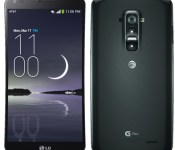
LG G Flex will be $300 on AT&T, pre-orders begin January 24th

Sprint was the first out of the gate to announce LG G Flex pricing and availability for the US, but AT&T isn’t too far behind. The network just made it be known that the curved smartphone will be available for pre-order online and at retail stores starting January 24th. We haven’t been given specifics on when the device will get shipped out to early adopters, nor do we have a date on when it’ll be stocked on shelves for everyone else — but we do know, however, that it’ll be all yours for $300 with a two-year contract. If you’d rather get it on a Next plan, you can do so by paying $27 per month (on an 18-month plan) or $35 per month (on a 12-month plan).
Filed under: Cellphones, Wireless, Mobile, Google, AT&T, LG
Source: AT&T
Google starts banning Chrome extensions bought by shady ad firms

A brouhaha over adware-laced Chrome extensions has forced Google to remove two from its store and possibly exposed a wider issue. According to the original developer of “Add to Feedly,” the problems happened after he sold his plug-in — created in a few hours — to a party for a too-good-to-be-true “four-figure” sum. As detailed in a blog, he discovered that new code was injecting ads into every page browsed without approval, angering users and lowering its rating. The same thing happened with “Tweet This Page,” another app that served up unwanted ads after being sold. Since other developers were also approached, there’s speculation that it could be a new type of scam: buying perfectly good extensions, altering them and then letting Google slip them to users via automatic updates. After it was contacted by the WSJ, Google pulled the renegade extensions, saying that recently altered terms of service prohibit them. However, that’s only because they didn’t ask user permission; there’s nothing to prevent apps from inserting such ads — something to keep in mind the next time you tweak Chrome.
Via: The Verge
Source: WSJ, Amit Angarwal

Nest promises not to force any privacy changes on customers after Google’s takeover

Google’s acquisition of Nest prompted more than a few privacy concerns, legitimate and otherwise — will you have to share temperature data with advertisers? You won’t, as long as CEO Tony Fadell has his way. He told those at the DLD Conference that there aren’t any plans to change Nest’s current privacy policy, and any changes will be both transparent and opt-in; your smoke alarm won’t start posting Google+ updates without permission. It will be a while before we see how well the company lives up to its promise, but it’s good to know that Nest’s ideal connected home won’t be too connected. Check out Fadell’s privacy remarks in the video below at about the 12:49 mark.
Filed under: Household, Internet, Google
Via: The Next Web
Source: DLD Conference
Weekly Roundup: Google acquires Nest, President Obama speaks out on surveillance and more!

You might say the week is never really done in consumer technology news. Your workweek, however, hopefully draws to a close at some point. This is the Weekly Roundup on Engadget, a quick peek back at the top headlines for the past seven days — all handpicked by the editors here at the site. Click on through the break, and enjoy.

Google acquires Nest
Google acquired Nest’s line of home automation products for a whopping $3.2 billion. iPhone users have no need to fear, however, as Google has pledged to continue support for both iOS and Android. Click on through for the rest of the story.

President Obama speaks out on surveillance
In a speech last week, President Obama addressed concerns surrounding the NSA’s data collection and surveillance programs. While the NSA won’t stop gathering private information anytime soon, Obama is putting a few restrictions in place to prevent governmental abuse. Click the link for all the details.

Privacy-focused Blackphone
Spanish manufacturer Geeksphone says it’s working on a privacy-focused smartphone for release at MWC. The Android-based handset, called Blackphone, will utilize a “PrivatOS” skin to secure calls, texts and web browsing. Follow the link for details.

Google’s smart contact lens
Google’s developing a smart contact lens that can measure glucose levels from your tears, offering diabetics a pain-free way to keep tabs on their health. Click through for more information.
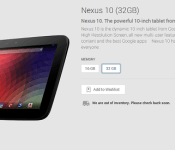
The 32GB Nexus 10 is out of stock on the U.S. Play Store; cue Nexus 10 refresh Rumours
 It seems like at the very mention of any activity regarding the Nexus 10, a whole slew of rumours begin with trigger-happy fans and writers, myself included, excitedly trying to predict when Google will replace its aging Nexus 10 tablet. Well, there is about to be more fuel added to the flames as the 32GB Nexus 10 is out of stock on the U.S. Play Store (note that it will probably still be in stock in Play Stores around the world). The 32GB Nexus 10 now joins its 16GB counterpart in the ‘out of stock’ category on the U.S. Store which for some would appear to imply a new version of the tablet is nigh.
Unfortunately, there’s little to suggest that the inventory of the Nexus 10 has anything to do with future product release; while you might argue that the Nexus 4 going out of stock heralded the release of the Nexus 5, we had heard a fair amount about the Nexus 5 through unintentional (or intentional) leaks leading up to the release. That’s not to say that this isn’t an indication though, as we could be savouring a new Nexus 10 in a few weeks’ time, but it pays to be cautious.
I guess we’ll just have to be stuck with waiting till Google decides to ‘accidentally’ drop some video of the new Nexus 10. Who thinks the 32GB Nexus 10 going out of stock is an indication of things to come? Let us know what you think.
Source: Google Play via Android Police

The future of beauty school is Google Glass

At least according to L’Oreal. The hair care giant (and purveyor of giant hair) just announced Matrix Class for Glass, which gives clients and beauty school students a stylists-eye view of your head. The three-part program includes a video series of in-depth beauty tutorials shot with Google’s wearable; Matrix Eye for Style, an “exclusive” salon experience provided by George Papanikolas, who will record sessions with the headset; and a series of lessons for beauty professionals given by be-Glassed hair care superstars.
This isn’t the first or last time L’Oreal has taken advantage of the wearable; it used Glass to document Mercedes Benz Fashion Week in Madrid late last year and has plans to release a Glass app sometime in 2014. It might seem like an odd coupling considering most glass holes are more Super Cuts than Vidal Sassoon, but L’Oreal says there’s an intersection between the early adopters of fashion and tech. According to a study done by its partner at Fashion Week, Nurun, “The futuristic nature of Google Glass appealed to the fashion-forward, tech-savvy audience…” When we start seeing years-old issues of Wired replacing copies of Southern Hair at Truvy’s, we’ll believe it.
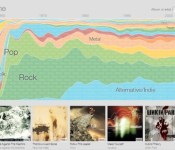
Google is mapping the history of modern music

It’s no surprise that Google has been tracking music uploads, but what’s unexpected is exactly what the search giant is doing with all of that info. Interactive maps of music’s ongoing journey are charted through Play Music’s users’ libraries, found over on Google’s Research Blog. You could, for example, trace the ebb and flow of a genre era by era (rock remains one of the biggies while electronica’s presence is relatively new), or even identify which release from a band is the most prominent. Looking at the Deftones, their biggest album is 2000′s White Pony, and they’re near the top of the alt-metal heap overall. Music nerds could lose a few days poring over the various ins and outs of the soundtrack to their lives, so be careful who you share this with. Perhaps best of all, Google says this likely won’t be the last collaboration we see between the research and music teams.
Filed under: Google
Source: Google Research (1), (2)
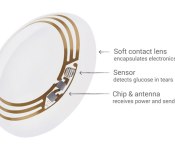
The power of tears: Why Google has its eye on smart contact lenses

When the cronut craze swept across New York in early spring of last year, the only major inconvenience associated with Dominique Ansel’s novel culinary confection was the pain of waiting in line to get it. For a responsible person living with Type 1 (or Type 2) diabetes, like my good friend Cara, that wait time for a hip baked good would’ve been compounded by a few more irritating factors.
First, there’d be a necessary finger prick test (administered in the open by an always on-hand glucometer) to measure blood sugar levels an hour before eating. Then, a guesstimate would need to be calculated of just how many carbs that precious SoHo sweet contained, followed by an adjustment of insulin delivery levels on a waist-worn pump. And, finally, a follow-up finger prick test would need to be done two hours after eating the cronut to once again establish a necessary insulin base line. That is true inconvenience. That is life with diabetes. And as you might imagine, not all diabetics are this disciplined. But Google wants to change that… with contact lenses.
The idea isn’t new, so don’t race to applaud Google just yet. Researchers have been kicking around various ways to implement contact lens-based glucose monitoring for years; methods that include a biofuel cell that runs on tears and glucose level fluctuation via fluorescence. Google’s taking a similar approach with its smart contact lenses, only with LEDs in place of fluorescence to alert wearers. Yes, that means diabetics could be walking around with color-changing contacts in their eyes, just not in the way you or Lil’ Kim would necessarily want.
The idea isn’t new, so don’t race to applaud Google just yet.
The other obvious upside to contact lens-based glucose monitoring can be boiled down to two words with heavy resonance amongst diabetics: continuous and non-invasive. Would you want to prick your fingers multiple times a day? Don’t worry, I’m aware the sane answer is no. Would you want to check a mirror or compact every few hours to monitor a colored dot beneath your lower eyelid that corresponded to varying glucose levels? The correct response is: “Sure. I prefer anything that doesn’t involve stabbing myself and running the risk of infection daily.” And that’s the promise of Google’s smart contact lens technology. It would afford diabetics a degree of freedom they don’t currently enjoy; an ability to forgo that crude blood drawing ritual in favor of contacts that wirelessly “generate a reading once per second.”

Unfortunately, wearable diabetes-detection technologies like this haven’t yet made it to the mainstream. It’s not because they lack a proof of concept, but because of price, as one researcher behind fluorescence-based detection discovered. That cost barrier is something Google could help to alleviate with its pervasive, free-to-use services model… or, at least, I assume that will be the approach. When daily disposable contacts are already too much for most people’s health insurance to cover, the prospects for disposable, glucose-monitoring contact lenses appear niche and dim. But are they?
According to a Center for Disease Control report from 2011, nearly 26 million Americans are currently living with diabetes and about a further 7 million are undiagnosed. That figure doesn’t even take into account the additional 79 million people living with prediabetes, the precursor to Type 2 diabetes, which accounts for up to 95 percent of all cases in the United States. Type 2 is the form of diabetes associated with aging and a sedentary lifestyle, so the figure, though alarming, shouldn’t faze you all that much.
Now, that’s our government’s latest data from three years ago. Google, in its smart contact lens announcement, cited 2013 figures gathered by the International Diabetes Foundation, a non-profit based in Brussels, Belgium. The IDF numbers peg the United States as the number three country for persons living with diabetes between the ages of 20 and 79, with about 24.4 million diabetics. Contrast that with China and India, which are home to 98.4 million and 65.1 million diabetics, respectively. Those numbers then conflate to about 382 million globally when every territory is factored in, and that’s just for 2013. Estimates for the year 2035 have the incidence of global diabetes spiking up to 592 million. Or to go with the CDC’s projections, we’re looking at one in every three Americans being diagnosed with diabetes by 2050. Are you starting to see the problem here?
The truth is, Google wants data. It’s a company that’s built on information-gathering as a trade.
But why does Google care about diabetes? Surely, the news of its contact lens project would’ve been met with less confusion had Google announced it was an obvious progression of the Glass project; a mobile wearable that’s literally on your eye. I’m sure that’s what most of us expected, anyway. The truth is, Google wants data. It’s a company that’s built on information-gathering as a trade. It’s why the company recently shelled out $3.2 billion for Nest — an obvious bid to track our energy usage. You get your Gmail and search and various other Google services for free because Google gets your personal data. That’s Google currency and our health information is just another facet of that. We all get sick, and we all know doctors and HMOs and hospitals and pharmacies are a chore to deal with. Google knows this and if it can flip that paradigm around and put the control into its users’ hands, well then it’s a win/win. We get to track, control and monitor our health data via a Google-hosted database and partner apps, and Google gets to mine that info for every last dollar it’s worth.
You’re not alone in sensing a state of déjà vu here; Google’s done this before and the results were disappointing. Back in 2008, the company introduced Google Health, a database for the personal collection of health records that was, in theory, a great idea: health records that belong to and move with you, not medical practices. In the company’s own words, Google Health was “based on the idea that with more and better information, people can make smarter choices … in regard to managing personal health and wellness[.]” Of course, that access to information is a two-way street. This being Google, the usage habits of Health users were recorded (e.g., links clicked, number of sign-ins) for internal purposes — the kind of data that makes up Google Trends. Ultimately, though, the power to disclose information remained solely in the hands of users, as Google Health’s privacy policy explicitly stated. So Google, barring any mandatory compliance with governmental requests, could only see what medical info users chose to disclose and nothing more.
It failed, though, and Google was forced to shutter the project in 2012. Turns out, it was unsurprisingly only popular with “tech-savvy patients and their caregivers, and … fitness and wellness enthusiasts.” Let’s break that down a bit further. Google Health’s base was comprised primarily of early adopters and fitness freaks — the exact sort of demo that takes immediately to wearable technologies. Take that demo, add in a known (and growing) epidemic like diabetes, existing contact lens-based glucose monitoring technologies, mix them all together and you have a recipe for the successful resurrection of Google Health. But let’s not call it that just yet, until Google does, that is.
So Google’s getting back into the health game, albeit through the backdoors of upward trending wellness issues like geriatrics and diabetes. And all because Google cares… about your data.
Daily Roundup: Google’s smart contact lens, President Obama on the NSA and more!

You might say the day is never really done in consumer technology news. Your workday, however, hopefully draws to a close at some point. This is the Daily Roundup on Engadget, a quick peek back at the top headlines for the past 24 hours — all handpicked by the editors here at the site. Click on through the break, and enjoy.

Rumored HTC One sequel
Bloomberg sources claim that the follow-up to the HTC One, the M8, will be released in late March. Click on through for more information about the launch and its rumored double-camera setup.
Google’s smart contact lens
Google’s developing a smart contact lens that can measure glucose levels from your tears, offering diabetics a pain-free way to keep tabs on their health. Click through for more information.

Citation for driving with Glass dismissed
Google Glass early-adopter Cecilia Abadie received her second ticket for wearing the headset while driving, but this time it was dismissed because there was no evidence she was operating Glass during transit. Follow the link for the whole story.
President Obama speaks out on surveillance
In a speech today, President Obama addressed concerns surrounding the NSA’s data collection and surveillance programs. While the NSA won’t stop gathering private information anytime soon, Obama is putting a few restrictions in place to prevent governmental abuse. Click the link for all the details.

