


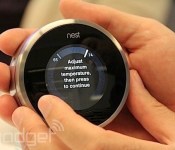
Nest is now officially a Google-owned company, ready to produce all sorts of who-knows-what

Prepare for a world of Google-controlled thermostats, smoke alarms and no doubt other mysterious projects we don’t know about yet. Shortly after receiving the green light from the FTC, the search giant announced that its $3.2 billion acquisition of home automation company Nest is now a done deal. Google’s already touting Nest as the perfect partner to”enhance its suite of products and services,” and is allowing founders Tony Fadell and Matt Rogers (both ex-members of the original iPod team) to continue operating the company under its own brand. Google’s involvement brings its fair share of privacy concerns, but Fadell says there aren’t currently any plans to change the company’s current privacy policy, and that any future changes will be both transparent and opt-in. While we don’t fully know what Google has planned, now that it has swapped smartphones for smart homes, we guess it could make a good start simply by making Nest’s existing products available in more countries, as they’re barely known outside of the US.
Filed under: Household, Internet, Google
Via: Recode
Source: Google SEC
Daily Roundup: alleged Windows Phone 8.1 leak, ARM’s Cortex-A17 processor, and more!

You might say the day is never really done in consumer technology news. Your workday, however, hopefully draws to a close at some point. This is the Daily Roundup on Engadget, a quick peek back at the top headlines for the past 24 hours — all handpicked by the editors here at the site. Click on through the break, and enjoy.

Samsung Galaxy S5 teaser
Samsung’s next-generation Galaxy S5 handset is set to launch at this year’s Mobile World Congress. And though we have relatively few details on the device itself, the company’s event invitation hints at a couple of new privacy and fitness features. Click the link for details.

Windows Phone 8.1 leak
A Reddit user claims to have grabbed the above screenshot from a developer preview of Microsoft’s Windows Phone 8.1 SDK. Though we don’t see any hints of the rumored Action Center or Cortana virtual assistant, the image may provide new insight into Redmond’s unification of Windows Phone and Windows RT. Read on for more.

Google acquires NASA hangar
Google has many interesting irons in the fire (robots, barges, et cetera), but its latest endeavor is no less intriguing. One of the company’s subsidiaries, Planetary Ventures, took ownership of NASA’s “Hangar One” with plans to transform the enormous building into an educational facility. Follow the link for more information.

ARM announces new Cortex-A17 processor
ARM plans to bring even better speeds to the mid-range smartphone and tablet markets with its new Cortex-A17 processor. And while there’s no release date just yet, we can expect to see a huge push for the A17 come 2015. Click on through for details.

Pebble engineer explains why its Android app isn’t ready yet

iOS users have been enjoying the new Pebble app store for the past week, but the Android version of the app is still MIA. Sure, you can download the beta if you sign up to be a developer, but if you’d rather wait for the final product, it’s still in the works. What gives? Pebble engineer Keon Wong wrote a bit about the subject on the company’s official blog about the process involved. The Cliff’s Notes version is that there are two factors at play: one is how complex it can be to develop an Android app, and the other is a lack of resources.
Wong explains that the team has to make the app jive properly with several environments of the OS, such as Bluetooth, Javascript runtime, the internet, background processes, several versions of Android and hundreds of different devices with different specs. This isn’t unlike what many developers run into when writing apps for Google’s mobile OS, but Pebble’s complications with engineering run a couple layers deeper than most others because it’s an accessory that involves its very own app store.
Next comes the matter of available resources, which Wong explains is because Pebble has had a small team working on the Android app for a long time. “In order to ship a high quality, reliable Android experience that will work for many thousands of users across the myriad of devices and operating systems, we need engineers working on the Android app who are both fantastic engineers and great Android developers.” This is where existing devs come in handy — the more feedback Pebble receives, the better. The bad news is that the team doesn’t have an ETA on Android release as of yet; on the bright side, however, the company apparently needs a few extra hands to help out, if you’re on the hunt for a job.
Filed under: Cellphones, Wearables, Mobile, Google
Source: Pebble

With an Android search update, you can tell your phone to ‘call Mom’

One of Siri’s cleverer tricks is its support for terms of endearment — you can tell an iPhone to “call Mom” rather than saying your mother’s name every time. Today, that handy shortcut is reaching Android through a Google search update. You can now rely on shorthand when using the search app to call or text family members. If you haven’t already established the appropriate relationship in your contacts, Android will ask you to clear things up. The feature is already live, so you can test it out right away — we’re sure your folks would be glad to hear from you.
Filed under: Cellphones, Internet, Mobile, Google
Source: Google (Google+)

MightyText Android app goes Pro, adds extra features for monthly cost

Three years ago, MightyText started out as a clever app that, when paired with a Chrome extension, could sync your texts and incoming call alerts to your computer. Since then, it’s blossomed into a web app in which you can access your SMS/MMS, calls, contact list and photos/videos from any browser. Next up in the app’s progression: a Pro version. It’s technically been in a limited beta for the past few weeks, but the developers of MightyText have wiggled most of the bugs out and are ready to open Pro account access to any and all who are willing to pay a monthly or annual fee.
The Pro account, which is launching at an early bird price of $2.50 per month (or a flat annual rate of $30, if you know you’ll hang onto it for a while), comes with a rather large list of additional features. A Pro’s arsenal of software weaponry will include eternal message storage, number blocking, mass group messaging (up to 25 people), themes, the ability to sync older texts from your phone to the app, message templates, 50GB storage space for photo and video uploading and a scheduler. If Pro isn’t your thing, the free version will continue to be available — MightyText plans to always have one.
Filed under: Cellphones, Wireless, Mobile, Google
Source: MightyText (Play Store link), MightyText

Google Endorses “The Day We Fight Back.” Calling for Government Surveillance Reform
A blog post went up this morning through the Google Public Policy page stating that they have joined “The Day We Fight Back” and are saying “It’s Time to Reform Government Surveillance Laws”. Google is joining the ranks of internet centric organization such as Reddit, Tumblr, Mozilla, EFF, Fight for the Future, Freedom of the Press Foundation, Free Press and thousands more.
 David Segal, the executive director of Demand Progress that has helped to organize “The Day We Fight Back” issued the following statement about Google joining the ranks.
“We are thrilled that Google is joining activists around the world — more than 20,000 calls have been placed to Congress already this morning — in standing up against the NSA’s intrusion into our privacy. Winning this fight is going to require a broad coalition of individuals, organizations, and businesses, one that is coalescing around today’s activism and will persist until we win the fight against mass suspicion-less surveillance.”
Google’s VP of Public Policy, Susan Molinari, has put up an article on the Google Public Policy page going into detail about Google’s policy and action. Google recognizes that there is a real threat out there for U.S. and plenty of other countries, but they believe that the Governments need to operate “under a legal framework that is rule-bound, narrowly tailored, transparent, and subject to oversight.”
Back in December Google unveiled a set of reform principles that addressed many of the recent concerns that have arisen about the NSA and Government surveillance.
- Limit Governments Authority to Collect Users’ Information
- Oversight and Accountability
- Transparency About Government Demands
- Respecting the Free Flow of Information
- Avoid Conflicts Among Governments
We can’t get anywhere without taking the first steps to change things. In an open letter to Washington, signed by AOL, Apple, Facebook, Google, LinkedIn, Microsoft, Twitter, Yahoo, one paragraph reads:
For our part, we are focused on keeping users’ data secure — deploying the latest encryption technology to prevent unauthorized surveillance on our networks and by pushing back on government requests to ensure that they are legal and reasonable in scope.
The scope doesn’t stop there though, there is also a push to get Congress to update the Electronic Communications Privacy Act (ECPA) asking that the Government obtains a warrant before they can contact online companies for disclosure of and content of users communications. More than 100 online companies, including Google, Dropbox, Amazon, Adobe, Apple, AT&T and T-Mobile to name a few, along with over 100,000 signatures from supporting Americans. You can take a look at that list at Digital Due Process.
You can stick your name on the list through Google Take Action page.
Sources: Google Public Policy, Google Take Action, Reform Government Surveillance, Digital Due Process, Whitehouse.gov

Google lends its robot expertise to help boost Foxconn’s assembly lines

As the world’s biggest electronics manufacturer, Foxconn has often been there to help Google. It provides the nuts and bolts for Glass, after all. However, a new report suggests Google’s continued investment in robotics has put it in a position to give something back, using its own technology to better automate Foxconn’s assembly robots. The Wall Street Journal reports that Google’s Andy Rubin, the man who once led Android and now directs Mountain View’s robotics efforts, recently met with Foxconn chairman Terry Gou to help “speed up robot deployment” at Hon Hai factories, with a view to integrating one of Google’s own engineering companies later down the line. Google, of course, acquired Big Dog-maker Boston Dynamics late last year, snatching up an additional seven technology companies to help it realise its robotic dreams. As it stands, Google and Foxconn’s partnership will initially focus on improving the efficiency of the Taiwanese company’s robot workforce, as it looks to mitigate against rising labor costs and improve production yields. Google is also tipped to turn its robots loose on Amazon, with Jeff Bezos’ retail business reportedly fixed firmly in its crosshairs.
Source: WSJ Digits

Google to take over huge NASA hangar, give execs’ private planes a home

You might get zero hits now when you search for pics of a giant fleet of Google zeppelins, but that could change in the not-too-distant future. Planetary Ventures, one of the company’s subsidiaries, just got into an agreement to take over a humongous NASA hangar (named Hangar One) in Mountain View that’s big enough to house a slew of dirigibles. To be exact, Google will lease Hangar One and its surrounding land, including its associated airfield, from NASA — that is, if the two can agree on the lease’s terms. Considering Google’s rolling in dough, however, price will likely not be an issue.
If the deal goes through, Planetary Ventures will re-skin Hangar One (it was stripped down to its metal framework years ago), build an educational facility and upgrade an existing golf course in the area. It will also handle the airfield’s operations, so NASA can slash off its maintenance costs and earn from the lease at the same time. It’s unclear what exactly Google plans to do to more than eight acres of space, but we’re guessing it’s big enough to house its many projects, its execs’ numerous jets and even all its internet balloons.
[Image credit: Erik Charlton/Flickr]
Via: TechCrunch
Source: NASA
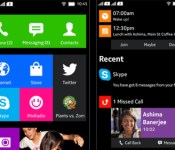
No Google Core Apps for the Nokia Android Device
A Nokia built Android device has been a rumor for a while now. It has unofficially been confirmed a multitude of times. Various leaked images, leaked specs and talks of it being an entry level Android powered device set for emerging markets has everyone in huff. Many of us would like to see a high-end Android powered Nokia device come to market, but it certainly doesn’t sound like that will happen anytime soon.
A recent report from the Wall Street Journal does lean to a launch of the Nokia Normandy, or Nokia X, or whatever the final production name will be, sometime this month. It is fully expected that Nokia will have it on hand and make the official announcement at Mobile World Congress later this month. Don’t expect the Nokia Android powered device to be much though. Talks now push towards the device being free and clear of Google’s core apps like the Play Store, Gmail and everything else we live and die by on our devices. Instead expect a more forked variant of a custom Android build much like that of the Kindle Fire line from Amazon. It will be housing Android as the base but being loaded up with a Nokia app store and powered with Microsoft and Bing.
While we know that the developing community could and probably will break into the device and clean things up, the overall specs of the device that leaked out at the end of January don’t necessarily mean it would be worth it. As Eveleaks mentions “2 x 1GHz Snapdragon, 4″ WVGA, 512MB / 4GB / microSD, 5MP Camera, 1500mAh battery, Nokia Store + 3rd party, dual-SIM, 6 colors.” At the time of the tweet we didn’t even give a thought to the mention of the Nokia Store + 3rd Party. Samsung has their own store on their devices as well. Heck, even the leaked screenshots don’t have any core Google apps in them.
 With Microsoft behind the helm none of it is really all that surprising. Microsoft already makes a killing on licensing when it comes to Android devices anyways. Testing the waters with something affordable and forked is a pretty safe bet, but it sure won’t be looked upon or be very well received by the majority of Android users.
Source: WJS via 9to5Google

You can now play most embedded YouTube videos on your Chromecast

You no longer have to jump through hoops to stream embedded YouTube videos through your Chromecast. Google has quietly rolled out support for sending most web clips to its media stick, regardless of the site they’re on; you just need to choose the device as your playback target. About the only clips that won’t work on the Chromecast are live streams, private footage and desktop-only videos. If you’re looking for an excuse to test the new feature, you can check out a highly relevant sample video below.
Filed under: Home Entertainment, Internet, HD, Google
Via: Android Police
Source: Google Support

