


Verizon will offer Google’s Nexus 7 tablet starting this Thursday

As reported yesterday, Google’s Nexus 7 tablet will soon become available on Verizon Wireless with support for the carrier’s LTE network. And soon means very soon; the 7-inch Android slate will go on sale at Verizon this Thursday, February 13th, with the 32GB model priced at $350. Apparently, the Nexus 7 will also be available on a two-year contract for $250, though only for a limited time. If you already own a 2013-edition Nexus 7 — as many of us do; it did come out almost six months ago — you’ll be able to access Verizon’s LTE network once you’ve downloaded the latest software update. Adding the tablet to your plan will cost $10 per month.
Filed under: Tablets, Mobile, Google, Verizon
Via: The Verge
Source: Verizon Wireless

[LEAK] Android KitKat for the Galaxy S4 and Note 3 are coming and this is what the status bar will look like
 Knock, knock. Leak. Leak who? Leak from Eldar Murtazin, that’s who! Eldar Murtazin has been on top of some very important leaks the last few weeks including ones regarding the Samsung Galaxy S5 and the apparent demise of the Nexus line of devices. This time his leak comes in the form of the above picture which is allegedly the status bar for Samsung’s Android KitKat update. Naturally, that would be the Android KitKat for the Galaxy S4 and Note 3 that is imminently due, and no doubt also to be featured on the Galaxy S5 to be announced at MWC 2014.
Pure white is definitely an interesting choice, particularly if you have a white background, but it looks like it adheres to the standard KitKat interface that we have seen on all the devices that have already received Android 4.4. Murtazin also tweeted earlier today that this change to the standard white icons “means a lot for TouchWiz‘s future” which suggests that Samsung may be finally playing Google‘s fiddle after the two were at loggerheads regarding Samsung’s Magazine UX and treatment of native Android apps. This can only mean good things for Samsung and, in turn, TouchWiz, which has been increasingly disparaged for its memory space hogging and general operation.
What do you think about the status bar leaked today? Think this is Samsung turning over a new leaf with Google? Let us know what you think in the comments.
Source: Twitter (1), (2) via Phone Arena

Weekly Roundup: Satya Nadella named Microsoft CEO, Sony sells its PC business, and more!

You might say the week is never really done in consumer technology news. Your workweek, however, hopefully draws to a close at some point. This is the Weekly Roundup on Engadget, a quick peek back at the top headlines for the past seven days — all handpicked by the editors here at the site. Click on through the break, and enjoy.

Meet Satya Nadella
The speculation has ended. Earlier this week, Microsoft named its enterprise chief Satya Nadella as the company’s third CEO. Like Ballmer, Nadella has history with Redmond, but their personalities couldn’t be more different. Click on through for more about the man tasked with reinventing Microsoft.

Kill-switch for stolen smartphones
The New York Times is reporting that smartphone theft in California is so rampant that lawmakers are stepping up their game. A proposed bill would require manufacturers to include kill-switch measures on all devices. If ignored, companies could receive a $2,500 fine for each handset sold. Follow the link for more.

Experience Rugby with an Oculus Rift
Virtual reality may still be in its infancy, but its influence on entertainment is sure to grow. And to prove it, the UK mobile network O2 and English rugby team combined nine GoPro Hero 3s and an Oculus Rift for the ultimate immersive experience. Click on through for details.

Sony sells its PC business
Sony announced it’s shifting focus toward post-PC products, and unfortunately, part of that decision means the company letting go of its VAIO business. Click through to read more about the sale.

Verizon-ready Nexus 7 tablet sneaks into stores
Verizon has repeatedly promised that it would officially support the Nexus 7 on its LTE network, only to fall short each time. However, it now seems that a launch really is close at hand — a Droid-Life tipster has revealed that a Big Red-approved Android tablet is making its way into Verizon stores, complete with the carrier’s logo on the box. While staffers can’t sell the Nexus 7 just yet, the arrival supports rumors that the device would be available on February 13th. It’s coming too late for anyone content to use the regular LTE model, but it could be handy as a last-minute Valentine’s gift for the tablet lover in your life.
Filed under: Tablets, ASUS, Google, Verizon
Source: Droid-Life

IRL: Motorola Droid Mini

After a quiet first half of the year, Motorola finished off 2013 by releasing a staggering five devices. Three of them were sold under Verizon’s exclusive Droid brand, and here’s the crazy part: aside from differences in battery life and screen size, they were exactly alike. We reviewed the two higher-end models, known as the Ultra and the Maxx, but we now want to return our attention to the smallest of the three, the Droid Mini. This 4.3-inch device came out a few months ago, but it’s aging quite well, having recently received an update to Android 4.4 KitKat. Also, it’s now free on-contract, so it’s definitely worth a closer look, especially compared to the Galaxy S4 mini which costs $50 with the usual two-year agreement.

The Mini is perhaps the most compelling of the three Droid devices in that it’s smaller than its bigger siblings, but just as good. Indeed, what it lacks in battery size it makes up for in other specs: much like the Moto X and the other Droids, the Mini takes advantage of an X8 system-on-a-chip with a dual-core 1.7GHz processor, 2GB of RAM, a 720p TFT display (which promises a pixel density of 342 ppi), a 10-megapixel rear camera, 16GB of internal storage, wireless charging, NFC, Bluetooth 4.0+LE, dual-band WiFi with 802.11ac and — as of December 19th — KitKat, the latest version of Android.
Is it the device of everyone’s dreams? Not really, but it does a fantastic job of delivering solid performance in a small and inexpensive package — a difficult feat, it seems, now that phone makers are turning more of their attention to handsets with large screens. Just like the Ultra, the Mini sports a layer of woven DuPont Kevlar fiber locked into place by resin and covered by a plastic casing. At 121.3 x 61.3 x 8.9 mm (4.78 x 2.41 x 0.35 in), the Droid Mini is thinner, narrower and shorter than the HTC One mini, and nearly the same exact dimensions as the Galaxy S4 mini (albeit, Moto’s version is a tad shorter). However, it’s also heavier than those other two phones at 4.59 ounces (versus 4.3 and 3.77).
The Mini almost gets lost in my hands, but it’s a perfect size for those of you who don’t want anything larger than five inches. The plastic casing feels a bit cheap, with creaky spots and a slick finish that picks up fingerprints. Needless to say, I would’ve rather seen Motorola simply do away with it altogether, like it did on the Maxx. Still, that doesn’t seem to make the phone any less durable.
Even though this is a Verizon-branded smartphone, Motorola outfitted the Mini with enough radio frequencies to be useful in other parts of the world. In addition to having Verizon-specific LTE, it offers quad-band HSPA+ (850/900/1900/2100), quad-band GSM/EDGE and the requisite CDMA/EVDO bands for use in North America. And because the phone’s unlocked, you’ll be able to stick in an AT&T nano-SIM and get HSPA+ data. I’d love to see more LTE support on the Mini, but that’s the only major complaint I have here.

In general, the Mini offers an experience consistent with the Droid Ultra and Droid Maxx thanks to the large similarity in its specs and user interface. One area in which the Mini completely differs from its siblings, however, is the display. Whereas the Ultra and Maxx both feature AMOLED panels, the LED screen on the Mini is brighter and less color saturated. And thanks primarily to the fact that it uses the same pixel count in a smaller display, it’s actually the sharpest-looking of the three Droids.
It’s worth repeating that the Droid Mini is now running Android 4.4, the latest version of Google’s mobile OS. This is a big deal, because Verizon devices using custom OEM user interfaces often don’t get upgrades to the newest installment of Android, and if they do, it can take a while. But here we have the Droid Mini, whose update came through pretty quick. Along with the usual KitKat features, Verizon also threw in enhancements to the phone’s image quality (better color and less noise), along with Fitbit support and a new version of Droid Zap, Moto’s multimedia-sharing feature. And let’s not forget Moto Assist, a contextual app that automates tasks based on things like your location, scenario, calendar appointment and even speed.
Fortunately, not only will your user experience be the same regardless of which Droid you buy, but the performance will be the same as well. The Mini features Motorola’s X8 architecture, which consists of a dual-core 1.7GHz Snapdragon S4 Pro CPU, Adreno 320 GPU, 2GB of RAM and two cores reserved for natural language processing and contextual computing. Active notifications and touchless control work just as well here as the Moto X and the other Droids, and I experienced very few hiccups and frame skips when gaming and multitasking.

The Droid Mini’s 2,000mAh battery is naturally smaller than on the other Droids. As such, don’t expect it to last more than a day with moderate use. In our video rundown test, the Droid Mini made it through six hours and 45 minutes before needing a recharge, which was just short of the GS4 mini’s results — a bit of a shock, since the Droid’s battery is technically a hair larger. I can’t suggest that you put the phone through a lot of gaming, multitasking and other processor-intensive activities without keeping a car charger or external battery pack near you at some point during your day, but I’m confident you’ll be OK in most scenarios (read: you should have enough juice to get you through the work day).
The Droid Mini may not grab as much attention as the Moto X or the Droid Maxx, but it’s a compelling device for those of you who don’t want to go with a big smartphone, or would simply rather not pay anything for the hardware. Its Verizon branding certainly limits its appeal, since it’s officially only available on one carrier (even though it’s unlocked to GSM SIMs), but if you’re a Big Red customer or a frequent international traveler, it’s not a bad deal for $350 at full retail or free with a two-year contract. The Galaxy S4 mini is also $350 off contract, but agreeing to two years of your life with Verizon will cost $50; for that money you’re getting a worse display, smaller battery, slower GPU, less internal storage (although Samsung at least offers microSD compatibility) and slightly lower camera resolution. All told, this is a great phone if you want a smaller screen and solid specs but can’t afford to pay a flagship price.
Filed under: Cellphones, Mobile, Google
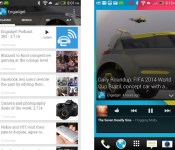
Google Play Newsstand gets a widget, adds mini view for easy reading

The idea behind a magazine or a newspaper is that you will actually sit down and read it — but if you only have time to glance at a few headlines, the latest update to Google Play Newsstand is for you. The content aggregator now features a “mini card” view that compresses each story down to just its headline, expanding to the full story only when tapped. A new widget offers truncated versions of the latest stories too, allowing users to click through a limited set of stories from their device’s home screen. The update also adds new organization features for magazines, additional language support, a smattering of bug fixes and the ability to translate foreign news sources instantly. It’s hardly a visual overhaul, but the the update is certainly a no-brainer for the Google Play news junkie.

Google’s Field Trip app adds ratings to its recreational recommendations

Google knows that not everything in Field Trip will reach the high watermark of creepy areas around New York, but it hopes that the app’s latest update will make cool spots easier to find wherever you are. The search giant’s Niantic Labs has added a rating system on Android and iOS and is enabling the community to possibly cull banal info from the mobile point-of-interest database. The five-star rankings should offer more granularity than the previous thumbs-ups/thumbs-down system, and soon enough the cards with the highest average score could be all you see. If your city is inherently boring though, there’s nothing Mountain View can do about that.
Filed under: Cellphones, Misc, GPS, Mobile, Google
Via: Field Trip (Google+)
Source: Google Play, iTunes

Google+ photos get more ‘pop’ with new dynamic range tool

So far, you’ve had to use Snapseed on your phone to add high dynamic range effects to Google+ photos after you’ve taken them — not very convenient if you’re at your computer. That won’t be a problem after today, though. Google has brought its mobile apps’ HDR Scape tool to the web-based photo editor in Google+, letting you brighten shadows and tone down highlights in a single step. And if you’re fussy about your edits, it’s now easy to zoom in and verify that everything is just right. The new tools are already available for some Google+ users, and they should reach the rest of the social network in the near future.
Source: Andre Meyer (Google+)

Daily Roundup: FIFA 2014 World Cup Brazil, concept car with a drone companion and more!

You might say the day is never really done in consumer technology news. Your workday, however, hopefully draws to a close at some point. This is the Daily Roundup on Engadget, a quick peek back at the top headlines for the past 24 hours — all handpicked by the editors here at the site. Click on through the break, and enjoy.

Concept car with a companion drone
Renault’s latest concept vehicle, called the KWID, aims to take sting out of commuting with the aid of an aerial companion. This futuristic vehicle comes with a camera-equipped drone designed to give you a bird’s-eye view of the road ahead. Click the link for details.
Kill-switch for stolen smartphones
The New York Times is reporting that smartphone theft in California is so rampant that lawmakers are stepping up their game. A proposed bill would require manufacturers to include kill-switch measures on all devices. If ignored, companies could receive a $2,500 fine for each handset sold. Follow the link for more.

Google refuses to pay French privacy fine
Early last month, France fined Google $200,000 for failing to adequately inform users of how it uses their personal data. Now, Google is lawyering up and refusing to pay. Read on for more.

FIFA 2014 World Cup Brazil not coming to new consoles
Unfortunately for hardcore football fans, EA Sports won’t be bringing FIFA 2014 World Cup Brazil to the Xbox One or PlayStation 4. Click through to read lead designer Mat Prior’s explanation of the decision.
California introduces anti-theft “kill switch” bill
It is not uncommon to store basically every bit of personal information on your smartphone. And with cellphones being more popular than they ever have been, if somebody steals your phone, you could lose everything. That’s where a new bill proposed in California hopes to come in.
The idea has been thrown around many times in the past few years, especially with all of the sensitive information that we carry around with us. It turns out, some California lawmakers may want to make it legislation. The bill, if passed, would require all smartphones and tablets sold after January 1st, 2015, to ship with a certain type of security feature. What’s more is that they would fine companies up to $2,500 for each device that ships without this “antitheft solution”.
State Senator Mark Leno is the man proposing this bill, and has backing from California’s District Attorney. Leno explains in an official statement,
“With robberies of smartphones reaching an all-time high, California cannot continue to stand by when a solution to the problem is readily available. Today we are officially stepping in and requiring the cellphone industry to take the necessary steps to curb violent smartphone thefts and protect the safety of the very consumers they rely upon to support their businesses.”
We have seen something along these lines when Google introduced Android Device Manager, and when Apple introduced Activation Lock. But is that enough? Some people seem to think that it isn’t.
The CTIA stated last year that “a kill switch isn’t the answer.” They went on to say that there would be many risks involved, especially with hackers taking advantage of the system. Also, if the owner retrieves the phone at a later date, they will have no way of using it again.
Obviously there is a lot to talk about here. It’s still very early in the process to be making any assumptions, or to be worried about anything. What are your opinions on this? Do you think the government should step in and help with theft? Or do you think Google and Apple can take care of it themselves? Let us know in the comments!
Source: The New York Times
The post California introduces anti-theft “kill switch” bill appeared first on AndroidGuys.
 AIVAnet