



Google and Twitter join forces for disaster alerts

Google’s and Twitter’s relationship has been a bit rocky since the former launched a social network of its own, but, for the greater good, that’s changing. When a “more extreme” natural disaster strikes, Google Now, Search and Maps will populate with tweets related to the Public Alert event in an effort to add context, both on mobile and the desktop. On Google+, the search giant notes that these related tweets will serve to answer questions about school closings, nearby evacuations and to display what people closest to a storm are seeing. At the moment, this is only available for English-speaking countries, but Mountain View says it’s working to add new kinds of social content to more places and its other products for the future. It isn’t quite the Realtime Search of yore that added everyone’s tweets to Search results, but it is something. If you had bets on The Blue Bird and Big G never ever getting back together, it’s time to pay up.
Filed under: Cellphones, Mobile, Google

Google Play Movies & TV gets offline viewing on Chromebooks, info cards in Chrome browsers

Google has unleashed a Chrome add-on for the video on-demand arm of its Play store, a move that also to combat the notion that Chromebooks die and wither away from internet connections. Just as promised, the add-on lets the ChromeOS devices store movies for offline playback — you know, those long flights or camping trips in places where Netflix doesn’t reach, like anywhere with Verizon FiOS. Unfortunately the trick doesn’t extend to Chrome browsers on other platforms, although you can still use the extension to view your library of content or purchase new stuff to watch. The Google Play Movies & TV extension also promises a better Chromecast experience, and the info cards about actors in a scene that rolled out on Android last year. Those are now available in all countries with Google Play Movies, so head to the Chrome store to try it out for yourself.
[Image credit: David Paul Morris/Bloomberg via Getty Images]

Filed under: Desktops, Home Entertainment, Laptops, HD, Google
Source: Google Play (G+)
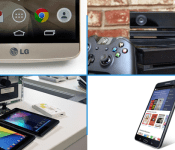
Engadget Daily: LG G3 review, Xbox One performance and more!

Today, we review LG’s latest handset, gain insight into how significantly the Kinect affects the Xbox One’s performance, go hands-on with Google’s secretive 3D-mapping tablet and learned about the Samsung Galaxy Tab 4 Nook. Read on for Engadget’s news highlights from the last 24 hours.

LG G3 review: the company’s best phone yet
The G3 may only look like it’s made of metal, but we’re not holding any grudges. LG’s 5.5-inch handset has 10-hour battery life and top-shelf specs, not to mention the nicest display on the market. Assuming it’s not too pricey, the G3 could be one of the best Android phones available.

Microsoft admits the Xbox One performs better without Kinect features
Despite the fact that the One’s Kinect has its own onboard processor, it apparently does weigh the console down to some degree. Thanks to the June update, however, developers can access “up to 10 percent additional GPU performance by re-allocating a few resources.

Google’s secretive 3D-mapping project now has a tablet: here it is
Remember Google’s sensor-loaded, 3D-mapping smartphone called Project Tango? Well, today we went hands-on with its new tablet counterpart. And yes, the slate is also replete with sensors and high-spec cameras.

Barnes & Noble teams up with Samsung for its newest Nook tablet
We knew that Barnes & Noble was working with someone else to develop future Nook devices, we just didn’t know who. But today, the company announced that it partnered with none other than Samsung to develop the 7-inch Galaxy Tab 4 Nook, which will launch in August.
You also might like:

KitKat is now on nearly 14 percent of Android devices

You know how Apple was keen to point out that only 9 percent of Android users (technically, 8.5 percent) were running KitKat in May? Well, that figure’s now out of date. Google has published fresh usage stats which show that 13.6 percent of Android owners are using KitKat as of early June. That’s still far from a majority, but it represents 60 percent jump in a single month. It’s not hard to see why the newer OS would be making such big strides. Major new phones like the HTC One and Galaxy S5 have had more time on the market, and KitKat upgrades are still making their way to older gadgets.
While the data will no doubt be welcome to Google, it also shows that quite a few people are hanging on to ancient devices. Jelly Bean still has the lion’s share at 58.4 percent (down from 60.8), while 28 percent are using Ice Cream Sandwich and older (a dip from 30.7 percent). These aging platforms are bound to fade away, but that may take some time — many pre-Jelly Bean phones are budget models sold in developing markets like China and India, where it’s not as easy to upgrade to the latest and greatest hardware.

Filed under: Cellphones, Tablets, Mobile, Google
Source: Android Developers
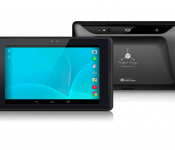
Project Tango Tablet Developers Kit Announced by Google; Packs Tegra K1, 4GB RAM and 3D Mapping Fun
Google has unveiled Project Tango Tablet Developers’ Kit today. It is pretty much the most badass tablet you can dream of owning so far, and that is putting it mildly.
 The Project Tango kit is a 7-inch Android powered tablet. Nothing amazing there. however, inside you find a NVIDIA Tegra K1 processor with a 192 programmable cores, 4GB of RAM and 128GB of internal storage. The front facing camera offers up 120 degree view and the rear camera is 4MP. There is third rear motion tracking camera too , along with a depth sensor. All of that means that the Project Tango Tablet can 3d scan rooms and create intense interactive augmented reality excitement. For instance, turn your living room into a battlefield, or scan a room and move things around for interior design.
What is Project Tango?
As we walk through our daily lives, we use visual cues to navigate and understand the world around us. We observe the size and shape of objects and rooms, and we learn their position and layout almost effortlessly over time. This awareness of space and motion is fundamental to the way we interact with our environment and each other. We are physical beings that live in a 3D world. Yet, our mobile devices assume that physical world ends at the boundaries of the screen.
The goal of Project Tango is to give mobile devices a human-scale understanding of space and motion.
Our team has been working with universities, research labs, and industrial partners spanning nine countries around the world to build on the last decade of research in robotics and computer vision, concentrating that technology into a unique mobile device. We are putting early prototypes into the hands of developers that can imagine the possibilities and help bring those ideas into reality.
We can’t forget to mention that the Project Tango Tablet also has Wi-Fi, Bluetooth LE and 4G LTE connectivity (depending on region and carrier, of course). Check out the cool little video they put out about it.
The Project Tango Tablet is being marketed toward developers and comes with a hefty price tag when it becomes available, $1024. Absolutely worth the money for the talent that exists in the world. We fully expect Google to show it off a bit at Google I/O and hopefully they will be able to give us all a little bit more hands on detail of how it all works. If you want to get on the list to be notified when the Project Tango Developers Kit is ready, pop on over to the sign-up page.
So, who is jumping on the list?
//<![CDATA[
ord = window.ord || Math.floor(Math.random()*1E16);
document.write('’);
//]]>
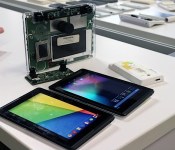
Google’s secretive 3D-mapping project now has a tablet: here it is

Comprehending the world around us is something we humans take for granted, but it’s not so easy for our technology. Sure, autonomous robots and military-grade research labs have hardware that can approximate the same visual acuity of human eyes, but Google’s Advanced Technologies and Projects (ATAP) division started Project Tango to bring that sort of tech to the masses. Its mission is to make mobile devices capable of using depth sensors and high-spec cameras to craft three-dimensional maps more cheaply and easily than other current efforts. ATAP announced its first piece of hardware in February, a prototype smartphone equipped with Kinect-like 3D sensors and other components, but the team is now expanding the project to a new form factor: a seven-inch tablet that’s packed with a lot more power.
The prototype tablet has a 1080p display and runs a stock version of Android 4.4 KitKat, but what’s most important is the oomph under the hood: NVIDIA’s quad-core Tegra K1 chip alongside 4GB of RAM and 128GB internal storage (microSD cards are not supported). That’s in addition to USB 3.0, micro-HDMI, Bluetooth LE and LTE (availability will depend on carrier, but Google isn’t announcing which frequencies are supported just yet) — and if that all sounds like overkill for a tablet, it’s because the team wanted to make it extremely difficult to hit a ceiling in terms of computing power.

The Tango tablet sees the world through the two cameras and a depth sensor on the back. One camera has a 4MP sensor and comes with (relatively) huge two-micron pixels that offer high light sensitivity and faster speeds than most standard options (similar to the UltraPixel sensor in HTC’s One), while the other camera tracks motion more broadly with a 170-degree wide-angle fisheye lens.
If that all sounds like overkill for a tablet, it’s because the team wanted to make it extremely difficult to hit a ceiling in terms of computing power.
The smartphone is a bit chunky and unsightly, from an industrial design standpoint, but the tablet actually looks like it could pass as a consumer device. It’s neither as thick as I expected, nor does it appear hastily put together. Even though device aesthetics don’t really matter in a tablet aimed squarely at developers, the ATAP team has put a lot of effort into the design to ensure its slate is best equipped to do its job. For example, the cameras are mounted at a 13-degree angle to give them the view needed to gather accurate data, while allowing any meatbag holding it to do so in a natural way — instead of awkwardly holding the tablet directly in front of their faces when mapping a room.

Through Tango, the ATAP team wants to give mobile devices a sense of human scale and an understanding of space and motion — it wants your phone or tablet to mimic the way we see the world. Should Tango succeed, the phone in your pocket will be able to map out a three-dimensional mockup of your office building or home, as well as measure the distance between objects within them (walls, counters, couches and so on).
The NVIDIA chip inside uses desktop GPU architecture, making it easier for companies to port over complex programs that they’ve already spent years developing on PCs.
The benefits of these spatial talents are broader than you’d think. If you’re wandering aimlessly through a Home Depot to find a small trinket, you could install an app that guides you through the store, like an indoor version of in-car GPS. Or, instead of imagining how that Swedish sofa would look in your living room, another app might deftly show you if the furniture will fit where you want it to go, no tape measures or imagination required. Virtual real estate tours could become much more realistic for buyers, while three-dimensional maps would be especially handy for visually impaired users. “If you walk around the office building, [a device with Tango tech] could read the names of each conference room out loud as you pass them,” says Johnny Lee, Tango’s technical program lead.
The project’s already getting plenty of support from the graphics community, with renowned game engine builders Unity and Epic among the many companies working with Tango; even Autodesk (the makers of AutoCAD) has several projects in the works. That corporate support, which began with Qualcomm’s Adreno GPU inside the Tango smartphone, should continue to grow stronger on the tablet because of the K1 chip involved. The NVIDIA chip uses desktop GPU architecture, making it easier for companies to port over complex programs that they’ve already spent years developing on PCs.
“If the device can understand your environment, you could turn your living room into a dungeon.”
Then there’s games: Lee showed us an impressive game demo that let us explore a fantasy world by walking around in real space, making the tablet a virtual window into a completely different place or time. “If the device can understand your environment,” said Lee, “you could turn your living room into a dungeon.” This type of environment also seems ripe for a good game of virtual hide-and-seek, with characters hiding behind real objects in your house.

This 3D mapping technology is still considered bleeding-edge, but Lee envisions a day in which the enhanced sensing capabilities are expected in a device, much like Bluetooth is a fundamental feature in phones today. To get Project Tango where it is today, ATAP collaborated with a number of manufacturers and component suppliers to produce the necessary hardware, while universities and research labs contributed much of the software. Work in the 3D mapping space has been ongoing for the last twenty years, but the challenge Tango tackles is condensing all that technology into a small enough device that consumers will want to carry around.
We’ve outlined a few examples of what Tango could bring to the table, but none of it would be possible without the creative input of developers. Back in March, the team distributed 200 phones to third-party devs, but in the next six months Lee plans to ship out these high-powered tablets on a far wider scale; beginning today, developers can sign up to get notified when they’re available. The tablet’s expected to go on pre-order later this month, but Google is hesitant to lock down a specific date for release. Whenever it shows up, however, it’ll cost $1,024 to get your hands on one — if you get whitelisted for an invite. (Like Google Glass before it, there are criteria one must meet to be deemed worthy.) Regardless, the team hopes to showcase the device at I/O if it’s ready.
Like Google’s continued experiment in wearable computing, this isn’t a consumer product yet. The tablet’s loaded with top of the line components throughout to give devs what they need, while retaining a realistic price tag. For their money, developers won’t be getting capabilities different from the phone released in Feburary, but the larger form factor does provide an upgrade in ergonomics. According to Lee, when holding the slate you’re less likely to block the cameras with your fingers. Plus, a bigger device can house a much larger battery (ATAP isn’t giving an official size yet, but it’s likely quite generous, if the phone was any indication). More space between the cameras and sensors also allows for more accurate 3D measurements, and there’s more room for heat to dissipate, which means these bigger devices can handle more computing power.
Eighteen months into the 24-month project, Lee and his team see a bright future, but Tango’s ambitions don’t stop with phones and tablets; the Program Lead believes that Tango could eventually extend to wearables as well. “[Tango] is a camera-based system … and in a wearable we can explore [always-on] cameras that constantly track positions everywhere.”
Filed under: Cellphones, Wireless, Mobile, Google

Tech CEOs push US Senate for stronger surveillance reform

The CEOs of AOL, Apple, Dropbox, Facebook, Google, LinkedIn, Microsoft, Twitter and Yahoo! all agree: more needs to be done to reform the government’s snooping capabilities. That’s the thrust of a letter that appeared online yesterday, anyway. Though the list of signatories contains a handful of rivals, all of them agree that the version of the USA Freedom Act that recently passed through the US House of Representatives still sucks and that the US Senate needs to fix it.
Why? Well, it was originally meant to stop the NSA’s bulk collection of metadata (like who emailed you or when you called someone) outright, but some (including the nine companies who issued the letter) believe the version of the act that passed was watered down to the point where it could easily be exploited. Naturally, there’s still a raging debate on just how valuable and safe that bulk collection actually is. The undersigned nine also call for greater transparency when it comes to user data requests it receives from the government, though that’s not a surprise considering how frequently they already bring up the issue. Just take a peek at, say, Facebook’s most recent transparency report — you’ll find that the social giant received between 0 and 999 national security requests for data. Painting in strokes that broad is unsatisfying at best and obscurantist at worse, which is why companies like Twitter are weighing legal options to push for more specificity.
Source: Reform Government Surveillance

YouTube v5.7 debuts with streaming quality picking

After updating Hangouts, Google gives some love to YouTube as well. YouTube gets yet another great and long-awaited feature in the newest update. Choose the quality of your YouTube video stream.
This feature is long overdue if you ask me. Every time I watch a YouTube video via mobile data I wish I could see exactly in which quality is video being streamed. You might say: “well you could choose whether the video will be HQ or not thus far”, that is true, but there are times when you have enough data to watch a video in 360p, there are times when you’re trying to save as much as you can, so you want to lower it to 144 or 240p and so on. In this new update you can do just that, as long as you don’t go over 720p, that is the highest stream quality you can pick at this time.
You can download the update via the link below although it might not be yet available to your device. If you’re not prone to waiting you can manually sideload it, you can find the APK here.

The post YouTube v5.7 debuts with streaming quality picking appeared first on AndroidGuys.

Sainsbury’s teams up with Google to stop you wasting food

It turns out that us Brits are a wasteful bunch. Studies suggest we’re throwing out as much as £60 worth of food and drink each month when we could be putting it to better use. Instead of trying to convince you to head over to one of its stores to replenish your supplies, Sainsbury’s has teamed up with Google to create a tool that provides suggestions on how to use the food you’d otherwise be chucking out. It’s called Food Rescue, and Google plays a small but vital role in proceedings by lending the same voice-recognition tech that powers its search engine to the supermarket’s new mobile and online tool. When you visit the website, you can say (or type) what foodstuffs you have an it’ll find a range of recipes that use those ingredients. In a bid to get more people involved, the supermarket chain will record the weight of food rescued and calculate the money saved in each recipe. That information will then be added to a real-time leaderboard of top ‘rescuers’ across the UK. You say tomato, I say tomato, it’ll still work the whole thing out.
Filed under: Internet, Software, Mobile, Google
Via: Sainsbury’s
Source: Sainsbury’s Food Rescue

Google Hangouts updated to V2.1.223 [Download APK]

Everyone’s favourite messaging app Google Hangouts has just been updated to version 2.1.223 and with it brings some pretty minor changes, but noteworthy nonetheless.
It seems in Google Hangouts version 2.1.223 you’re now able to set custom sounds for messages and hangout calls, which can be accessed in the “People & Options” section of the Menu.
The update is slowly rolling out to the Google Play Store so either hit below to grab it from the Store, or this link to download the Hangout version 2.1.223 APK file.
VIA: Droid-Life
The post Google Hangouts updated to V2.1.223 [Download APK] appeared first on AndroidGuys.

